
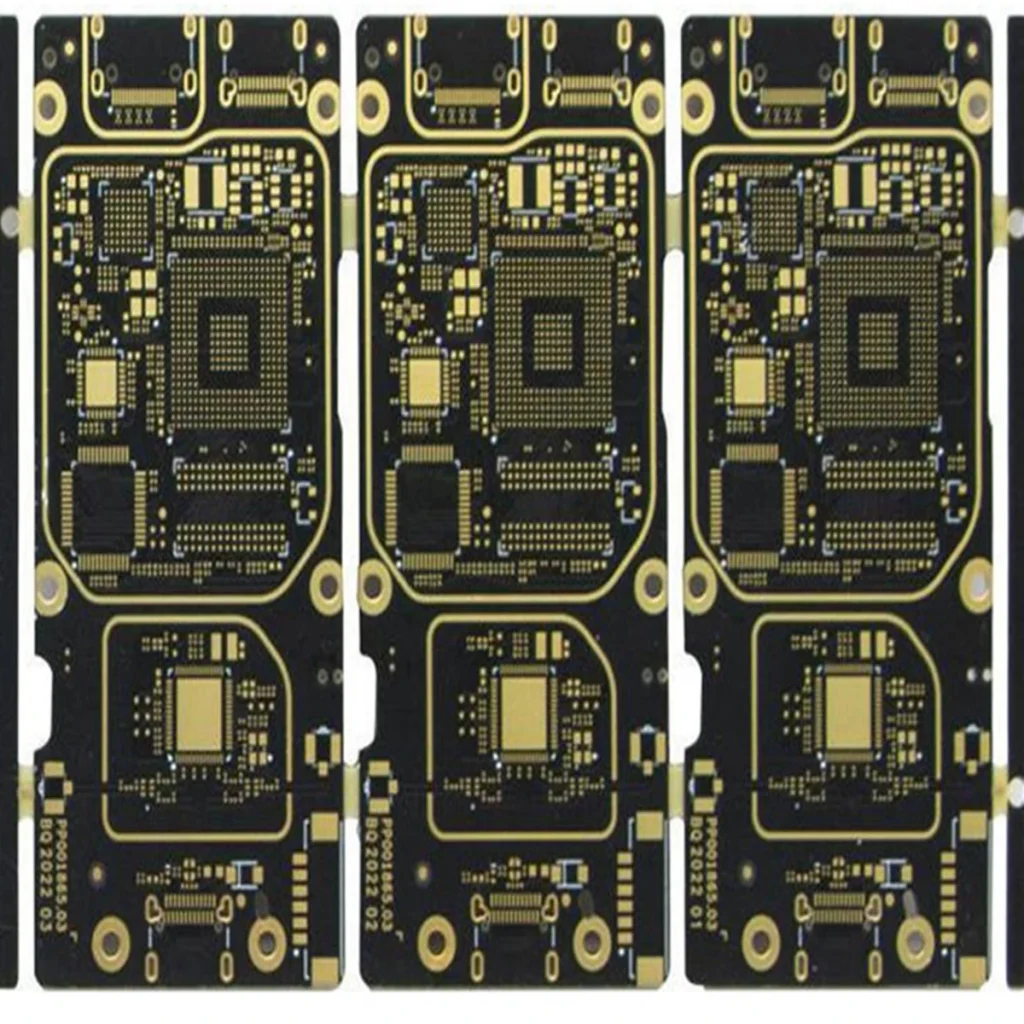
Standard Process
Interlayer Alignment Accuracy:≤5 μm
Prepreg Thickness / Resin Content: 0.05–0.06 mm; high resin (≥4 sheets)
Lamination Profile: Staged ramp (e.g., 120°C → 180°C); PTFE: up to 350°C
Laser Drilling (UV): 355 nm wavelength; via Ø 0.1 mm ±3 μm
Hole Wall Roughness (Ra): <0.5 μm ia Copper Uniformity / Void Rate: 80 μm ±10%; void rate <0.1% DI Resolution / Trace Tolerance: 10,000 dpi; ±3 μm Etch Factor (Anisotropy): >5:1
Characteristic Impedance Tolerance: ±5% (50Ω/75Ω single-ended; 100Ω diff); ±3% for mmWave
mpedance Continuity (TDR): Variation≤±2% along trace
“Copper Foil Roughness (Ra) : HVLP/RTF: ≤0.3–0.5 μm (graphene-coated options)”
Surface Finish Thickness: ENIG: ≥2 μm (for ≥6-layer boards)
older Mask Thickness: ≥8 μm at corners; ≥170 μm on traces
CTE (Z-axis): ≤25 ppm/°C (critical for 5G base stations)
Dk Batch Stability / Temp Drift: ΔDk ≤±0.1; drift ≤5% (-40°C to +125°C)
Product Details
What is a High-Frequency PCB?
A High-Frequency PCB is a specialized printed circuit board designed exclusively for high-frequency circuits (operating at 1GHz and above, including microwave >3GHz and millimeter-wave >30GHz bands). Unlike standard PCBs, it uses high-performance dielectric substrates with exceptional electrical and thermal properties to minimize signal loss, delay, and interference—critical for maintaining signal integrity in high-speed RF systems.
At Shenzhen Hongda Circuit Technology Co., Ltd., our High-Frequency PCB is manufactured via advanced, substrate-specific production processes (paired with standard PCB manufacturing expertise) to transform premium high-frequency materials (including Rogers, Arlon, Taconic, and Isola) into reliable circuit solutions. High-frequency circuits, the backbone of modern RF technology, consist of passive components, active devices, and passive networks (oscillators, transformers, resonators, filters) that enable signal transmission, frequency selection, and impedance matching—and our High-Frequency PCB is engineered to maximize the performance of every these critical components.
With the global rollout of 5G/6G, and the rapid evolution of aerospace, automotive ADAS, and wireless communication technology, electronic systems are pushing into higher frequency bands than ever before. This demands High-Frequency PCB substrates with superior electrical performance, chemical stability, and ultra-low insertion loss—requirements that Shenzhen Hongda Circuit Technology Co., Ltd.’s High-Frequency PCB is engineered to exceed, making it an indispensable component for next-gen technology innovation.
Core Performance Characteristics
Shenzhen Hongda Circuit Technology Co., Ltd.’s High-Frequency PCB is defined by four non-negotiable performance pillars, each optimized to address the unique challenges of high-frequency signal transmission and ensure long-term reliability in the most demanding environments:
- Ultra-Low, Stable Dk & Df: Our PCBs feature a tightly controlled, ultra-low dielectric constant (Dk) and dissipation factor (Df) that remain stable across operating temperatures and frequencies. A low Dk eliminates signal transmission delay, while a minimal Df drastically reduces high-frequency signal attenuation—ensuring pristine signal integrity for critical RF communications.
- Thermal Expansion Compatibility: The thermal expansion coefficient (TCE) of our high-frequency substrates is precisely matched to copper foil. This eliminates delamination and copper foil separation during extreme temperature cycles, a common pain point in high-frequency PCB design, and guarantees structural stability in harsh operating conditions.
- Near-Zero Water Absorption: Our High-Frequency PCB boasts ultra-low water absorption properties. Even in humid environments, moisture penetration is negligible, preventing unwanted shifts in Dk/DF values and ensuring consistent electrical performance—no matter the operating environment.
- Superior Mechanical & Chemical Durability: Engineered for rugged use, our PCBs deliver exceptional heat resistance, chemical corrosion resistance, impact strength, and peel strength. They withstand exposure to industrial chemicals, extreme temperature fluctuations, and mechanical stress, making them suitable for both commercial and industrial-grade applications.
Critical Manufacturing Considerations
High-Frequency PCB manufacturing requires substrate-specific expertise and precision—standard PCB production processes are insufficient to unlock the full performance of high-frequency materials. At Shenzhen Hongda Circuit Technology Co., Ltd., we leverage decades of specialized manufacturing experience and state-of-the-art equipment to address the unique challenges of high-frequency PCB production, with six non-negotiable manufacturing protocols:
- Premium Substrate Selection: We exclusively use high-performance fluoropolymer dielectric substrates (e.g., PTFE/Teflon) as the gold standard for high-frequency applications, paired with other top-tier branded substrates to balance performance and cost.
- Plasma Treatment for Adhesion: High-frequency substrates have low surface adhesion, which can compromise PTH copper plating and solder resist coverage. We use advanced plasma treatment to precision-roughen via walls and board surfaces, dramatically increasing adhesion between PTH copper, substrates, and solder resist ink for long-term reliability.
- Micro-Etch Pre-Solder Mask Treatment: Unlike standard PCBs, our High-Frequency PCB never undergoes sanding before solder mask application—this avoids damaging the substrate surface and reducing adhesion. Instead, we use a specialized micro-etch solution for controlled surface roughening, preserving substrate performance while ensuring strong solder resist bonding.
- Specialized Milling for Burr-Free Forming: High-frequency materials like PTFE produce excessive burrs when cut with standard milling cutters. We use custom, high-precision milling tools designed exclusively for high-frequency substrates to achieve burr-free, tight-tolerance forming for every board.
- Ultra-Precision Parameter Control: Our manufacturing process adheres to strict tolerances for physical performance, dimensional accuracy, and electrical parameters—reflecting the high standards required for automotive collision avoidance systems, satellite communications, radio systems, and aerospace applications.
- Industry-Leading Impedance Control: We maintain an ultra-tight impedance tolerance of ±2% (and custom tighter tolerances on request), with equally strict line width control. This precision eliminates signal reflection and ensures consistent impedance matching—essential for low-loss high-frequency signal transmission.
Expert High-Frequency PCB Layout Guidelines
Optimal High-Frequency PCB performance depends on both superior manufacturing and intelligent layout design. Shenzhen Hongda Circuit Technology Co., Ltd.’s team of RF engineering experts has developed 13 industry-leading layout guidelines to minimize interference, signal loss, and delay, and maximize the performance of your high-frequency circuit:
- Multi-Layer Design for Density & EMI Reduction: High-frequency circuits demand high integration—our multi-layer High-Frequency PCB not only meets layout density needs but also acts as an effective EMI shield, reducing cross-talk and external interference.
- Smooth, Direct Routing: Minimize lead bending between high-speed device pins; use straight lines wherever possible. For necessary turns, use 45° angled lines or circular arcs (avoid right angles) to reduce high-frequency signal radiation and mutual coupling.
- Minimize Lead Length: Shorter leads between high-frequency device pins reduce signal delay and radiation—critical for maintaining signal integrity at GHz frequencies.
- Reduce Layer Transitions: Minimize via usage by reducing lead layer alternation; each via introduces approximately 0.5pF of parasitic capacitance, which degrades signal speed. Fewer vias = faster, more reliable signal transmission.
- Eliminate Cross-Interference: Avoid close parallel routing of signal lines where possible. If parallel routing is necessary, place a large ground plane on the reverse side to suppress cross-talk. Adjacent layers must use perpendicular routing directions to eliminate layer-to-layer interference.
- Ground Shielding for Critical Signals: Implement ground wrapping for high-priority signal lines and local units (e.g., clock circuits). This creates a protective ground barrier that minimizes EMI radiation and interference, a game-changer for high-speed systems.
- No Loops Allowed: Ensure all signal traces and ground lines do not form current loops—loops create unwanted resonance and EMI, degrading high-frequency performance.
- Local High-Frequency Decoupling Capacitors: Place a high-frequency decoupling capacitor immediately adjacent to each integrated circuit (IC) block to filter power supply noise and ensure stable power delivery to high-speed devices.
- Isolated Analog & Digital Grounds: Connect analog and digital grounds to a common ground using a high-frequency choke (e.g., ferrite bead). We recommend defining ferrite beads as dedicated components in your PCB library to ensure proper placement during layout.
- Separate Analog & Digital Circuit Layout: Lay out analog and digital circuits in distinct board sections, with power and ground connected at a single point only. This eliminates cross-interference between the two circuit types, a major source of signal degradation in high-frequency systems.
- Filter Capacitors for DSP & Memory: Add filter capacitors to DSP, off-chip program memory, and data memory power pins—placed as close to the pins as possible—to filter power supply noise. For maximum performance, shield these critical components to block external EMI.
- Optimize Memory Placement: Place off-chip program and data memory directly adjacent to the DSP chip, with data and address lines of equal length to ensure synchronous signal transmission. For multi-memory systems, use equal clock trace lengths or a dedicated programmable clock driver chip; keep high-frequency traces short and thick, and isolate them from analog signal lines. For complex DSP circuits, create a minimal DSP system (DSP + clock + reset + memory) to reduce interference.
- Simulation-Driven Validation: After manual layout, validate your design with advanced PCB simulation software (HFSS, ADS, etc.). This step is critical to identify and resolve hidden signal integrity issues, ensuring the reliability and producibility of your High-Frequency PCB design—our engineering team is on hand to support all simulation and validation needs.
Shenzhen Hongda Circuit Technology Co., Ltd.’s High-Frequency PCB Product Portfolio & Capabilities
At Shenzhen Hongda Circuit Technology Co., Ltd., we offer a comprehensive portfolio of High-Frequency PCB solutions to cover every high-frequency, RF, and microwave application—from standard microstrip antennas to complex radar systems. Our product range includes:
Rogers PCB, Microwave PCB, Radar PCB, RF PCB, Microstrip PCB, Antenna PCB, Thermal Management High-Frequency PCB, Arlon PCB, Hybrid Laminated PCB, F4B PCB, Ceramic PCB, Induction PCB
These solutions are engineered for seamless integration in slot antennas, RF antennas, broadband antennas, frequency-scanning antennas, ceramic antennas, power dividers, couplers, combiners, power amplifiers, low-noise amplifiers, 5G/6G base stations, and all professional RF modules.
Unmatched Substrate Inventory & Supply Chain
We maintain an extensive, in-stock inventory of the world’s leading high-frequency substrates, including Rogers, Arlon, Taconic, Isola, Panasonic, TUC, ITEQ, Shengyi, Wangling, Nelco, Doosan, Nanya, Ventec, EMC, and Hitachi. This ensures fast lead times and flexible material selection, allowing you to balance performance, cost, and delivery for your project—no long waits for substrate procurement.
End-to-End Technical Expertise & Support
Shenzhen Hongda Circuit Technology Co., Ltd. is more than a manufacturer—we are your trusted High-Frequency PCB partner, with decades of specialized engineering and manufacturing experience. We provide our clients with custom High-Frequency PCB design rules, professional layout guidance, and full technical support for every stage of your project, from initial design and prototyping to mass production.
Our knowledgeable technical support team is available to answer all your PCB technical questions, resolve design challenges, and optimize your High-Frequency PCB for performance and producibility. We offer fast, transparent quoting and flexible production runs—from small-batch prototypes to large-scale mass production—with rapid turnaround times and consistent quality.