
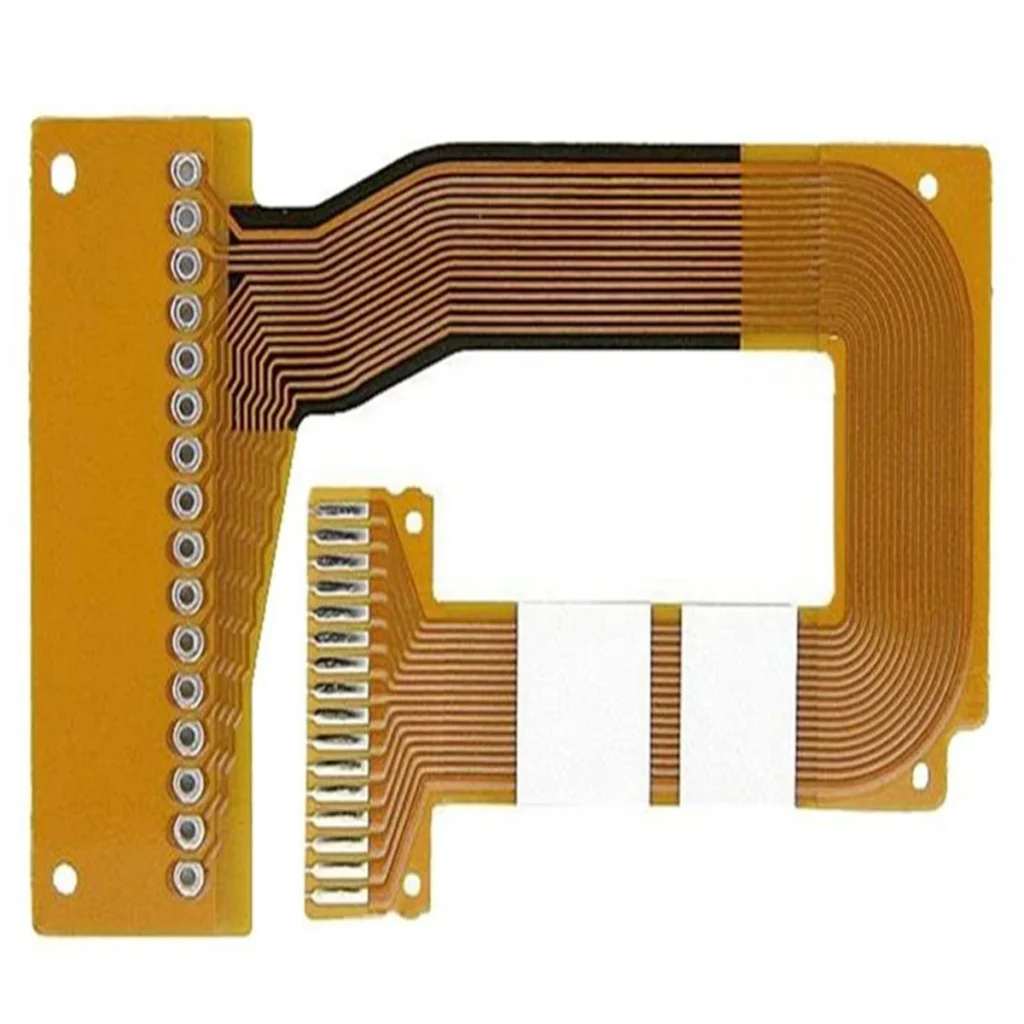
Standard Process
Layer Count: Flex (1–16L)
Ultra-Thin: 0.05–0.1 mm (Optimized for 2026 Wearables/Foldables)
Max Panel Length: Up to 3600 mm (Proto) | 1200 mm (Mass Production)
Bending: Dynamic Flex >10M cycles (RA Copper)
Trace (mSAP): ≤10 μm L/S (MiniLED & RF)
Standard MP: 0.05/0.05 mm (50μm)
Drilling: Laser micro-vias down to 50 μm
Placement: ±25 μm SMT precision
Copper: RA for dynamic flex; Adhesiveless laminates for ultra-thin
PI: -269°C to 260°C (High-temp reliability)
LCP: Low Dk/Df (5G/6G RF specialized)
PET/PEN: Cost-effective for static/low-temp
Embedded Components: Integrated R/C (Reduce area by 20%+)
Impedance Control: ±5% tolerance for high-speed Rigid-Flex
Thermal Stability: Reflow compatible up to 260°C
Peel Strength: ≥1.8 N/mm (Premium foldable grade)
Green: 100% Halogen-Free, RoHS, REACH compliant
Product Details
What is FPC?
Flexible Printed Circuit (FPC), the core flexible interconnect solution of Shenzhen Hongda Circuit Technology Co., Ltd., is a high-integration circuit board crafted from advanced flexible substrates such as modified polyimide (PI), colorless PI (CPI) and high-performance PET. Breaking the limitations of traditional rigid circuits, FPC features ultra-high circuit density, extreme thinness, light weight and super bending resistance — withstanding over 2 million times of dynamic bending (2026 upgraded fatigue resistance) without conductor damage, perfectly adapting to the miniaturization, integration and 3D spatial layout needs of 2026 electronic products.
FPC realizes the seamless integration of circuit assembly and conductor connection, and is endowed with excellent heat dissipation, high-precision weldability and easy assembly by Shenzhen Hongda Circuit Technology Co., Ltd.’s 2026 manufacturing technology. Its low comprehensive application cost and customizable structural design make it the first choice for high-end electronic product design in 2026, and it has been widely applied in Shenzhen Hongda Circuit Technology Co., Ltd.’s global supply chain covering 6G communication, flexible display, automotive intelligence, medical implants and aerospace fields.
FPC vs Rigid PCB: Core Differences
- Categorization & DefinitionBoth FPC and rigid PCB belong to printed circuit boards, but rigid PCB is a fixed planar circuit based on FR4/ceramic substrates, while FPC is a flexible circuit evolved by Shenzhen Hongda Circuit Technology Co., Ltd. with 2026 digital manufacturing technology, which is the upgraded version of traditional printed circuits for 3D interconnection scenarios.
- Spatial UtilizationRigid PCB is limited to planar layout and only realizes simple 3D extension through slot-interface card structures. Shenzhen Hongda Circuit Technology Co., Ltd.’s FPC adopts 2026 heterogeneous integration technology, which can be arbitrarily arranged according to the 3D spatial layout of products, realizing free movement and expansion in complex mechanical structures, and saving up to 40% of internal space for electronic devices (2026 industry data).
- Material & Performance CharacteristicsRigid PCB is made of rigid materials such as FR4, ceramics and Teflon with no bending performance. Shenzhen Hongda Circuit Technology Co., Ltd.’s FPC is based on modified PI/CPI/PET, and integrates 2026 new materials such as silver nanowire conductive layer and liquid metal stretchable circuit, supporting free bending, winding and folding, and maintaining stable electrical performance in extreme temperature (-40℃ ~ 200℃) and high-vibration environments.
- Application ScenariosRigid PCB is suitable for fixed installation scenarios with no bending requirements and high hardness needs. Shenzhen Hongda Circuit Technology Co., Ltd.’s FPC is dedicated to dynamic connection scenarios that require repeated bending, micro-size and 3D interconnection, such as 6G antenna modules, foldable screen hinges, automotive sensor links and medical implantable equipment — the core application scenarios of electronic products in 2026.
7 Advanced FPC Types of Shenzhen Hongda Circuit Technology Co., Ltd. (2026 Upgraded)
- Single-Side Flexible PCBComposed of single-side circuit + high-temperature resistant protective film (2026 new formula), it has ultra-strong folding resistance and is the most cost-effective FPC for basic flexible connection. Optimized by Shenzhen Hongda Circuit Technology Co., Ltd.’s 2026 roll-to-roll production process, its production efficiency is increased by 50%.
- Double-Side Flexible PCBStructured as protective film + double-sided circuit + protective film, with copper foil on both sides of the substrate and interlayer conduction through 2026 laser micro PTH holes. Its flexibility is slightly lower than single-side FPC, but it supports higher circuit density, and is suitable for medium-complexity flexible interconnection.
- Single + Single Composite FPCComposed of protective film + single-side circuit + high-adhesion pure glue + single-side circuit + protective film, two single-side copper foils are bonded by high-performance pure glue, and the pure glue in the bending area is precision excavated by Shenzhen Hongda Circuit Technology Co., Ltd.’s 2026 AI-driven laser cutting tech, which balances circuit density and bending performance.
- Embossed FPCMade of high-purity thick copper foil + upper/lower high-transmittance protective film, the thick copper foil is pressed on modified PI by 2026 high-precision lamination tech, forming a suspended finger structure in key areas. It is specially used for TFT liquid crystal display crimping, providing high-density welding plug-in function, and is the core component of 2026 flexible display devices.
- Flexible Multilayer PCB (16 Layers Max)Constructed by multi-layer single/double-sided CCL + low-loss pure glue + CVL protective film, interlayer conduction through micron-level PTH holes. Shenzhen Hongda Circuit Technology Co., Ltd. adopts 2026 digital deposition technology to solve the flexibility reduction problem caused by multi-layer design — the pure glue opening area maintains super bending performance, supporting ultra-high density circuit design for 6G communication devices.
- Rigid-Flex PCB (2026 Core Upgraded)Combined by single/double-sided FPC substrate + multi-layer rigid PCB substrate through Shenzhen Hongda Circuit Technology Co., Ltd.’s 2026 advanced lamination and laser welding tech, with interlayer conduction by high-reliability PTH holes. It integrates the rigidity of rigid PCB and the flexibility of FPC, realizing 3D assembly of electronic products, reducing 70% of connection points, and significantly lowering assembly size, weight and wiring errors — the core solution for 2026 high-end smart devices.
- Flexible PCB Antenna (6G Adapted)Based on 2026 multi-band antenna design, it decouples the antenna circuit from the main board and integrates external high-conductivity metal as the radiation body. It supports more than 15 frequency bands including 6G/5G/4G, with better performance and lower cost than traditional antennas. It is the standard configuration of medium and high-end mobile phones and complex frequency band intelligent hardware in 2026, and is applicable to all small electronic products.
Shenzhen Hongda Circuit Technology Co., Ltd.’s 2026 FPC Advanced Manufacturing Process
1-Layer FPC Manufacturing Process (AI + Digital Upgraded)
Cutting → Laser micro-drilling (0.08mm min) → AI-aligned dry film lamination → Exposure → Development → High-precision etching → Film stripping → 2026 plasma cleaning (enhanced hydrophilicity) → Silver nanowire surface treatment → Covering film lamination → High-temperature pressing → Curing → Nickel-gold deposition / conductive coating → Character printing → Precision shearing → Electrical performance testing → CNC punching → AOI visual inspection → Packaging → Shipment
2-Layer & Multilayer FPC Manufacturing Process (2026 Digital Deposition Tech)
Cutting → Laser micro-drilling → PTH (micron-level plating) → Electroplating (ultra-thin copper foil) → Pretreatment → AI-aligned dry film lamination → Exposure → Development → Graphic electroplating → Film removal → Plasma cleaning → Dry film lamination → Exposure & Development → Etching → Film removal → 2026 digital deposition conductive layer → Covering film lamination → High-precision pressing → Curing → Nickel deposition → Character printing → Cutting → Electrical testing → Punching → AOI + X-ray dual inspection → Packaging → Shipment
FPC Soldering, Cleaning & Reinforcement (Shenzhen Hongda Circuit Technology Co., Ltd. 2026 Tech)
FPC & Rigid PCB Interconnection
Traditional FPC soldering requires connectors, while Shenzhen Hongda Circuit Technology Co., Ltd.’s 2026 integrated Rigid-Flex PCB directly realizes the seamless connection of flexible and rigid parts, saving the cost of connectors and soldering processes, and improving space utilization by 40% and performance stability by 60%. Although its R&D cost is slightly higher than ordinary FPC, it significantly reduces the overall assembly cost of customers’ products.
Advanced FPC Cleaning Technology
Aiming at the poor hydrophilicity of PI material that affects plating reliability, Shenzhen Hongda Circuit Technology Co., Ltd. adopts 2026 upgraded plasma cleaning machine and AI-driven cleaning process, which reduces the water contact angle of PI material from over 45° to less than 3° (optimized from 5° in traditional tech). After cleaning, magnetron sputtering coating is applied to make the copper film bonding force reach the 2026 industrial high standard, completely solving the plating peeling problem.
High-Precision FPC Reinforcement Design
For the softness problem of FPC in soldering, Shenzhen Hongda Circuit Technology Co., Ltd. uses 2026 Altium flexible PCB professional simulation software to design customized reinforcement structures, and adopts flexible aluminum PCB and FR4 high-hardness reinforcement materials for key soldering areas. The reinforcement area is precisely processed by laser cutting, which improves the hardness of the FPC soldering port while not affecting the bending performance of other areas, making assembly more convenient and precise.
Core Features of Shenzhen Hongda Circuit Technology Co., Ltd.’s FPC (2026 Upgraded)
Shenzhen Hongda Circuit Technology Co., Ltd.’s FPC has the dual core advantages of extreme flexibility and industrial-grade reliability, and is divided into four mainstream types: single-sided, double-sided, multilayer and Rigid-Flex PCB, all upgraded with 2026 new materials and manufacturing technology:
- Single-Sided FPC: The most cost-effective option for low electrical performance requirements, with chemical etched conductive patterns and calendered copper foil (or silver nanowire conductive layer) on flexible insulating substrates (PI/PET/CPI). It is the first choice for basic flexible connection in 2026 low and medium-end electronic products.
- Double-Sided FPC: Conductive patterns are etched on both sides of the insulating base film, and the double-sided patterns are connected by 2026 laser metalized holes to form conductive paths. The surface is protected by high-temperature resistant covering film, which can clearly mark the component placement position, and supports the flexible design of medium-complexity circuits.
- Multilayer FPC (1-16 Layers): Composed of three or more layers of single/double-sided flexible circuits, with interlayer conductive paths formed by laser drilling and electroplating metalized holes. It eliminates complex welding processes, and has higher reliability, better thermal conductivity and more convenient assembly by Shenzhen Hongda Circuit Technology Co., Ltd.’s 2026 heterogeneous integration tech. The layout design fully considers the interaction of assembly size, layer count and flexibility, and is suitable for 6G communication and high-end smart devices in 2026.
- Rigid-Flex PCB: The core product of Shenzhen Hongda Circuit Technology Co., Ltd. in 2026, formed by selective lamination of rigid and flexible substrates with high-precision metalized holes for conduction. It is the best choice for products with components on both sides of the circuit board; for single-side component products, Shenzhen Hongda Circuit Technology Co., Ltd. provides a cost-effective solution of double-sided FPC with FR4 reinforcement material on the back (2026 new high-adhesion reinforcement tech).
- Hybrid Structure FPC (2026 High-End Custom): A high-end multilayer FPC with conductive layers made of different metals (lanthanum alloy, copper, gold, liquid metal). The 8-layer and above versions use FR4 as the inner medium and modified PI as the outer medium, with leads of different metals extended in three directions. It is specially designed for low-temperature, high-demand scenarios of electrical signal-heat conversion and electrical performance, and is the only feasible solution for 2026 aerospace and ultra-high-end industrial control equipment.
Economic Benefits of Shenzhen Hongda Circuit Technology Co., Ltd.’s FPC (2026 Cost Optimization)
- Cost Selection Based on ScenariosFor simple circuit design, small size and regular space, traditional rigid connection is more economical; for complex circuits, multi-signal processing and special electrical/mechanical performance requirements (the mainstream demand of 2026 electronic products), Shenzhen Hongda Circuit Technology Co., Ltd.’s FPC is the most cost-effective design option. When the application size and performance exceed the limit of rigid circuits, flexible assembly can reduce the overall cost by 30% – 50%.
- High Precision & High ReliabilityShenzhen Hongda Circuit Technology Co., Ltd.’s FPC can realize 12mil bonding pad with 3mil holes and 1.5mil line/space on a single film by 2026 laser micro-processing tech, supporting direct chip mounting on the film. The film does not contain flame retardants that cause ionic drilling dirt, and can be cured at high temperature to obtain a higher glass transition temperature, which significantly improves the product reliability and reduces the after-sales cost.
- Raw Material & Process Cost OptimizationThe traditional FPC raw material cost is high, while Shenzhen Hongda Circuit Technology Co., Ltd. has realized the localization and large-scale supply of 2026 new materials (CPI, silver nanowire, liquid metal composite), reducing the raw material cost of high-performance PI FPC by 40% compared with the traditional process. At the same time, the introduction of 2026 digital deposition technology and AI-driven automation production line has solved the problem of low automation efficiency caused by material flexibility, increasing the production yield by 35% and reducing the manufacturing cost by 25%.
- Polymer Thick Film Process (2026 Low-Cost Solution)Shenzhen Hongda Circuit Technology Co., Ltd. has launched the 2026 upgraded polymer thick film process for low and medium-end applications, which prints conductive polymer ink on low-cost PET substrates by selective digital printing. The process is pollution-free, uses lead-free SMT adhesives and no etching, and the circuit cost is only 1/10 of the traditional copper PI thin film circuit and 1/2 – 1/3 of the rigid PCB. It is specially suitable for device control panels, mobile phone switches and lighting devices, saving both cost and energy consumption for customers.
- Overall Assembly Cost ReductionAlthough the single product cost of FPC is slightly higher than that of rigid PCB, its foldable, bendable and multi-layer splicing features can reduce the overall component size by 40%, reduce the material usage by 30% and reduce the assembly steps by 50%, which significantly offsets the single product cost and realizes the overall cost reduction of the product.
Shenzhen Hongda Circuit Technology Co., Ltd.’s FPC 2026 Core Application Fields
Benefiting from excellent flexibility, thinness and high reliability, Shenzhen Hongda Circuit Technology Co., Ltd.’s FPC has been widely applied in the global high-end electronic product supply chain in 2026, covering 5 core fields with targeted technical optimization for each field:
- Next-Gen Consumer ElectronicsApplied in 6G mobile phones, foldable/rollable screen devices, smart wearables, AR/VR equipment and portable audio. Shenzhen Hongda Circuit Technology Co., Ltd.’s ultra-thin FPC (0.08mm) and liquid metal stretchable circuit perfectly adapt to the miniaturization and flexible design of consumer electronics, supporting high-density circuit connection and millions of times of folding, and enhancing the product portability and user experience.
- Automotive Smart Systems (2026 Automotive Grade Standard)Widely used in in-car 6G communication, intelligent driving sensors, flexible central control screens, seat adjustment systems and battery management systems. Shenzhen Hongda Circuit Technology Co., Ltd.’s automotive grade FPC meets the ASIL-D certification standard, with high temperature resistance, anti-vibration and anti-interference performance, providing reliable flexible connection solutions for the narrow and complex space of automobiles, and ensuring the stable operation of automotive electronic systems in extreme environments.
- Medical Equipment (Medical Grade Certification)Increasingly applied in implantable medical devices (such as cardiac pacemakers), medical imaging equipment, portable monitoring devices and rehabilitation equipment. Shenzhen Hongda Circuit Technology Co., Ltd.’s medical grade FPC complies with the ISO 13485 standard, has biocompatibility, high precision and high stability, and can maintain reliable performance in high temperature and high humidity medical environments, supporting the miniaturization and intelligence of 2026 medical equipment.
- Industrial Control & RoboticsUsed in industrial automation equipment, collaborative robots, intelligent sensors and industrial Internet of Things devices. Shenzhen Hongda Circuit Technology Co., Ltd.’s industrial grade FPC provides high-density wiring and reliable connection, withstand long-term vibration and frequent mechanical movement, and meets the high performance and stability requirements of modern industrial equipment, which is the core interconnect component of 2026 Industry 4.0.
- Aerospace & MilitaryApplied in aerospace satellite equipment, aircraft avionics systems, military communication devices and high-vibration detection equipment. Shenzhen Hongda Circuit Technology Co., Ltd.’s aerospace grade FPC is made of high-temperature resistant modified PI and high-strength conductive materials, with ultra-light weight, high vibration resistance and radiation resistance, which can reduce the overall weight of aerospace equipment by 30% and improve the equipment performance and reliability in extreme space environments.
2026 FPC Cost Trend & Shenzhen Hongda Circuit Technology Co., Ltd.’s Advantages
The price of Shenzhen Hongda Circuit Technology Co., Ltd.’s FPC assemblies is continuously approaching that of traditional rigid circuits, with the core driving factors being the introduction of 2026 new materials, the upgrading of digital manufacturing processes and the optimization of product structure:
- New Material Application: CPI, silver nanowire and liquid metal composite materials realize large-scale production, reducing raw material costs by 40%; the direct copper foil deposition technology on the substrate (no adhesive) is adopted, making the copper layer thickness reach the micron level, supporting finer line processing and lighter component design.
- Process Upgrading: 2026 digital deposition technology, laser micro-processing and AI-driven automation production line are fully applied, increasing production yield by 35% and reducing manufacturing costs by 25%; the flame retardant performance of FPC without adhesive is realized, accelerating the UL certification process and further reducing the certification cost.
- Surface Coating Optimization: 2026 new solder mask and silver nanowire conductive coating are applied, which improve the product performance and reduce the cost of flexible assembly by 20% at the same time.
As a global leading FPC manufacturer, Shenzhen Hongda Circuit Technology Co., Ltd. has built a complete industrial chain of 2026 new materials, digital manufacturing and customized design, which can provide customers with high-performance, low-cost FPC products and one-stop solutions, with obvious price and performance advantages in the global market.
Future Development of FPC & Shenzhen Hongda Circuit Technology Co., Ltd.’s R&D Direction (2026 & Beyond)
Driven by 6G communication, flexible electronics, automotive intelligence and aerospace technology, FPC is moving towards the development direction of ultra-thin, ultra-flexible, high-density, high-reliability and low-cost, and Shenzhen Hongda Circuit Technology Co., Ltd.’s core R&D focus in 2026 and the future is as follows:
- Ultra-Thin & Ultra-Flexible: Further reduce the finished thickness of FPC to 0.05mm, develop self-healing polymer substrate FPC, and support arbitrary folding and stretching without damage — the core technology for 2027 wearable and implantable devices.
- Super Bending Resistance: Upgrade the bending resistance to 5 million times through material modification and structural optimization, and develop liquid metal stretchable FPC with 300% stretch rate, adapting to the extreme dynamic connection scenarios of future electronic products.
- Continuous Cost Reduction: Realize the large-scale application of bio-degradable flexible substrates (cellulose nanofiber, polylactic acid) and low-cost graphene conductive ink, and reduce the cost of high-performance FPC by another 50% on the basis of 2026.
- Ultra-High Precision: Break through the 1mil/1mil trace/space limit through 2026 advanced laser micro-processing and digital deposition technology, and the minimum hole diameter is reduced to 0.05mm, supporting the ultra-high density circuit design of 6G and beyond communication devices.
- Green & Sustainable: Develop 100% recyclable FPC materials and low-carbon manufacturing processes, realize zero emission of production waste, meet the global carbon neutrality target while ensuring product performance.
- Hybrid & Integrated: Develop more advanced hybrid structure FPC and system-level FPC (SiP-FPC), integrate chips, sensors and passive components directly into the FPC, realize the integration of “circuit + component”, and further reduce the size and weight of electronic products.
In the future, with the continuous upgrading of electronic product design requirements, smaller, more complex and high-performance FPC will become the mainstream. Shenzhen Hongda Circuit Technology Co., Ltd. will continue to lead the innovation of FPC technology with 2026 digital manufacturing and new material R&D capabilities, keep up with the global demand for consumer electronics, remote communication, automotive intelligence and aerospace, and play a core role in the global lead-free manufacturing and green electronics industry.
About Shenzhen Hongda Circuit Technology Co., Ltd.
Shenzhen Hongda Circuit Technology Co., Ltd. is a global professional manufacturer of FPC flexible printed circuit boards, focusing on the R&D, production and customization of high-performance FPC with 2026 latest manufacturing technology. We have a complete R&D and production system of modified PI/CPI, liquid metal composite materials and digital deposition technology, and can provide customers with FPC prototype customization, mass production and one-stop interconnect solutions of 1-16 layers FPC, Rigid-Flex PCB and flexible antenna.
Shenzhen Hongda Circuit Technology Co., Ltd. adheres to the concept of “technology-driven, customer-centric”, its products have passed automotive grade ASIL-D, medical grade ISO 13485 and aerospace grade certification, and are widely supplied to global customers in consumer electronics, automotive intelligence, medical equipment, industrial control and aerospace fields. We are committed to providing high-quality, low-cost and customized FPC products for global electronic product manufacturers with advanced 2026 manufacturing technology and perfect after-sales service.
Contact us for your custom FPC solution!
Custom FPC Inquiry: [Shenzhen Hongda Circuit Technology Co., Ltd. Official Contact Channel]
Global Supply & Technical Support: 24/7 Online Service