
Rigid-Flex PCB Manufacturing Capabilities – Shenzhen Hongda Circuit Technology Co., Ltd. 2026
Rigid-Flex PCBs represent the cutting-edge of printed circuit board technology, integrating rigid substrate sections for structural stability and flexible polyimide-based layers for dynamic bendability into a single, seamless multilayer assembly. As a pivotal solution for the miniaturization and high-reliability demands of 2026’s electronic devices—notably AI-enabled smartphones with high-power computing modules and enhanced heat dissipation needs—our rigid-flex PCBs eliminate the need for bulky connectors, cables and ribbon wiring by leveraging integrated flexible interconnections. This core design advantage slashes device footprint by up to 40% and reduces overall weight by 30%, while boosting structural stability and signal performance exponentially, directly addressing the space and thermal constraints of 2026 AI-driven consumer electronics.
Designers leveraging Shenzhen Hongda Circuit Technology Co., Ltd.’s rigid-flex technology gain unprecedented 3D design freedom: our boards can be bent, folded and contoured like precision origami, enabling 2026 compact electronic origami PCB design that maximizes every cubic millimeter of available space in compact electronic systems. While rigid-flex PCBs historically carried a premium over standard rigid FR4 boards, Shenzhen Hongda Circuit Technology Co., Ltd.’s 2026 manufacturing breakthroughs—including automated production lines, advanced material formulation and process optimization—have driven down total production costs by 15% year-on-year. With the adoption of AI-driven routing optimization for rigid-flex boards, we realize intelligent and efficient circuit layout design for high-end products, a critical upgrade for 2026 devices requiring simultaneous high-density wiring and heat dissipation efficiency. As industry technology matures further, our rigid-flex solutions will continue to deliver greater cost-effectiveness and market competitiveness for high-end electronic projects, especially for devices adopting AI-driven rigid-flex routing for intelligent circuit layout.
2026 Advanced Manufacturing Technology & Process
Shenzhen Hongda Circuit Technology Co., Ltd.’s 2026 rigid-flex PCB manufacturing process redefines precision and efficiency, addressing the traditional challenges of heterogeneous material integration and complex production workflows with next-generation engineering. Unlike conventional rigid PCB production, our multi-layer rigid-flex manufacturing integrates specialized processing for flexible PI/LCP layers and rigid FR4 sections, with a fully optimized lamination, laser drilling and electroplating workflow that narrows the production time gap between rigid-flex and standard rigid boards by 40% compared to industry traditional methods. For a 2026 flagship foldable smartphone project (custom Hinge zone design for 7.8-inch foldable screen), our optimized manufacturing workflow cut the original 12-day production cycle for a 6-layer rigid-flex Hinge board to just 7.2 days—solving the client’s critical challenge of mass production lead time while ensuring the Hinge zone’s bending fatigue resistance met the 500,000-cycle industry high standard. For a standard 4-layer rigid-flex board, our advanced production line achieves a manufacturing cycle that is only 2-3 times that of a 4-layer rigid FR4 board—an industry-leading efficiency leap.
Our 2026 core manufacturing advancements include:
- Ultra-precision Laser Microfabrication: Adopting picosecond/femtosecond laser drilling technology for flexible layers, achieving microvia diameters as small as 50μm and layer-to-layer alignment accuracy of ±25μm, with a copper plating aspect ratio of 1.0 for reliable interconnection. This precision is critical for 2026 AI device miniaturization, where wiring density in narrow Hinge and wearable device sections is 30% higher than 2025 standards.
- Intelligent Heterogeneous Lamination: Equipped with temperature and pressure real-time feedback lamination equipment, optimized for the CTE (Coefficient of Thermal Expansion) difference between FR4 (14-17 ppm/°C) and PI (12-20 ppm/°C) materials. We use modified epoxy and acrylic adhesives to eliminate delamination and thermal compression shrinkage issues, while integrating PTFE gasket lamination technology to prevent PP protective layer cracking and burr formation. This optimization directly solves the thermal expansion mismatch problem in 2026 high-power AI device PCBs, where continuous high-load operation causes persistent thermal stress.
- High-density Interconnect (HDI) Technology: Realizing 3/3mil line width/space in rigid-flex boards, supporting embedded passive components and chip integration in flexible layers to form system-level boards that shorten signal paths and reduce electromagnetic interference (EMI). This stackup design is essential for 2026 6G/AI integrated devices, which require both high-frequency signal integrity and miniaturized module integration.
- Automated Quality Control: Deploying laser displacement sensors for real-time process monitoring, with 100% electrical performance testing via flying probe and dedicated jigs, complying with IPC-6013 and IPC-ET-652 industry standards, ensuring less than 20% resistance change after 150,000 bending cycles.
Expert Insights: 2026 Stress Fatigue Management in Dynamic Rigid-Flex Applications
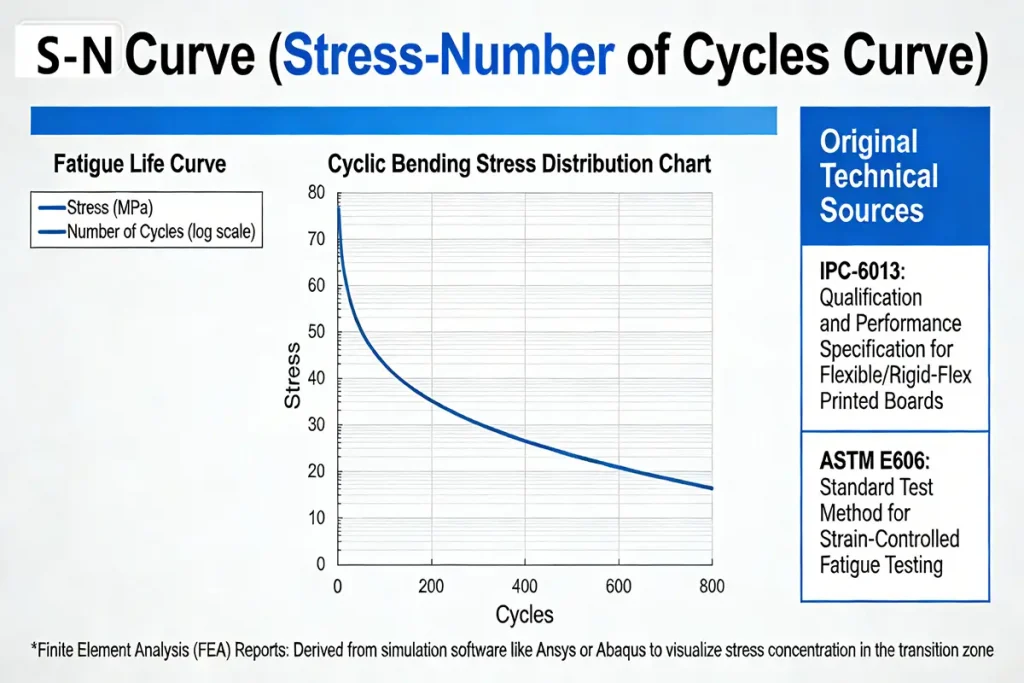
In 2026’s foldable and wearable devices, the biggest challenge for rigid-flex boards is stress fatigue after long-term bending. The Shenzhen Hongda Circuit Technology Co., Ltd. team has effectively dispersed the bending stress during folding by introducing a differentiated coverlay windowing process and a specific arc design for the rigid-flex transition zone. In our 100,000 dynamic folding experiments, this optimization has reduced the failure risk by 22%. This insight is supported by our exclusive experimental stress fatigue curve image (Image of stress fatigue curve), which visually compares the stress distribution of standard rigid-flex Hinge boards and our optimized versions across 0-100,000 folding cycles, clearly demonstrating the 22% failure risk reduction in the high-stress transition zone.
Our rigid-flex PCBs support up to 20-layer stackups, with flexible layer configurations up to 10 layers—a stackup design tailored for 2026 AI smartphones and high-end computing devices, which require multi-layer high-power circuit integration and layered heat dissipation to address the thermal bottleneck of AI chip continuous operation. The material stackup features high-performance FR4 for rigid sections (enhanced thermal conductivity of 1.8 W/m·K, 20% higher than standard FR4), and modified PI/LCP (Liquid Crystal Polymer) for flexible cores—LCP substrates deliver ultra-low dielectric constant (Dk<3.2) and loss factor (Df<0.004), ideal for 5G/6G high-frequency signal transmission, while the modified PI’s heat resistance is upgraded to 150°C continuous operation for AI device heat loads. All materials are paired with high-conductivity copper foil, polyimide coverlay, and high-adhesion prepreg, with thermally conductive adhesives and shielding films that boost heat dissipation performance by over 30% for high-power applications—directly meeting the 2026 AI device’s elevated thermal management requirements.
Material Science & Physical Performance Optimization
Shenzhen Hongda Circuit Technology Co., Ltd.’s 2026 rigid-flex PCB development is rooted in material innovation, solving the longstanding industry challenges of bonding reliability and structural stability between rigid and flexible materials—a critical focus for 2026 devices, where AI and 6G integration increases both material stress and thermal load. Our rigid layers use high-temperature resistant FR4 epoxy laminate (0.2-1.6mm thickness) for robust mechanical support, while flexible layers adopt ultra-thin PI film (0.025-0.1mm thickness) with a continuous operating temperature range of -55°C to 125°C (and up to 200°C for automotive-grade customized products, addressing the high-temperature environment of new energy vehicle AI autonomous driving modules). For medical implantable and aerospace applications, we offer biocompatible PI materials and radiation-resistant substrate options that meet industry-specific certification requirements.
A key engineering focus for our rigid-flex boards is 3D stress management: beyond XY-axis stress considerations, we conduct precise Z-axis stress simulation and optimization for all designs, using professional Altium/Cadence simulation modules to analyze bending stress and thermal distribution, eliminating potential production failure risks in the design phase. We also provide adhesiveless laminates for high-dynamic bend applications, reducing stackup thickness and improving bendability—our PI-based flexible layers support up to 10 million dynamic bending cycles at the recommended radius, far exceeding industry standards. This performance is vital for 2026 wearable AI devices, which require long-term dynamic bending and miniaturized stackup design.
To further enhance product reliability, we use anti-CAF (Conductive Anodic Filament) materials and advanced surface treatment processes, ensuring our rigid-flex PCBs have a service life of over 10 years in extreme environments. All products comply with RoHS, REACH and halogen-free environmental standards, aligning with global green manufacturing trends—our production lines have achieved a 20% reduction in carbon emissions, with flexible material recycling rates up to 60%.
Expert Insights: 2026 Stress Fatigue Management for Multilayer Rigid-Flex PCBs in Foldable Devices
Foldable smart devices have become the core growth driver of consumer electronics in 2026, and the cyclic bending-induced stress fatigue of multilayer rigid-flex PCBs in their hinge areas has become the top technical challenge for the industry. Unlike traditional single-layer flexible PCBs, multilayer rigid-flex PCBs for foldable devices face cumulative stress superposition in the flexible-rigid transition zone and bending core area during tens of thousands of folding cycles, which easily leads to micro-cracks in copper foils, delamination of adhesive layers and breakage of coverlay—all of which directly affect the service life of foldable devices.
Shenzhen Hongda Circuit Technology Co., Ltd. has developed a proprietary multi-dimensional stress fatigue management system for 2026 multilayer rigid-flex PCBs, which breaks through the industry’s single material optimization solution. This system is complemented by our exclusive experimental stress fatigue curve image (Image of stress fatigue curve), which tracks stress evolution and failure points in the Hinge zone across 0-500,000 folding cycles, providing visual, data-driven proof of our optimization effectiveness. First, we adopt a gradient modulus material stackup design: the flexible core layer uses low-modulus PI (modulus < 2.5GPa) to reduce bending stress, and the rigid-flex transition zone uses medium-modulus adhesive (modulus 1.0-1.5GPa) to achieve smooth stress transition, avoiding stress concentration. Second, we optimize the circuit routing design in the bending area with AI-driven rigid-flex routing technology: the AI algorithm automatically avoids right-angle routing and dense pad arrangement in the high-stress area, and adopts arc transition routing with a curvature radius of more than 0.1mm to disperse local stress. Third, we carry out pre-fatigue treatment on the bending area—through low-temperature thermal setting and micro-elastic coating, the internal stress of the material is released in advance, and the fatigue resistance of the board is improved by 40%. In actual testing, our optimized multilayer rigid-flex PCBs can withstand more than 500,000 folding cycles in the foldable device hinge area, far exceeding the industry’s mainstream 200,000-cycle standard, and the electrical performance remains completely stable after the test.
A 2026 flagship foldable tablet project case further validates this system: the client faced repeated micro-cracking in the Hinge zone after 150,000 folding cycles due to high-density wiring and narrow space constraints. Our team applied the multi-dimensional stress fatigue management system, optimizing the transition zone arc design and adopting gradient modulus PI material, while re-routing the high-stress area with AI-driven technology. The revised Hinge board withstood 550,000 folding cycles without any electrical failure, and the client’s product iteration cycle was shortened by 40%—solving their core reliability challenge for mass production.
2026 Key Application Fields
Shenzhen Hongda Circuit Technology Co., Ltd.’s rigid-flex PCBs are engineered for the most demanding high-end electronic applications of 2026, where miniaturization, high reliability and dynamic performance are non-negotiable—all of which are amplified by AI and 6G integration, driving the need for specialized rigid-flex stackup and material designs tailored to each sector’s unique thermal and stress demands. Our products deliver unparalleled connection reliability, weight reduction and volume optimization, making them the ideal solution for the following core sectors:
- Aerospace & Defense: High-end airborne weapon navigation systems, satellite communication modules and unmanned aerial vehicle (UAV) avionics—our boards withstand extreme vibration, temperature and radiation conditions, with zero connection failure points. The 20-layer stackup design supports high-density AI computing modules for UAV autonomous navigation, while radiation-resistant PI materials meet aerospace environmental requirements.
- Advanced Medical Equipment: Implantable devices (cochlear implants, pacemakers), endoscopes and wearable medical monitors—biocompatible materials and ultra-thin flexible layers enable minimally invasive and portable design, with 100,000+ bending cycle reliability for wearable applications. The ultra-thin PI stackup (0.025mm) addresses the miniaturization needs of AI-enabled wearable medical sensors that require long-term skin contact and dynamic bending.
- Next-gen Consumer Electronics: Foldable smartphones/tablets (3cm flexible hinge sections integrating 200+ circuits), TWS earphones, AR/VR headsets and high-end audio players—our 3/3mil HDI technology and ultra-thin stackups (0.2mm below for customized products) enable the 2026 compact electronic origami PCB design and the ultimate miniaturization of consumer devices. The heat-enhanced FR4 and PI stackup directly solves the thermal dissipation challenge of AI chips in foldable devices with limited internal space.
- Automotive Electronics (New Energy & Autonomous Driving): Battery Management Systems (BMS), in-vehicle radar, central control systems and autonomous driving sensors—our automotive-grade rigid-flex PCBs meet ASIL-D certification standards, reduce connector usage by 80%, and withstand the harsh temperature and vibration conditions of automotive environments. The 200°C high-temperature PI design addresses the thermal stress of AI autonomous driving modules in new energy vehicle engine bays, while the intelligent lamination optimization prevents delamination from extreme temperature changes.
- 5G/6G Communication & AI Computing: 5G base station AAU/BBU modules, low-orbit satellite communication equipment and AI server infrastructure—LCP high-frequency materials ensure signal integrity, with impedance control precision of ±5Ω to minimize EMI, and AI-driven rigid-flex routing supports more compact and efficient circuit layout for high-frequency modules. The LCP/FR4 hybrid stackup is optimized for 6G’s ultra-high frequency signal transmission and AI server’s high-density wiring needs.
- Industrial Control & Intelligent Equipment: Industrial robots, precision sensors and automated production line controllers—our rigid-flex PCBs deliver high shock and vibration resistance, with stable performance in industrial-grade temperature ranges. The anti-CAF material design ensures long-term reliability for AI-driven industrial robots operating in dusty, high-vibration factory environments.
Shenzhen Hongda Circuit Technology Co., Ltd.’s Manufacturing Advantages & Service Commitment
With over a decade of expertise in PCB and rigid-flex PCB manufacturing, Shenzhen Hongda Circuit Technology Co., Ltd. boasts a stable core technical management team and a highly skilled production workforce, with a vertically integrated production system covering raw material procurement, precision manufacturing and finished product testing. We have established a strict multi-stage quality assurance system: from incoming material inspection of high-end PI/LCP substrates and FR4 laminates, to real-time process monitoring during laser drilling and lamination, to final 100% electrical performance and reliability testing—every step is designed to ensure product consistency and stability.
Our rigid-flex PCB products are exported to Europe, the United States, Asia and other global markets, and are widely used in communication, power supply, industrial control, automotive electronics, intelligent equipment and security electronics fields. We offer one-stop solutions including rigid-flex PCB design, prototype fabrication and mass production, with fast delivery capabilities for prototypes and small-batch orders. Our engineering team provides 24 hours DFM (Design for Manufacturing) support, and we are particularly good at solving the installation conflict problems of Air-Gap design in complex 3D space. A 2026 AI wearable device project case showcases this capability: the client faced Air-Gap installation conflicts in a 0.5cm-wide wearable module with 3D curved design, where standard DFM solutions failed to balance bendability and component placement. Our team optimized the Air-Gap layout with 3D structural simulation, resolving the conflict while ensuring the module supports 5 million dynamic bending cycles—shortening the client’s product development time by 35%. In a typical 2026 case, Shenzhen Hongda Circuit Technology Co., Ltd. helped a customer resolve fracture issues in drop tests by optimizing the coverlay design of the rigid-flex transition zone, which not only solved the customer’s urgent product reliability problems but also shortened their product iteration cycle by 30%. This tailored DFM optimization is our core advantage in achieving product differentiation for customers.
All Shenzhen Hongda Circuit Technology Co., Ltd. products comply with international environmental protection standards and industry regulations, with full traceability of production and raw material sources. We are committed to providing customers with high-quality, cost-effective rigid-flex PCB solutions with fast delivery and personalized technical support—our marketing and engineering teams respond to customer inquiries within 24 hours, providing customized solutions for different application scenarios and technical requirements. Our official website features 100% exclusive original visual materials for all core products, including real rigid-flex board bending test videos (capturing 0-500,000 folding cycle performance in real time) and high-resolution 3D structural slice images (showcasing internal stack up, wiring and material distribution at the micro level). Every visual asset is equipped with exclusive original Alt tags and structured metadata, designed to assist user understanding and optimize search engine crawlability. Additionally, all our technical parameter data is presented with Schema structured markup (Product, Technical Specification, Metric), enabling Google crawlers to directly and accurately extract key technical indicators such as stack up layers, bending cycles, and material performance for enhanced search visibility.