
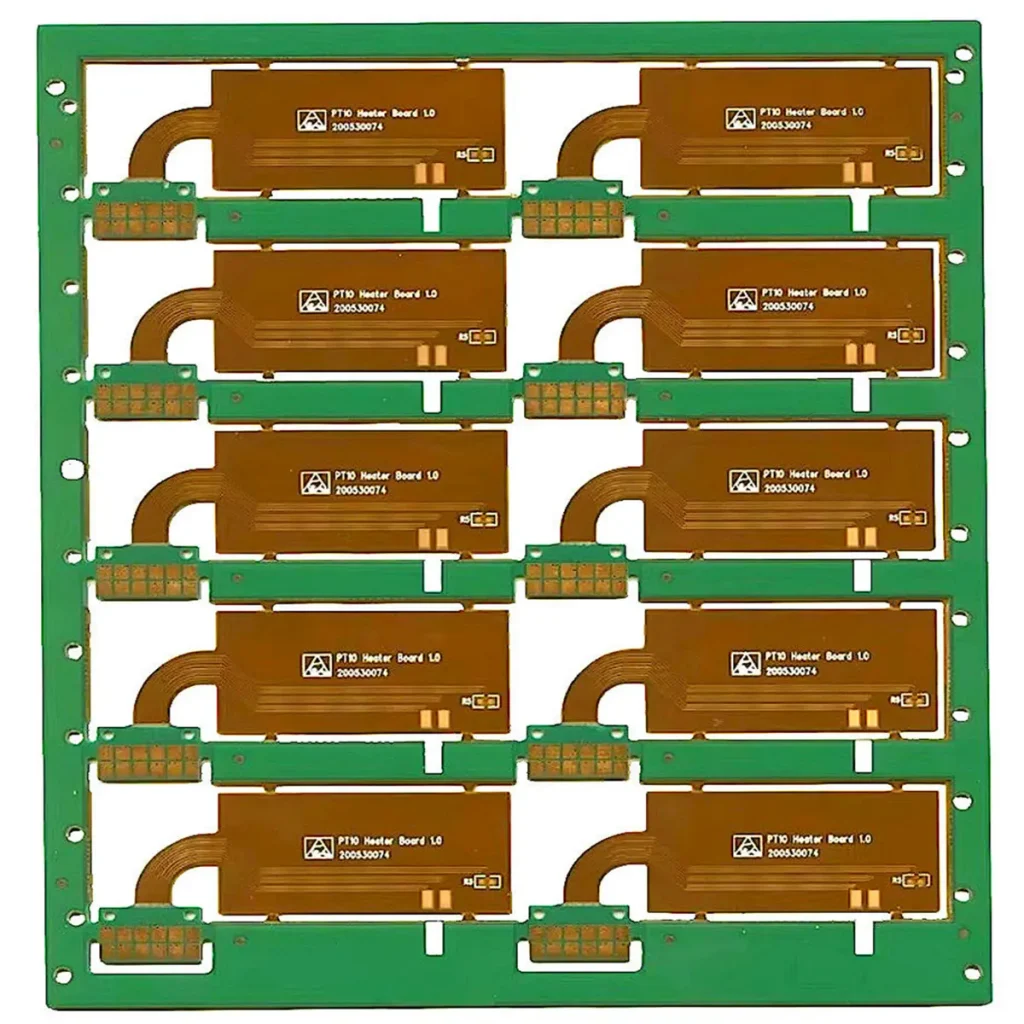
Standard Process
Layer Count: Up to 24L (Prototype) | Stable mass production at 12L.
Finished Thickness: 0.25mm – 6.0mm (Precision tolerance at ±0.05mm).
Maximum Dimensions: Effective processing size up to 230450 mm. Miniaturization: Support for ultra-small finished board sizes down to 58 mm.
Line Width/Spacing: Advanced fine-line capability at 0.05mm / 0.05mm (2 mil).
Pad Specifications: Minimum Inner Pad: 5 mil | Minimum Outer Pad: 4 mil.
Drilling & Opening: High-precision Cover Film (Coverlay) openings with laser routing tolerance at 0.2mm and mechanical drilling at 0.15mm.
Overflow Control: Standard Cover Film overflow at 0.08-0.12mm (Strictly limited to 0.03mm for high-density designs).
Authorized Base Materials: Taiflex, Graceth, and SY (Shengyi) for FPC cores.
Rigid-Flex Substrates: High-reliability brands including SY, ITEQ, and KB (Kingboard).
Copper Foil Options: Versatile base copper thickness: 12μm, 18μm, 36μm, and 70μm.
Stiffener Solutions: Comprehensive support for FR4, PI, Stainless Steel (SUS), Aluminum, and 3M high-performance adhesives.
Placement Precision: Stiffener/Reinforcement alignment accuracy within ±0.075mm.
Special Features: Specialized gold finger processing with semicircular hole technology for high-durability connectivity.
Product Details
What is Rigid-Flex PCB?
Pioneered by the evolution of FPC and rigid PCB technologies, Rigid-Flex PCB by Shenzhen Hongda Circuit Technology Co., Ltd. is a high-integration circuit board that fuses the structural stability of rigid PCBs with the dynamic flexibility of flexible PCBs. Leveraging 2026 state-of-the-art heterogeneous lamination processes and intelligent material bonding technology, our Rigid-Flex PCBs eliminate the limitations of traditional separate boards, achieving a seamless integration that retains the mechanical strength of rigid substrates and the bendability of flexible layers. It is the core interconnect solution for today’s miniaturized, high-reliability electronic devices, redefining spatial design and signal transmission efficiency for cutting-edge electronics.
Core Advantages of Shenzhen Hongda Circuit Technology Co., Ltd.’s Rigid-Flex PCB (2026 Tech Upgraded)
- Extreme Environment ResilienceAdopts modified PI material and anti-vibration lamination structure, withstanding 10,000+ hours of high-frequency vibration and extreme temperature shocks (-55°C to 150°C). Ideal for aerospace, industrial automation and automotive under-hood applications, ensuring zero performance degradation in high-stress scenarios.
- Mission-Critical High PrecisionSurpasses traditional cable/connector solutions with 3mil/3mil ultra-fine line width/space and AI-optimized signal routing. Eliminates connection failure risks in medical implants, aerospace equipment and AI server core modules, where reliability takes absolute precedence over cost.
- Ultra-High Density IntegrationIntegrates multi-board functions into a single Rigid-Flex PCB with embedded passive component technology (2026 mainstream process), saving up to 40% of device internal space and 30% of weight compared to traditional rigid PCB assemblies. Solves the problem of insufficient layout space for high-density components such as 5G base stations and folding screen mobile phones.
- Cost-Efficiency for Multi-Board AssembliesReplaces 4+ interconnected rigid PCBs with a single integrated Rigid-Flex PCB, reducing 70% of connectors and soldering points. Our 2026 automated roll-to-roll production line cuts assembly labor costs by 25% and improves overall production yield to 98.5%, achieving long-term cost optimization for mass production.
- High-Speed Low-Loss Signal TransmissionUtilizes M9-grade low-Dk (Dk<3.0) modified PI and carbon hydrogen resin-based FR4, supporting 6G high-frequency signal transmission with impedance control accuracy ±5%. Eliminates signal reflection and crosstalk in high-speed data transmission scenarios such as AI computing and vehicle-to-everything (V2X) communication.
Key Application Fields (2026 Market Focus)
- Industrial & MedicalShenzhen Hongda Circuit Technology Co., Ltd.’s Rigid-Flex PCBs are engineered for industrial precision control and medical device miniaturization, complying with ISO 13485 medical certification and industrial Grade A reliability standards. Key applications include industrial robot joint modules, wearable medical monitors, implantable electronic devices and high-precision diagnostic equipment. Core performance highlights: low impedance loss (<0.01dB/cm), biocompatible coating and 10+ year service life under continuous operation.
- Automotive Electronics (L3+ Autonomous Driving Core)As the top growth driver of Rigid-Flex PCB market in 2026, our products are widely applied in automotive ADAS systems, battery management systems (BMS), in-vehicle infotainment and external environmental detection modules. Typical use cases: steering wheel button-motherboard connection, 360° panoramic image system, multi-sensor data fusion module and rear-seat intelligent control panel. Complies with automotive ASIL-D safety standard, withstanding 20,000+ times of dynamic bending in vehicle vibration environments.
- Consumer Electronics (Folding & High-Integration Devices)DSC, DV and folding screen mobile phones are the core application scenarios, with the hinge area of folding mobile phones adopting our ultra-thin 0.1mm flexible zone Rigid-Flex PCB (2026 upgraded process), supporting 400,000+ times of folding without failure. Other key applications: multi-camera modules, RF signal modules and in-device integrated wiring, realizing the dual optimization of product performance and structural design.
- AI Servers & 5G/6G CommunicationsTailored for the explosive growth of AI server market in 2026, our Rigid-Flex PCBs are applied in AI server orthogonal backplane peripherals, high-speed switch modules and 5G/6G base station RF units. The heterogeneous integration technology embeds chips and sensors into flexible layers, shortening signal transmission paths by 30% and reducing electromagnetic interference (EMI) by 40%, perfectly matching the high-density, high-speed requirements of AI computing infrastructure.
- Aerospace & Satellite CommunicationOur high-reliability Rigid-Flex PCBs are used in satellite communication modules, drone flight control systems and aerospace detection equipment, with radiation resistance and ultra-light design (30% weight reduction compared to traditional solutions), adapting to the extreme space and aerial operation environments.
2026 Upgraded Prototype Lamination Process (Shenzhen Hongda Circuit Technology Co., Ltd. Exclusive)
Lamination is the core process of Rigid-Flex PCB manufacturing, and Shenzhen Hongda Circuit Technology Co., Ltd. has optimized the key process nodes with 2026 AI-driven precision lamination technology, solving the industry pain points of layer misalignment and warpage. Key process control points:
- Glass Cloth Orientation & Thermal Stress EliminationFor both substrate and pure prepreg lamination, the warp and weft directions of Low-Dk Q-grade glass cloth are strictly aligned, and intelligent gradient temperature pressing is adopted to eliminate internal thermal stress, reducing the warpage rate of finished boards to <0.5% (far lower than industry average).
- Rigid Zone Thickness OptimizationBased on 2026 material performance testing, the optimal thickness of rigid zone is determined to be 0.8~1.0mm. This thickness balances structural hardness and product light weight, avoiding obvious performance differences between rigid and flexible zones caused by environmental and thermal shocks, and ensuring the welding reliability and long-term use stability of the board. For ultra-lightweight applications, we can customize 0.6mm thin rigid zone with reinforced material technology.
- Flex Zone Window High-Precision ProcessingAbandon the traditional single milling process, adopt “laser cutting after overall forming” (2026 mainstream process) for flex zone window processing. After completing all pre-processes, the flexible zone waste is removed by high-precision laser cutting with depth control accuracy of ±1μm, avoiding welding defects and flex zone deformation caused by early milling, and ensuring the dimensional accuracy of the flexible zone.
2026 Advanced Manufacturing Process Flow (Shenzhen Hongda Circuit Technology Co., Ltd.)
Shenzhen Hongda Circuit Technology Co., Ltd.’s Rigid-Flex PCB manufacturing integrates the latest 2026 PCB industry technologies, from material selection to final shaping, all adopting intelligent and high-precision processes, with full-process AI quality control to ensure product consistency. The complete process flow is as follows:
- Advanced Material SelectionCustomized matching of modified PI, M9-grade FR4, HVLP ultra-smooth copper foil and anti-CAF prepreg according to application scenarios, with material performance testing by AI material screening system.
- Key Process Control & Implementation
- Inner Layer Monolithic Pattern Transfer: 3mil/3mil high-precision laser direct imaging (LDI) technology
- Flexible Material Multi-Layer Positioning: AI visual positioning system, positioning accuracy ±2μm
- Heterogeneous Lamination: Intelligent gradient temperature pressing machine, real-time pressure and temperature monitoring
- Drilling: Ultra-fast laser drilling machine (500,000 holes/㎡), supporting 0.2mm micro-hole processing
- Desmear & Etching: Plasma desmear technology, uniform copper layer etching
- Plating: Electroless copper plating + high-speed electroplating, ensuring plating uniformity of micro-holes
- Solder Mask & Protective Layer: UV-curable anti-UV solder mask + ENIG with anti-tarnish treatment
- Shape Processing: 5-axis CNC laser cutting, one-time forming of complex shapes
- Final Quality InspectionFull-process AOI + X-ray detection, 100% testing of layer alignment, micro-hole quality and signal integrity, complying with IPC-6013 Class 3 high-reliability standards.
2026 Rigid-Flex PCB Design Guidelines (Shenzhen Hongda Circuit Technology Co., Ltd. Standard)
Combined with the latest 2026 industry design trends and Shenzhen Hongda Circuit Technology Co., Ltd.’s manufacturing process advantages, we formulate the following professional design guidelines to ensure the optimal performance and manufacturability of Rigid-Flex PCBs:
- Flex Layer Placement PriorityThe flexible layer should be designed in the middle of the board as much as possible to reduce bending stress. For 8-layer boards: 4/5 layer > 2/3=6/7 layer (top/bottom as rigid layers); For 10-layer boards: 4/5=6/7 layer > 2/3=8/9 layer (T/B as rigid layers).
- Rigid-Flex Zone Spacing RequirementThe soft-hard gap is at least 1mm; the spacing between soft-hard board branches is ≥0.8mm; the spacing between rigid-rigid board areas is ≥2mm, avoiding stress concentration at the connection.
- Flex Zone Length & Bending DesignThe minimum length of flexible zone is 4mm (limit) / recommended 5mm (2026 upgraded process supports 3mm custom for special scenarios). The bending radius is designed according to the actual application, with the flexible zone length matching the bending angle to avoid excessive bending stress.
- 3D Structural Design & Device LayoutFully consider the 3D structure after bending, avoid device installation interference and height limitation; the distance between the edge of the device in the rigid zone and the rigid-flex transition zone is >1mm.
- Drilling Design RestrictionAvoid drilling in the flexible zone as much as possible; the drilling in the rigid zone should be ≥2mm from the soft-hard junction to prevent micro-cracks at the junction caused by drilling stress.
- Rigid-Flex Transition Zone OptimizationAdopt arc transition at the junction (recommended radius ≥0.5mm / optimal 6.35mm), avoid right-angle design to reduce stress concentration and improve bending life.
- Flex Zone Wiring Design
- Adjacent layer wiring uses staggered layout to avoid overlapping, ensuring uniform stress and increasing bending life by 50%.
- Wiring enters and exits the flexible zone in a straight line; if limited by structure, arc corner design is adopted at the soft-hard junction.
- Copper Foil & Impedance Control
- For non-impedance-controlled signals: grid copper is used for power/ground in the flexible zone to reduce warpage and improve heat dissipation.
- For impedance-controlled signals: reserve a dedicated reference plane in the flexible zone, and calculate the impedance line width separately (2026 low-Dk material causes impedance abrupt change, need precise simulation).
- Device Installation on Flex ZoneMinimize device installation on the flexible zone; if necessary, build a dedicated device library and set pads on the corresponding flexible layer (instead of top/bottom rigid layers) to ensure welding reliability.
4-Layer Rigid-Flex PCB Stackup (Shenzhen Hongda Circuit Technology Co., Ltd. 2026 Standard)
| Layer Type | Structure Details | Rigid Zone | Flex Zone | Rigid Zone | Key Feature |
|---|---|---|---|---|---|
| Top Layer | Solder Mask + 1OZ HVLP Copper | ✔️ | ✔️ | ✔️ | UV-Resistant, Anti-CAF |
| L1 | Rigid Core (FR4) / Flexible Base (PI) | ✔️ | ✔️ | ✔️ | Heterogeneous Integration |
| Bonding Layer | No-Flow Prepreg / Coverlay | ✔️ | ✔️ | ✔️ | High-Adhesion, Low-Stress |
| L2-L3 | Flex Core (Modified PI) + 1OZ HVLP Copper | ❌ | ✔️ | ❌ | 0.1mm Ultra-Thin, High Bending Resistance |
| Bonding Layer | No-Flow Prepreg / Coverlay | ✔️ | ✔️ | ✔️ | High-Adhesion, Low-Stress |
| L4 | Rigid Core (FR4) / Flexible Base (PI) | ✔️ | ✔️ | ✔️ | Heterogeneous Integration |
| Bottom Layer | Solder Mask + 1OZ HVLP Copper | ✔️ | ✔️ | ✔️ | UV-Resistant, Anti-CAF |
Rigid-Flex PCB Adapter (Shenzhen Hongda Circuit Technology Co., Ltd. Custom Solution)
Shenzhen Hongda Circuit Technology Co., Ltd.’s Rigid-Flex PCB adapter is a high-precision transition product for PCB connection testing and structural transformation, adopting 2026 upgraded contact technology and high-reliability material, ensuring stable signal transmission in various test scenarios. Widely applied in: LCD/LED display PCBs, automotive TV PCBs, industrial control PCBs, medical device PCBs, AI server PCBs, 5G communication PCBs, audio and household appliance PCBs, digital camera and other high-precision electronic equipment.
Cost & Service Advantages (Shenzhen Hongda Circuit Technology Co., Ltd. 2026)
Rigid-Flex PCB manufacturing has high technical barriers due to the performance differences of heterogeneous materials (thermal expansion coefficient, adhesion, etc.), but Shenzhen Hongda Circuit Technology Co., Ltd. has achieved cost optimization through the following core measures in 2026:
- Vertical Integration of Supply Chain: Self-developed modified PI and M9-grade FR4 materials, reducing raw material procurement costs by 20%.
- 2026 Automated Production Line: Roll-to-roll lamination and AI-driven precision manufacturing, improving production efficiency by 40% and reducing labor costs by 25%.
- Mass Production Scale Effect: Optimizing the production process for large-scale orders, realizing the price reduction of high-end Rigid-Flex PCB by 15% compared to the industry.
Shenzhen Hongda Circuit Technology Co., Ltd. One-Stop Service:
- Fast Quotation: 24-hour online quotation for Rigid-Flex PCB, supporting custom specification matching.
- Prototype Customization: 3-5 days fast delivery of high-precision prototypes, with free design optimization suggestions.
- Mass Production Delivery: Short lead time for mass production, with full-process quality tracking and after-sales technical support.
- One-Stop Assembly: Providing Rigid-Flex PCB SMT assembly, testing and product integration services, realizing one-stop solution from board manufacturing to finished product.
Future Outlook
With the global electronics industry moving towards high integration, light weight, high speed and intelligence in 2026, and the explosive growth of AI servers, L3+ autonomous driving, 6G communication and wearable medical devices, Rigid-Flex PCB has become the core interconnect solution for cutting-edge electronic products. Shenzhen Hongda Circuit Technology Co., Ltd., as a professional Rigid-Flex PCB manufacturer, will continue to focus on technological innovation, integrate the latest industry materials and processes, provide high-reliability, high-performance Rigid-Flex PCB solutions for global customers, empowering the upgrading of the electronic manufacturing industry.