PCB Assembly Cost Breakdown: How Is PCBA Priced?
Here is the revised introduction, maintaining your exact original structure and intent while seamlessly integrating the target keyword right at the beginning:
Mastering Your Sourcing Strategy
PCB Assembly Cost Breakdown analysis is the only way to make sense of a confusing procurement cycle. If you’ve ever stared at a PCBA quote and wondered why two suppliers gave you numbers 30% apart for what looks like the same job, you’re not alone. Most procurement engineers run into this at some point — the quote arrives, the total is there, but the logic behind it isn’t.
At Shenzhen Hongda Circuit Technology Co., Ltd., we think that’s backwards. A PCB assembly cost breakdown shouldn’t be a black box that only the factory understands. It should be something you can open up, line by line, and use to make better decisions — whether that means requalifying a component, adjusting your panel layout, or simply knowing which line items are negotiable and which aren’t.
The 4 Major Pillars of PCBA Cost
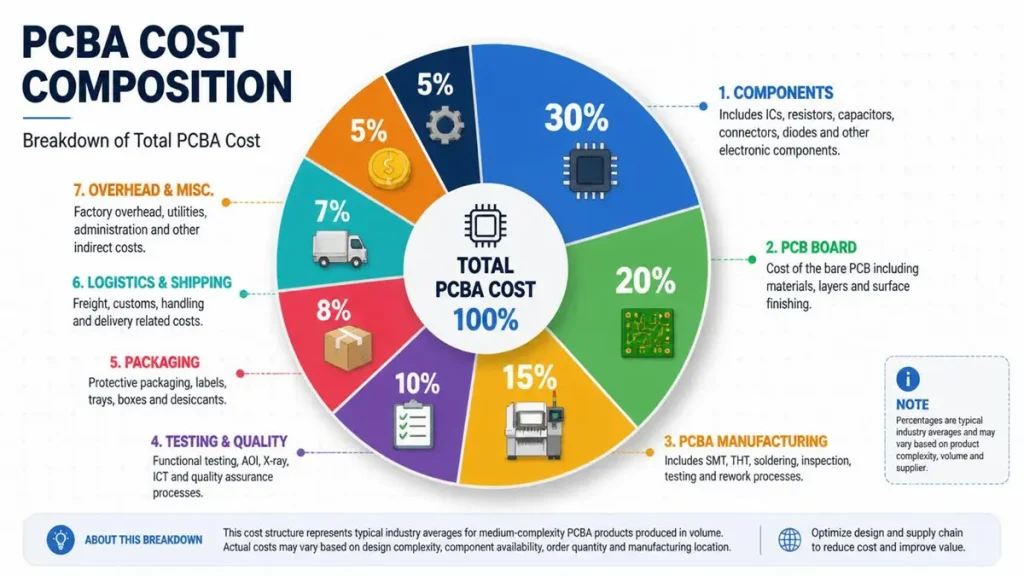
Typical PCBA Cost Composition Breakdown Chart
Every PCB assembly cost breakdown, regardless of the factory issuing it, is built from the
same four cost blocks. Understanding each one lets you see exactly where your money is
going.
1. PCB Board Fabrication Cost
This is the bare board itself, before a single component is placed. Board fabrication cost is
driven by:
Layer count — a 2-layer board and a 12-layer HDI board are not remotely comparable
in drilling time, lamination cycles, or yield loss, so cost scales sharply with layer count.
Base material — standard FR-4 is the cost baseline; high-frequency or high-speed
laminates (such as Rogers or PTFE-based materials for RF and 5G designs) carry a
significant material premium.
Surface finish — LF HASL is the most economical finish for general-purpose boards,
while ENIG (or ENEPIG for fine-pitch and wire-bond applications) costs more but
delivers the flatness and shelf life needed for BGA and QFN packages.
Trace width and spacing — pushing below standard line width/spacing tolerances
lowers fabrication yield, and that yield loss is reflected directly in unit price.
2. Component Sourcing Cost (BOM Pricing)
For most assemblies, the bill of materials — not the labor — is the largest single cost driver.
Three factors matter most here:
Core IC/MCU selection — the main controller or processor typically represents a
disproportionate share of total BOM cost, especially in assemblies with tight
functional requirements.
Passive component volume — resistors, capacitors, and inductors are individually
cheap but add up fast in high component-count designs, and lead-time-driven spot
market premiums can spike pricing on parts affected by allocation.
Sourcing channel — authorized distributor stock, franchised inventory, and open
market buys all carry different risk-adjusted price points, which is why traceable
sourcing is worth paying for even when a cheaper unofficial source exists.
3. Assembly Labor & Engineering Fees (SMT/THT)
This is where the physical act of turning a bare board and a BOM into a working assembly
gets priced. It typically breaks into three sub-costs:
Stencil cost — a one-time tooling charge for the solder paste stencil, usually a fixed
fee regardless of order quantity.
Machine programming / setup fee — the engineering time to program pick-and
place equipment, reflow profiles, and AOI inspection parameters for a new board. This
is a fixed cost that gets diluted across your order quantity — the larger the run, the
smaller the per-unit impact.
Solder joint count — placement and reflow cost scales with the number of solder
joints, which is why a 200-pin BGA design costs meaningfully more to assemble than
a simple through-hole board with the same board area.
Engineering setup fees heavily influence small-batch runs, which is why optimizing your
design for our standard
PCB Assembly lines can dramatically lower setup costs.
4. Testing, Inspection, and Packaging
The last pillar covers everything between “assembled” and “shipped”:
X-Ray inspection — required for BGA, QFN, and other bottom-terminated packages
where solder joints are hidden from optical inspection; this adds a per-board or per
panel fee depending on complexity.
Test fixture / jig fabrication — functional test and ICT fixtures are a one-time NRE
(non-recurring engineering) cost, similar in structure to stencil fees.
Packaging — ESD-safe packaging is standard for most assemblies, but moisture
sensitive devices (MSD) may require vacuum sealing with desiccant and humidity
indicators, which adds material cost.
Logistics — freight mode (air vs. sea), customs handling, and insurance all factor into
the landed cost, which is often left out of factory-floor quotes but very much part of
your real budget.
Hidden Factors That Escalate Your PCBA Price
Beyond the four pillars, several variables quietly move your final number — and they’re
often the ones buyers overlook when comparing quotes.
Order Volume and Economies of Scale
The gap between a 10-piece prototype run and a 1,000-piece production run isn’t linear —
it’s dramatic. Fixed costs like stencil fabrication, engineering setup, and test fixture NRE
get spread across the entire order. At 10 units, those fixed costs might represent 40–60% of
your unit cost. At 1,000 units, the same fixed costs might contribute only a few cents per
board. This is the single biggest reason prototype pricing and production pricing look so
different for the “same” design.
Lead Time and Urgency Premiums
Rush orders force a factory to reshuffle its production schedule, often pulling your job
ahead of others already queued on the line. That disruption has a real cost, and it’s typically
passed on as an expedite fee. If your project timeline has any flexibility at all,
communicating it upfront — rather than defaulting to “as fast as possible” — can
meaningfully lower your quote.
Design Complexity: Single-Sided vs. Double-Sided SMT
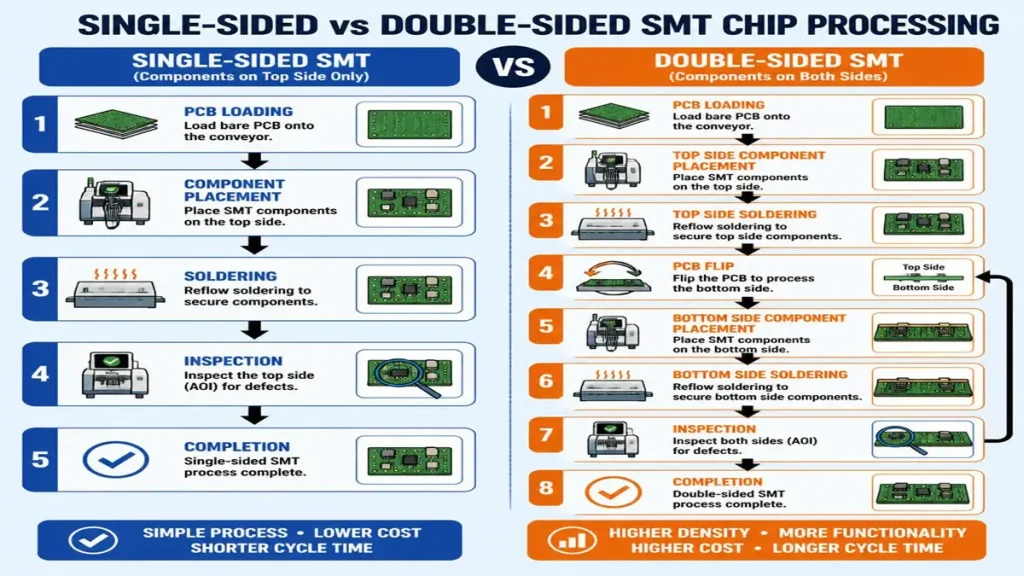
Single-Sided vs Double-Sided SMT Process Comparison
A single-sided SMT assembly runs through the line once. A double-sided, high-density
assembly requires a second pass — additional stencil printing, a second reflow cycle, and
often a second AOI inspection step. That doubling isn’t reflected in a doubled price, but it’s a
meaningful cost adder that’s worth understanding before finalizing a layout, especially for
cost-sensitive consumer designs.
Practical Tips to Lower Your PCB Assembly Costs
None of this means cost and quality are locked in a permanent trade-off. There are concrete,
engineering-level levers that reduce cost without touching reliability:
1. Standardize component packages. Avoid exotic passives like 01005 unless your
design truly requires that footprint for space constraints — they carry higher
placement cost and higher defect risk than 0402 or 0201 equivalents.
2. Bring DFM review in early. A Design for Manufacturability review at the layout stage
— not after Gerbers are finalized — catches panelization inefficiencies that would
otherwise waste base material and drive up your per-board fabrication cost.
3. Choose full turnkey sourcing. Consignment or partial-turnkey models can look
cheaper on paper, but splitting the supply chain between you and the factory usually
creates duplicated international freight and customs handling. A full turnkey PCB
assembly cost model consolidates that logistics spend into a single, transparent line.
Modern PCB manufacturing is also changing what “low cost” means in practice. AI-assisted
routing and placement optimization, closed-loop process control on SMT lines, and layered
AOI/X-ray inspection are reducing defect rates and rework — and rework, historically, has
been one of the largest hidden costs in any PCBA cost breakdown. Factories that have
invested in these capabilities can often hold tighter tolerances at the same price point,
which is worth asking about when you’re comparing PCB assembly quotes.
Get an Instant and Transparent PCBA Quote
You shouldn’t have to guess where your PCB assembly cost comes from. Submit your BOM
and Gerber files to Shenzhen Hongda Circuit Technology Co., Ltd. and get a line-item
PCBA cost breakdown back within 2 hours — no hidden fees, no vague lump sums, just a
quote you can actually defend in your own budget review.
FAQ:
How much does PCB assembly typically cost per board?
There’s no single number —per-board cost depends on layer count, component count, order volume, and turnaround time. A simple 2-layer, low-density board might run a few dollars per unit at volume, while a
complex, high-density multilayer assembly can run into the tens of dollars per unit. The only reliable way to know your actual cost is a quote built from your specific BOM and Gerber files, not a generic price list.
Why is my low-volume (prototype) order so much more expensive per unit than production volume?
Because fixed costs — stencil fabrication, engineering setup, test
fixture NRE — don’t scale down with quantity. At 10 units, those one-time charges are spread across very few boards; at 1,000 units, the same charges are barely noticeable per unit. This is normal and expected, not a sign of being overcharged.
What’s the difference between turnkey and consignment PCB assembly, and which is cheaper overall?
In turnkey assembly, the factory sources 100% of the BOM; in consignment, you supply some or all components yourself. Consignment can look cheaper if you already have favorable component pricing, but it shifts sourcing risk, logistics coordination, and often duplicated freight costs onto you. For most buyers, full turnkey PCB assembly produces a lower total landed cost once logistics and coordination time are factored in.
How do I know if a supplier’s low quote is hiding costs that will show up later?
Ask specifically whether the quote includes stencil and NRE fees, X-Ray inspection (if you have BGA/QFN parts), test fixture costs, and packaging/freight. A transparent PCBA cost breakdown should itemize all four cost pillars separately. If a quote is unusually low and doesn’t break out these items, assume they’re going to appear later as change orders.
What information do I need to provide to get an accurate PCB assembly cost quote?
minimum: Gerber files (or ODB++/native CAD data), a complete BOM with manufacturer part numbers, assembly drawings or a pick-and-place file, and your target order quantity and lead time. The more complete this package is, the more accurate — and the more stable — your quoted price will be once production starts
About Author
David Chen https://www.linkedin.com/in/pcbcoming
David Chen boasts an extensive professional background in PCBA manufacturing, PCBA testing, and PCBA optimization, with specialized expertise in high-precision PCBA fault analysis and rigorous PCBA reliability testing. The author has worked with high-layer-count server PCB fabrication, ultra-low-loss backplane stackups, and thermo-mechanical reliability optimization for AI infrastructure projects involving 112G and 224G PAM4 architectures. Skilled in complex circuit design and cutting-edge advanced PCB manufacturing processes, he delivers solutions that elevate product durability and performance across industrial applications. His technical articles focusing on PCBA manufacturing workflows and testing methodologies are widely cited by industry peers, research institutions, and technical platforms, solidifying his reputation as a recognized technical authority in the global circuit board manufacturing sector.