Halogen-Free PCB Manufacturer: What Should Buyers Check?
Choosing a reliable Halogen-Free PCB Manufacturer requires more than confirming that a supplier offers halogen-free FR-4. Buyers should verify the laminate specification, applicable halogen limits, supporting compliance documents, manufacturing capabilities, traceability, and production consistency. A qualified supplier should also review the design, identify material-related processing risks, and provide a clear quotation before prototype or mass-production orders begin.
For OEMs, electronics design companies, and procurement teams, these checks help reduce material substitution risks, compliance uncertainty, and manufacturing delays.
What Is a Halogen-Free PCB and Which Standards Apply?
A halogen-free PCB uses base materials designed to meet specified limits for halogens, particularly chlorine and bromine. These elements can be present in certain flame-retardant systems used in conventional PCB laminates. Halogen-free alternatives use different material chemistries to achieve the required fire performance.
However, halogen-free does not necessarily mean that a material contains absolutely zero halogens. It is a specification-based claim that must be evaluated against the applicable standard or customer requirement.
Commonly referenced PCB laminate criteria include:
| Reference | Typical purpose | What buyers should verify |
|---|---|---|
| IEC 61249-2-21 | Requirements for halogen-free PCB base materials | Whether the selected laminate complies with the applicable specification |
| JPCA-ES-01 | Halogen-free requirements for PCB materials | The edition and limits specified by the customer |
| IPC-4101 | Specifications for rigid and multilayer PCB base materials | The exact material specification and relevant slash sheet, where applicable |
| Customer-specific material specification | OEM or industry-specific compliance requirements | Whether the supplier’s material documents satisfy the purchase specification |
For commonly used halogen-free laminate criteria, the limits are generally stated as:
| Parameter | Commonly referenced limit |
|---|---|
| Chlorine (Cl) | ≤ 900 ppm |
| Bromine (Br) | ≤ 900 ppm |
| Total chlorine and bromine | ≤ 1,500 ppm |
These values should not be treated as a universal definition covering every product, component, or assembly. Requirements can differ according to the standard, product category, and customer specification.
Procurement recommendation: Include the required halogen-free standard or customer specification in the RFQ. Ask the supplier to identify the proposed laminate grade and provide documentation that supports the specific claim.
It is also important to distinguish halogen-free from halide-free. Halogen-free requirements generally concern the halogen content of materials, while halide-free classifications often concern ionic halides in soldering fluxes or related materials. One claim does not automatically establish the other.
How Does Halogen-Free PCB Material Differ from Standard FR-4?
Halogen-free PCB is not a separate circuit-board construction method. It is a material requirement that can affect laminate selection, processing conditions, and qualification procedures.
Standard FR-4 is a broad category of glass-reinforced epoxy laminate. Its properties vary according to resin formulation, glass construction, copper foil, and material grade. Halogen-free FR-4 uses an alternative resin and flame-retardant system designed to meet the specified halogen limits.
The correct comparison is therefore between two defined material grades—not between all halogen-free materials and all conventional FR-4 materials.
| Selection factor | What buyers should evaluate |
|---|---|
| Halogen content | Chlorine and bromine limits under the required specification |
| Glass transition temperature (Tg) | Whether the material supports the assembly and operating temperature requirements |
| Decomposition temperature (Td) | Thermal stability during manufacturing and service |
| Coefficient of thermal expansion (CTE) | Compatibility with plated-through holes, layer count, and thermal cycling |
| Moisture behavior | Suitability for the operating environment and assembly process |
| Electrical properties | Dielectric constant, dissipation factor, and frequency-dependent performance where relevant |
| Mechanical properties | Drilling behavior, dimensional stability, and suitability for the board construction |
| Availability | Whether the selected grade can be procured consistently for prototypes and production |
| Documentation | Material datasheets, compliance declarations, and supporting test evidence |
For a simple control board, a qualified halogen-free FR-4 grade may be sufficient. A multilayer industrial controller, automotive electronic assembly, or high-temperature power board may require additional consideration of Tg, thermal expansion, copper weight, layer count, and assembly conditions.
Do not assume that every halogen-free laminate has a higher Tg, lower dielectric loss, or better reliability than conventional FR-4. These characteristics depend on the specific material formulation and must be evaluated using the relevant datasheet and qualification requirements.
How Can Buyers Verify Halogen-Free PCB Material Compliance?
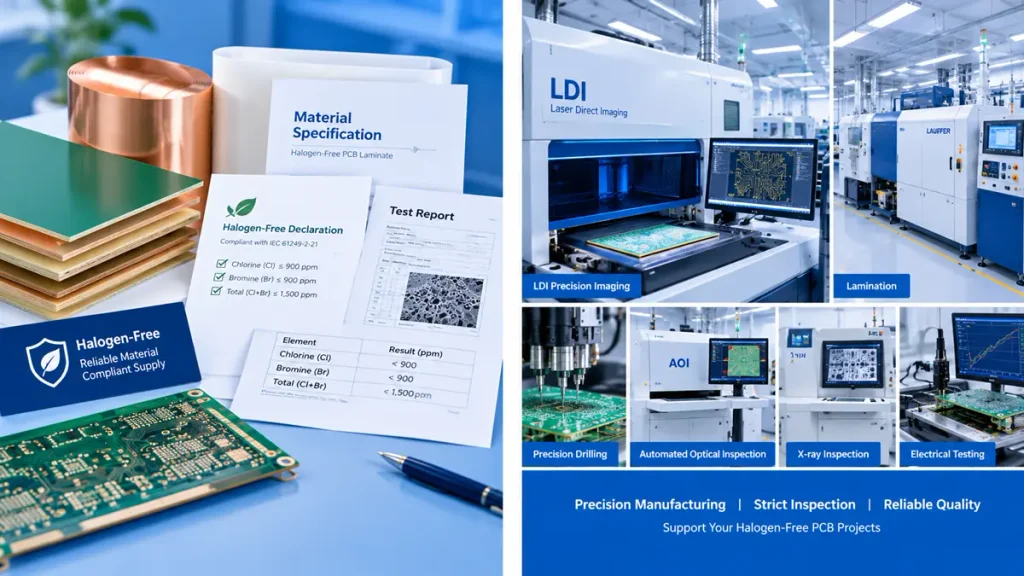
Halogen-Free PCB Manufacturer – Material Compliance Verification
The most reliable approach is to verify the material itself and the documents associated with the production order. A general statement on a supplier’s website is not sufficient evidence for a demanding OEM qualification process.
Ask the Halogen-Free PCB Manufacturer to identify the proposed material grade and provide the following documents where applicable:
| Document or record | What it helps establish | What buyers should check |
|---|---|---|
| Material technical datasheet | The specified physical, thermal, and electrical properties | Exact grade, manufacturer, revision, and applicable test conditions |
| Halogen-free declaration | The supplier’s stated compliance position | Named standard, limits, material scope, and issuing organization |
| Material test report | Measured results for specified halogen content | Test method, sample identity, reported values, and laboratory details |
| Certificate of conformity | Conformity with a defined purchase or product specification | Whether it applies to the material and order being purchased |
| Material batch or lot information | Traceability to a particular supply lot | Whether the lot can be connected to the production order |
| Material change notification | Control of substitutions or formulation changes | Whether changes require prior customer approval |
Not every material grade or order will automatically include every document. Buyers should specify their documentation requirements before quotation and confirm which records the supplier can provide.
Where independent testing is required, confirm the applicable test method and laboratory scope. Do not assume that a test for ionic halides in flux is sufficient to establish the total chlorine and bromine content of a PCB laminate.
Does RoHS Compliance Automatically Mean a PCB Is Halogen-Free?
No. RoHS and halogen-free requirements are related to environmental and material compliance, but they are not interchangeable.
A product may meet applicable RoHS restrictions without meeting a customer’s halogen-free specification. Conversely, a halogen-free laminate declaration does not establish compliance with every other substance restriction or product-level requirement.
Procurement teams should list each required environmental declaration separately. If an OEM requires RoHS compliance, halogen-free laminate, and additional restricted-substance declarations, each requirement should be checked against the relevant evidence.
How Should Buyers Control Material Substitution?
Material substitution is a significant risk when a product has already completed engineering validation or customer qualification.
A substitute may have a similar nominal Tg or belong to the same broad FR-4 category while differing in resin chemistry, CTE, dielectric properties, moisture behavior, or processing characteristics.
To reduce this risk, buyers should:
- Identify the approved laminate manufacturer and exact material grade.
- State whether equivalent materials are permitted.
- Require prior approval for substitutions that could affect compliance or performance.
- Confirm the documentation required for any approved alternative.
- Maintain traceability between the approved specification, purchased material, and production order.
For regulated or reliability-sensitive products, do not approve a substitute based only on a supplier’s statement that it is equivalent.
What Manufacturing Technologies Matter When Producing Halogen-Free PCBs?
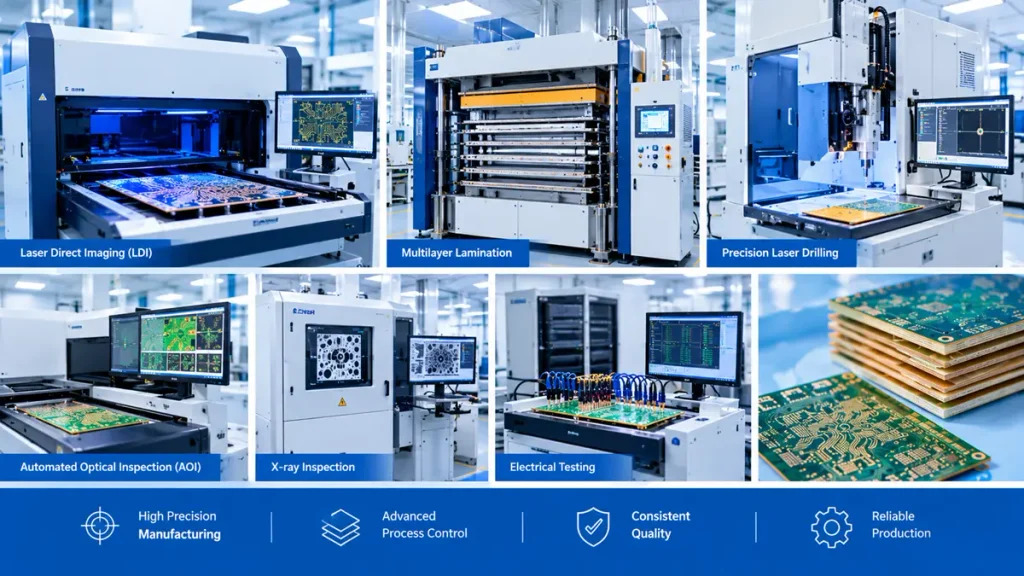
Halogen-Free PCB Manufacturer – Precision PCB Manufacturing and Inspection
Halogen-free compliance starts with material selection and verification. Manufacturing technology matters because the selected laminate must also be processed into a circuit board that meets dimensional, interconnection, and quality requirements.
Modern PCB fabrication uses a combination of imaging, lamination, drilling, plating, and inspection technologies. Their relevance depends on the board’s layer count, line-and-space requirements, via geometry, thickness, and reliability targets.
How Does Laser Direct Imaging Help Control Fine Circuit Patterns?
Laser direct imaging (LDI) creates circuit patterns directly from digital design data. Compared with conventional photographic imaging, it can support precise pattern registration and fine-feature processing when the complete process is properly controlled.
For projects that require tight conductor spacing or consistent multilayer registration, buyers should ask the manufacturer about its actual production design rules, achievable tolerances, inspection methods, and demonstrated experience with the specified construction.
PCBKR’s stated manufacturing equipment includes SCREEN Ledia LDI, with an 8 µm target and a stated ±10 µm figure. These figures should be interpreted in their specified process context rather than as a universal guarantee for every board design.
The minimum manufacturable line and space depend on more than the imaging tool. Copper thickness, etching behavior, material properties, panel dimensions, and process control also affect the final result.
For halogen-free PCB procurement, the practical question is whether the supplier can process the specified halogen-free laminate and finished board construction to the required dimensional tolerances.
How Do Lamination and Drilling Affect Multilayer PCB Quality?
Multilayer PCB fabrication depends on stable lamination, accurate layer registration, and reliable interconnections. The chosen laminate’s thermal and mechanical characteristics can influence process settings and manufacturing behavior.
A manufacturer should review the material grade alongside the proposed stack-up, finished thickness, copper weights, layer count, hole sizes, and reliability requirements.
PCBKR’s stated equipment includes LAUFFER lamination equipment with 80, 150, and 200 psi pressure settings and vacuum capability below 50 mbar. The appropriate conditions depend on the material system and the validated production recipe; equipment specifications alone do not establish that a particular stack-up has been qualified.
For projects with small vias or demanding interconnection requirements, PCBKR also identifies Mitsubishi UV/CO₂ laser equipment with a stated 75 µm ±5 µm capability and picosecond laser processing down to a stated 50 µm feature size.
These capabilities may be relevant to selected advanced PCB constructions, but they should not be presented as a universal requirement for halogen-free boards. Buyers should confirm which process is appropriate for their design and whether the proposed material and structure have been validated together.
How Do Automated Inspection and Electrical Testing Reduce Production Risk?
A board that meets a material specification must still meet the electrical and manufacturing requirements of the finished design.
Depending on the project, useful inspection and test methods may include:
- 3D automated optical inspection (3D AOI): Helps identify selected surface-pattern and assembly-related defects.
- X-ray inspection: Supports examination of internal structures and features that cannot be assessed through surface inspection alone.
- Four-wire Kelvin testing: Provides low-resistance measurements where the test setup and product requirements call for them.
- Flying-probe electrical testing: Checks electrical connectivity against the test program.
- Impedance testing: Helps verify controlled-impedance requirements when specified.
PCBKR identifies these inspection and testing capabilities, including a vector network analyzer (VNA) with a stated range up to 70 GHz. The relevant test method depends on the board’s electrical requirements and the intended acceptance criteria.
These technologies do not independently verify halogen content. Their value is in checking other aspects of board quality while material compliance is established through the appropriate material specifications and supporting documents.
For OEM procurement, a strong supplier qualification process should therefore evaluate material compliance, fabrication capability, inspection coverage, and production traceability as separate but connected requirements.
What Manufacturing Risks Should Buyers Discuss with a Halogen-Free PCB Supplier?
A capable supplier should discuss material-specific manufacturing risks before the order is released—not after a problem appears during production.
The following areas deserve particular attention.
| Potential risk | Why it matters | Questions to ask the supplier |
|---|---|---|
| Unclear material specification | Different grades may have different thermal and electrical properties | Which exact laminate grade will be used? |
| Unapproved substitution | A substitute may affect compliance, reliability, or qualification status | Will any alternative be used without written approval? |
| Multilayer registration | Misregistration can affect fine features and layer connectivity | What registration tolerance applies to this construction? |
| Drilling and hole quality | Material-dependent behavior can affect hole-wall quality and tool wear | Has the proposed material been processed successfully with the specified hole sizes? |
| Lamination compatibility | Resin flow and thermal behavior influence bonding and dimensional stability | Has the stack-up and lamination process been reviewed for this material? |
| Incomplete compliance evidence | A generic declaration may not satisfy the OEM’s requirements | Which documents will accompany the order? |
| Uncontrolled production changes | Changes in material or process may affect consistency | How are material lots and approved changes recorded? |
| Unclear acceptance criteria | Supplier and buyer may interpret the specification differently | Which drawings, standards, test methods, and acceptance limits govern the order? |
For high-reliability applications, buyers should define acceptance criteria before production begins. These may include electrical testing, dimensional inspection, material documentation, and additional qualification testing required by the customer’s product specification.
Avoid relying on generic claims such as “high quality,” “advanced equipment,” or “fully compliant.” Request evidence that relates directly to the intended material and board construction.
How Much Does a Halogen-Free PCB Cost and What Affects Lead Time?
The cost of a halogen-free PCB depends on the selected laminate, board construction, fabrication requirements, order quantity, and documentation or qualification needs. It cannot be estimated accurately from the halogen-free designation alone.
Important cost factors include:
- Laminate grade and availability: Specialty or high-performance grades may cost more or have longer procurement lead times.
- Layer count and finished thickness: More complex multilayer constructions generally require additional processing.
- Copper weight and finished features: Heavy copper, fine lines, and demanding hole structures may affect process time and yield.
- Board dimensions and panel utilization: Panel layout influences material usage and manufacturing efficiency.
- Surface finish: The specified finish affects material, process, and inspection requirements.
- Electrical and quality requirements: Controlled impedance, additional testing, or special qualification requirements may add cost.
- Documentation and traceability: Customer-specific evidence and lot-control requirements may affect the quotation scope.
- Order quantity: Prototype, pilot, and volume orders can have different setup costs and unit prices.
Halogen-free materials are not universally a fixed percentage more expensive than conventional FR-4. The actual difference depends on the material grade, supplier availability, construction, quantity, and current purchasing conditions. A supplier quotation should identify the proposed material and the assumptions used.
Lead time also depends on whether the specified laminate is available, whether engineering review is needed, and how complex the manufacturing requirements are.
To obtain a useful comparison, ask all shortlisted suppliers to quote against the same Gerber data, stack-up, material specification, quantity tiers, finish, test requirements, and delivery target. A low price is not a fair comparison if one supplier has excluded material documentation, testing, or required process steps.
How Should Buyers Compare Halogen-Free PCB Manufacturers?
A practical supplier comparison should evaluate compliance evidence and manufacturing capability together. A supplier that can source a suitable laminate but cannot control the required fabrication process may not meet the project’s production needs. Likewise, advanced fabrication equipment cannot compensate for missing material evidence.
Use the following checklist during supplier qualification.
| Evaluation criterion | Evidence to request | Why it matters |
|---|---|---|
| Material identification | Manufacturer and exact laminate grade | Prevents ambiguity about the material being quoted |
| Halogen-free compliance | Applicable declaration and supporting test evidence | Connects the claim to a defined requirement |
| Technical review | Stack-up and design-for-manufacturing feedback | Identifies risks before production |
| Process capability | Relevant dimensional tolerances and process experience | Establishes whether the design is manufacturable |
| Inspection and testing | Proposed test coverage and acceptance criteria | Clarifies how the finished board will be verified |
| Traceability | Material lot and order records, as applicable | Helps investigate issues and control changes |
| Change management | Written substitution and change-approval procedure | Reduces the risk of unauthorized changes |
| Commercial clarity | Quotation scope, lead time, quantity breaks, and exclusions | Supports a fair supplier comparison |
| Production continuity | Plan for prototypes, pilot runs, and repeat orders | Helps maintain consistency as demand grows |
For buyers sourcing from China, a supplier’s geographic location should not replace technical qualification. The same applies to claims about equipment, certifications, or production capacity: verify that the evidence is relevant to the proposed product and scope.
PCBKR’s stated capabilities include precision imaging, multilayer lamination, laser processing, AOI, X-ray, electrical testing, and impedance-related measurement equipment. For a specific halogen-free project, buyers should confirm the exact laminate grade, available documentation, applicable manufacturing design rules, and the inspection plan during the RFQ review.
What Information Should You Include in a Halogen-Free PCB RFQ?
A complete RFQ helps a manufacturer assess material compliance, manufacturability, pricing, and delivery requirements without unnecessary clarification cycles.
Provide the following information wherever it is available:
| RFQ item | Information to provide |
|---|---|
| Design files | Gerber or other accepted manufacturing data, drill files, and fabrication drawings |
| Board construction | Layer count, dimensions, finished thickness, and stack-up |
| Copper requirements | Outer and inner layer copper weights |
| Material requirement | Halogen-free specification, approved manufacturer, and exact grade if already selected |
| Thermal requirements | Required Tg, Td, or other material properties where applicable |
| Electrical requirements | Controlled impedance, relevant tolerances, and test requirements |
| Surface finish | ENIG, lead-free HASL, OSP, or another specified finish |
| Mechanical features | Minimum hole size, via structure, slots, cutouts, and other special features |
| Compliance documents | Required declarations, test reports, and traceability records |
| Quantities | Prototype quantity, pilot quantity, and expected production volume |
| Delivery | Target delivery date and shipping destination |
| Additional requirements | Customer-specific standards, inspection criteria, and change-control requirements |
If the material grade has not yet been selected, state the electrical, thermal, mechanical, and compliance requirements rather than asking the supplier to choose an unspecified “equivalent” material.
Before placing the order, confirm the approved material, quotation scope, production lead time, required documentation, and acceptance criteria in writing.
Request a Halogen-Free PCB Manufacturing Review
If you are sourcing custom halogen-free PCBs for industrial electronics, communications equipment, automotive electronics, power systems, or other OEM products, share your design files and material requirements for engineering review.
To help PCBKR evaluate your project, include:
- Gerber and drill files, or the available design package.
- Layer count, finished thickness, copper weight, and board dimensions.
- The required halogen-free standard or customer specification.
- The approved laminate grade, if already defined.
- Required surface finish, electrical testing, and inspection criteria.
- Prototype and production quantities.
- Target delivery date and required compliance documents.
Contact Shenzhen Hongda Circuit Technology Co., Ltd.
Email: sales@pcbkr.com
Website: www.pcbkr.com
Core product page: [Insert the confirmed PCBKR core product page URL here before publishing.]
A clear specification at the quotation stage helps align material selection, manufacturing requirements, compliance evidence, and commercial expectations before production begins.
Frequently Asked Questions About Choosing a Halogen-Free PCB Manufacturer
How Can I Confirm That a Halogen-Free PCB Manufacturer Uses Compliant Materials?
Ask for the exact laminate manufacturer and grade, the applicable halogen-free specification, and supporting documentation. Depending on the customer’s requirements, this may include a material datasheet, compliance declaration, test report, and lot-level traceability. Verify that the evidence covers the actual material being quoted rather than a generic product family.
What Is the Difference Between Halogen-Free PCB and RoHS-Compliant PCB?
They are different requirements. RoHS compliance concerns restricted substances covered by the applicable RoHS rules, while halogen-free PCB requirements typically focus on specified halogen content in materials. A PCB should not be assumed to meet one requirement merely because it meets the other. List each requirement separately in the RFQ.
Can Halogen-Free Materials Be Used for Multilayer PCBs?
Yes. Halogen-free laminate systems are available for multilayer PCB constructions. However, material selection must account for the layer count, finished thickness, thermal properties, copper weight, drilling requirements, and assembly conditions. Ask the manufacturer to review the stack-up and confirm the proposed material’s suitability for the design.
Does a Halogen-Free PCB Cost More Than a Standard FR-4 PCB?
It may, but there is no universal price premium. The difference depends on the exact laminate grade, availability, board construction, order quantity, testing, and documentation requirements. For a meaningful comparison, request quotations based on the same design data, material requirements, quantities, and acceptance criteria.
What Should I Send a Supplier to Get a Halogen-Free PCB Quote?
Provide Gerber and drill files, layer count, dimensions, finished thickness, copper weight, surface finish, the required halogen-free standard or laminate grade, testing and documentation requirements, quantities, and target delivery date. If the material is not yet selected, state the product’s thermal, electrical, and environmental requirements so the supplier can review suitable options.
About Author
David Chen LinkedIn Profile
David Chen is a Senior RF/PCB Process Engineer at Shenzhen Hongda Circuit Technology Co., Ltd., with over 12 years of experience in high-frequency PCB fabrication, impedance-controlled stack-up design, and Rogers/PTFE laminate processing. He also boasts an extensive professional background in PCBA manufacturing, PCBA testing, and PCBA optimization, with specialized expertise in high-precision PCBA fault analysis and rigorous PCBA reliability testing. The author has worked with high-layer-count server PCB fabrication, ultra-low-loss backplane stackups, and thermo-mechanical reliability optimization for AI infrastructure projects involving 112G and 224G PAM4 architectures. Skilled in complex circuit design and cutting-edge advanced PCB manufacturing processes, he delivers solutions that elevate product durability and performance across industrial applications. His technical articles focusing on PCBA manufacturing workflows and testing methodologies are widely cited by industry peers and technical platforms, and have gained attention and recognition from industry colleagues.