PCB EMS Provider: How Can OEM Buyers Choose the Right Manufacturing Partner?
Choosing a PCB EMS provider involves more than comparing assembly prices or checking whether a supplier offers one-stop manufacturing services. OEM buyers need to understand who is responsible for PCB fabrication, component sourcing, PCBA assembly, inspection, and electrical testing—and whether the supplier can control these activities throughout production.
A suitable EMS partner should provide a clearly defined manufacturing scope, verifiable technical capabilities, transparent material management, and a quality process that supports the transition from prototype to mass production. This guide explains how overseas OEM procurement and engineering teams can evaluate an EMS provider, identify manufacturing and supply-chain risks, compare quotations fairly, and select a manufacturing partner that fits their actual project requirements.
What Does a PCB EMS Provider Actually Do?
A PCB EMS provider coordinates electronic manufacturing activities according to an agreed project scope. Depending on the supplier and purchasing arrangement, these activities may include PCB fabrication, component procurement, SMT and THT assembly, inspection, and electrical testing.
However, the term EMS does not automatically mean that every manufacturing or product-development activity is included. OEM buyers should verify the supplier’s actual responsibilities instead of relying on broad descriptions such as one-stop service or complete manufacturing solutions.
The main service areas should be evaluated separately.
| Service area | Typical activities | What buyers should confirm |
|---|---|---|
| PCB fabrication | Multilayer PCB production, drilling, plating, imaging, lamination, surface finishing | Who manufactures the bare PCB? Is fabrication performed internally or subcontracted? |
| Component procurement | BOM review, purchasing, and material tracking | Which purchasing responsibilities are included in the agreement? |
| SMT assembly | Solder paste printing, component placement, reflow soldering | Which component packages and assembly requirements can be supported? |
| THT assembly | Through-hole insertion, wave soldering, selective soldering, manual soldering | Which soldering processes are included? |
| Inspection | Incoming inspection, AOI, X-ray, visual inspection | Which inspection stages and acceptance criteria are included? |
| Electrical testing | Flying probe, continuity, insulation, functional testing where specified | What test coverage, fixtures, and procedures are required? |
These activities may be provided directly by one manufacturer or coordinated through multiple suppliers. If subcontracting is involved, buyers should clarify who controls the manufacturing documents, inspection records, delivery schedule, and corrective actions.
A written responsibility matrix helps prevent misunderstandings after an order has been placed.
How Is an EMS Provider Different From a PCB Manufacturer or PCB Assembly Supplier?
A PCB manufacturer focuses on producing bare circuit boards, while a PCB assembly supplier focuses on mounting and soldering components onto those boards. An EMS provider may coordinate a broader combination of manufacturing and procurement services, but its actual scope depends on the agreement.
| Supplier type | Main responsibility | Typical customer requirement |
|---|---|---|
| PCB manufacturer | Bare PCB fabrication | Gerber files, stack-up, fabrication specifications |
| PCB assembly supplier | Component assembly | Bare PCB, BOM, assembly files, production quantity |
| EMS provider | Agreed combination of fabrication, sourcing, assembly, and testing | Complete manufacturing and procurement requirements |
The supplier’s business description is not proof that every process is performed in-house. Ask which operations are internal, which are outsourced, and who is accountable for the final product.
For OEM projects requiring component assembly, PCB fabrication and assembly should be evaluated as connected but distinct manufacturing activities. Buyers can review the specific assembly process scope in PCBKR’s PCB Assembly services.
Which Procurement Responsibilities Should OEM Buyers Define Before Ordering?
Procurement responsibility should be agreed before production because component availability, approved substitutions, and material ownership can affect product quality and delivery schedules.
An EMS quotation should identify whether the supplier is responsible for purchasing all components, selected BOM lines, or only assembling customer-supplied materials. The buyer should also confirm how procurement-related decisions are communicated and approved.
A practical responsibility agreement should identify:
- Which party purchases the bare PCBs and electronic components.
- Whether the supplier may use alternative manufacturers or sourcing channels.
- Who reviews and approves component substitutions.
- How material shortages or extended lead times are reported.
- Who owns customer-supplied and unused materials.
- Which purchasing and traceability records will be retained.
These points should be agreed before the purchase order is released. They should not be left to informal communication during production.
For projects where component purchasing is part of the supplier’s scope, buyers can review the specific service responsibilities in PCBKR’s Component Sourcing service.
How Should an EMS Provider Handle Component Changes?
Component substitutions should follow a documented approval process. A component with similar electrical ratings is not necessarily a drop-in replacement.
Differences in package dimensions, pin configuration, tolerance, thermal performance, operating temperature, qualification status, and long-term availability may affect product performance or assembly compatibility.
OEM buyers should establish whether alternative manufacturers are permitted, which electrical and mechanical parameters must remain unchanged, and who has authority to approve a replacement.
For critical components, engineering approval should consider package compatibility, electrical characteristics, operating conditions, and the intended application. The original BOM should remain the approved production reference until the customer authorizes a change.
The supplier should also clarify what purchasing records and traceability documents are available for the components supplied under the project.
How Can OEM Buyers Verify an EMS Provider’s PCB Manufacturing Capabilities?
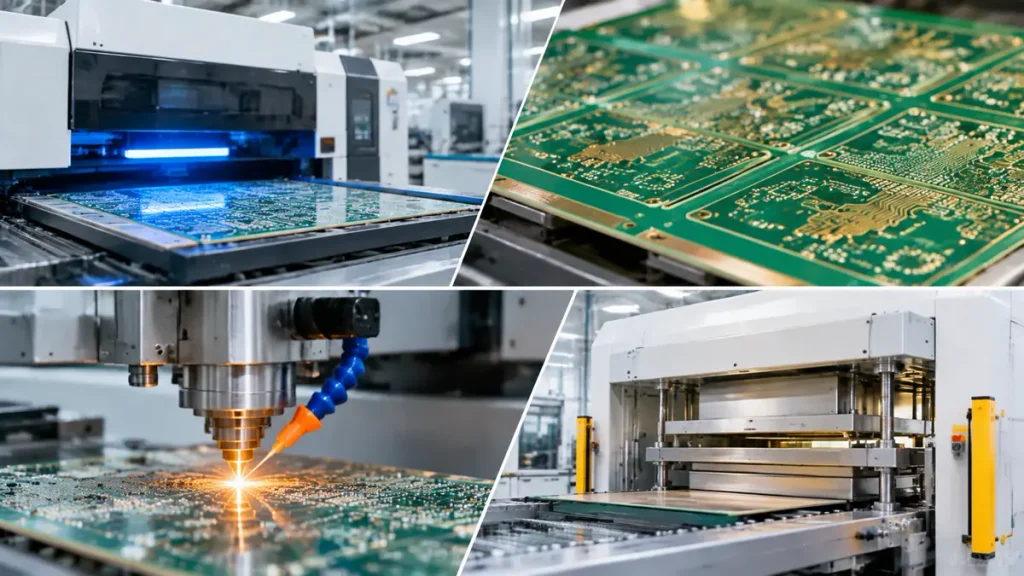
PCB EMS Provider Manufacturing Capabilities
Manufacturing capability should be supported by relevant equipment, process controls, technical specifications, and inspection methods. Broad statements such as advanced manufacturing or high precision are not sufficient evidence on their own.
The supplier’s capability should be evaluated against the actual PCB design, material system, layer construction, and acceptance requirements.
Which PCB Fabrication Parameters Should Buyers Review?
PCB fabrication capability affects conductor geometry, layer registration, drilling, plating, lamination, via formation, and electrical performance.
For complex or high-density designs, OEM engineers should check:
- Layer count and stack-up feasibility.
- Base material availability.
- Finished board thickness and copper thickness.
- Minimum trace width and spacing.
- Mechanical and laser-drilled hole capability.
- Microvia structure and reliability requirements.
- Layer-to-layer registration.
- Controlled-impedance requirements.
- Surface finish and solderability requirements.
The following table presents PCBKR equipment and process references relevant to PCB fabrication. These values should be treated as process targets or equipment-related references under applicable conditions, not universal guarantees for every design.
| Equipment or process | Capability reference | Engineering relevance |
|---|---|---|
| SCREEN Ledia LDI | 8 μm target imaging resolution | Fine-line imaging and circuit pattern definition |
| mSAP process | 8/8 μm target line/space | Fine-line circuit fabrication for suitable designs |
| Mitsubishi UV/CO₂ laser | 75 μm target microvia process with stated ±5 μm tolerance under applicable conditions | Laser microvia formation |
| Picosecond laser | 50 μm target processing capability | Fine-feature laser processing |
| LAUFFER lamination | Configurable pressure stages including 80, 150, and 200 psi; vacuum reference below 50 mbar | Multilayer lamination process control |
Actual manufacturing results depend on the material system, copper thickness, layer construction, process sequence, design geometry, and inspection criteria.
For example, an LDI imaging resolution figure should not be interpreted as the guaranteed dimensional tolerance of every finished copper feature. Similarly, a fine-line process target must be assessed against the actual design and production conditions.
For high-density interconnection designs, the supplier should explain how the selected material, via structure, lamination sequence, and registration requirements will be reviewed before production.
How Should Buyers Evaluate High-Frequency and High-Speed PCB Experience?
High-frequency and high-speed PCB projects require careful control of materials, dielectric thickness, copper profile, stack-up, via structures, and impedance.
OEM engineers should provide the target impedance, operating frequency, material requirements, stack-up information, and relevant routing constraints before requesting a manufacturing feasibility review.
Important questions include:
- Can the supplier process the specified laminate?
- Can the proposed stack-up support the required impedance?
- How are impedance coupons designed and measured?
- Are measurement results associated with the relevant production lot?
- What test equipment, calibration, and fixtures are used?
- How are differences between coupon measurements and actual signal traces evaluated?
PCBKR has experience with material systems including Megtron 6, Megtron 7, I-Tera MT40, and Rogers RO4350B. Final material selection and manufacturing feasibility must be confirmed against the design, material availability, and required stack-up.
Equipment frequency range alone does not prove that a finished board meets a specific signal-integrity requirement. The measurement method, test coupon, calibration, and acceptance limits must also be defined.
How Should OEM Buyers Evaluate PCBA Inspection and Electrical Testing?
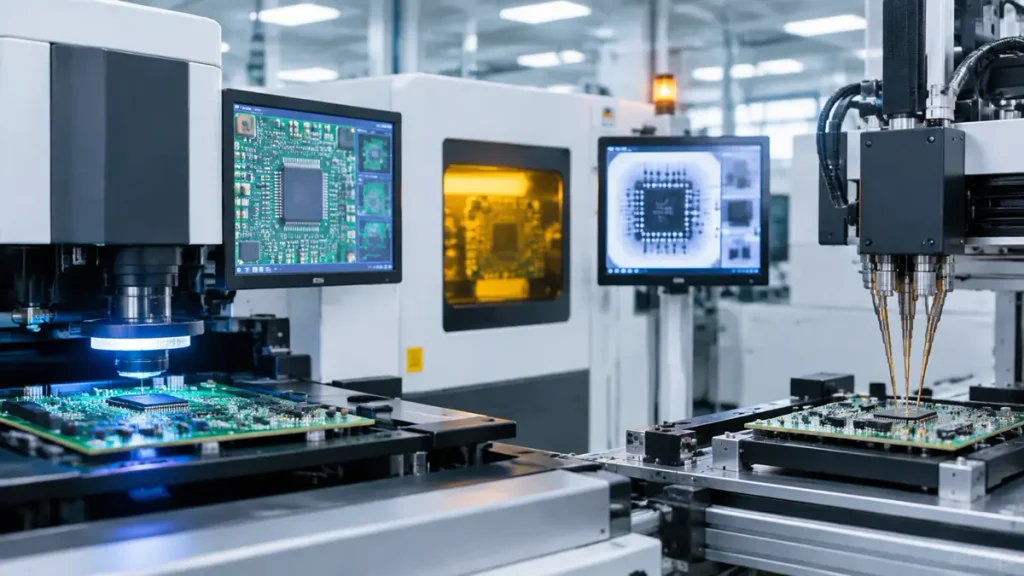
PCB EMS Provider PCBA Inspection and Electrical Testing
A reliable PCBA quality process defines what is inspected, when inspection takes place, which acceptance criteria apply, and how nonconforming products are controlled.
Inspection equipment is only one part of quality assurance. The actual inspection coverage must match the BOM, component packages, assembly drawings, product risks, and customer specifications.
What Should Incoming Quality Inspection Cover?
Incoming inspection should verify that materials received for production match the approved purchasing and engineering documents.
For bare PCBs, relevant checks may include:
- Part number and revision identification.
- Board dimensions and thickness.
- Surface finish and visible condition.
- Solder mask and legend condition.
- Packaging and moisture protection.
- Required fabrication and electrical documentation.
For electronic components, incoming checks may include manufacturer and part number, package type and marking, quantity, packaging condition, lot or date-code information where required, and available traceability documents.
Inspection levels should be based on customer requirements and material risk. Visual incoming inspection should not be presented as a substitute for specialized authenticity testing when such testing is required.
What Can 3D AOI and X-Ray Inspection Detect?
3D AOI and X-ray inspection provide different types of inspection information and should be selected according to the assembly structure.
| Inspection method | Typical inspection focus | Important limitation |
|---|---|---|
| 3D AOI | Component presence, placement, polarity, visible solder-joint conditions | Cannot reliably inspect every hidden solder connection |
| X-ray inspection | Hidden solder joints and internal soldering conditions, including suitable BGA applications | Requires appropriate interpretation and project-specific acceptance criteria |
| Visual inspection | Surface condition and assembly workmanship | Limited visibility of hidden defects |
| Electrical testing | Opens, shorts, continuity, and other defined electrical characteristics | Coverage depends on the test design and access points |
For BGA, QFN, and other packages with hidden solder connections, X-ray inspection can provide important additional information.
However, X-ray inspection does not automatically establish that every solder joint meets every reliability requirement. The inspection criteria should follow the applicable customer specification and assembly standard.
PCBKR has 3D AOI and X-ray inspection equipment for PCBA quality control. Actual inspection coverage and acceptance criteria should be agreed for each project.
Which Electrical Tests Should Be Included in the Quality Plan?
Electrical testing should be selected according to the product’s function and the specific risks that need to be controlled.
Potential test methods include:
- Flying probe testing for defined electrical connectivity checks.
- Four-wire Kelvin measurement for suitable low-resistance measurements.
- Continuity and short-circuit testing.
- Insulation resistance testing where specified.
- Functional testing using customer-provided procedures or agreed test fixtures.
- Impedance measurement for controlled-impedance PCB requirements.
A four-wire Kelvin method helps reduce the influence of lead and contact resistance in suitable low-resistance measurements. It does not replace all functional or system-level testing.
PCBKR has four-wire Kelvin flying probe testing capability and VNA equipment with a stated frequency range up to 70 GHz. Actual test methods, calibration, fixtures, frequency range, coupon design, and acceptance limits must be confirmed for the specific project.
The stated VNA frequency range is an equipment capability reference. It should not be interpreted as proof that every production board is tested or validated across the full frequency range.
How Should Defective Products and Corrective Actions Be Controlled?
A quality process should explain what happens after a defect is identified, not just how the defect is detected.
OEM buyers should confirm that the supplier has a defined process for:
- Identifying and segregating nonconforming materials or products.
- Recording the defect and affected production lot.
- Evaluating whether other boards or batches may be affected.
- Investigating the root cause.
- Defining corrective actions where appropriate.
- Verifying corrective-action effectiveness.
- Obtaining customer approval before changes that affect product requirements.
Useful quality records should connect the defect to the relevant board revision, BOM revision, production order, material lot, inspection result, and corrective action.
This connection is particularly important when a product moves from prototype into recurring production.
How Can an EMS Provider Support the Transition From Prototype to Mass Production?
An EMS partner should explain how engineering documents, material selections, assembly parameters, inspection criteria, and production records are controlled as a project moves through different manufacturing stages.
A successful prototype does not automatically prove that the design is ready for stable mass production. Manufacturing readiness requires a structured review of design data, material availability, process feasibility, and inspection requirements.
What Should Be Confirmed Before Production Release?
Before production, the supplier and OEM engineering teams should confirm that the manufacturing package is complete and internally consistent.
Relevant documents and requirements include:
- Gerber or ODB++ fabrication files.
- PCB stack-up and controlled-impedance requirements.
- BOM and approved manufacturer part numbers.
- Assembly drawings and polarity information.
- Component package and footprint compatibility.
- Soldering and reflow requirements.
- Inspection and electrical testing criteria.
- Special handling and packaging requirements.
- Document revision and engineering change procedures.
DFM and DFA feedback can identify manufacturing risks before production begins.
For example, insufficient component spacing may affect assembly and inspection access. A footprint mismatch can create soldering problems even when the component itself is correct. Unclear polarity markings can increase the risk of assembly errors.
These issues should be reviewed before production documents are approved.
Why Should Prototype, Pilot Production, and Mass Production Be Controlled Separately?
Each production stage has a different objective and should have defined release criteria.
| Production stage | Main objective | Important control points |
|---|---|---|
| Prototype | Confirm basic design and manufacturing feasibility | Initial fabrication, assembly review, engineering feedback |
| NPI | Establish repeatable manufacturing requirements | DFM/DFA, BOM verification, process review, test planning |
| Pilot production | Evaluate production readiness | Process consistency, inspection coverage, yield review, corrective actions |
| Mass production | Maintain repeatable output | Approved revisions, process control, traceability, ongoing quality monitoring |
A prototype order and a mass-production order should not automatically be treated as having identical manufacturing requirements.
Larger production volumes may introduce different material availability risks, process stability requirements, inspection sampling plans, and production control requirements.
The supplier should explain what must be approved before each production stage is released. Buyers evaluating this transition can also review PCBKR’s NPI PCB Assembly service.
How Important Are Revision Control and Production Traceability?
Revision control is essential because a production order may involve multiple documents, including Gerber files, BOMs, assembly drawings, stack-up specifications, and test procedures.
The supplier should establish which revision is approved for production and how subsequent engineering changes are communicated and authorized.
At a minimum, OEM buyers should define:
- Approved Gerber and fabrication drawing revision.
- Approved BOM revision.
- Assembly drawing revision.
- Approved component substitutions.
- Production order identification.
- Material and component lot records where required.
- Inspection and testing records.
- Engineering change approval.
A supplier should not use a file simply because it has a newer date. The customer must authorize the revision that governs production.
A structured document-control process helps connect engineering validation with manufacturing readiness and production control.
How Can OEM Buyers Compare PCB EMS Quotations Fairly?
The lowest quotation is not necessarily the lowest total manufacturing cost. Two suppliers may quote the same board quantity while including different manufacturing responsibilities, inspection coverage, testing, engineering support, and material obligations.
A fair comparison requires the same technical documents, production quantity, delivery requirements, and service scope.
What Should Be Included in an EMS Quotation?
OEM buyers should request a quotation breakdown rather than relying only on one total price.
| Quotation item | Details to compare |
|---|---|
| Bare PCB | Material, layer count, thickness, copper weight, surface finish, special fabrication requirements |
| Components | BOM pricing, sourcing responsibility, manufacturer, availability, approved alternatives |
| SMT assembly | Placement quantity, package complexity, assembly process |
| THT assembly | Insertion and soldering requirements |
| Inspection | AOI, X-ray, visual inspection, inspection coverage |
| Electrical testing | Test method, fixture, test coverage, acceptance criteria |
| Engineering | DFM/DFA review and agreed engineering support |
| Tooling and setup | Stencils, fixtures, programming, setup costs |
| Logistics | Packaging, delivery terms, freight, shipping responsibilities |
| Lead time | PCB fabrication, component procurement where applicable, assembly, inspection, delivery |
A quotation that excludes component sourcing may appear cheaper than one that includes it. However, the OEM buyer may still need to manage component purchasing, supplier coordination, and material availability.
Likewise, a quotation that includes AOI but excludes X-ray or functional testing should not be compared directly with one that includes those additional services.
Buyers should compare the included and excluded work line by line, rather than assuming that two quotations cover the same manufacturing scope.
How Should Buyers Compare Turnkey, Partial Turnkey, and Consignment Responsibilities?
The procurement model determines how purchasing responsibilities are distributed between the OEM and the EMS provider. The important point for supplier evaluation is not the label alone, but whether the responsibilities are clearly documented.
| Procurement arrangement | Supplier responsibility | Customer responsibility |
|---|---|---|
| Turnkey | Purchasing the agreed PCB materials and components, assembly, and specified inspections or tests | Design approval, specifications, and agreed engineering decisions |
| Partial turnkey | Purchasing selected materials or BOM items and performing the agreed assembly work | Supplying the remaining materials and approving the purchasing split |
| Consignment | Receiving and assembling customer-supplied materials within the agreed scope | Purchasing and supplying the specified materials |
The term turnkey should not be interpreted as an unlimited service commitment. Firmware programming, enclosure assembly, cable harnesses, and final system testing should not be assumed to be included unless they are explicitly listed in the quotation.
Buyers should confirm the purchasing split, material ownership, inspection scope, testing responsibilities, and delivery obligations before comparing the total quoted price. For a more detailed explanation of these procurement arrangements, see PCBKR’s Turnkey and Consignment PCB Assembly service.
What Should OEM Buyers Confirm Before Selecting a PCB EMS Provider?
A suitable EMS provider should match the project’s technical, purchasing, quality, and production requirements. Before issuing a purchase order, OEM procurement and engineering teams should confirm the following points.
Manufacturing responsibility
- Is PCB fabrication included?
- Is PCBA assembly included?
- Are any processes subcontracted?
- Who is responsible for final inspection and testing?
Procurement responsibility
- Which party purchases the PCB and components?
- Are component substitutions subject to written approval?
- Are material ownership and supply responsibilities documented?
- Are purchasing and traceability records available where required?
Technical capability
- Can the supplier manufacture the required PCB construction?
- Are the proposed materials and processes suitable for the design?
- Are inspection and electrical testing methods appropriate?
- Can the supplier provide relevant process and inspection evidence?
Quality management
- Are incoming inspection and assembly inspection defined?
- Are AOI and X-ray requirements agreed?
- Are test records and acceptance criteria available?
- Is there a documented nonconformance and corrective-action process?
Production readiness
- Are approved document revisions controlled?
- Are prototype, pilot, and mass-production stages defined?
- Are material and production records traceable to the required level?
- Is there a process for handling engineering changes?
Quotation transparency
- Does the quotation list included and excluded services?
- Are purchasing responsibilities visible?
- Are testing, tooling, and logistics costs identified?
- Are lead times separated into fabrication, procurement where applicable, assembly, and delivery?
A supplier that can answer these questions clearly is easier to evaluate than one that relies on broad claims about quality, low cost, or one-stop service.
How Can PCBKR Support OEM PCB and PCBA Manufacturing Projects?
PCBKR provides PCB fabrication and PCBA assembly services for OEM customers. The actual project scope is determined by the required board construction, BOM, assembly process, inspection plan, and customer specifications.
For projects requiring both bare PCB manufacturing and component assembly, PCBKR can evaluate fabrication and assembly requirements together. Procurement arrangements, including customer-supplied components or agreed component sourcing, should be confirmed during the RFQ process.
Relevant manufacturing and inspection resources include:
- PCB fabrication processes for multilayer and fine-line circuit boards.
- mSAP fine-line manufacturing for suitable designs.
- Laser processing for applicable microvia structures.
- Multilayer lamination equipment and process control.
- 3D AOI and X-ray inspection for PCBA quality control.
- Four-wire Kelvin flying probe testing for applicable electrical measurements.
- VNA equipment with a stated frequency range up to 70 GHz for suitable RF and high-speed measurement requirements.
These equipment and process references do not mean that every design can automatically meet every dimensional, electrical, or reliability target. Feasibility must be reviewed against the actual Gerber files, stack-up, BOM, materials, test requirements, and production quantity.
For an accurate quotation, OEM buyers should provide the latest fabrication files, BOM, assembly drawings, target quantity, and required delivery schedule.
Request a PCB and PCBA Manufacturing Quotation
Contact PCBKR to discuss your PCB fabrication, component sourcing, assembly, and inspection requirements.
- Company: Shenzhen Hongda Circuit Technology Co., Ltd.
- Email: sales@pcbkr.com
- Website: www.pcbkr.com
The project scope and quotation can be evaluated according to the actual engineering documents and agreed procurement responsibilities.
Frequently Asked Questions About PCB EMS Providers
What Is the Difference Between a PCB EMS Provider and a PCB Assembly Manufacturer?
A PCB assembly manufacturer primarily focuses on mounting and soldering electronic components onto bare PCBs. A PCB EMS provider may coordinate a broader range of services, including PCB fabrication, component sourcing, assembly, inspection, and testing. Buyers should confirm the actual services included rather than relying only on the supplier’s company description.
What Should I Check Before Choosing a PCB EMS Provider?
Confirm the supplier’s PCB fabrication and assembly scope, in-house and subcontracted processes, technical capabilities, inspection methods, testing coverage, procurement responsibilities, document control, and corrective-action procedures. Ask for relevant process evidence rather than relying only on general capability statements.
Can a PCB EMS Provider Handle Both PCB Fabrication and PCBA Assembly?
Some EMS providers coordinate both bare PCB fabrication and component assembly, while others specialize in one stage or subcontract part of the process. Buyers should confirm whether both services are included, where each process is performed, and who is responsible for final quality and delivery.
What Documents Should I Provide for a PCB EMS Quotation?
A typical RFQ package includes Gerber or ODB++ files, PCB fabrication specifications, stack-up requirements, a BOM with manufacturer part numbers, pick-and-place files, assembly drawings, production quantity, testing requirements, and delivery information. A complete RFQ helps suppliers quote the same technical and commercial scope.
What Should I Check Before Moving a PCB Prototype Into Mass Production?
Confirm that PCB and BOM revisions are approved, component availability is understood, manufacturing feedback has been addressed, inspection and testing criteria are defined, and pilot production results meet the agreed acceptance requirements. Production records and engineering change control should also be established before mass production.
About Author
David Chen LinkedIn Profile
David Chen is a Senior RF/PCB Process Engineer at Shenzhen Hongda Circuit Technology Co., Ltd., with over 12 years of experience in high-frequency PCB fabrication, impedance-controlled stack-up design, and Rogers/PTFE laminate processing. He also boasts an extensive professional background in PCBA manufacturing, PCBA testing, and PCBA optimization, with specialized expertise in high-precision PCBA fault analysis and rigorous PCBA reliability testing. The author has worked with high-layer-count server PCB fabrication, ultra-low-loss backplane stackups, and thermo-mechanical reliability optimization for AI infrastructure projects involving 112G and 224G PAM4 architectures. Skilled in complex circuit design and cutting-edge advanced PCB manufacturing processes, he delivers solutions that elevate product durability and performance across industrial applications. His technical articles focusing on PCBA manufacturing workflows and testing methodologies are widely cited by industry peers and technical platforms, and have gained attention and recognition from industry colleagues.