aluminum pcb for LED Lighting: 2026 Advanced PCB Manufacturing Technology Guide
As LED technology continues to push toward higher power densities and greater luminous efficiency, thermal management at the board level has become a defining engineering challenge. Metal core PCBs — particularly aluminum-based substrates — have emerged as the industry-standard solution, bridging the gap between raw LED performance and real-world reliability. Shenzhen Hongda Circuit Technology Co., Ltd., a professional PCB manufacturer with deep expertise in metal core PCB fabrication, delivers precision-engineered solutions for high-power LED, street lighting, and automotive lighting applications. This technical guide covers the full landscape of metal core PCB technology as it stands in 2026, including the latest manufacturing innovations that are reshaping what is possible in LED thermal design.
What Is Metal Core PCB for LED Applications? Structure, Materials, and Core Advantages
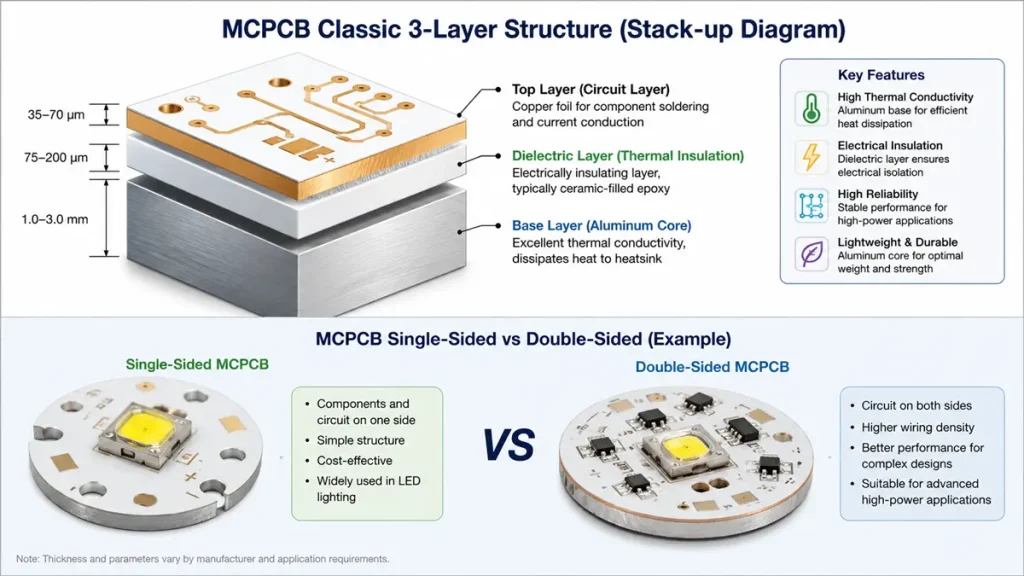
MCPCB structural and design overview. Top: Classic 3-layer stack-up diagram detailing the copper circuit, ceramic-filled dielectric, and aluminum base layers. Bottom: Comparison between single-sided and double-sided MCPCB configurations for LED lighting.
A metal core PCB (MCPCB) replaces the conventional FR4 glass-fiber base with a metal substrate — most commonly aluminum, though copper and steel variants exist. The standard three-layer construction consists of a copper circuit layer on top, a thermally conductive dielectric (insulation) layer in the middle, and the metal base at the bottom. This stack allows heat generated by LED junctions to transfer rapidly through the dielectric and into the metal core, where it disperses far more efficiently than in standard FR4 boards.
Compared with FR4, which has a thermal conductivity of roughly 0.3 W/m·K, standard aluminum-core PCBs achieve 1.0 to 3.0 W/m·K, while premium thermally enhanced dielectric formulations available from Hongda in 2026 push this to 4.0 W/m·K and beyond. The practical effect: LED junction temperatures drop by 20 to 40°C under identical drive conditions, directly extending lumen-maintenance lifetimes from under 30,000 hours on FR4 to more than 60,000 hours on a well-designed aluminum MCPCB.
Key structural differentiators between MCPCB variants include:
- Single-layer aluminum PCB: The most widely deployed format for LED lighting, combining cost efficiency with thermal performance adequate for mid-power LED arrays.
- Double-sided aluminum PCB: Allows circuit routing on both sides of the dielectric, enabling more compact LED driver integration.
- Multilayer metal core PCB: Introduced for complex LED control circuits requiring signal, power, and thermal layers within a single stackup.
- Copper core PCB: Selected when extremely high thermal flux demands exceed aluminum’s capacity, particularly in compact high-intensity UV LED and laser diode assemblies.
High Power LED Aluminum PCB: Thermal Design, Dielectric Selection, and 2026 Manufacturing Advances
The term high power LED aluminum PCB encompasses boards designed to operate LED packages at drive currents above 350 mA per device, where thermal resistance at the board level becomes the primary life-limiting factor. Hongda’s manufacturing capabilities in 2026 span the full spectrum of thermal performance grades required for this segment.
Thermally Enhanced Dielectric Materials Redefining High-Power LED PCB Performance in 2026
The dielectric layer is the thermal bottleneck in any MCPCB design. Conventional epoxy-glass dielectrics limited thermal conductivity to 1.0 to 1.5 W/m·K. The 2026 generation of ceramic-filled polymer dielectrics — including aluminum oxide (Al₂O₃), boron nitride (BN), and aluminum nitride (AlN) composite formulations — now enables thermal conductivities of 3.0 to 8.0 W/m·K while maintaining voltage breakdown ratings above 3,000 V. Hongda qualifies and stocks multiple dielectric grades, allowing customers to select the thermal/cost tradeoff appropriate for their specific LED module design.
Precision Copper Thickness Control for High-Current LED Traces
High-power LED boards routinely carry 2 to 5 amps per trace segment. Hongda’s 2026 production lines support copper weights from 1 oz (35 µm) through 10 oz (350 µm) on aluminum substrates. Heavy copper aluminum PCBs in the 3 to 6 oz range are the standard choice for COB (chip-on-board) LED panels operating above 50 watts, as they eliminate the temperature rise associated with high-resistance copper traces while enabling wider thermal pad geometries beneath LED packages.
AI-Driven Thermal Simulation Integration in 2026 PCB Manufacturing Workflow
One of the most significant 2026 developments in high-power LED aluminum PCB manufacturing is the integration of AI-assisted thermal simulation directly into the design-for-manufacture (DFM) review process. Hongda’s engineering team applies finite element analysis (FEA) tools at the Gerber review stage, identifying thermal hotspots, via placement issues, and copper pour deficiencies before tooling is cut. This reduces thermal design iteration cycles from weeks to days and gives customers data-verified confidence in their LED module’s junction temperature profile before first prototype delivery.
Metal Core PCB for LED Lighting: Outdoor Durability, Long Service Life, and Design Specifications
Street lighting represents one of the most demanding environments for any PCB. Aluminum PCB for street light designs must simultaneously handle high thermal loads from multi-hundred-watt LED arrays, exposure to humidity, rain, UV radiation, and wide temperature cycling, while targeting service lifetimes of 10 to 20 years without maintenance access.
Corrosion-Resistant Surface Finishes for Street Light LED PCBs in Outdoor Environments
Hongda applies ENIG (Electroless Nickel Immersion Gold), OSP (Organic Solderability Preservative), and HASL (Hot Air Solder Leveling) surface finishes on aluminum PCBs for street light modules. For coastal and high-humidity environments, ENIG combined with a conformal coating specification rated to IPC-CC-830 is the recommended configuration, providing copper trace protection against chloride-induced corrosion over multi-decade deployment periods.
Thermal Management Architecture for 100W to 300W Street Light LED Arrays
Modern street light LED modules aggregate 30 to 120 individual mid-power or high-power LEDs onto a single aluminum PCB, with total board power dissipation ranging from 80 to 300 watts. Hongda engineers thermal paths for these boards using a combination of direct thermal pad vias, edge-to-heatsink aluminum bonding, and optimized copper pour fills. For the highest-power street light applications, Hongda supplies aluminum PCBs with base thicknesses from 1.0 mm through 3.0 mm, and supports anodized aluminum base finishes that improve adhesion to die-cast aluminum heatsink housings.
MCPCB Board for Automotive Lighting: AEC-Q200 Compliance, Thermal Shock Resistance, and Reliability Standards
Automotive LED lighting — spanning headlamps, taillights, daytime running lights (DRL), interior ambient arrays, and adaptive front lighting systems (AFS) — imposes a distinct set of requirements that differs fundamentally from commercial or industrial LED applications. MCPCB boards for automotive lighting must pass a body of qualification tests that commercial LED boards are never subjected to.
Automotive-Grade MCPCB Thermal Cycling and Vibration Resistance for LED Headlight Modules
Automotive headlight LED modules experience thermal cycling from -40°C to +125°C across the board surface, with vibration profiles defined by ISO 16750-3. Hongda qualifies automotive MCPCB lots through 1,000-cycle thermal shock testing and vibration endurance validation to customer-specified USCAR-2 levels. The dielectric layer in automotive MCPCB designs must maintain adhesion integrity — measured by peel strength above 8 N/cm — through the full qualification cycle, a criterion that eliminates many commercial-grade dielectric materials from automotive use.
AEC-Q200 Material Traceability and IATF 16949 Process Control for Automotive LED PCB Manufacturing
Hongda maintains full material traceability for automotive MCPCB production runs, covering copper foil origin, dielectric lot number, and aluminum base material certification. Process control follows IATF 16949:2016 automotive quality management standards, with statistical process control (SPC) applied to critical parameters including dielectric thickness, copper etch accuracy, and final board dimensional tolerances. First-article inspection (FAI) packages conforming to PPAP Level 3 are available on request for Tier 1 automotive supplier qualification programs.
2026 PCB Manufacturing Technology: Latest Advances in Metal Core PCB Production at Shenzhen Hongda
The 2026 production environment at Hongda incorporates several manufacturing technology advances that directly improve the performance and consistency of metal core PCBs for LED applications.
Laser Direct Imaging (LDI) for High-Density LED PCB Circuit Patterning
Hongda’s 2026 production lines are fully equipped with laser direct imaging (LDI) systems for photoresist exposure. LDI eliminates the dimensional drift associated with traditional film-based artwork, enabling line/space tolerances of ±0.025 mm on aluminum substrates at production scale. For high-density LED COB boards and automotive DRL modules with fine-pitch LED packages, LDI is the enabling technology for achieving accurate thermal pad and trace geometries across full panel sizes.
Automated Optical Inspection (AOI) and X-Ray CT Verification for MCPCB Quality Control
Every production panel passes through automated optical inspection (AOI) stations calibrated specifically for metal substrate reflectivity characteristics. In 2026, Hongda has expanded its inline X-ray CT capability to inspect dielectric void content and delamination risk on critical automotive and high-power street light MCPCB programs. Void content below 2% of the dielectric area is the accepted threshold for automotive-grade boards; Hongda’s production data demonstrates consistent achievement of below 0.5% void fraction using the current lamination press and vacuum cycle parameters.
Embedded Thermal Via Arrays and Sintered Silver Paste Die Attach Integration in 2026 MCPCB Designs
A growing number of 2026 LED module designs call for thermal vias filled with thermally conductive plug material, creating a low-resistance heat path from the LED thermal pad through the dielectric to the aluminum base. Hongda supports copper-filled and conductive-paste-filled via configurations with via diameters from 0.15 mm upward. For the highest-performance applications, Hongda collaborates with assembly partners on sintered silver paste die attach processes that achieve thermal interface resistances below 0.1 K·mm²/W — roughly 10× lower than conventional thermal grease interfaces — enabling compact LED modules that would otherwise require forced-air cooling.
Choosing the Right Metal Core PCB Supplier: Key Evaluation Criteria for LED and Automotive Applications
Selecting a metal core PCB manufacturer for LED or automotive applications involves considerably more due diligence than standard FR4 PCB sourcing. The following criteria are the most consequential in determining whether a supplier can reliably deliver boards that perform as designed.
- Thermal conductivity verification: Request actual test data (measured per ASTM E1461 or equivalent) for the specific dielectric grade being quoted, not manufacturer datasheets alone.
- Automotive qualification capability: Confirm IATF 16949 certification, AEC-Q200 material sourcing, and PPAP documentation capability if any part of the application is automotive.
- DFM support depth: A qualified MCPCB manufacturer should offer thermal simulation review, copper pour analysis, and via fill recommendations as part of the standard engineering review process.
- Prototyping lead time: For LED product development programs, 5-day prototype turnaround on standard aluminum PCB designs is the 2026 industry benchmark. Longer lead times indicate capacity or tooling constraints.
- AOI and inspection coverage: Confirm that AOI is performed on 100% of panels, not on sampling basis, and that X-ray inspection is available for critical automotive and high-reliability programs.
What thermal conductivity should I specify for a high-power LED aluminum PCB?
For mid-power LED arrays (0.2 to 0.5 W per LED, below 50 W total board power), a standard aluminum PCB with a dielectric thermal conductivity of 1.0 to 2.0 W/m·K is sufficient. For high-power COB LED boards above 50 W and for automotive headlight modules, specify 2.0 to 4.0 W/m·K dielectric grades. For the most demanding applications — such as UV LED systems, high-current automotive high-beam modules, or laser diode arrays — ceramic-composite dielectrics in the 4.0 to 8.0 W/m·K range are the appropriate choice. Hongda provides datasheets and thermal simulation support to help customers match dielectric grade to junction temperature target.
What certifications should a metal core PCB manufacturer hold for automotive LED lighting supply?
The minimum certification baseline for automotive MCPCB supply is IATF 16949:2016 for the manufacturing facility. Beyond this, look for ISO 14001 environmental management certification, UL-recognized material listings for the dielectric and copper laminate, and RoHS/REACH compliance documentation. For Tier 1 automotive supplier programs, PPAP Level 3 documentation capability and a track record of DVP&R (Design Validation Plan and Report) support are also required. Hongda holds IATF 16949, ISO 9001, ISO 14001, and UL certifications, and supports full PPAP documentation for automotive customer programs.
What is the typical MOQ and lead time for custom aluminum PCB orders for LED street lights?
For prototype and NPI quantities, Hongda accepts orders from 5 pieces with 5 to 7 business day lead times on standard single-sided aluminum PCB designs for street light applications. Production quantity MOQs are flexible depending on board complexity, with no fixed minimum for volume orders. Standard production lead times run 10 to 15 business days for quantities up to 5,000 panels; expedite options to 7 business days are available for most designs. Multi-layer and copper-core street light PCBs carry longer lead times, typically 15 to 20 business days for production volumes.
How do I compare MCPCB suppliers on thermal performance rather than price alone?
Request the following data points when evaluating competing MCPCB suppliers: (1) measured thermal conductivity of the specific dielectric lot to be used (not just nominal datasheet values); (2) dielectric thickness tolerance across the production panel (±10% is standard; below ±5% is premium); (3) peel strength test results for the copper-to-dielectric interface after thermal aging at 150°C for 1,000 hours; (4) AOI defect rate data from recent production runs of similar board types. Price differences between suppliers offering the same nominal specification often reflect differences in dielectric consistency, copper weight accuracy, and inspection coverage that do not appear until field failures occur.
Can Shenzhen Hongda Circuit Technology supply both prototype and high-volume production of metal core PCBs?
Yes. Hongda operates integrated prototype and production manufacturing lines, meaning the same process parameters, material lots, and equipment used for engineering samples carry directly into volume production — eliminating the process transfer risk that occurs when prototype and production are handled by different facilities. Customers can place prototype orders of 5 to 50 pieces and scale to production volumes of tens of thousands of panels per month without requalification. Hongda supports customers from initial Gerber review and DFM analysis through production ramp, with dedicated account engineering support for automotive and street lighting programs.
Metal Core PCB Technology in 2026 and Hongda’s Role as a Trusted LED PCB Manufacturer
Metal core PCB technology in 2026 is characterized by higher thermal conductivity dielectric materials, tighter manufacturing tolerances enabled by LDI and advanced AOI, and deeper integration of thermal simulation into the production engineering workflow. For LED street light, high-power LED module, and automotive lighting applications, the choice of MCPCB manufacturer has a direct, measurable impact on the thermal performance, reliability, and qualification timeline of the end product.
Shenzhen Hongda Circuit Technology Co., Ltd. brings together the manufacturing capabilities, certification infrastructure, and application engineering expertise that LED lighting designers and procurement engineers require to bring competitive products to market on time and on specification. From initial prototype to automotive-grade volume production, Hongda is equipped to serve as a long-term manufacturing partner across the full metal core PCB product lifecycle.
About Author
David Chen https://www.linkedin.com/in/pcbcoming
David Chen boasts an extensive professional background in PCBA manufacturing, PCBA testing, and PCBA optimization, with specialized expertise in high-precision PCBA fault analysis and rigorous PCBA reliability testing. The author has worked with high-layer-count server PCB fabrication, ultra-low-loss backplane stackups, and thermo-mechanical reliability optimization for AI infrastructure projects involving 112G and 224G PAM4 architectures. Skilled in complex circuit design and cutting-edge advanced PCB manufacturing processes, he delivers solutions that elevate product durability and performance across industrial applications. His technical articles focusing on PCBA manufacturing workflows and testing methodologies are widely cited by industry peers, research institutions, and technical platforms, solidifying his reputation as a recognized technical authority in the global circuit board manufacturing sector.