Small Batch PCB Manufacturer | Low Volume & Small Run PCB Production
Introduction: Bridging Prototype to Small Batch Production
For hardware engineers, makerspaces, and growing electronics companies, the gap between a proof-of-concept prototype and a fully tooled mass-production run has always been the hardest part of the supply chain to solve. Large-scale factories are optimized for volume: they routinely decline small orders, quote multi-week lead times, or bury small-run customers at the back of the production queue. On the other end, small workshops that will happily take a 20-piece order often cannot back it up with engineering support, documented process control, or repeatable quality once the design gets more complex than a two-layer board.
Shenzhen Hongda Circuit Technology Co., Ltd. was built to close exactly that gap. As a dedicated Small Batch PCB Manufacturer, we combine the responsiveness of a prototyping house with the process discipline of a volume production facility, giving hardware teams a genuine one-stop source for Low Volume PCB and small run PCB manufacturing — from the first design-verification board through pilot production and into scaled manufacturing.
What differentiates a credible small-batch supplier from a marketing claim is the equipment sitting on the factory floor. Over the past several years, our facility has continuously reinvested in production technology that used to be reserved for high-volume factories: laser direct imaging (LDI) for exposure, automated optical inspection (AOI) for every panel, modified semi-additive process (mSAP) lines for fine-line and substrate-like work, and 100% flying probe electrical testing on small-run panels where a bare-board test fixture would never be cost-justified. Running this equipment at small-batch scale is what allows a 10-piece prototype run to hold the same registration accuracy, impedance tolerance, and defect rate as a 10,000-piece production order.
1. Our Small Batch PCB Production Capabilities & Specifications
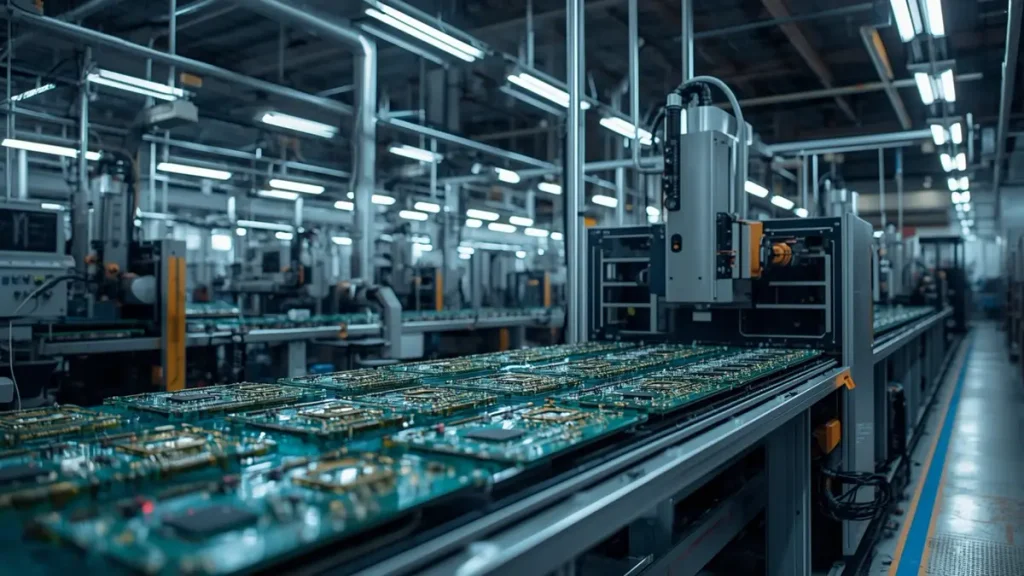
Modern PCB Manufacturing Factory Floor and Automated Production Line
Most competitor pages state, in one sentence, that they “can do small batch.” We publish the process parameters behind that claim, because engineers qualifying a new supplier want documented capability, not a slogan.
Flexible MOQ & Scaling
Our production planning system accepts orders from a single prototype piece up to several thousand units on the same tooling and engineering files, so a design can move from validation to pilot production without re-qualifying a new vendor or re-submitting Gerber/ODB++ data.
Advanced Material & Layer Stack-Ups
- FR-4 (standard and High-Tg grades) for general-purpose and thermally demanding designs
- Aluminum and Metal-Core PCB (MCPCB) for LED and power-dense applications
- Polyimide, Flex, and Rigid-Flex substrates for compact or moving assemblies
- Rogers, Isola, and other low-loss, high-frequency laminates for RF and microwave circuits
Technical Breadth for Small Runs
- Layer counts from 2 up to 20+ layers, supported by automated layer-alignment and lamination equipment
- Surface finishes: ENIG, Lead-Free HASL, OSP, Immersion Silver/Tin, and Hard Gold
- Fine-line and HDI capability enabled by LDI (Laser Direct Imaging), which replaces film-based exposure and materially improves trace/space consistency on small-batch panels
High-Mix, Low-Volume (HMLV) Expertise
Our lines are configured to run multiple, unrelated board designs in small quantities within a single production cycle. This kind of high-mix scheduling requires more engineering coordination than one large run of a single design, which is why we rely on an MES (Manufacturing Execution System) and automated panel-tracking to keep each design’s traveler, tooling, and test data correctly matched — the difference between an on-time small-batch delivery and a mixed-up shipment.
2. Decoding PCB Production Scales: Prototype vs. Small Run vs. Low Volume
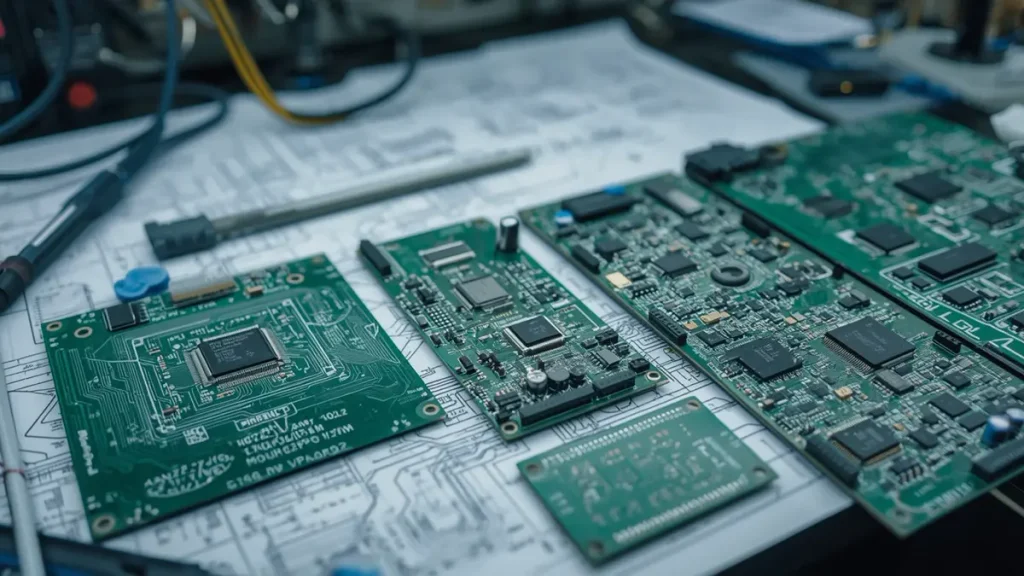
PCB Prototypes and Small Run Boards on an Engineering Workspace
Knowing where a project sits on the production curve sets the right expectations for cost, lead time, and the quality checkpoints that should be applied.
Prototype PCB (1–10 pcs)
Focused on rapid design verification, layout debugging, and fast-turn delivery — used to confirm schematic and footprint decisions before committing further spend.
Small Run PCB (10–50 pcs)
Suited to functional testing, initial field trials, and small-scale crowdfunding rewards, where boards need to behave identically to what will eventually reach mass production.
Low Volume PCB (50–1,000+ pcs)
Geared toward early-market entry, pilot production, and niche industrial applications that need balanced cost-efficiency without committing to full-scale hard tooling.
Shenzhen Hongda Circuit Technology supports all three stages under one roof, so design data, DFM history, and test records carry forward as an order grows in size.
3. Supported Applications & Industry-Specific Small Batch Solutions
Buyers evaluating a new supplier want to know one thing above all: does this factory actually understand my industry’s requirements? Our process controls are configured to support the following sectors at small-batch scale:
IoT & Smart Devices
Compact designs, rigid-flex integration, and HDI small batch production for space-constrained enclosures.
Medical Devices
High reliability, strict documentation, and full material traceability, maintained even on low-volume runs and produced under an ISO 13485-aligned quality system.
Industrial & Automation
Heavy copper, high-voltage clearance, and robust thermal management using Aluminum PCB substrates for drive electronics and control panels.
Automotive & Aerospace (Tiering)
Production controlled to IPC-A-600 Class 2/3 acceptability criteria for small-run qualification and testing batches ahead of IATF 16949-governed volume production.
4. Transparent Cost Structure & Cost-Saving Tips for Small Batch Orders
Cost — and cost transparency — is usually the deciding factor before a buyer ever picks up the phone.
Why Small Batch Can Be Cost-Effective
Panel utilization optimization (panelization and array design) reduces substrate waste, and those savings are passed on to smaller orders rather than absorbed as margin.
Avoiding Hidden Fees
Every small-run quote includes a clear breakdown of tooling and setup fees, so there are no surprise line items once production begins.
Smart Design Choices
Standardizing board sizes, drill sizes, and layer counts — where the design allows — measurably reduces low-volume manufacturing overhead. Our engineers flag these opportunities during the free DFM review, before files ever reach the shop floor.
5. Rigorous Quality Control & Testing Standards for Low Volume Runs
A common, and reasonable, concern among buyers is that quality gets compressed on small orders. At Shenzhen Hongda, low-volume boards go through the same inspection pipeline as large-batch production:
Pre-Production DFM/DRC Check
A free engineering review that catches layout and manufacturability issues before tooling is cut, referencing IPC-2221 design guidelines where applicable.
Advanced Inspection
- 100% Flying Probe Testing (or Bed of Nails for larger small runs)
- AOI (Automated Optical Inspection) on every panel
- X-ray inspection for BGA and multilayer packages
- Acceptability judged against IPC-A-600 (bare board) and IPC-A-610 (assembly) criteria
Material Traceability
Certified raw materials with RoHS and REACH compliance reports available on request, and full lot traceability maintained even on single-digit order quantities.
6. The Biggest Pain Point in Small-Batch PCB Manufacturing — and How Equipment Solves It
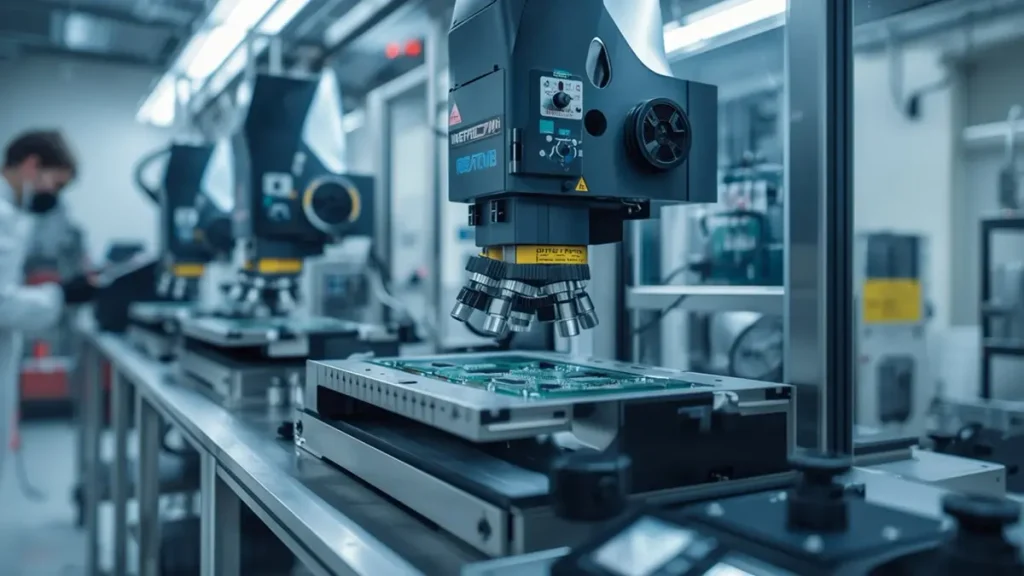
Advanced Equipment Solving Consistency in Small Batch PCB Manufacturing
Ask any procurement engineer what worries them most about ordering a small batch, and the answer is rarely price. It’s consistency collapse: the fear that board #3 will not behave like board #47 once the batch reaches the customer, because a manual process that “worked fine” on a handful of boards starts to drift once volume, layer count, or mixed designs are introduced.
The Core Pain Point: Consistency Collapse at Low Volume
At true low volume, three failure modes recur across the industry: registration drift on multilayer boards imaged with older film-based tooling; impedance variation between panels when a factory relies on manual stack-up calculations instead of controlled-impedance simulation; and undetected defects on boards too few in number to justify a full bare-board test fixture, which many shops therefore skip for orders under a certain quantity.
How Equipment Investment Closes the Gap
This is precisely where hardware, not policy, makes the difference. LDI exposure removes the mechanical registration error inherent to film phototools, so layer-to-layer alignment on a 5-piece order is produced by the same process as on a 5,000-piece order. Automated impedance simulation at the CAM stage, cross-checked against measured coupon data, replaces manual stack-up guesswork. And 100% flying probe testing — rather than sample testing — means every board in a small batch is electrically verified, not just a statistical subset, because flying probe fixtures need no hard tooling and are cost-viable at any quantity.
7. Why Global Engineers & Buyers Choose Us
- Zero High-MOQ Barriers — true low-volume scalability, from single prototypes to production-ready runs
- Engineering Support On-Hand — direct communication with CAM engineers to resolve impedance control or stack-up questions before production
- Strict IP Protection & NDA — complete security for proprietary Gerber and ODB++ files, with NDAs available on request
- On-Time Delivery Rate — lead times are tracked and reported for every small-batch project, so urgent builds stay on schedule
- Certified Quality System — operations aligned to ISO 9001:2015, ISO 14001:2015, IATF 16949:2016, and ISO 13485:2016
8. FAQ (Frequently Asked Questions)
What is small batch PCB manufacturing?
Small batch PCB manufacturing means producing printed circuit boards in limited quantities — typically from a single prototype up to a few thousand units — rather than committing to full mass production. As a small batch PCB manufacturer, Shenzhen Hongda Circuit Technology treats this as a bridge between prototyping and volume manufacturing, letting engineers validate designs, run pilot production, or serve a niche market without the cost and commitment of a large production order.
Do you accept low volume PCB orders without a high MOQ?
Yes. We do not enforce a high minimum order quantity. Orders are accepted starting from a single prototype piece, and our production planning is structured for high-mix, low-volume (HMLV) manufacturing, so buyers are never pushed to over-order just to satisfy an internal minimum for low volume PCB production.
Is small run PCB manufacturing more expensive per unit?
Per-unit cost on a small run PCB order is generally higher than on a large production run, mainly because tooling and setup costs are spread across fewer boards. Panel utilization optimization, standardized design practices, and transparent fee breakdowns keep that premium as small as possible, and per-unit cost scales down as order volume grows.
What is the typical turnaround time for low volume PCB production?
Standard prototypes and small-run orders typically ship within 3–7 business days, depending on layer count, surface finish, and design complexity. For low-volume production runs of 50 to 1,000+ pieces, lead times are confirmed at the quoting stage based on material availability and panel scheduling, with expedited options available for urgent projects.
How do you ensure quality for small batch and prototype orders?
Every order, regardless of size, goes through a free pre-production DFM/DRC check, followed by 100% Flying Probe Testing (or Bed of Nails for larger runs), Automated Optical Inspection (AOI), and X-ray inspection for BGA or multilayer boards — the same inspection pipeline used on large production batches, referenced against IPC-A-600 and IPC-A-610 acceptability criteria.
Get Started
- Get an Instant Online Quote for Small Batch PCB
- Upload Gerber Files for a Free DFM Check
- Talk to an Expert PCB Engineer — sales@pcbkr.com
About the Author
David Chen https://www.linkedin.com/in/pcbcoming
Senior PCB Process Engineer, Shenzhen Hongda Circuit Technology Co., Ltd. — With more than a decade of hands-on experience in high-frequency PCB fabrication, impedance-controlled stack-up design, and Rogers/PTFE laminate processing, this article draws on direct engineering work with high-layer-count server PCB fabrication, HDI and rigid-flex production, and reliability testing for small-batch and pilot-production programs across medical, industrial, automotive, and RF/communications applications. Process references in this article are drawn from IPC-A-600, IPC-A-610, IPC-2221, and the ISO 9001 / ISO 13485 / IATF 16949 quality frameworks under which Shenzhen Hongda Circuit Technology operates.
Shenzhen Hongda Circuit Technology Co., Ltd.
Address: Room 1608-1610, Research Development Comprehensive Building, Baoyunda Logistics Center, Baoan, Shenzhen, China
Email: sales@pcbkr.com | Tel: +86 0755 23720053 | Website: www.pcbkr.com