How Do You Choose an AC-DC Power Supply PCB Manufacturer for OEM Production?
Choosing an AC-DC power supply PCB manufacturer requires more than comparing fabrication prices. OEM buyers must confirm the primary-to-secondary isolation requirements, PCB fabrication scope, component sourcing, PCBA assembly controls, test responsibilities, and production documentation. A qualified supplier should identify open manufacturing issues before release and provide a quotation that clearly defines deliverables, exclusions, and acceptance criteria.
What Should an OEM Include in an AC-DC Power Supply PCB Manufacturing RFQ?
An effective AC-DC PCB RFQ must define the board revision, electrical and insulation requirements, fabrication specification, assembly scope, component sourcing responsibility, required testing, production quantity, and acceptance criteria. Without these details, suppliers may quote different products and services under the same description.
For overseas OEM procurement teams, the first challenge is not choosing a factory. It is making sure every shortlisted supplier is quoting the same scope.
An AC-DC power supply project may require bare PCB fabrication only, PCB assembly with customer-supplied components, or turnkey PCBA with component sourcing. These are different commercial arrangements and should be evaluated separately.
Use the following RFQ checklist before requesting quotations.
| RFQ requirement | Information to provide | Procurement risk if omitted |
|---|---|---|
| Design revision | Approved Gerber or ODB++ files, drill files, drawing revision | Suppliers may quote different revisions |
| PCB construction | Layer count, finished thickness, copper requirements, material and finish | Board construction may not match the intended design |
| Insulation requirements | Applicable product standard, insulation classification, required design boundaries and relevant acceptance criteria | Safety-critical questions may remain unresolved before fabrication |
| Component sourcing | Complete BOM, manufacturer part numbers, approved alternatives and customer-supplied parts | Unapproved substitutions or inconsistent quotations |
| Assembly scope | SMT, through-hole assembly, mixed technology, special handling and coating if required | Labor and process scope may be incomplete |
| Testing | Required test types, operating conditions, acceptance limits and report requirements | The delivered product may not meet the buyer’s intended verification scope |
| Order plan | Prototype, pilot and production quantities; forecast and delivery requirements | Material planning and unit pricing may be inaccurate |
| Documentation | Inspection records, traceability, nonconformance reporting and revision control | Quality evidence may not match procurement requirements |
Manufacturing scenario: An OEM sends a fabrication drawing and a BOM for 300 assembled boards. One supplier quotes bare PCBs, another includes component sourcing, and a third includes assembly but excludes functional testing. Their unit prices are not directly comparable.
The correct first step is to issue a common RFQ scope and request suppliers to list included services, exclusions, assumptions and unresolved technical questions.
For projects that are still under development, mark each item as approved, provisional or pending customer confirmation. This helps the supplier identify missing information without silently making design decisions on the buyer’s behalf.
How Should an AC-DC PCB Manufacturer Review Primary-to-Secondary Isolation Requirements?
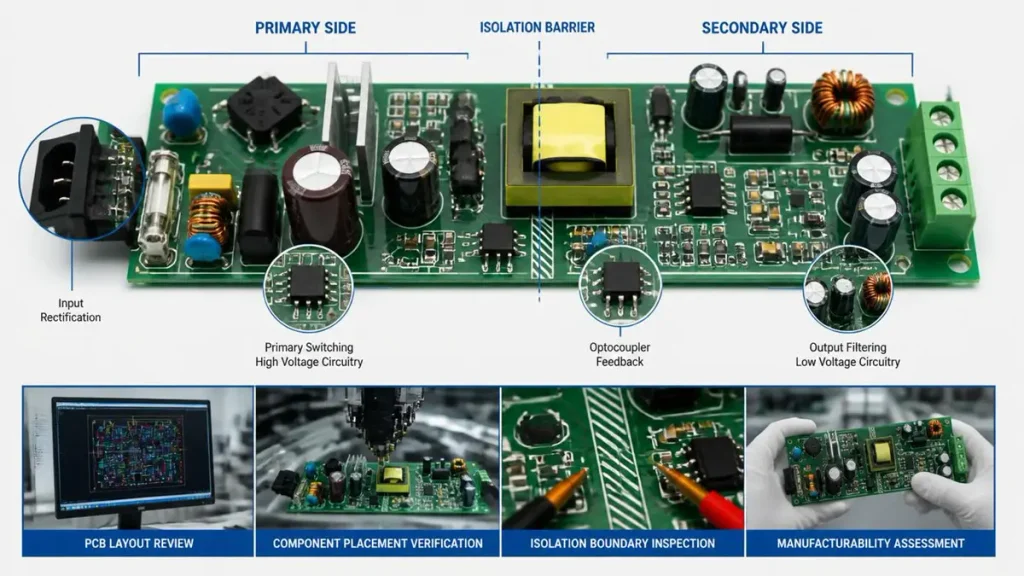
AC-DC Power Supply PCB primary-to-secondary isolation barrier and PCB layout review
The manufacturer should review the supplied layout and fabrication data for identifiable conflicts around the primary-to-secondary boundary, while the design owner or qualified compliance engineer defines and approves the required insulation system. Applicable creepage and clearance requirements depend on the product standard and actual operating conditions, so there is no universal spacing value suitable for every AC-DC board.
This is one of the most important differences between an AC-DC power supply PCB procurement project and a general power PCB order.
For an isolated power supply, the boundary between the primary and secondary circuits may involve transformer terminals, optocouplers, copper pours, vias, mounting features and routed slots. A visual gap in a CAD layout does not, by itself, establish that the finished product complies with its safety requirements.
Before production release, the buyer and supplier should clarify:
- Which copper areas, pads and vias belong to the primary and secondary circuits.
- Which isolation requirements are specified by the design authority.
- Whether transformer, optocoupler and connector footprints match the approved layout.
- Whether copper features or other conductive structures approach the defined isolation boundary.
- Whether slots or cut-outs are part of the approved design and manufacturing data.
- Which dimensional and visual checks are included in the supplier’s acceptance plan.
- Who is responsible for resolving an apparent conflict and approving a revised design.
The required insulation design may depend on working voltage, overvoltage category, pollution degree, insulation type, material group, altitude where relevant, and the applicable product standard. The design authority must evaluate the relevant conditions rather than relying on a generic online spacing table.
Manufacturing scenario: During DFM review, a supplier notices that a copper pour approaches the isolation boundary near an optocoupler. The supplier should document the location, identify the relevant drawing or data revision, and request engineering disposition. It should not independently move the copper, alter a safety-critical gap, or release an unapproved change.
This distinction matters to procurement. A supplier’s ability to fabricate a board does not automatically establish that the design meets electrical safety requirements. Buyers should ask how manufacturing questions are recorded, who approves changes, and how the released revision is controlled.
How Can OEM Buyers Control BOM Changes and Component Substitution During AC-DC PCBA Production?
Require a revision-controlled BOM, documented substitution approval, agreed component sourcing rules, and traceability appropriate to the project. A replacement part should not be accepted solely because it fits the same PCB footprint.
Component procurement is a major source of variation between AC-DC PCBA suppliers. A quotation may depend on component availability, manufacturer part numbers, authorized alternatives, minimum order quantities and customer-supplied inventory.
The risk becomes more significant when the BOM contains safety-critical or power-stage components. Transformers, optocouplers, switching devices, rectifiers, capacitors and protection components may have different electrical, thermal or insulation characteristics even when two parts appear mechanically compatible.
The purchase specification should distinguish three categories:
| Component category | Required control |
|---|---|
| Exact manufacturer part number required | No substitution without written customer authorization |
| Approved alternative listed in the BOM | Substitute only within the defined approval and revision rules |
| Alternative under evaluation | Obtain technical approval before purchasing or assembling the replacement |
Manufacturing scenario: An original capacitor becomes unavailable after a successful pilot run. A proposed alternative has the same nominal capacitance and a compatible package, but its voltage rating, temperature rating, ripple-current capability or safety classification may differ. A footprint match does not prove functional equivalence.
The procurement team should define who reviews the proposed alternative, which datasheet parameters must be compared, whether samples or engineering validation are required, and how the approved change is recorded.
The same controls apply to changes in assembly materials, process instructions, programming data and test limits when they can affect the released product.
For repeat orders, ask the supplier to identify the BOM revision used for purchasing, the assembly revision used on the production line, and the lot records available for the delivered boards. This reduces the risk of receiving units built to an undocumented configuration.
How Should Buyers Compare PCB Fabrication, PCBA Assembly and Turnkey AC-DC Supply Quotes?
Compare quotations by scope, not by unit price alone. A valid comparison separates bare-board fabrication, component sourcing, assembly, tooling, inspection, agreed testing, documentation and delivery so that every supplier is priced against the same requirements.
An AC-DC PCB supplier may offer one or several of the following service models:
| Service model | Typical scope | Buyer should confirm |
|---|---|---|
| PCB fabrication only | Bare PCB manufactured to the approved data | Whether the quote includes tooling, specified finish, electrical testing and packaging |
| Consigned-component PCBA | Buyer supplies the components; supplier assembles the boards | Material receipt checks, shortage handling, component storage and responsibility for supplied parts |
| Turnkey PCBA | Supplier sources components and performs agreed assembly operations | BOM approval, sourcing rules, substitutions, component traceability and excess-material treatment |
| PCBA with specified testing | Assembly plus the tests expressly included in the quotation | Test procedure, fixture responsibility, test coverage, acceptance limits and report format |
The term “turnkey” does not automatically mean that the supplier includes every possible test, compliance activity or system integration task. The purchase order should define the actual deliverables.
Manufacturing scenario: Supplier A offers a low price but excludes stencil charges, test-fixture development and component sourcing. Supplier B includes assembly, agreed inspection and a defined functional test. The second quote may be more expensive per unit but more closely match the project’s actual delivery requirements.
A procurement comparison should request a line-item breakdown where applicable:
- Bare PCB fabrication.
- Component sourcing and approved alternatives.
- SMT and through-hole assembly.
- Stencil, tooling and fixture charges.
- Inspection and specified electrical testing.
- Required records and packaging.
- Freight, delivery terms and quote validity.
- Exclusions, assumptions and customer-supplied items.
Also confirm how material shortages, engineering changes and urgent component purchases affect price and schedule. Lead times should be based on the approved specification and confirmed material availability rather than an unqualified standard promise.
For PCBKR, this RFQ structure provides a practical starting point for evaluating the requirements of an AC-DC project. The final quotation must still be based on the actual files, quantity, assembly scope and agreed acceptance criteria.
What Quality Records Should an AC-DC PCBA Supplier Provide?
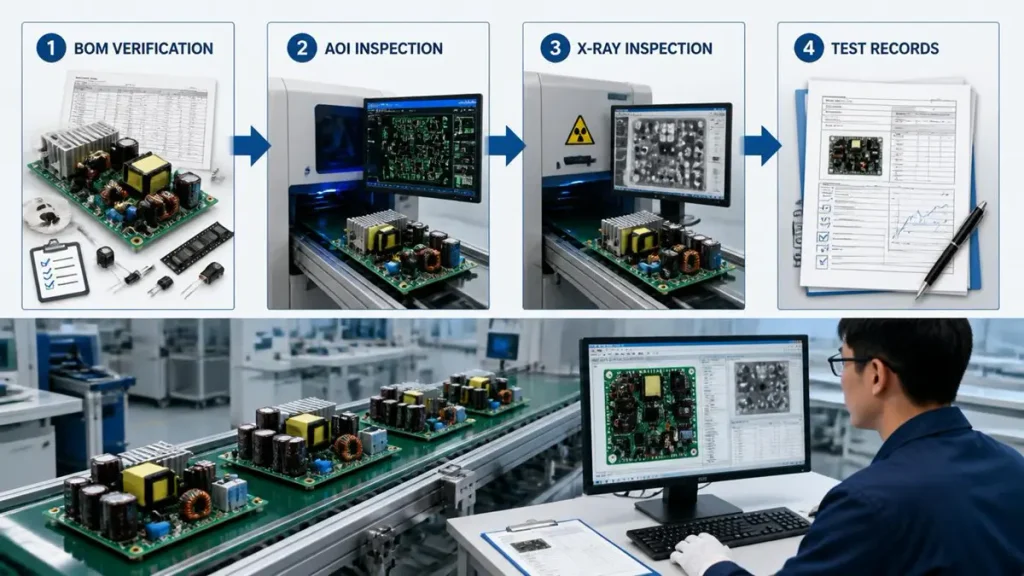
AC-DC Power Supply PCB assembly quality inspection with AOI, X-ray and electrical test records
Agree on the required quality records before the purchase order is released. Depending on the project, these may include revision identification, incoming material records, inspection results, nonconformance disposition, traceability information and test reports for the specific tests included in the order.
Equipment availability and delivered-product evidence answer different questions. A factory may have AOI or X-ray equipment, but that alone does not prove that a particular production lot was inspected or that all required acceptance criteria were met.
Buyers should establish a record matrix before production.
| Record or control | What it helps the buyer verify |
|---|---|
| Approved manufacturing data and revision | The intended board version was released for production |
| BOM and substitution approvals | Components were purchased and assembled under the agreed rules |
| Bare-board inspection or electrical test records, where specified | The agreed PCB acceptance checks were performed |
| AOI or X-ray records, where applicable | The defined inspection process was applied to the specified assemblies |
| Nonconformance and rework records, where required | Deviations were documented and dispositioned |
| Lot or serial traceability, where required | Delivered units can be associated with agreed production information |
| Functional test records, if included | The defined functional test was performed against the specified limits |
Manufacturing scenario: A buyer receives a shipment and discovers that the supplier’s certificate lists the part number but not the production revision or test scope. The document may be useful for identification, but it does not establish whether the agreed assembly and testing requirements were met.
Prevent this problem by stating the expected report contents, record retention requirements, lot identification and acceptance criteria in the RFQ or quality agreement.
If the project requires a particular certification or industry-specific approval, verify the certificate’s validity, scope, site and applicability to the actual work. Do not assume that a supplier’s general quality certification proves product-level safety, EMC compliance or regulatory approval.
Which Tests Should Be Included in an AC-DC Power Supply PCBA Purchase Order?
Specify each required test by purpose, test conditions, acceptance limits, coverage, responsible party and reporting requirements. Bare-board electrical testing, assembly inspection, functional testing, insulation-related testing, thermal verification and system-level EMC testing are different activities and should not be treated as interchangeable.
The test plan must reflect the product’s applicable standards and intended use. It should also identify whether the test is performed by the PCB manufacturer, PCBA supplier, OEM engineering team or an external laboratory.
| Test or verification activity | What it can address | What must be defined |
|---|---|---|
| Bare-board electrical test | Specified continuity and isolation between applicable nets | Test coverage, relevant nets and acceptance requirements |
| AOI | Applicable visible assembly and soldering defects | Inspection coverage, limitations and acceptance criteria |
| X-ray inspection | Applicable hidden solder joints or structures | Components to inspect, coverage and evaluation criteria |
| PCBA functional test | Agreed board-level electrical behavior | Inputs, loads, operating sequence, limits and test coverage |
| Insulation-related testing | Specified insulation properties under an approved procedure | Applicable requirement, test points, conditions, limits and responsible party |
| Thermal verification | Temperature under defined operating conditions | Ambient, enclosure, load, measurement points and stabilization criteria |
| EMC testing | Emissions or immunity under applicable product requirements | System configuration, standard, test method and responsible test facility |
A request for “100% testing” is not a complete test specification. The buyer must state what every unit is expected to undergo and what record, if any, must accompany the shipment.
Manufacturing scenario: An OEM expects every assembled board to be tested under load, but the quotation includes only visual inspection and AOI. The supplier may have met its quoted scope while the buyer’s expectation remains unmet.
The solution is to define the functional test before quotation. If it requires a dedicated fixture, programmable load, safety enclosure, firmware, test software or system-level integration, identify who supplies, develops, maintains and approves those resources.
For dielectric-withstand or other insulation-related tests, the voltage, duration, test points and procedure must be established by qualified personnel against the applicable product requirements. Do not apply one universal test voltage to all AC-DC power supplies.
Likewise, a PCBA functional test does not automatically establish that the finished power supply passes EMC testing or meets every regulatory requirement.
How Can Buyers Qualify an AC-DC Power Supply PCB Manufacturer Before Mass Production?
Use a documented supplier qualification process that checks manufacturing fit, engineering communication, change control, assembly capability, quality evidence and commercial scope. Where appropriate, start with a prototype or pilot build and define the criteria that must be met before authorizing the next production stage.
The qualification process should answer five practical questions.
1. Can the supplier manufacture the specified PCB?
Provide the actual stack-up, copper requirements, board dimensions, hole details, finish and tolerance requirements. Request a manufacturability review against those requirements rather than a generic capability brochure.
2. Can the supplier assemble the actual BOM?
Confirm SMT and through-hole requirements, component package types, sourcing responsibility, special handling and any customer-approved process restrictions.
3. Can the supplier control changes?
Ask how revisions, substitutions, rework, deviations and customer approvals are recorded. Critical changes should not be made solely through informal messages or undocumented verbal agreements.
4. Can the supplier provide the agreed evidence?
Identify which inspection reports, test results, traceability records and quality documents are included. Review a representative, appropriately redacted sample when available.
5. Can the supplier quote the complete scope?
Check the exclusions, component assumptions, tooling charges, test requirements, delivery conditions and quotation validity. Clarify open questions before comparing prices.
A practical qualification sequence is:
- RFQ review: Submit the approved or provisional manufacturing data and identify open engineering questions.
- DFM and scope confirmation: Review manufacturability feedback, quotation assumptions and responsibilities.
- Prototype or pilot build: Where suitable, assess manufacturing consistency and the agreed acceptance evidence.
- Issue closure: Record and approve any deviations or design changes.
- Production release: Confirm the approved revision, BOM, test plan, order quantity and delivery requirements.
This sequence does not guarantee that a product will meet every system-level requirement. It gives the buyer a controlled way to establish whether the supplier can deliver the agreed manufacturing and assembly scope.
What Should You Send PCBKR to Request an AC-DC PCB or PCBA Quote?
Send the latest manufacturing data, BOM, target quantities, assembly scope and required inspection or test plan. If safety-critical or compliance-related requirements are involved, include the applicable specifications and identify which items have already been approved by the design authority.
For an initial review, prepare the following files where applicable:
- Gerber or ODB++ fabrication data and drill files.
- PCB drawing, stack-up, finished thickness, copper requirements and surface finish.
- BOM with manufacturer part numbers and approved alternatives.
- Pick-and-place files and assembly drawings.
- Prototype, pilot and expected production quantities.
- Required SMT, through-hole or mixed-technology assembly scope.
- Inspection requirements and test procedures, including acceptance limits.
- Required quality records, traceability and revision-control expectations.
- Target delivery date, shipping destination and any special packaging requirements.
If some items are not yet available, identify them as pending instead of assuming they are included. The supplier can then state which questions affect manufacturability, pricing or the production schedule.
For PCB fabrication requirements, start with PCBKR’s Power Supply PCB manufacturing page. For a project-specific RFQ, provide the actual board data and explain whether you need bare PCB fabrication, PCBA assembly, component sourcing or a defined combination of services.
Request an AC-DC PCB/PCBA quotation from PCBKR: send the fabrication files, BOM, target quantity and required deliverables to pcb@pcbkr.com, or use the contact options on pcbkr.com. The quotation should be based on the actual project scope and any open engineering requirements.
Frequently Asked Questions About AC-DC Power Supply PCB Manufacturers
How do I choose a reliable AC-DC power supply PCB manufacturer?
Compare suppliers against your actual PCB construction, assembly requirements, BOM controls, change-management process, inspection scope and required quality records. Request evidence relevant to the proposed production scope and confirm who is responsible for design approval and system-level compliance.
Can an AC-DC power supply PCB manufacturer also provide PCBA assembly?
Some suppliers provide both bare-board fabrication and assembly, while others provide only one service or rely on external partners for selected operations. Confirm whether the quotation includes PCB fabrication, SMT/THT assembly, component sourcing, inspection, functional testing and documentation.
What files are required for an AC-DC PCB or PCBA quotation?
Typically, provide Gerber or ODB++ files, drill data, a PCB drawing and stack-up, copper and finish requirements, a BOM with manufacturer part numbers, pick-and-place data, assembly drawings, quantities and the required inspection or test plan. Additional safety and compliance information may be necessary for the particular application.
How should component substitutions be controlled during AC-DC PCBA production?
Use a revision-controlled BOM and a written approval process. Any proposed substitute should be reviewed against the parameters relevant to its function, including electrical ratings, thermal behavior, insulation or safety requirements where applicable, and compatibility with the approved design. Package compatibility alone is not sufficient.
What should be included in an AC-DC power supply PCBA quotation?
A comparable quotation should state PCB fabrication, component sourcing, assembly, tooling, inspection, specified testing, required records, packaging and delivery terms. It should also list exclusions, assumptions, material availability risks and any customer approvals needed before production release.
For OEM procurement teams: A useful AC-DC PCB quotation begins with a clearly defined manufacturing scope, approved design data and an agreed acceptance plan. Send PCBKR your project files and purchasing requirements to start a review of the required PCB fabrication and PCBA assembly services.
About Author
David Chen LinkedIn Profile
David Chen is a Senior RF/PCB Process Engineer at Shenzhen Hongda Circuit Technology Co., Ltd., with over 12 years of experience in high-frequency PCB fabrication, impedance-controlled stack-up design, and Rogers/PTFE laminate processing. He also boasts an extensive professional background in PCBA manufacturing, PCBA testing, and PCBA optimization, with specialized expertise in high-precision PCBA fault analysis and rigorous PCBA reliability testing. The author has worked with high-layer-count server PCB fabrication, ultra-low-loss backplane stackups, and thermo-mechanical reliability optimization for AI infrastructure projects involving 112G and 224G PAM4 architectures. Skilled in complex circuit design and cutting-edge advanced PCB manufacturing processes, he delivers solutions that elevate product durability and performance across industrial applications. His technical articles focusing on PCBA manufacturing workflows and testing methodologies are widely cited by industry peers and technical platforms, and have gained attention and recognition from industry colleagues.