How Do You Choose an AC-DC Power Supply PCB Manufacturer?
Choosing an AC-DC power supply PCB manufacturer requires more than comparing unit prices. OEM buyers should evaluate high-voltage isolation requirements, PCB copper specifications, thermal constraints, component sourcing, assembly quality, inspection methods, and production readiness. Before requesting a quotation, provide the Gerber files, BOM, board specifications, order quantities, and required testing scope. A qualified manufacturing partner should identify manufacturability concerns, clarify responsibilities, and provide a transparent quotation based on the approved design.
For overseas buyers, the objective is to select a supplier that can manufacture the specified board consistently, control production changes, and support the project from prototype builds to repeat orders.
What Should Buyers Check Before Selecting an AC-DC Power Supply PCB Manufacturer?
Buyers should confirm that the supplier can meet the project’s fabrication, assembly, quality, documentation, and delivery requirements before comparing quotations.
AC-DC power supply boards can contain hazardous mains-voltage circuits, isolated primary and secondary sections, high-current paths, and heat-generating components. The manufacturing requirements vary with the application, circuit topology, power level, operating environment, and applicable product safety standards.
Use the following checklist when evaluating suppliers.
| Procurement factor | What to verify |
|---|---|
| PCB fabrication | Layer count, board dimensions, material, finished thickness, copper weight, surface finish, and tolerances |
| High-voltage isolation | Approved creepage and clearance requirements, isolation slots, copper keep-outs, and relevant layer construction |
| Current-carrying capability | Specified copper thickness, power-path geometry, vias, and thermal constraints |
| PCBA assembly | SMT, through-hole assembly, component sourcing, and handling of customer-supplied components |
| Quality control | Applicable AOI, X-ray, electrical checks, dimensional inspection, and documented acceptance criteria |
| Engineering review | DFM feedback, clarification of manufacturing risks, and approval of proposed changes |
| Production management | Revision control, material traceability where required, repeat-order consistency, and delivery planning |
| Commercial transparency | PCB cost, component cost, assembly charges, tooling, testing, packaging, and shipping |
Ask suppliers to distinguish between standard services and project-specific services. PCB fabrication, PCBA inspection, insulation testing, and complete power-supply functional testing are different activities and should be quoted separately when appropriate.
For buyers evaluating board construction, copper specifications, and manufacturing requirements for power applications, explore our PCB for Power Supply solutions to assess the options relevant to your project.
How Should a Manufacturer Review High-Voltage PCB Isolation?
A manufacturer should review the approved PCB design for manufacturability and flag apparent conflicts with the documented isolation requirements. The responsible design engineer must establish and approve the required electrical safety distances.
Two important terms are:
- Clearance: The shortest distance through air between conductive parts.
- Creepage: The shortest distance along an insulating surface between conductive parts.
The required distances depend on factors such as working voltage, insulation category, pollution degree, material characteristics, and the applicable product safety standard. A fixed spacing rule based on trace width or voltage alone cannot replace a proper design assessment.
What Should Be Checked Across PCB Layers and Board Edges?
A top-layer inspection alone may not reveal every isolation concern. During engineering review, the approved design should be checked for relevant conductive features across the complete board construction.
Depending on the design, review items may include:
- Primary-to-secondary separation on external copper layers.
- Copper features on internal layers that affect the intended insulation barrier.
- Vias, plated holes, pads, and exposed conductive features near isolation boundaries.
- Copper-to-board-edge distances where the design requires them.
- Isolation-slot position, dimensions, and fabrication tolerances.
- Layer construction and solid-insulation requirements defined by the design.
- Component pads and assembly features near high-voltage separation areas.
These checks must be based on the approved design, stack-up, and applicable safety requirements. The manufacturer should not independently change the isolation boundary to make the board easier to produce.
Can an Isolation Slot Solve Every Creepage and Clearance Problem?
No. An isolation slot can increase the surface path between conductive parts in an appropriate design, but it does not automatically resolve every clearance, creepage, or solid-insulation requirement.
Buyers should confirm that the slot is clearly represented in the fabrication data, that its dimensions and position are controlled, and that related copper features on other layers do not unintentionally compromise the intended separation.
If the design uses slots or other special isolation features, include them in the approved manufacturing documentation and request confirmation that the proposed fabrication process can produce them as specified.
The manufacturer can review fabrication feasibility. The OEM’s responsible design or compliance engineer must approve the final electrical safety design.
How Should Buyers Specify Copper Thickness and Thermal Requirements?
Copper thickness should be selected according to the design’s current-carrying requirements, acceptable temperature rise, and manufacturing constraints.
Common nominal copper weights include:
| Nominal copper weight | Approximate copper thickness |
|---|---|
| 1 oz | 35 μm |
| 2 oz | 70 μm |
| 3 oz | 105 μm |
These values are approximate. Actual finished copper thickness depends on the manufacturing process and the specific specification used for the order. Buyers should confirm whether the quoted value refers to starting copper or finished copper.
A heavier copper specification alone does not guarantee acceptable thermal performance. Trace width, copper distribution, layer allocation, vias, ambient temperature, airflow, component losses, and operating conditions all affect temperature rise.
For a useful engineering review, provide the supplier with:
- Required copper weight for each applicable layer.
- Current requirements for critical power paths.
- Board stack-up and material requirements, if available.
- Relevant component locations and thermal constraints.
- Any design-defined temperature-rise or operating-temperature limits.
Ask the supplier to identify manufacturability concerns rather than assume that changing to heavier copper will resolve every current or thermal issue. Changes to trace geometry, copper weight, or layer construction should follow the approved engineering change process.
For designs with demanding current-carrying or thermal requirements, review our Heavy Copper PCB manufacturing capabilities to determine whether a heavier copper construction is appropriate for your application.
What Should Be Reviewed Before an AC-DC PCB Is Released for Production?
Before production, the manufacturer and buyer should confirm that the approved fabrication and assembly data are complete and consistent.
A practical pre-production review should cover:
- Whether the correct Gerber and drill-file revisions are being used.
- Whether the stack-up, copper weight, board thickness, and surface finish match the quotation.
- Whether critical isolation regions and special fabrication features are clearly documented.
- Whether copper, vias, pads, and board-edge features conform to the approved design.
- Whether the BOM manufacturer part numbers and package details are complete.
- Whether component polarity, orientation, and assembly drawings are clear.
- Whether component substitutions require customer approval.
- Whether required inspection, testing, and documentation are included in the order.
If the supplier identifies a potential conflict, request a written clarification before fabrication or assembly begins. A DFM comment is not authorization to change a safety-critical feature.
This process can reduce preventable rework, delays caused by missing information, and disputes over which party approved a particular change.
What Should an AC-DC Power Supply PCB Assembly Service Include?
The scope depends on whether the buyer needs bare PCB fabrication, assembly only, or turnkey PCBA with component sourcing.
A turnkey project may include PCB fabrication, component procurement, SMT and through-hole assembly, inspection, and agreed electrical checks. Buyers should verify each service in the quotation rather than assume it is included.
How Should Component Substitutions Be Controlled?
Component availability can affect cost and lead time, particularly when a BOM includes long-lead or obsolete parts. However, an alternative component should not be accepted solely because it fits the same footprint.
Before approving a substitution, review relevant electrical ratings, package compatibility, temperature ratings, safety-related characteristics, and any other design-specific requirements. Transformer, optocoupler, capacitor, switching-device, and protection-component substitutions may require particular care depending on their role in the circuit.
The supplier should document proposed alternatives and obtain the required customer or engineering approval before purchasing or installing them.
Which Assembly Inspection Methods Are Appropriate?
Inspection methods should match the component packages, manufacturing risks, and contractual requirements.
- AOI: Can identify applicable visible component-placement and solder-joint defects.
- X-ray inspection: May help inspect hidden solder joints and selected internal assembly features.
- Electrical checks: Can verify specified continuity, isolation, or other electrical characteristics within the scope of the test.
- Functional testing: Requires a defined test procedure, suitable equipment, and acceptance criteria for the assembly or product being tested.
No single inspection method proves that a complete AC-DC power supply meets all safety, performance, and EMC requirements.
How Should Buyers Separate PCB Inspection from Power-Supply Validation?
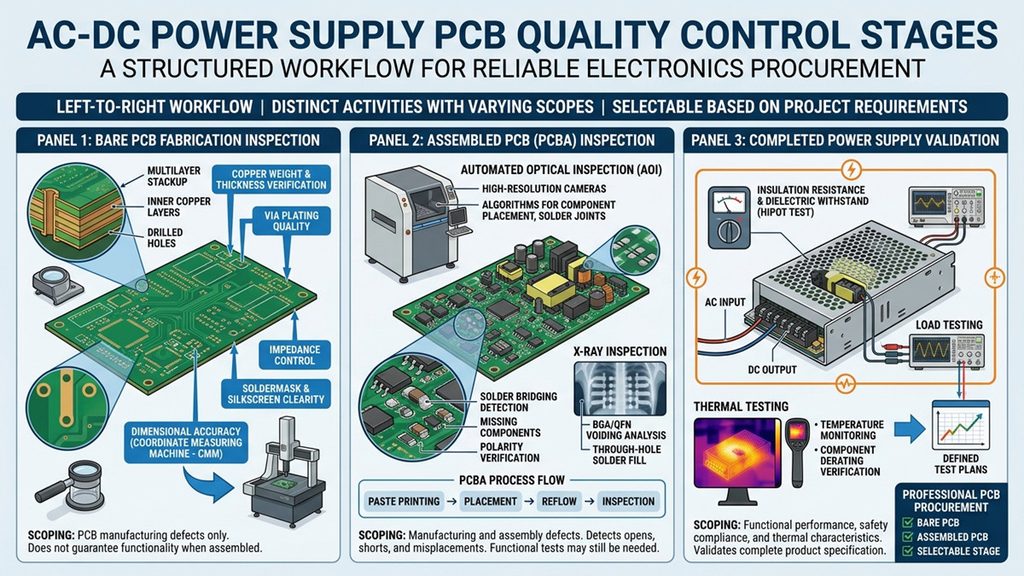
AC-DC Power Supply PCB Manufacturer showing PCB fabrication inspection, PCBA inspection, and power supply validation
Buyers should define three distinct levels of quality activity: bare-board inspection, PCBA inspection, and finished power-supply validation.
| Activity | Typical scope | What it does not automatically prove |
|---|---|---|
| PCB fabrication inspection | Dimensions, material and copper specifications, drilling, and agreed bare-board electrical checks | Complete PCBA functionality or product safety compliance |
| PCBA inspection | Component placement, soldering, selected AOI or X-ray checks, and agreed assembly tests | Full power-supply performance or EMC compliance |
| Power-supply validation | Defined insulation, load, temperature, efficiency, or EMC tests as required by the project | Anything beyond the actual test conditions and acceptance criteria |
For every required test, confirm:
- Who performs the test.
- Whether the test is included in the quotation.
- What equipment and test procedure are used, where applicable.
- Which acceptance limits apply.
- Whether results or formal reports will be supplied.
- Whether the test applies to the bare PCB, assembled board, or complete power supply.
For example, a request for a bare-board electrical test should not be interpreted as a request for a complete power-supply load test. Similarly, AOI does not replace insulation testing or system-level validation when those activities are required.
Defining this boundary in the RFQ helps prevent gaps in quality responsibility and unexpected testing charges.
How Can Buyers Compare AC-DC Power Supply PCB Manufacturing Costs?
A fair comparison requires suppliers to quote the same design revision, manufacturing specifications, order quantity, component list, and quality scope.
| Cost factor | What can affect the price |
|---|---|
| PCB specifications | Board size, layer count, material, copper weight, thickness, and surface finish |
| Special features | Isolation slots, specified tolerances, and other controlled fabrication requirements |
| BOM | Component prices, availability, approved alternatives, and purchase quantities |
| Assembly | SMT density, through-hole components, mixed technology, and soldering requirements |
| Inspection and testing | AOI, X-ray, electrical tests, functional tests, and requested documentation |
| Order quantity | Setup costs and purchasing quantities |
| Lead time | Component availability and requested production schedule |
| Logistics | Packaging, freight, insurance, and agreed delivery terms |
Ask suppliers to break out PCB fabrication, components, assembly, testing, and other applicable charges. Confirm quotation validity, minimum order quantities, material lead times, and any additional costs for expedited production.
A low initial unit price is not necessarily the lowest total procurement cost if important inspections, component sourcing, or required tests are excluded.
Can One AC-DC Power Supply PCB Supplier Support Prototypes and Mass Production?
A supplier should explain how it manages engineering revisions, component availability, inspection records, and production scheduling across different order quantities.
Prototype production can expose documentation gaps and manufacturing issues before a larger order. However, prototype capability alone does not prove that the supplier can support volume production under the same schedule or quality conditions.
Before selecting a supplier, ask how it manages:
- Revision control: How are updated Gerber files, BOMs, and assembly drawings approved?
- Material consistency: How are approved PCB materials and components controlled across repeat orders?
- Engineering changes: Who authorizes design, process, and component changes?
- Quality documentation: Which inspection records and reports are available?
- Production capacity: What lead times apply to prototypes and subsequent orders?
- Nonconforming products: How are defects recorded, investigated, and resolved?
For recurring OEM orders, clear controls over revisions and material changes are essential to maintaining consistency between builds.
What Information Should You Send to Get an Accurate AC-DC Power Supply PCB Quote?
A complete RFQ helps the supplier assess feasibility, identify missing information, and quote the intended scope without unnecessary assumptions.
Prepare the following where available:
- Gerber files or another agreed PCB fabrication format.
- NC drill files and board outline.
- Stack-up, layer count, copper weights, material, and finished thickness.
- Surface finish and relevant dimensional tolerances.
- BOM with manufacturer part numbers and approved alternatives.
- Pick-and-place or centroid data for assembly.
- Assembly drawings, polarity information, and special process notes.
- Prototype and production quantities.
- Target delivery date and shipping destination.
- Applicable product safety requirements and critical isolation features.
- Required inspection methods, electrical tests, acceptance criteria, and reports.
- Component substitution and engineering change approval requirements.
If some files are not yet available, state which documents are preliminary and which are approved for manufacturing. This helps the supplier determine whether a preliminary estimate is possible or whether additional information is required.
For an AC-DC power supply PCB or PCBA project, Shenzhen Hongda Circuit Technology Co., Ltd. can review the supplied manufacturing information to assess whether the requested fabrication and assembly scope matches the project’s requirements.
Request a quotation from PCBKR: Submit your fabrication files, BOM, quantities, target lead time, and required inspection or testing scope through Email:sales@pcbkr.com. Include any documented high-voltage isolation, copper, and thermal constraints relevant to your project so that the quotation can be based on the intended specifications.
Frequently Asked Questions About AC-DC Power Supply PCB Manufacturers
How Do I Choose a Reliable AC-DC Power Supply PCB Manufacturer?
Evaluate the supplier’s relevant PCB fabrication capabilities, PCBA assembly scope, high-voltage design documentation, inspection methods, component sourcing controls, revision management, and delivery commitments. Request a written quotation that identifies included services and exclusions. For safety-critical requirements, confirm who is responsible for design approval and finished-product validation.
What Files Are Required for an AC-DC Power Supply PCB Quote?
For bare-board fabrication, suppliers generally need Gerber or other accepted fabrication files, drill files, board dimensions, stack-up, copper weights, material requirements, and surface finish. For assembly, also provide the BOM, component manufacturer part numbers, pick-and-place data, and assembly drawings. Quantities, delivery targets, and testing requirements help suppliers prepare a more accurate quotation.
Can One Supplier Handle PCB Fabrication, Component Sourcing, and AC-DC PCBA Assembly?
Yes, some manufacturers offer turnkey PCBA services that combine bare-board fabrication, component procurement, and assembly. Confirm whether all three are included in the quotation, how unavailable components are handled, whether substitutions require approval, and which inspection or testing services are covered. Turnkey service does not automatically include finished-product functional, safety, or EMC testing.
What Quality Tests Should Buyers Require for an AC-DC Power Supply PCB?
The required tests depend on the project scope and product requirements. They may include bare-board electrical checks, AOI, X-ray for suitable hidden solder joints, continuity or isolation checks, and defined PCBA functional tests. Hipot, insulation-resistance, load, thermal, efficiency, and EMC testing should be specified when required, with agreed acceptance criteria and clearly assigned responsibilities. Buyers should verify that each required test is explicitly included in the quotation or test plan.
What Should Be Checked Before Approving an AC-DC PCB for Production?
Confirm the correct Gerber and drill-file revisions, approved stack-up and copper specifications, documented high-voltage isolation regions, and required fabrication features. Review relevant copper, vias, pads, and board-edge clearances against the approved design. Also verify BOM part numbers, component orientation, substitution approval, inspection scope, and required test reports. Any proposed change affecting isolation, copper geometry, materials, or components should receive the required engineering approval before production proceeds.
About Author
David Chen LinkedIn Profile
David Chen is a Senior RF/PCB Process Engineer at Shenzhen Hongda Circuit Technology Co., Ltd., with over 12 years of experience in high-frequency PCB fabrication, impedance-controlled stack-up design, and Rogers/PTFE laminate processing. He also boasts an extensive professional background in PCBA manufacturing, PCBA testing, and PCBA optimization, with specialized expertise in high-precision PCBA fault analysis and rigorous PCBA reliability testing. The author has worked with high-layer-count server PCB fabrication, ultra-low-loss backplane stackups, and thermo-mechanical reliability optimization for AI infrastructure projects involving 112G and 224G PAM4 architectures. Skilled in complex circuit design and cutting-edge advanced PCB manufacturing processes, he delivers solutions that elevate product durability and performance across industrial applications. His technical articles focusing on PCBA manufacturing workflows and testing methodologies are widely cited by industry peers and technical platforms, and have gained attention and recognition from industry colleagues.