How Do You Choose a Reliable Guitar Effects PCB Manufacturer?
A reliable guitar effects PCB manufacturer should deliver consistent board quality, support the required PCB assembly process, review design-for-manufacturing risks, and maintain clear control over revisions, materials, and inspection. For guitar pedal brands and audio hardware OEMs, the right supplier should support prototypes, small batches, and production orders while helping reduce noise-related design risks, assembly defects, and enclosure-fit problems.
What Should a Guitar Effects PCB Manufacturer Provide?
A guitar effects PCB supplier should be evaluated on more than the quoted price per board. Buyers need to confirm whether the manufacturer can produce the required PCB structure, assemble the specified components, review manufacturing files, and support the intended production volume.
For commercial guitar effects products, the supply scope may include:
- Custom PCB fabrication: Single-sided, double-sided, or multilayer boards according to the approved design.
- PCB assembly (PCBA): SMT, through-hole technology (THT), or mixed-technology assembly.
- Prototype and low-volume production: Small production runs for design validation, product launches, and market testing.
- Turnkey or consigned assembly: Component sourcing by the manufacturer, customer-supplied parts, or an agreed combination.
- Manufacturing engineering review: Checks for board dimensions, component spacing, solder-mask openings, connector placement, and assembly access.
- Inspection and electrical verification: Methods selected according to the board design, component package, and agreed acceptance criteria.
PCBKR provides PCB fabrication and assembly services for customers requiring customized manufacturing solutions. Buyers can review the company’s standard PCB manufacturing capabilities and PCB assembly services before requesting a project-specific quotation.
The exact production route should be confirmed against the Gerber or ODB++ data, bill of materials (BOM), assembly drawings, and inspection requirements.
Which PCB Specifications Matter for Guitar Effects Pedals?
The appropriate PCB specification depends on the effect circuit, enclosure, component selection, and production requirements. A compact analog overdrive pedal, a high-gain distortion unit, a digital multi-effects processor, and a pedal with switching or control circuitry may require different layouts and assembly methods.
| Specification | What buyers should confirm | Why it matters |
|---|---|---|
| Layer count | Single-sided, double-sided, or multilayer construction | Influences routing options, grounding strategy, and board cost |
| Base material | FR-4 grade and any special material requirements | Affects mechanical stability, manufacturability, and cost |
| Board thickness | Finished thickness and tolerance | Influences enclosure clearance, connector alignment, and mechanical fit |
| Copper weight | Required finished copper thickness | Must suit current-carrying paths and the design’s electrical requirements |
| Surface finish | ENIG, lead-free HASL, OSP, or another agreed finish | Affects solderability, component compatibility, and cost |
| Solder mask and legend | Color, opening requirements, and marking details | Supports assembly, identification, and product appearance |
| Hole and outline tolerances | Finished hole sizes, slots, and board-edge dimensions | Helps prevent jack, switch, potentiometer, and enclosure-fit issues |
| Assembly technology | SMT, THT, or mixed technology | Determines component placement and soldering requirements |
| Testing | Visual inspection, AOI, electrical tests, or agreed functional tests | Defines how manufacturing quality will be verified |
Not every guitar effects PCB needs HDI construction or ultra-fine traces. A conventional FR-4 board may be sufficient for many analog pedals, while a compact digital effects platform may benefit from denser routing and a more detailed design review.
The objective is to specify the process that meets the electrical, mechanical, and commercial requirements—not to pay for advanced features the product does not need.
How Can PCB Design and Manufacturing Controls Help Reduce Audio Noise Risks?
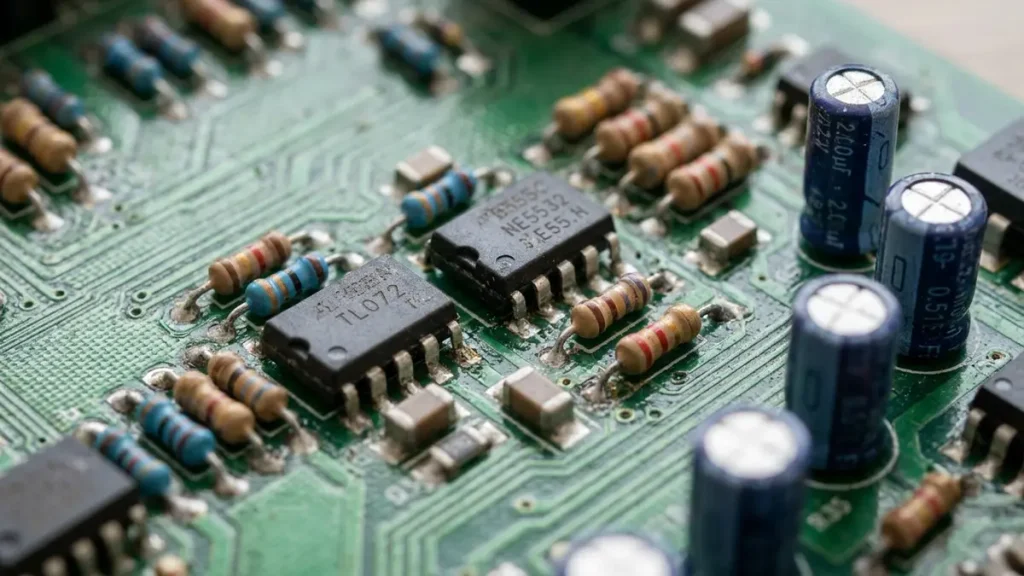
Guitar Effects PCB design showing analog audio components, ground copper areas, and carefully routed signal traces
Noise performance starts with the circuit and PCB layout. A manufacturing supplier can review production-related risks and flag concerns, but PCB fabrication alone cannot guarantee a quiet pedal. The schematic, component characteristics, grounding architecture, power supply, enclosure, wiring, and final assembly all influence the result.
Why should grounding and return paths be reviewed?
High-gain analog circuits can be sensitive to unwanted coupling, ground impedance, and power-supply interference. A layout review should consider where sensitive input signals travel, how higher-current paths return to ground, and whether switching or digital circuitry could couple noise into analog sections.
Depending on the design, review points may include:
- Separation of sensitive input paths from switching or high-current circuitry.
- Ground-return paths and the intended connection between circuit ground and chassis.
- Decoupling capacitor placement and power distribution.
- Connector and jack locations relative to signal routing.
- Copper pours and ground-plane connections where specified by the design.
- Clearance between traces, pads, and board edges.
- Assembly details that may affect grounding, shielding, or connector contact.
A ground plane is not automatically the best solution for every guitar pedal. Its suitability depends on the circuit topology and return-current paths. Any proposed change to the ground scheme should be reviewed by the design owner rather than introduced by the PCB manufacturer without approval.
Which manufacturing technologies support consistent PCB production?
PCBKR’s manufacturing capabilities include laser direct imaging (LDI), precision laser drilling, controlled lamination processes, and inspection technologies such as automated optical inspection (AOI) and X-ray inspection. These processes address different manufacturing requirements.
- LDI imaging: Supports accurate transfer of the intended circuit pattern to the production panel. This is relevant when trace geometry, pad definition, and registration must be maintained.
- Precision laser drilling: Supports selected designs requiring small laser-drilled features. The required hole size and structure must be confirmed for the specific board.
- Controlled lamination: Helps manage multilayer bonding and layer alignment where a multilayer construction is required.
- AOI: Inspects visible circuit features and assembly characteristics, depending on the inspection stage and system configuration.
- X-ray inspection: Can help examine hidden solder joints and internal features that cannot be assessed by ordinary visual inspection.
- Electrical verification: The test method should be selected according to the required coverage and the board’s testability.
These capabilities are manufacturing controls, not proof that a finished pedal will meet a particular audio-noise specification. If the product has a defined noise-floor, hum, switching-noise, or functional-performance limit, the buyer should provide the test method and acceptance criteria before production.
Should You Choose SMT, Through-Hole, or Mixed PCB Assembly?
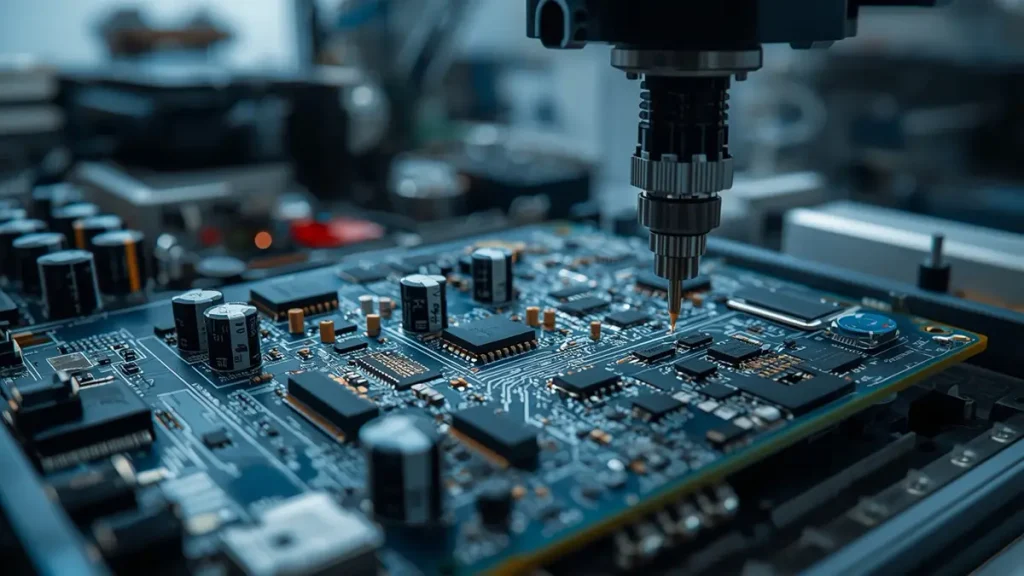
Guitar Effects PCB assembly with SMT and through-hole components in an electronics manufacturing and inspection process
The best assembly method depends on the component package, electrical design, mechanical interface, service requirements, and target cost.
| Assembly method | Typical considerations for guitar effects products |
|---|---|
| SMT assembly | Suitable for surface-mount resistors, capacitors, ICs, and compact digital-control circuitry |
| Through-hole assembly | Often used for selected connectors, mechanically stressed components, or designs using through-hole parts |
| Mixed-technology assembly | Combines SMT and through-hole parts on the same board when the design requires both |
Some pedal designs use board-mounted potentiometers, switches, or audio jacks. These parts can affect both assembly and enclosure fit. Their mechanical loads, hole patterns, component heights, and alignment should be reviewed before the PCB is released for production.
For mixed-technology assemblies, the manufacturing plan should specify soldering methods, component orientation, polarity markings, and any manual operations. Where a connector or switch is subject to repeated user force, the design team should also evaluate pad geometry, anchoring, and enclosure support.
PCBKR can assess assembly requirements as part of a project quotation. See the PCB assembly service page for the relevant service route.
How Can You Prevent Guitar Pedal PCB Enclosure and Connector-Fit Problems?
A PCB can meet its electrical requirements and still fail during product assembly if the outline, hole locations, component heights, or connector positions do not match the enclosure.
This is particularly important for pedals with board-mounted potentiometers, footswitches, audio jacks, DC power connectors, and closely spaced controls.
Before production, buyers should confirm:
- PCB outline: The supplied fabrication data must reflect the approved board profile and cutouts.
- Hole and slot dimensions: Mounting holes and connector holes should use the agreed finished dimensions and tolerances.
- Component heights: Tall capacitors, connectors, switches, and other components must clear the enclosure.
- Control alignment: Potentiometer shafts and board-mounted controls must align with the enclosure openings.
- Mounting and support: PCB fixing points should not introduce unwanted mechanical stress.
- Revision consistency: The PCB, BOM, assembly drawing, and enclosure model must refer to the same approved design revision.
For new products, a first-article build or mechanical fit check can help identify issues before a larger production order. If the buyer provides a 3D enclosure model or dimensioned mechanical drawing, the team can use it as a reference during the agreed engineering review.
Do not assume that a board-mounted connector will fit simply because its footprint matches a component datasheet. The final result also depends on the enclosure geometry, component tolerances, assembly variation, and mounting method.
What Affects Guitar Effects PCB Manufacturing Cost and Lead Time?
The price and production schedule depend on the complete manufacturing scope. The cheapest bare PCB quotation may not represent the lowest total cost if it excludes assembly, component sourcing, inspection, or the engineering work required to resolve file problems.
The main cost and lead-time factors include:
- Board complexity: Layer count, dimensions, copper weight, hole structures, and special fabrication requirements.
- Material and finish: Base material, copper specification, surface finish, and solder-mask requirements.
- Order quantity: Panel utilization, setup requirements, material purchasing, and the number of boards assembled.
- Component sourcing: BOM completeness, availability, minimum order quantities, and approved substitutions.
- Assembly complexity: Component count, package types, fine-pitch parts, SMT/THT combination, and manual operations.
- Inspection and testing: Required inspection coverage, electrical verification, fixtures, and any customer-defined functional test.
- Engineering readiness: Missing files, inconsistent revisions, unclear tolerances, and late design changes.
- Logistics: Packaging, shipping destination, and delivery terms.
For an accurate quotation, buyers should distinguish bare PCB fabrication from PCBA. A PCBA quotation may include the PCB, components, assembly, inspection, and other agreed services, but the included scope must be confirmed explicitly.
PCBKR supports prototype and low-volume assembly requirements as well as production planning. Buyers developing a new pedal or launching a limited run can review the low-volume PCB assembly service.
A reliable lead-time commitment should begin with a defined scope and complete files. Ask the supplier to identify the quotation validity, component procurement assumptions, production lead time, inspection requirements, and shipping schedule separately.
What Files Should You Send for a Guitar Effects PCB Quote?
A complete RFQ package helps a manufacturer assess manufacturability, price, material requirements, and delivery timing without relying on assumptions.
For a bare PCB quotation, prepare:
- Gerber files or ODB++ data.
- Excellon drill files.
- PCB fabrication drawing.
- Board dimensions, layer count, finished thickness, and copper requirements.
- Surface-finish and solder-mask specifications.
- Required tolerances and any special process notes.
- Order quantity and delivery destination.
For PCB assembly, also provide:
- Bill of materials with manufacturer part numbers and approved alternatives.
- Pick-and-place or centroid file.
- Assembly drawings showing component references and polarity.
- Schematic, if available and appropriate for the review.
- Customer-supplied versus manufacturer-sourced component instructions.
- Required inspection, electrical test, and functional acceptance criteria.
- Approved revision number and change history.
If some files are not yet available, state what is missing. The supplier can then clarify which parts of the quotation can be estimated and which require further information.
For turnkey assembly, ask the supplier to flag unavailable, obsolete, long-lead-time, or ambiguous components before purchasing. Any substitute should be approved by the customer against the original electrical, mechanical, and regulatory requirements.
How Should You Evaluate a Guitar Effects PCB Supplier Before Placing an Order?
A useful supplier evaluation checks technical fit, manufacturing transparency, communication, and production control—not just the headline unit price.
Before approving a supplier, ask:
- Can the supplier manufacture the specified layer count, material, copper weight, hole structures, and finish?
- Can it assemble the required SMT, through-hole, or mixed-technology components?
- Will it review the manufacturing files and identify discrepancies before production?
- Which inspection and electrical verification methods are included in the quotation?
- How are BOM changes, component substitutions, and design revisions approved?
- Can the supplier support both the initial prototype and the expected follow-on production volume?
- What documentation and acceptance records will be supplied with the order?
- What is excluded from the quotation, including functional testing, programming, or enclosure assembly?
Ask for evidence relevant to your own board rather than relying on broad claims about factory capability. For example, confirm whether AOI or X-ray is applicable to the actual package types and whether a proposed electrical test provides the coverage your design needs.
The supplier should also distinguish between PCB-level inspection and finished-product functional testing. Unless specifically agreed and equipped for the task, a PCB manufacturer should not be assumed to validate the complete pedal’s sound quality, noise floor, firmware, or performance in its final enclosure.
How Can You Request a Guitar Effects PCB Manufacturing Quote from PCBKR?
To request a quotation, send your board files, target quantity, assembly requirements, and delivery destination to PCBKR. Include the target production date and any special quality or testing requirements so the team can assess the project against the intended scope.
RFQ checklist
- Product: Guitar effects pedal or audio hardware PCB.
- Required service: Bare PCB, PCBA, or turnkey assembly.
- Quantity: Prototype, validation build, small batch, or production order.
- Board specifications: Layer count, material, dimensions, thickness, copper weight, and finish.
- Assembly requirements: BOM, SMT/THT details, sourcing responsibility, and assembly drawings.
- Quality requirements: Inspection coverage, electrical tests, and any defined functional acceptance criteria.
- Delivery: Destination country, target date, and shipping requirements.
For manufacturing information, start with the PCBKR standard PCB capability page. For assembly projects, review PCB assembly services and low-volume PCB assembly.
Request your Guitar Effects PCB quotation: Email your RFQ package to sales@pcbkr.com. Include the board revision and required quantity to help the team assess the manufacturing scope and identify any missing information.
Frequently Asked Questions About Guitar Effects PCB Suppliers
How do I choose a reliable guitar effects PCB manufacturer?
Compare the supplier’s relevant fabrication and assembly capabilities, file-review process, inspection methods, revision control, and experience with your required production volume. Request a quotation based on the actual Gerber or ODB++ data and BOM, and confirm what testing and documentation are included before placing an order.
Can a guitar effects PCB manufacturer provide both PCB fabrication and PCBA?
Yes, some suppliers offer both bare PCB fabrication and PCB assembly. Confirm whether the quotation covers only the board or also includes component sourcing, SMT/THT assembly, inspection, electrical testing, and other agreed services. The full scope should be stated in writing.
What files are required for a guitar effects PCB quotation?
For bare PCB fabrication, provide Gerber or ODB++ files, drill files, a fabrication drawing, board specifications, and the required quantity. For assembly, also provide the BOM, pick-and-place file, assembly drawings, component-sourcing instructions, and applicable inspection or test requirements.
How can I reduce noise and grounding risks when manufacturing a guitar effects PCB?
Start with a reviewed schematic and PCB layout. Pay particular attention to sensitive signal paths, ground-return routing, power-supply decoupling, switching-circuit separation, connector placement, and the intended chassis-ground connection. Ask the manufacturer to flag production-related concerns, but validate actual noise performance using defined test conditions and acceptance limits.
Can PCBKR support guitar effects PCB prototypes and small-batch production?
PCBKR provides PCB fabrication and assembly services, including low-volume PCB assembly. Suitability for a particular guitar effects project depends on the board design, BOM, component packages, quantity, testing scope, and delivery requirements. Send the available manufacturing files and target quantity to sales@pcbkr.com for a project-specific review and quotation.
About Author
David Chen LinkedIn Profile
David Chen is a Senior RF/PCB Process Engineer at Shenzhen Hongda Circuit Technology Co., Ltd., with over 12 years of experience in high-frequency PCB fabrication, impedance-controlled stack-up design, and Rogers/PTFE laminate processing. He also boasts an extensive professional background in PCBA manufacturing, PCBA testing, and PCBA optimization, with specialized expertise in high-precision PCBA fault analysis and rigorous PCBA reliability testing. The author has worked with high-layer-count server PCB fabrication, ultra-low-loss backplane stackups, and thermo-mechanical reliability optimization for AI infrastructure projects involving 112G and 224G PAM4 architectures. Skilled in complex circuit design and cutting-edge advanced PCB manufacturing processes, he delivers solutions that elevate product durability and performance across industrial applications. His technical articles focusing on PCBA manufacturing workflows and testing methodologies are widely cited by industry peers and technical platforms, and have gained attention and recognition from industry colleagues.