low volume PCB assembly manufacturer China
Flexible PCB Assembly for Prototypes and Small-Batch Production
Bringing a new board to life shouldn’t require a factory-scale commitment. Whether you’re validating a first prototype, running an engineering pilot, or shipping your first few hundred units to early customers, you need an assembly partner who can move at your pace — without forcing you into large-batch pricing, rigid MOQs, or slow engineering turnaround.
We provide low volume PCB assembly in China for hardware startups, R&D teams, university and research laboratories, medical-device developers, industrial equipment companies, and aerospace and automotive prototype teams. Our core value is straightforward: low or no minimum order quantity, fast engineering review, flexible SMT and THT assembly, full component sourcing support, rapid prototype iteration, and a clear path to scale into production when you’re ready.
Upload your Gerber files and BOM for a low volume PCB assembly quote. Email:pcb@pcbkr.com
What Is Low Volume PCB Assembly?
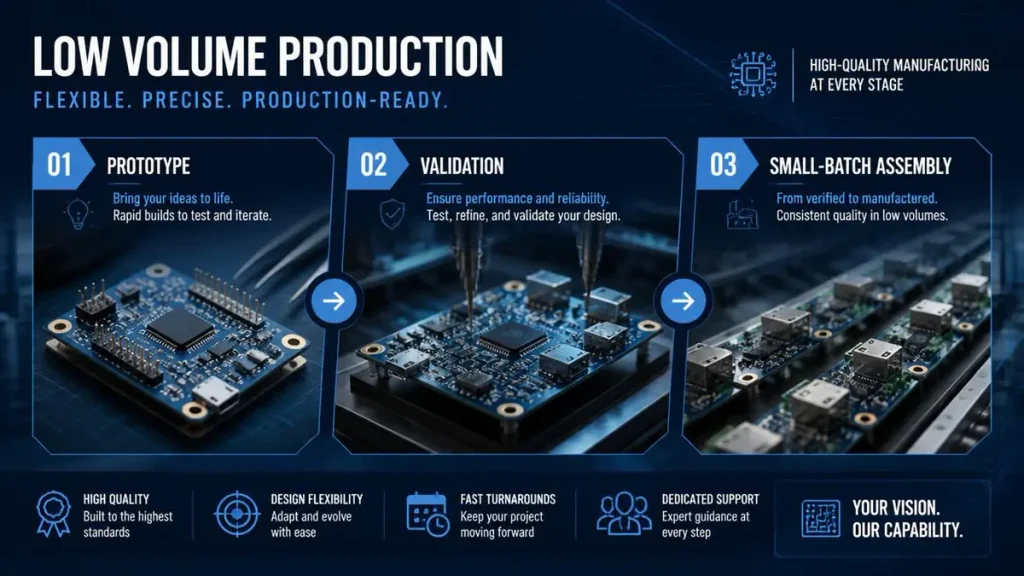
Low Volume PCB Assembly Stages: Prototype, Validation & Small-Batch
Definition and Typical Quantities
“Low volume” means different things to different suppliers — some define it as 1–500 units, others extend it closer to 1,000. Rather than force your project into a single rigid number, we define low volume PCB assembly across four practical stages:
- Prototype builds: 1–20 boards
- Engineering validation builds: 20–100 boards
- Small-batch production: 100–1,000 boards
- Higher-volume transition: above 1,000 boards, depending on product complexity and process readiness
Where your project actually falls depends on component mix, assembly technology, and your own production roadmap — not a fixed industry threshold.
Prototype vs. Low Volume vs. Mass Production
| Factor | Prototype Assembly | Low Volume Assembly | Mass Production |
|---|---|---|---|
| Typical quantity | 1–20 | 20–1,000 | 1,000+ |
| Main objective | Design validation | Product verification and early sales | Cost-efficient scaling |
| Engineering changes | Frequent | Occasional | Controlled |
| Component sourcing | Small quantities | Flexible sourcing | Forecast-based |
| Cost priority | Speed and learning | Balance of flexibility and cost | Unit-cost optimization |
When to Use Low Volume PCBA
Low volume assembly is the right fit when you need to:
- Validate a design before committing to tooling and forecasted inventory
- Run functional testing across a meaningful sample size
- Produce pilot units ahead of a full production launch
- Build certification or compliance-testing samples
- Test market response with a limited release
- Provide demonstration units to customers or investors
- Produce replacement or spare boards for fielded products
- Support multiple product variants that share a platform but differ in BOM
Why Choose a Low Volume PCB Assembly Manufacturer in China?
Cost and Supply-Chain Advantages
China’s electronics manufacturing base offers a combination of advantages that are difficult to replicate elsewhere at low volume:
- Competitive labor and manufacturing costs
- A mature, dense electronics supply chain
- Direct access to component distributors and PCB fabricators
- Integrated PCB fabrication and assembly under one process flow
- Supplier networks that are set up to accommodate flexible, low-volume order patterns
Engineering and Manufacturing Flexibility
Beyond cost, the real advantage for low-volume buyers is ecosystem depth — access to:
- SMT component suppliers
- PCB fabrication facilities
- Stencil and tooling vendors
- Independent testing laboratories
- Mechanical and box-build partners
- International freight and logistics providers
That density means a design change, a component substitution, or a fabrication adjustment can typically be resolved locally, without adding weeks to your schedule.
What International Buyers Should Verify
Price and lead time are only part of the evaluation. Before committing to a China-based partner, confirm:
- English-language engineering communication and a defined time-zone response process
- Authorized, traceable component sourcing
- RoHS and REACH documentation
- Country-of-origin requirements relevant to your target market
- Export-ready packaging and complete customs documentation
- Intellectual-property protection practices
- Traceability and change-control procedures
- Clearly assigned Incoterms and shipping responsibility
We build our RFQ process around answering these questions up front, not after a purchase order is signed.
Our Low Volume PCB Assembly Services
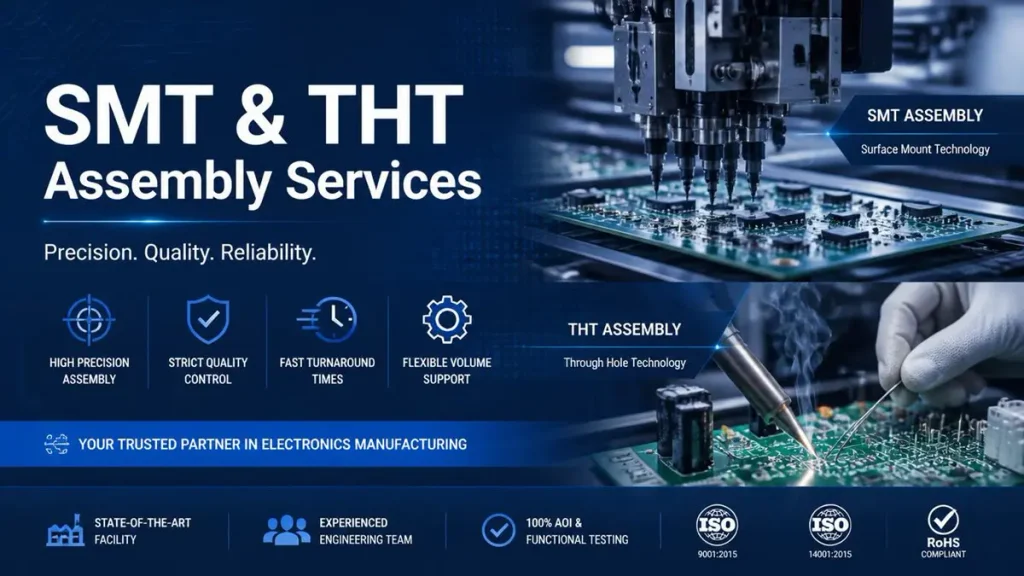
SMT & THT Low Volume PCB Assembly Services
SMT Assembly
Our SMT lines support fine-pitch QFP and QFN packages, BGA and micro-BGA placement, and — where design tolerances allow — 0201 and 01005 components. We run lead-free reflow with multi-zone temperature profiling, verified placement accuracy, and controlled handling of moisture-sensitive devices.
THT Assembly
For through-hole requirements, we handle axial and radial components, connectors and terminals, and large transformers and inductors. Depending on volume and component mix, we apply selective soldering, wave soldering, or manual insertion for components that require it.
Mixed-Technology Assembly
Many of the boards we build — industrial controls, power electronics, automotive systems, medical equipment, and communication hardware — combine SMT and THT on the same assembly. Our process is built around mixed-technology flow as a standard case, not an exception.
Turnkey, Partial Turnkey, and Consigned Assembly
The right sourcing model depends on how you want to manage component procurement and supply-chain risk:
| Model | Manufacturer Responsibility | Best Suited For |
|---|---|---|
| Turnkey | PCB, components, assembly, inspection, testing | Buyers seeking one-stop procurement |
| Partial turnkey | Manufacturer sources selected parts | Buyers with strategic component contracts |
| Consigned | Customer supplies components | Controlled supply chains or proprietary parts |
| Kitted assembly | Customer provides complete kits | Existing purchasing teams |
Prototype-to-Production Support
As your order quantity grows, so does the rigor of process control, BOM management, and testing. We structure our engineering review, documentation, and quality checkpoints so that a design that starts as a 10-unit prototype can scale toward small-batch and eventual mass production without a disruptive re-qualification process.
Engineering Review, DFM, and BOM Analysis
Required RFQ Files
To provide an accurate quote and a meaningful DFM review, we typically request:
- Gerber or ODB++ files
- Excellon drill files
- Bill of materials (BOM)
- Pick-and-place file
- Assembly drawings
- Schematic, when available
- PCB fabrication drawing
- Approved vendor list
- Test requirements
- Special process notes
- Revision history
DFM and DFA Checks
Every file package goes through a manufacturability review covering:
- Component-to-component spacing
- Component-to-board-edge clearance
- Pad and solder-mask design
- Fiducial placement
- BGA escape routing
- Via-in-pad requirements
- Polarity and orientation
- Silkscreen interference
- Thermal-pad design
- Panelization
- Depanelization stress
- Test-point accessibility
Component Sourcing and Lifecycle Review
Your BOM is checked for part-number validation, lifecycle status, obsolete and end-of-life parts, approved alternatives, lead-time risk, minimum order quantities, moisture sensitivity, counterfeit risk, and date-code requirements — whether components are customer-supplied or manufacturer-sourced.
Engineering Change Management
Low-volume projects often go through more design revisions than mass-production programs. We track engineering changes against the file package and revision history so changes are documented and traceable across builds.
Low Volume PCB Assembly Process
- Quotation and technical review — RFQ intake, file review, and engineering feedback
- PCB and component preparation — BOM validation, component sourcing, and incoming-board inspection
- SMT and THT assembly — solder-paste printing, SPI, placement, reflow, and through-hole soldering as required
- Inspection, testing, and final approval — AOI, X-ray, ICT or flying probe, and functional testing
- Packaging and global shipping — ESD-safe packaging and export documentation
Inspection and Testing Options
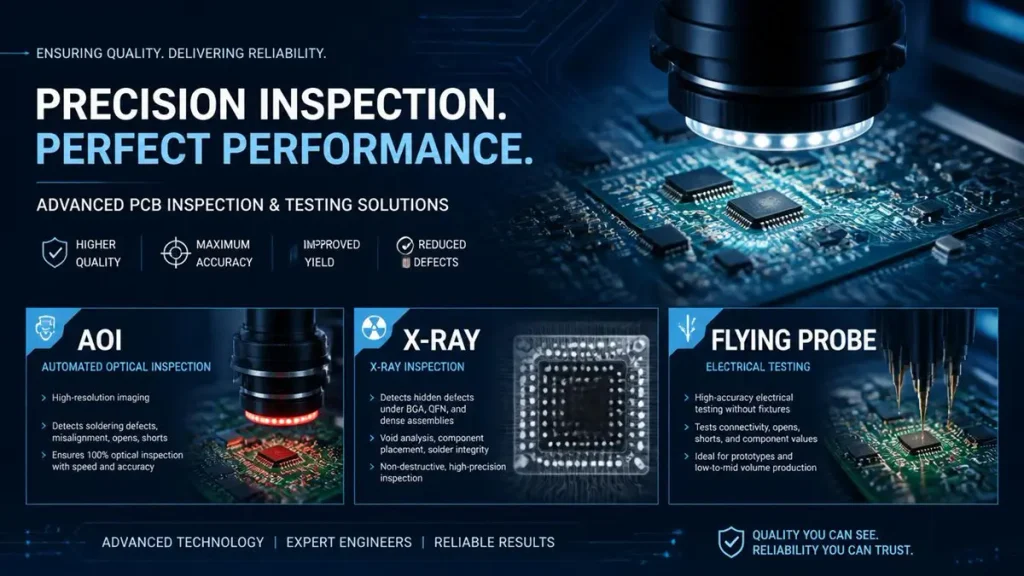
PCB Inspection and Testing Methods: AOI, X-Ray & Flying Probe
Different defects require different inspection methods. We apply the method that matches the risk profile of your board:
| Method | Main Purpose | Typical Defects or Risks Detected |
|---|---|---|
| SPI | Verify solder-paste printing | Excess, insufficient, offset, bridging risk |
| AOI | Inspect visible solder joints and components | Missing, misaligned, wrong-polarity, solder defects |
| X-ray | Inspect hidden solder joints | BGA voids, opens, shorts, hidden defects |
| ICT | Check electrical test points and components | Open circuits, shorts, component-value faults |
| Flying probe | Test low-volume boards without fixed tooling | Electrical continuity and net-level faults |
| Functional test | Verify product operation | System-level performance failures |
| Visual inspection | Final workmanship review | Cosmetic, labeling, and assembly issues |
Flying probe testing in particular is well suited to low-volume runs, since it avoids the cost and lead time of building a dedicated ICT fixture.
Technical Capabilities
We work with FR-4 and high-Tg materials, halogen-free materials, flexible and rigid-flex PCBs, heavy copper or power boards, aluminum-backed LED boards, controlled-impedance boards, and high-density interconnect (HDI) boards, supporting fine-pitch and BGA packages under both leaded and lead-free processes. Conformal coating, encapsulation, and box-build services are available for finished assemblies.
Rather than list every theoretical capability, we publish the limits that actually matter to your design review:
- Minimum component size
- Maximum PCB dimensions
- Placement accuracy
- Smallest supported pitch
- Maximum board thickness
- Maximum copper weight
- BGA pitch range
- Number of active SMT lines
- Supported soldering profiles
Ask for our current capability sheet during your RFQ — we’ll confirm the specific limits relevant to your board.
Quality Standards and Certifications
Depending on your application, our production is governed by:
- IPC-A-610 workmanship criteria
- IPC J-STD-001 soldering requirements
- ISO 9001 quality management
- ISO 13485 for medical-device manufacturing, where applicable
- IATF 16949 for automotive programs, where applicable
- AS9100 for aerospace programs, where applicable
- RoHS and REACH compliance
- ESD-controlled production
- Component and process traceability
We provide certificate name, issuing body, certificate number, scope, expiration date, and applicable facility for any certification cited to a customer — request documentation as part of your supplier qualification process.
Low Volume PCB Assembly Cost and Lead Time
Main Cost Drivers
Low-volume unit pricing is shaped by:
- PCB material and layer count
- Board size and panel utilization
- Component count and package complexity
- Number of assembly sides
- Stencil and tooling requirements
- Component availability and sourcing model
- Testing requirements
- Programming
- Conformal coating
- Shipping method
- Engineering changes between revisions
We don’t publish an artificial “starting price,” since a meaningful quote depends on your actual file package and requirements — but we’ll walk through each of these drivers with you during the RFQ.
Typical Lead-Time Stages
Lead time for a low-volume build is the sum of several distinct stages: engineering review, component sourcing, PCB fabrication, assembly, testing, and shipping. We break out an estimate for each stage so you know where time is being spent and where there’s room to compress the schedule.
How to Reduce Cost Without Increasing Risk
The most reliable ways to control cost at low volume are a clean DFM review before the build starts, early identification of long-lead or obsolete components, and panelization that makes efficient use of board area — not cutting corners on inspection or testing.
How to Select a Low Volume PCB Assembly Supplier
- Technical capability — confirm actual limits for pitch, package size, board dimensions, and layer count against your design
- Quality and testing — ask which inspection methods apply to your board and why
- Component sourcing — clarify turnkey, partial turnkey, or consigned responsibility and how obsolescence risk is handled
- Communication and logistics — verify response times, documentation practices, and export experience
- Scalability — confirm the supplier can carry your design from prototype through small-batch and into higher-volume production without a disruptive re-qualification
Low Volume PCB Assembly Case Studies
- 20-board industrial-controller prototype — first-article build supporting a functional-test cycle ahead of a design freeze
- 100-board medical-device pilot build — pilot production run supporting a compliance-testing milestone
- 500-board IoT gateway production run — transition from engineering validation into small-batch production
- BGA-based communications module — fine-pitch BGA assembly with X-ray inspection for hidden-joint verification
- Mixed SMT/THT power-control board — combined process flow with selective soldering for through-hole power components
- High-mix, multi-revision product launch — coordinated assembly across several BOM variants sharing a common platform
(Detailed case studies with application, challenge, process, and measurable outcome available on request.)
Frequently Asked Questions
What is low volume PCB assembly?
It’s the assembly of a limited quantity of circuit boards — typically ranging from a handful of prototypes to a few hundred or low-thousand units — with an emphasis on flexibility, fast engineering turnaround, and support for design changes between builds.
What quantity is considered low volume?
It depends on the stage of your project: prototype builds are usually 1–20 units, engineering validation runs 20–100 units, and small-batch production spans roughly 100–1,000 units. There isn’t one universal number across the industry.
Do you have a minimum order quantity?
We support no-MOQ and low-MOQ orders. Exceptions can occur when a component’s packaging or procurement terms impose their own minimum — we’ll flag this during BOM review if it applies to your design.
How much does low volume PCB assembly cost in China?
Cost depends on board complexity, component count and package types, layer count, tooling, testing requirements, and shipping method. Send your Gerber files and BOM for an itemized quote.
How long does low volume PCB assembly take?
Total lead time is the sum of engineering review, component sourcing, PCB fabrication, assembly, testing, and shipping — each stage is estimated separately in your quote.
Can you source all components?
Yes, under a turnkey model. We also support partial turnkey (manufacturer sources selected parts) and consigned or kitted assembly (customer supplies components), depending on your supply-chain requirements.
Do you support BGA and fine-pitch components?
Yes. Specific pitch and package limits are confirmed against your design during the DFM review — request our current capability sheet for exact figures.
What files are required for an assembly quote?
Gerber or ODB++ files, BOM, pick-and-place file, assembly drawings, and any relevant test requirements. Schematic and fabrication drawings help accelerate the review.
What inspection methods do you provide?
SPI, AOI, X-ray, ICT, flying probe, and functional testing — applied based on the defect risk and complexity of your specific board.
Can you assemble lead-free PCBs?
Yes, with multi-zone reflow profiling calibrated for lead-free solder alloys and full compliance documentation.
Can you support prototype-to-production scaling?
Yes. Process control, BOM management, testing rigor, and documentation are structured to scale with your order quantity, so moving from prototype to small-batch to higher-volume production doesn’t require starting the qualification process over.
How do you protect customer IP?
Through NDA handling, access control on design files, and defined production-confidentiality procedures throughout engineering review, sourcing, and assembly.
Request a Low Volume PCB Assembly Quote
Files to Upload
- Gerber or ODB++ files
- Bill of materials (BOM)
- Pick-and-place file (if available)
- Assembly drawings or schematic (optional, speeds up review)
Information Needed for a Fast Quotation
- Estimated quantity
- Target delivery date
- Assembly type (SMT, THT, or mixed)
- PCB dimensions and layer count (optional)
- Sourcing model preference: turnkey, partial turnkey, or consigned (optional)
- Testing or certification requirements (optional)
What Happens After RFQ Submission
- File-package review and confirmation of receipt
- BOM availability analysis and component-risk notes
- DFM/DFA feedback
- Tooling and stencil requirements, if applicable
- Estimated lead time and shipping options
- Itemized quotation with stated assumptions
- Any engineering questions requiring clarification before production
Get a Low Volume PCB Assembly Quote — upload your Gerber files and BOM, or contact our engineering team directly to discuss your project.
About Author
David Chen https://www.linkedin.com/in/pcbcoming
David Chen boasts an extensive professional background in PCBA manufacturing, PCBA testing, and PCBA optimization, with specialized expertise in high-precision PCBA fault analysis and rigorous PCBA reliability testing. The author has worked with high-layer-count server PCB fabrication, ultra-low-loss backplane stackups, and thermo-mechanical reliability optimization for AI infrastructure projects involving 112G and 224G PAM4 architectures. Skilled in complex circuit design and cutting-edge advanced PCB manufacturing processes, he delivers solutions that elevate product durability and performance across industrial applications. His technical articles focusing on PCBA manufacturing workflows and testing methodologies are widely cited by industry peers, research institutions, and technical platforms, solidifying his reputation as a recognized technical authority in the global circuit board manufacturing sector.