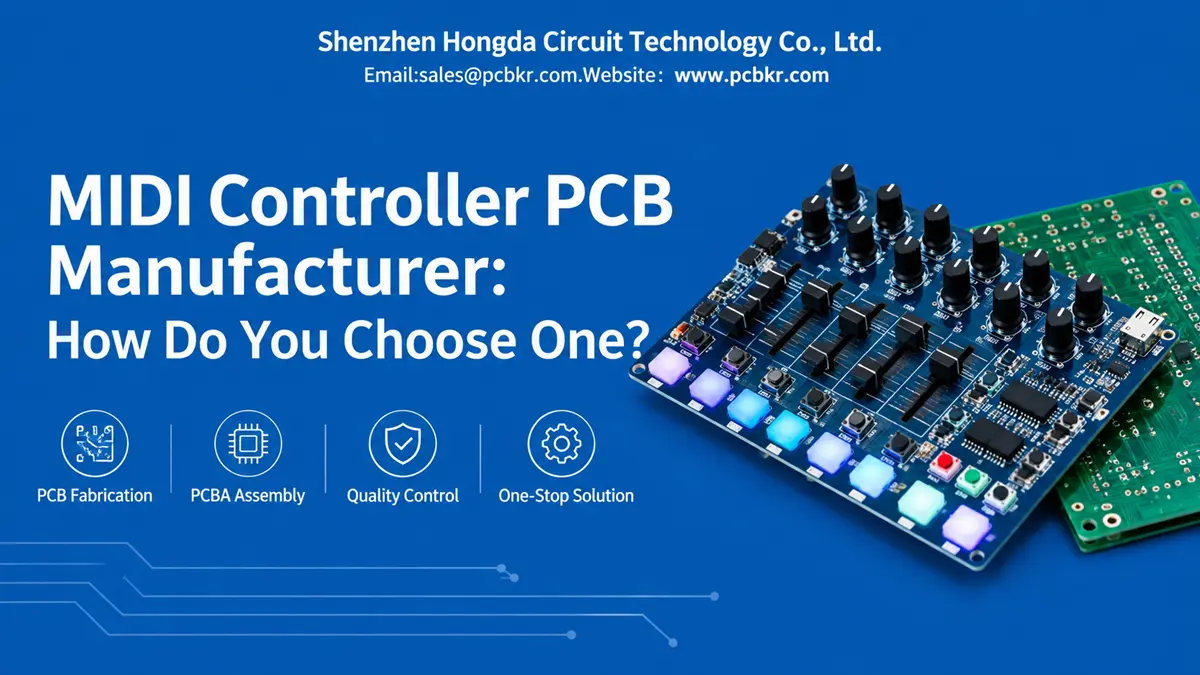
How Do You Choose a MIDI Controller PCB Manufacturer?
A reliable MIDI controller PCB manufacturer should support custom PCB fabrication, component sourcing, SMT and through-hole assembly, design-for-manufacturing (DFM) review, and clearly defined inspection and testing. For OEM buyers, the right supplier must also manage connector alignment, control-component placement, BOM availability, revision changes, and the transition from prototype builds to repeat production.
What Should Buyers Look for in a MIDI Controller PCB Manufacturer?
Buyers should evaluate engineering support, fabrication capability, PCBA assembly, quality verification, sourcing transparency, and production scalability together—not compare suppliers on bare-board price alone.
A MIDI controller PCB can be relatively simple or mechanically demanding, depending on the product. A compact USB-MIDI interface has different requirements from a DJ control surface containing multiple faders, rotary encoders, switches, RGB LEDs, and panel-mounted connectors.
Before requesting a quotation, establish whether the supplier can support the complete manufacturing scope.
| Procurement criterion | What buyers should verify | Why it matters |
|---|---|---|
| PCB fabrication | Layer count, board dimensions, thickness, copper weight, surface finish, and tolerance requirements | Determines whether the design can be manufactured consistently |
| PCB assembly | SMT, through-hole, and mixed-technology assembly requirements | Supports different connector and control-component designs |
| Component sourcing | Approved manufacturers, genuine-part sourcing, lead times, and substitution approval | Reduces procurement delays and unauthorized substitutions |
| DFM review | Footprints, clearances, solderability, panelization, and assembly access | Identifies preventable production problems before tooling or assembly |
| Quality inspection | Applicable AOI, X-ray, electrical testing, and documented inspection criteria | Helps establish objective acceptance requirements |
| Production planning | Prototype, pilot, repeat-order, and forecast-volume requirements | Makes it easier to plan a controlled production ramp |
A capable supplier should explain not only what it can manufacture, but also which requirements need further engineering review before a firm quotation can be issued.
For OEMs and product developers, this distinction matters: a board that can be fabricated is not necessarily a board that can be assembled efficiently, tested appropriately, and reproduced without repeated engineering changes.
Which PCB Design Features Affect MIDI Controller Manufacturing?
MIDI Controller PCB Manufacturer: How Do You Choose One?
A reliable MIDI controller PCB manufacturer should provide dependable PCB fabrication, custom PCBA assembly, component sourcing, design-for-manufacturing (DFM) review, and clearly defined quality controls. For OEM buyers, the right partner must also manage connector alignment, control-component assembly, BOM availability, and the transition from prototypes to repeat production without compromising the approved design.
What Should Buyers Look for in a MIDI Controller PCB Manufacturer?
Buyers should evaluate engineering support, fabrication capabilities, assembly processes, quality verification, component sourcing, and production planning together. Comparing suppliers on bare PCB price alone can overlook costs and risks that emerge during assembly or repeat production.
MIDI controller products range from compact USB-MIDI interfaces to complex DJ control surfaces with rotary encoders, faders, switches, and RGB LEDs. Their manufacturing requirements can differ significantly.
| Procurement criterion | What buyers should verify | Why it matters |
|---|---|---|
| PCB fabrication | Layer count, dimensions, board thickness, copper weight, surface finish, and tolerances | Confirms compatibility with the design and intended application |
| PCB assembly | SMT, through-hole, and mixed-technology assembly capabilities | Supports different component and connector requirements |
| Component sourcing | Manufacturer part numbers, availability, approved alternatives, and sourcing policy | Helps reduce shortages and unauthorized substitutions |
| DFM review | Footprints, clearances, panelization, solderability, and assembly access | Identifies manufacturing risks before production |
| Quality inspection | Applicable AOI, X-ray, electrical testing, and documented acceptance criteria | Establishes an objective basis for quality evaluation |
| Production planning | Prototype quantity, pilot quantity, forecast demand, and delivery schedule | Supports a controlled transition to repeat orders |
A qualified manufacturing partner should explain which requirements can be met directly, which require further engineering review, and which need confirmation before quotation.
For OEM buyers, the goal is not simply to find a factory that can produce a PCB. It is to find a supplier that can manufacture the approved design consistently, communicate production risks early, and provide a clear basis for evaluating delivered quality.
Which PCB Design Features Affect MIDI Controller Manufacturing?
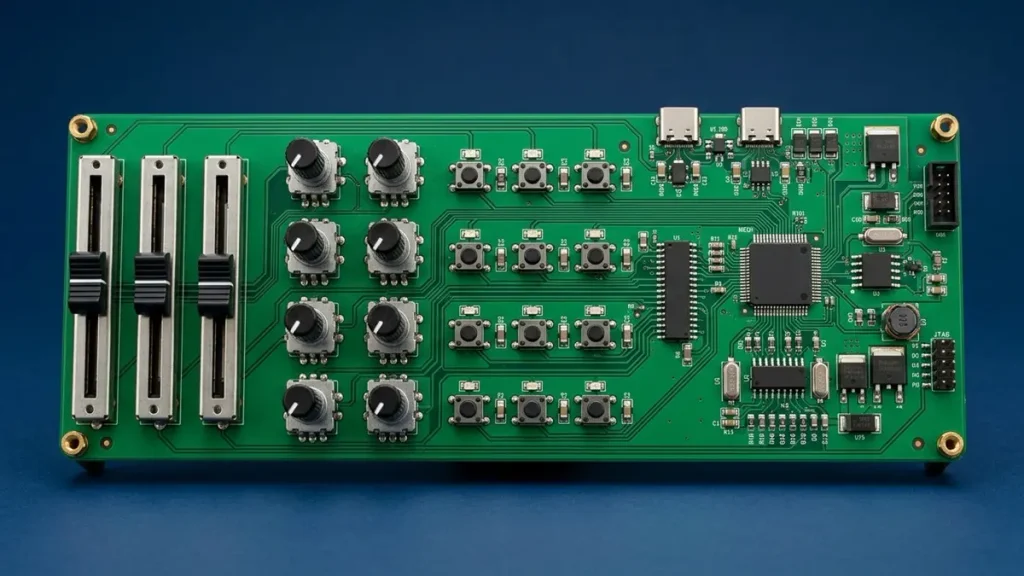
MIDI Controller PCB Manufacturer – Custom PCB Design Features
The main manufacturing risks often arise from the interaction between electrical design, mechanical layout, component selection, and assembly requirements.
| MIDI controller application | Typical design features | Manufacturing priorities |
|---|---|---|
| MIDI keyboard | Key switches, switch matrices, diodes, and connectors | Footprint accuracy, switch alignment, and assembly consistency |
| DJ controller | Faders, rotary encoders, buttons, and RGB LEDs | Component orientation, mechanical fit, and soldering quality |
| USB-MIDI interface | USB connector, protection components, and communication circuitry | Connector footprint, routing requirements, and interface verification |
| Drum pad controller | Trigger inputs, sensor connectors, and analog circuits | Connector reliability, signal-path assembly, and agreed functional checks |
| Motorized fader controller | Motor drivers, power paths, and feedback circuits | Current-carrying requirements, thermal considerations, and mechanical clearance |
| Compact control surface | Dense switches, encoders, LEDs, and small connectors | Routing density, assembly access, and component availability |
How Should Switch Matrices and Control Inputs Be Reviewed?
A switch matrix can reduce the number of microcontroller I/O pins required for a keyboard or button array. However, the correct circuit depends on the microcontroller, firmware, scanning method, and simultaneous-input requirements.
Some matrix designs require isolation diodes to prevent unwanted current paths when multiple switches are pressed. Other designs may use direct GPIO connections when the available pins and electrical requirements permit it.
The PCB manufacturer should not change the approved circuit based on assumptions about firmware behavior. Buyers should provide the released schematic, BOM, and design notes. Any proposed changes to matrix topology, diode selection, or component footprints should receive approval from the design owner before production.
This is particularly important when transferring a working prototype into repeat manufacturing. An unapproved design change can introduce faults even when the revised board appears physically correct.
What Should Buyers Check Around USB and MIDI Connectors?
USB-C connectors, DIN MIDI connectors, TRS jacks, board-to-board connectors, and panel-mounted controls must fit both the PCB and the finished enclosure.
Before production, review:
- Connector footprints and recommended land patterns.
- Pin numbering, orientation, and polarity.
- Board-edge clearances and insertion space.
- Mechanical support and solder-joint loading.
- Mounting holes, standoffs, and enclosure openings.
- Electrical clearances and routing requirements.
- Accessibility for assembly, inspection, and service.
For USB interfaces, controlled-impedance routing may be required by the relevant USB implementation. The impedance target, routing geometry, stackup, and test requirements should follow the actual design specification rather than a generic assumption about all MIDI controllers.
A bare-board inspection cannot establish that USB communication, firmware, or the complete MIDI application works correctly. Buyers should distinguish PCB fabrication acceptance from assembled-product functional acceptance.
How Can Advanced PCB Manufacturing Technology Improve MIDI Controller Production?
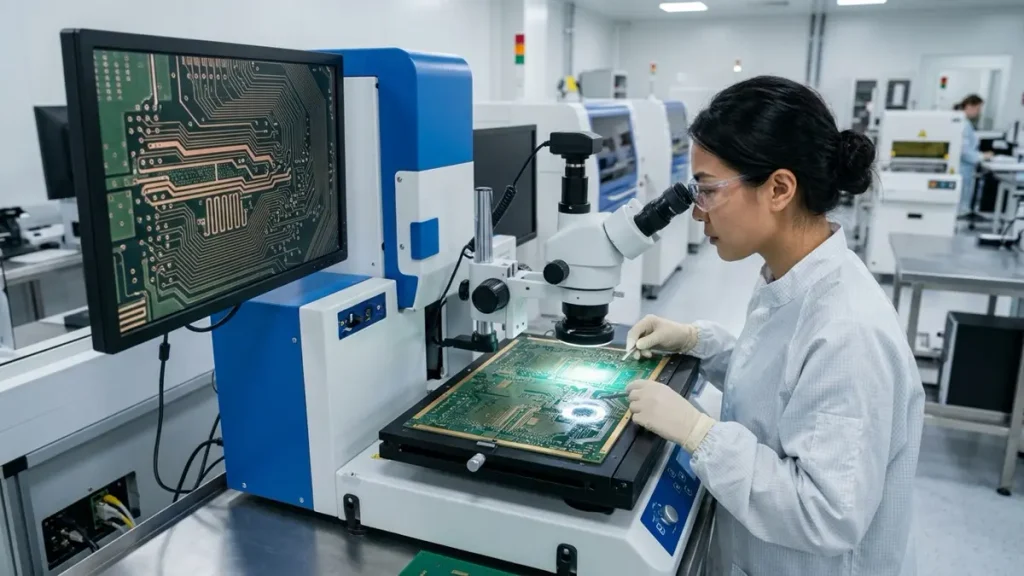
MIDI Controller PCB Manufacturer – Advanced PCB Manufacturing Technology
Advanced PCB manufacturing technology can improve circuit imaging, registration control, interconnect fabrication, and defect detection. Its value depends on the design: a conventional two-layer controller does not automatically need HDI, microvias, or specialized fine-line processing.
PCBKR reports manufacturing equipment and processes that include SCREEN Ledia laser direct imaging (LDI), Mitsubishi UV/CO₂ laser drilling, LAUFFER lamination equipment, and picosecond laser processing. The company also reports access to automated optical inspection (AOI), X-ray inspection, four-wire Kelvin flying-probe testing, and vector network analyzer (VNA) measurement capability.
These capabilities can be relevant to different PCB requirements, but the appropriate process and inspection scope must be confirmed for each project.
| Technology or capability | Potential manufacturing benefit | What buyers should confirm |
|---|---|---|
| SCREEN Ledia LDI | Circuit imaging and pattern-registration control | Achievable line/space and registration for the specified board construction |
| Mitsubishi UV/CO₂ laser drilling | Microvia fabrication for suitable HDI designs | Via structure, material compatibility, and process qualification |
| LAUFFER lamination equipment | Controlled lamination for multilayer constructions | Stackup, material system, dimensional stability, and process requirements |
| Picosecond laser processing | Specialized precision processing for suitable features | Whether the required feature is compatible with the process |
| AOI | Detection of inspectable circuit-pattern or assembly defects | Inspection stage, coverage, and acceptance criteria |
| X-ray inspection | Examination of selected hidden solder joints and internal structures | Whether the package types and project risks justify X-ray inspection |
| Four-wire Kelvin flying-probe testing | Low-resistance measurements using an appropriate test method | Test access, measurement limits, and required reporting |
| VNA measurement | Characterization of applicable RF or high-frequency structures | Whether the project requires this measurement and has a defined test method |
Equipment specifications alone do not guarantee that every design can be manufactured to a particular tolerance. Material selection, board construction, copper thickness, process qualification, and the complete design must also be considered.
Does a MIDI Controller PCB Need HDI or mSAP Technology?
Not necessarily. Most MIDI controller designs should use the simplest PCB construction that meets their electrical, mechanical, and production requirements.
A conventional two-layer or multilayer board may be sufficient for a standard control surface. HDI or fine-line processing becomes relevant when a compact enclosure, dense component placement, or routing constraints exceed the practical limits of a conventional design.
For projects where routing density is a genuine constraint, buyers can review PCBKR’s HDI PCB manufacturing capabilities and microvia PCB manufacturing capabilities.
PCBKR reports mSAP fine-line processing capability at 8/8 µm. This is a specialized process reference, not a recommendation that every MIDI controller should use such fine features. The appropriate manufacturing process should be selected against the actual design requirements and cost target.
For procurement teams, the key question is whether advanced technology solves a specific routing or size constraint. Unnecessary complexity can increase manufacturing cost and qualification effort without improving the intended product.
How Should MIDI Controller PCB Fabrication and Assembly Be Planned?
PCB fabrication and assembly should be reviewed as one coordinated manufacturing package, even when they are quoted as separate services.
A typical project may include bare-board fabrication, component procurement, SMT assembly, through-hole assembly, inspection, electrical checks, and agreed functional testing. The actual scope depends on the design and the supplier’s confirmed capabilities.
What Files Are Required for a MIDI Controller PCB Assembly Quote?
A complete RFQ package helps suppliers evaluate manufacturability, estimate costs, check component availability, and identify missing information before production begins.
| RFQ document or requirement | Information to provide | Procurement benefit |
|---|---|---|
| PCB fabrication files | Gerber or ODB++ data and drill files | Defines the board geometry and manufacturing data |
| Fabrication drawing | Layer count, board thickness, copper weight, finish, and tolerances | Establishes the required board construction |
| Stackup and material requirements | Material type and layer arrangement, where applicable | Supports consistent fabrication planning |
| BOM | Manufacturer part numbers, quantities, and approved alternatives | Enables component availability and cost checks |
| Pick-and-place file | Reference designators, coordinates, rotations, and units | Defines automated component placement |
| Assembly drawings | Orientation, polarity, and special assembly instructions | Reduces interpretation and assembly errors |
| Mechanical documentation | Board outline, mounting holes, enclosure interfaces, and critical dimensions | Helps identify mechanical-fit risks |
| Production requirements | Prototype quantity, pilot quantity, forecast volume, and target schedule | Supports production and capacity planning |
| Test and acceptance criteria | Required electrical tests, functional checks, and reports | Defines how the delivered product will be accepted |
If the design is still changing, identify the current revision and clearly mark preliminary files. Conflicting BOMs, placement files, and drawings should be resolved before the production data package is released.
Should Buyers Choose Turnkey PCBA or PCB-Only Manufacturing?
The right model depends on how much manufacturing and supply-chain coordination the buyer wants the supplier to manage.
PCB-only manufacturing is suitable when the buyer already has a qualified assembly partner or manages components and assembly internally.
Turnkey PCBA can consolidate bare-board fabrication, component sourcing, assembly, and agreed inspection or testing through one supplier relationship. It can simplify coordination, but buyers should verify component sourcing policies, substitution approval, and responsibility for shortages.
Consigned or partial-turnkey assembly can suit projects where the buyer needs to supply proprietary parts or retain control over selected components.
For a meaningful price comparison, request an itemized quotation that identifies bare-board fabrication, components, assembly, setup or tooling where applicable, inspection, testing, packaging, and shipping. A lower headline price may not represent a lower total cost if the quoted scope is incomplete.
What Quality Checks Should Be Defined Before MIDI Controller PCB Production?
Quality requirements should reflect the product’s actual failure risks and agreed acceptance criteria. A generic statement that every board receives comprehensive testing is not a substitute for a defined inspection and test plan.
For bare PCBs, applicable checks may include visual inspection, dimensional verification, circuit-pattern inspection, and electrical continuity or isolation testing. For assembled boards, inspection may include component identity, placement, polarity, and solder-joint quality, with additional methods selected according to the design.
A practical quality plan should distinguish the following stages:
- Design and fabrication review: Confirm manufacturing data, stackup, drill information, board dimensions, and critical tolerances.
- Bare-board verification: Apply the agreed visual, dimensional, and electrical acceptance requirements.
- Assembly inspection: Verify component identity, orientation, placement, and soldering quality.
- Application-specific testing: Perform agreed electrical or functional tests where suitable test access, fixtures, firmware, and procedures are available.
- Production release: Document the approved revision, relevant inspection results, accepted deviations, and delivery requirements.
AOI can detect certain visible defects, while X-ray can reveal selected hidden-joint conditions. Neither method independently proves that the entire MIDI controller functions correctly. Likewise, bare-board electrical testing does not validate firmware, USB enumeration, MIDI message handling, or fader calibration.
For a controller containing USB interfaces, encoders, faders, LEDs, or analog trigger inputs, buyers should specify which functions require verification and provide the required test procedure or acceptance criteria.
PCBKR reports AOI, X-ray, and four-wire Kelvin flying-probe testing capabilities. The methods, coverage, and deliverables applicable to an order should be confirmed before quotation and production.
How Can Buyers Control MIDI Controller PCB Cost and Lead Time?
The most effective cost control begins before production. Board dimensions, layer count, material selection, copper requirements, component availability, assembly complexity, and testing scope all influence the final quotation.
| Cost or schedule driver | Recommended procurement action |
|---|---|
| Board size and layer count | Use a construction that meets routing and mechanical requirements without unnecessary complexity |
| Fine-line or specialized processes | Confirm whether the design actually requires HDI, microvias, or fine-line fabrication |
| BOM availability | Identify obsolete, allocation-prone, or long-lead components before approval |
| SMT and through-hole assembly | Review component access, connector handling, and special soldering requirements |
| Mechanical tolerances | Define critical dimensions rather than applying unnecessarily tight tolerances everywhere |
| Test requirements | Agree on coverage, acceptance limits, and reports before quotation |
| Design revisions | Freeze the production revision and document engineering changes |
| Order quantity | Compare prototype, pilot, and forecast-volume pricing on a consistent basis |
Lead time should be divided into engineering review, component procurement, bare-board fabrication, assembly, testing, and shipping. Component availability can become the schedule constraint even when PCB fabrication itself is straightforward.
Ask the supplier to state when the quoted lead time begins, whether material availability is assumed, and which engineering approvals must be completed first. A realistic schedule should reflect the actual BOM and manufacturing package rather than a generic production estimate.
How Can a MIDI Controller PCB Move from Prototype to Mass Production?
A working prototype is an important milestone, but it does not automatically establish that the design is ready for repeat production.
A controlled production transfer helps preserve the approved electrical and mechanical design while reducing avoidable manufacturing uncertainty.
Stage 1: Prototype review
Confirm the released design files, board dimensions, footprints, connector interfaces, and issues found during initial assembly.
Stage 2: DFM review
Check fabrication tolerances, panelization, component availability, soldering access, polarity markings, and differences between prototype and production processes.
Stage 3: Pilot build
Build a representative quantity using the intended manufacturing process. Record assembly defects, sourcing issues, mechanical-fit problems, and necessary design changes.
Stage 4: Revision approval
Resolve identified issues and approve the final BOM, fabrication data, assembly files, and test criteria. Record authorized engineering changes so that the production version remains traceable.
Stage 5: Repeat production
Use the approved data package, sourcing rules, inspection plan, and acceptance criteria for subsequent orders. Monitor recurring defects and component changes instead of treating every batch as a separate project.
For OEM buyers, the objective is not simply to reduce the prototype price. It is to establish a repeatable process that supports consistent fit, approved components, predictable quality, and realistic delivery schedules.
What Should You Include in an RFQ for Custom MIDI Controller PCB Assembly?
A useful RFQ gives the supplier enough information to evaluate technical feasibility, calculate the manufacturing cost, and identify risks without guessing about the intended product.
Before requesting a quote, prepare:
- Gerber or ODB++ fabrication files and the current revision.
- BOM with manufacturer part numbers and approved alternatives.
- Pick-and-place file and assembly drawings.
- PCB specifications, including dimensions, layer count, thickness, copper weight, and surface finish.
- Mechanical drawings or critical enclosure dimensions.
- Prototype quantity, initial production quantity, and estimated annual demand.
- Required delivery date and shipping destination.
- Component sourcing preferences and substitution-approval rules.
- Inspection, electrical testing, functional testing, and documentation requirements.
- Known problems from previous prototypes or production runs.
If some documents are not ready, identify what is available and which decisions remain open. A preliminary DFM review may help reveal missing requirements before the design is released.
Request a MIDI Controller PCB and PCBA Quote from PCBKR
Shenzhen Hongda Circuit Technology Co., Ltd. supports enquiries for custom PCB manufacturing and assembly. PCBKR reports manufacturing capabilities that include LDI imaging, laser processing, lamination, and inspection and electrical-test equipment. The process route and quality checks for a MIDI controller project should be confirmed against the actual design and order requirements.
To request a quotation, email sales@pcbkr.com with your PCB fabrication files, BOM, assembly drawings, required quantity, and target delivery date.
Please specify whether you require bare PCB fabrication, component sourcing, SMT and through-hole assembly, or turnkey PCBA. If your design is still under development, describe the outstanding engineering questions so the quotation can separate confirmed requirements from items that need further review.
A complete technical package provides a better basis for evaluating manufacturability, total cost, and production scheduling.
Frequently Asked Questions About MIDI Controller PCB Suppliers
How do I choose a reliable MIDI controller PCB manufacturer?
Evaluate the supplier’s PCB fabrication capabilities, assembly processes, component sourcing controls, DFM support, inspection methods, and production planning. Request a written quotation with a clearly defined scope, lead time, acceptance criteria, and documentation. Verify relevant certifications, equipment claims, and project references before placing an order.
How much does custom MIDI controller PCB assembly cost?
The price depends on board dimensions, layer count, materials, copper requirements, order quantity, BOM availability, assembly complexity, and testing scope. Request an itemized quotation covering bare-board fabrication, components, assembly, setup where applicable, inspection, and shipping. Complete manufacturing files help improve quotation accuracy.
Can one supplier handle both MIDI controller PCB fabrication and PCBA assembly?
Yes. A supplier offering both services can coordinate bare-board fabrication, component sourcing, SMT or through-hole assembly, and agreed inspection or testing. Buyers should confirm which services are included, how substitutions are approved, and whether functional testing is included in the quoted scope.
What files are required to get a MIDI controller PCB manufacturing quote?
Suppliers typically need Gerber or ODB++ files, drill files, PCB specifications, a BOM, a pick-and-place file, and assembly drawings. Mechanical drawings, test requirements, order quantities, and delivery targets help complete the RFQ. Clearly identify preliminary files and the current revision if the design is not yet frozen.
Can a MIDI controller PCB manufacturer support prototypes, small batches, and mass production?
This depends on the supplier’s processes, sourcing arrangements, production capacity, and quality controls. Ask how prototype feedback, pilot-build approval, revision control, component availability, and repeat-order consistency are managed. Confirm supported quantities and lead times directly rather than assuming that every supplier offers the same production range.
About Author
David Chen LinkedIn Profile
David Chen is a Senior RF/PCB Process Engineer at Shenzhen Hongda Circuit Technology Co., Ltd., with over 12 years of experience in high-frequency PCB fabrication, impedance-controlled stack-up design, and Rogers/PTFE laminate processing. He also boasts an extensive professional background in PCBA manufacturing, PCBA testing, and PCBA optimization, with specialized expertise in high-precision PCBA fault analysis and rigorous PCBA reliability testing. The author has worked with high-layer-count server PCB fabrication, ultra-low-loss backplane stackups, and thermo-mechanical reliability optimization for AI infrastructure projects involving 112G and 224G PAM4 architectures. Skilled in complex circuit design and cutting-edge advanced PCB manufacturing processes, he delivers solutions that elevate product durability and performance across industrial applications. His technical articles focusing on PCBA manufacturing workflows and testing methodologies are widely cited by industry peers and technical platforms, and have gained attention and recognition from industry colleagues.