Energy Meter PCB Manufacturing and Assembly for OEMs
Energy meter PCB manufacturing requires more than producing a circuit board that matches the Gerber files. OEM buyers need a manufacturing partner that can control fabrication tolerances, maintain assembly consistency, review high-voltage and low-voltage design requirements, and provide inspection records appropriate to the project. Shenzhen Hongda Circuit Technology Co., Ltd. (PCBKR) supports PCB manufacturing and PCBA assembly projects, with engineering and inspection capabilities that can be matched to the board design, production volume, and customer specifications.
For energy meter manufacturers, the most effective supplier evaluation starts with the actual design package, required quality records, component sourcing plan, and the boundary between board-level manufacturing and meter-level calibration or certification.
What Energy Meter PCB Manufacturing Services Do OEMs Need?
An energy meter PCB supplier may be responsible for bare-board fabrication, component assembly, or both. Defining the required scope at the quotation stage helps prevent gaps between the PCB design, assembly process, and final product validation.
Depending on the project, an energy meter PCB may include:
- Voltage-sensing and current-sensing circuits
- Metering ICs and analog front-end components
- Microcontrollers and memory
- Power-supply circuitry
- Display, communication, and interface circuits
- Relays, connectors, and other power-handling components
- Protection, filtering, and isolation-related features
PCBKR can evaluate PCB fabrication and PCBA assembly requirements against the files and specifications supplied by the customer. The quotation should clarify whether the project requires bare PCBs, component sourcing, SMT assembly, through-hole assembly, or a combined manufacturing service.
For buyers seeking a broader manufacturing partner, see our PCB manufacturing services.
How Do Single-Phase and Three-Phase Energy Meter PCBs Differ?
Single-phase and three-phase energy meter PCBs may share some manufacturing processes, but they should not automatically be treated as interchangeable designs.
| Project consideration | Single-phase energy meter | Three-phase energy meter |
|---|---|---|
| Measurement channels | Typically designed around one phase | Typically handles three phases |
| Sensing and signal paths | Defined by the selected metering architecture | May require more sensing channels and additional routing |
| Component placement | Must protect sensitive measurement signals from interference | Must also account for interactions among measurement channels |
| Power and isolation requirements | Determined by the meter design and target application | Determined by the meter design and target application |
| Assembly requirements | Depend on component packages and board construction | May involve a higher component count or more complex assembly |
| Validation | Defined by the customer’s product test plan | Defined by the customer’s product test plan |
These are general design considerations, not universal specifications. Actual requirements depend on the metering IC, current-sensing method, voltage range, rated current, board architecture, and applicable product standards.
Before manufacturing begins, the OEM and supplier should confirm the board revision, critical components, polarity and orientation requirements, connector specifications, and the tests expected at each production stage.
Which PCB Manufacturing Technologies Matter for Energy Meter PCBs?
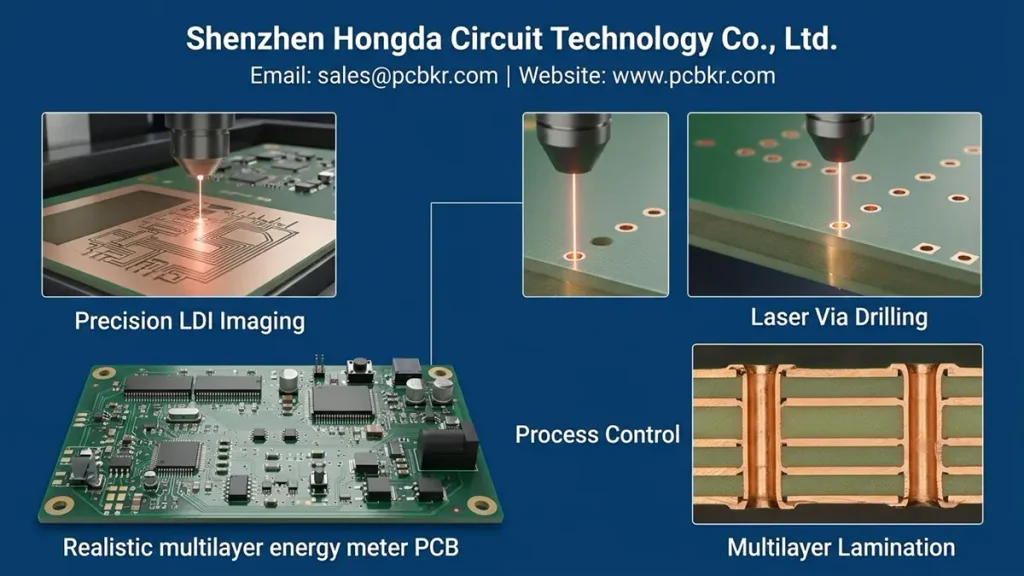
Energy Meter PCB manufacturing technologies including precision LDI imaging, laser drilling, and multilayer PCB fabrication
Advanced PCB equipment matters when it addresses a specific manufacturing risk. A smaller line width, finer laser-drilled feature, or more tightly controlled lamination process is not automatically better for every energy meter. The right process is the one that meets the design requirements with repeatable quality and a commercially sensible cost.
How Does LDI Improve Energy Meter PCB Fabrication?
Laser Direct Imaging (LDI) creates circuit patterns directly from digital design data. PCBKR’s SCREEN Ledia LDI equipment has an 8 µm target capability and a stated ±10 µm precision specification.
This capability is most relevant when a meter design uses fine-pitch components, dense routing, or narrow conductor geometry. Better control of imaging can help support the intended circuit pattern, but the achievable result also depends on copper thickness, laminate characteristics, etching compensation, artwork, and the complete process window.
For conventional meter boards, the supplier should use the feature sizes required by the design rather than automatically applying advanced fine-line processes that may add cost without providing a practical benefit.
How Do Laser Drilling and Lamination Affect PCB Reliability?
PCBKR uses Mitsubishi UV/CO₂ laser equipment with a stated 75 µm ±5 µm capability, alongside picosecond laser processing down to 50 µm for applicable designs.
These processes can be relevant when a board requires small vias, dense component routing, or advanced interconnection structures. They are not necessary for every energy meter PCB. Via diameter, aspect ratio, copper plating, annular ring, and reliability requirements must be assessed together.
For multilayer boards, lamination quality also matters. PCBKR’s LAUFFER lamination equipment supports process settings including 80, 150, and 200 psi, with a stated vacuum level below 50 mbar. The appropriate recipe depends on the material system, stack-up, board thickness, copper distribution, and construction.
The purpose is not to advertise the highest process setting. It is to select and control the process that fits the approved design.
When Are Advanced Fine-Line Processes Useful?
PCBKR has reported mSAP capability at 8/8 µm since Q3 2024. Modified semi-additive processing can support very fine circuit geometries where a design genuinely requires them.
For most energy meter projects, the decision should be driven by layout density, component pitch, electrical spacing, manufacturability, and cost. Fine-line capability is a manufacturing option, not proof that a board is more accurate as a meter.
The key question for an OEM is whether the selected process can manufacture the specified design consistently and whether the supplier can explain its inspection and process-control approach.
How Do PCBKR’s Inspection Capabilities Support Energy Meter PCBA Quality?
Manufacturing equipment is only one part of supplier qualification. Buyers also need to understand how defects are detected, which measurements are recorded, and what evidence is available for each production order.
PCBKR’s reported inspection and measurement capabilities include:
- 3D Automated Optical Inspection (3D AOI): Supports inspection of visible assembly features and solder-joint characteristics that are within the system’s inspection scope.
- X-ray inspection: Helps examine hidden solder joints and internal features that cannot be adequately assessed by ordinary optical inspection.
- Four-wire Kelvin flying-probe measurement: Supports low-resistance electrical measurements where the test setup and board design are suitable.
- Controlled-process capability monitoring: PCBKR has stated a Cpk target of at least 1.33 for applicable controlled processes. The relevant characteristic, measurement method, sample size, and actual data should be confirmed for each project before this target is treated as demonstrated performance.
These methods serve different purposes. AOI does not replace electrical testing; X-ray does not prove every hidden joint is defect-free; and a flying-probe result does not establish the energy meter’s final measurement accuracy.
For an OEM, the practical approach is to agree on the inspection plan before production. This can cover incoming material checks, bare-board electrical testing where specified, assembly inspection, X-ray sampling or coverage where appropriate, and any customer-defined functional tests.
The supplier should also clarify which inspection records can be delivered with the order and which remain internal process records.
How Should High-Voltage Isolation, Power Supply Noise, and EMI Risks Be Reviewed?
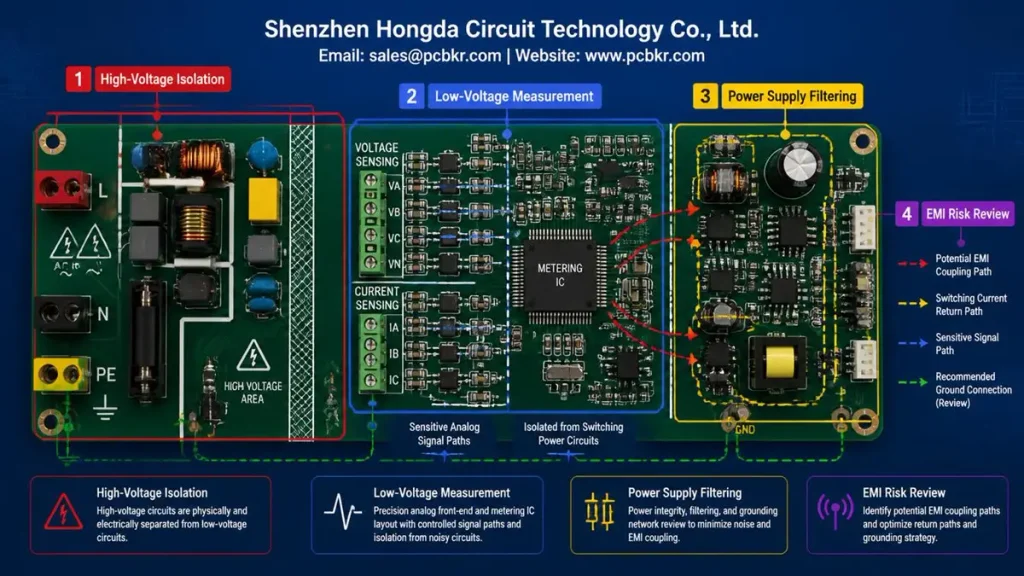
Energy Meter PCB high-voltage isolation, low-voltage measurement circuits, power supply filtering, and EMI risk review
Energy meter designs can combine mains-related circuits with low-voltage measurement, control, display, and communication circuits. The PCB layout must reflect the actual electrical and safety requirements of the finished product.
What Should Be Checked Between High-Voltage and Low-Voltage Circuits?
Creepage distance and electrical clearance are not interchangeable. Clearance concerns the shortest distance through air between conductive parts; creepage concerns the shortest path along an insulating surface.
The required distances cannot be selected from a generic online rule alone. They depend on factors such as working voltage, insulation category, pollution degree, material characteristics, altitude where applicable, and the product standard for the intended market.
During design review, the OEM and manufacturing partner should check:
- Whether the defined isolation boundaries are clearly identified
- Whether component footprints and copper features respect the approved spacing
- Whether vias, pads, solder mask assumptions, and mounting features affect the intended separation
- Whether slots or other structural features are required by the approved design
- Whether the fabrication files and assembly drawings match the reviewed revision
The PCB fabricator can identify manufacturability concerns, but the product designer remains responsible for defining the applicable safety requirements unless that engineering scope has explicitly been assigned elsewhere.
How Can Power-Supply Noise Affect Metering Circuits?
Switching power supplies, digital clocks, communication interfaces, and high-current switching paths can couple unwanted noise into sensitive measurement circuits.
Useful review points include current-loop area, return paths, grounding strategy, filter placement, component positioning, and the physical separation of sensitive analog signals from noisy switching nodes. The effectiveness of these measures must be assessed against the circuit architecture and relevant validation plan.
PCBKR also provides PCB manufacturing options for power-related designs. Where the energy meter includes a dedicated power-supply board or substantial power circuitry, our PCB for power supply page may be relevant.
Important scope distinction: PCB fabrication and PCBA inspection can help implement the approved design, but they do not by themselves certify insulation safety, electromagnetic compatibility, or metering accuracy of the finished meter.
Which Standards Should Energy Meter PCB Buyers Consider?
The applicable requirements depend on the type of meter and the target market. Buyers should identify the required product standards before finalizing the PCB and assembly specifications.
For example, IEC 62053-21:2020 covers particular requirements for static meters measuring AC active energy in specified accuracy classes. IEC 62053-22:2020 addresses specified accuracy classes for transformer-operated static meters measuring AC active energy. These standards apply to defined meter categories and type-test requirements; they are not universal PCB fabrication specifications.
Official references:
- IEC 62053-21:2020 — Static meters for AC active energy
- IEC 62053-22:2020 — Transformer-operated static meters for AC active energy
Before RFQ release, the buyer should confirm the applicable standard and edition, target-market requirements, and the scope of any required type testing. The PCB supplier should receive the relevant layout constraints, material requirements, test specifications, and acceptance criteria.
Do not assume that a PCB manufacturer’s quality-system certification means the finished meter is certified to a metering or safety standard.
How Can You Reduce Energy Meter PCBA Cost Without Increasing Production Risk?
The lowest initial quotation is not always the lowest-cost production option. Cost can be affected by board construction, component availability, assembly complexity, test coverage, yield, and engineering changes.
A practical cost review should consider:
- PCB construction: Confirm that layer count, board thickness, copper weight, surface finish, and tolerance requirements reflect the actual design.
- Component sourcing: Identify long-lead-time, obsolete, or allocation-sensitive components before the production schedule is committed.
- Approved alternatives: Require customer approval for substitutions that affect electrical performance, safety, firmware compatibility, or reliability.
- Assembly process: Review fine-pitch components, through-hole parts, mixed-technology assembly, and any special handling requirements.
- Inspection and testing: Define the required coverage and acceptance criteria instead of leaving test scope ambiguous.
- Order quantity and forecast: Provide prototype quantities, planned production volumes, and expected repeat-order schedules to support a realistic quotation.
PCBKR can assess manufacturing cost against the actual files and requirements supplied. No specific percentage saving or production lead time should be assumed without a project-level review.
What Files Are Required for an Energy Meter PCB Quotation?
A complete RFQ helps the manufacturer evaluate manufacturability, material availability, process requirements, and cost with fewer assumptions.
| RFQ item | Why it matters |
|---|---|
| Gerber or other approved fabrication data | Defines the PCB copper, mask, legend, and related manufacturing layers |
| NC drill files | Defines drilled features and via requirements |
| Stack-up and finished board thickness | Establishes layer construction, dielectric materials, and thickness targets |
| Copper weight and surface finish | Affects fabrication process, electrical design, and cost |
| Bill of Materials (BOM) | Identifies components, approved manufacturers, part numbers, and sourcing requirements |
| Pick-and-place file | Supports component placement for assembly |
| Assembly drawings and polarity information | Clarifies orientation, special assembly instructions, and mechanical details |
| Quantity and forecast | Supports pricing and production planning |
| Test plan and acceptance criteria | Defines the required electrical, assembly, or functional checks |
| Target delivery date and destination | Supports lead-time planning and logistics quotation |
| Applicable product standards | Establishes the relevant design and compliance constraints |
If some files are not yet available, send the current revision and explain what remains open. The quotation can then identify assumptions, missing information, and items that require engineering confirmation.
How Do You Choose a Reliable Energy Meter PCB Manufacturer?
A reliable energy meter PCB manufacturer should be able to explain how it will build the board, inspect the result, manage changes, and communicate manufacturing risks.
During supplier qualification, ask for evidence relevant to your actual project:
- Can the supplier manufacture the specified stack-up, copper weight, feature sizes, and tolerances?
- Which bare-board and PCBA inspection methods are available for this design?
- What quality records can be supplied with the order?
- How are revisions, approved substitutions, and engineering changes controlled?
- Can the supplier support both prototype builds and the planned production volume?
- Which tests are included in the quotation, and which require customer-supplied fixtures or external laboratories?
- Who is responsible for meter calibration, product-level safety validation, and final certification?
A useful supplier response should distinguish verified capability from a proposed process, and should identify any design constraints that need customer approval before production.
PCBKR welcomes overseas OEM and procurement teams to submit their manufacturing requirements for review. Our engineering assessment can begin with the fabrication data, BOM, target quantity, and required quality scope.
Frequently Asked Questions About Energy Meter PCB Manufacturing
How Do I Choose a Reliable Energy Meter PCB Manufacturer?
Compare the supplier’s ability to meet your specified PCB construction, assembly requirements, inspection plan, traceability expectations, and delivery schedule. Request relevant quality records and clarify whether the quotation covers bare-board fabrication, component sourcing, PCBA assembly, and functional testing. Also confirm who is responsible for meter calibration and product-level certification.
What Files Are Required to Get an Energy Meter PCB Quote?
For bare-board fabrication, provide Gerber or approved fabrication data, NC drill files, stack-up, board thickness, copper weight, surface finish, quantity, and required tolerances. For PCBA, also provide the BOM, Pick-and-Place file, assembly drawings, approved part alternatives, and test requirements. Include the target delivery date and destination for a more complete quotation.
Can One Supplier Provide Both Energy Meter PCB Fabrication and PCBA Assembly?
Yes, a supplier offering both services can coordinate bare-board fabrication and component assembly under one manufacturing workflow, provided the required capabilities and materials are available. Confirm whether component sourcing, SMT, through-hole assembly, inspection, and any functional testing are included in the proposed scope. Ask for a clear division of responsibility for tests that require meter-specific fixtures or calibration equipment.
What Affects Energy Meter PCB Manufacturing Cost and Lead Time?
The main factors include board size, layer count, copper weight, material selection, tolerance requirements, surface finish, component availability, assembly complexity, order quantity, and test coverage. Advanced features should be specified only when the design requires them. Complete manufacturing files and early approval of component alternatives can help reduce quotation delays and avoid preventable engineering changes.
How Can I Verify Energy Meter PCBA Quality Before Mass Production?
Agree on the inspection and acceptance plan before ordering prototypes. Depending on the design, this may include bare-board electrical testing, visual inspection, AOI, X-ray inspection, assembly checks, and customer-defined functional tests. Review the results against documented acceptance criteria and confirm which records will be supplied. Meter calibration, accuracy verification, safety testing, and regulatory type testing must be addressed separately when required by the finished product.
Request an Energy Meter PCB Manufacturing Quote
If you are sourcing an energy meter PCB manufacturer for an OEM project, send PCBKR the available fabrication files, BOM, estimated quantity, target delivery date, and required quality or test scope.
Our team can review the information, identify manufacturing questions that need clarification, and prepare a quotation based on the agreed requirements.
Shenzhen Hongda Circuit Technology Co., Ltd. (PCBKR)
Email: sales@pcbkr.com
Website: https://www.pcbkr.com/
To speed up your RFQ, please include: PCB fabrication data, stack-up, BOM, assembly files, quantity, target market, applicable standards, required inspection records, and delivery requirements.
About Author
David Chen LinkedIn Profile
David Chen is a Senior RF/PCB Process Engineer at Shenzhen Hongda Circuit Technology Co., Ltd., with over 12 years of experience in high-frequency PCB fabrication, impedance-controlled stack-up design, and Rogers/PTFE laminate processing. He also boasts an extensive professional background in PCBA manufacturing, PCBA testing, and PCBA optimization, with specialized expertise in high-precision PCBA fault analysis and rigorous PCBA reliability testing. The author has worked with high-layer-count server PCB fabrication, ultra-low-loss backplane stackups, and thermo-mechanical reliability optimization for AI infrastructure projects involving 112G and 224G PAM4 architectures. Skilled in complex circuit design and cutting-edge advanced PCB manufacturing processes, he delivers solutions that elevate product durability and performance across industrial applications. His technical articles focusing on PCBA manufacturing workflows and testing methodologies are widely cited by industry peers and technical platforms, and have gained attention and recognition from industry colleagues.