How to Choose a GPU Carrier Board Manufacturer for AI Accelerators?
How to Choose a GPU Carrier Board Manufacturer for AI Accelerators?
Choosing a GPU Carrier Board manufacturer requires more than comparing PCB prices. OEM buyers should evaluate the supplier’s experience with complex board structures, BGA manufacturing requirements, material sourcing, engineering support, inspection records and production consistency. A qualified supplier should be able to review the actual design, identify manufacturing risks and provide a clear path from prototype to repeat production.
For AI accelerator developers, the right manufacturing partner can help reduce fabrication uncertainty, avoid unnecessary design revisions and improve the reliability of the PCB supply chain.
What Is a GPU Carrier Board and Which Architecture Do You Need?
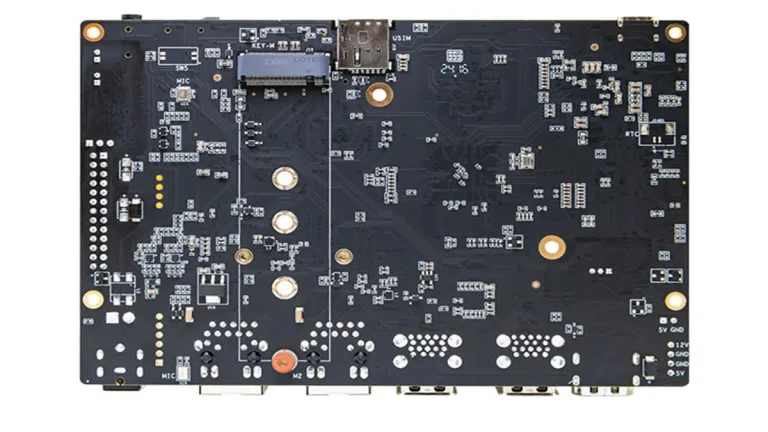
A GPU Carrier Board is a PCB designed to carry, connect or interface with GPU or AI accelerator components within a computing system. Its configuration depends on the accelerator package, system architecture, electrical interfaces, mechanical requirements and power delivery design.
Before contacting a manufacturer, buyers should identify which type of board they need.
| Board type | Typical function | What the PCB manufacturer needs to understand |
|---|---|---|
| Custom GPU Carrier Board | Supports a GPU or accelerator in a customer-specific system | Package footprint, board outline, connectors, routing and power requirements |
| OAM Accelerator Module PCB | Supports an Open Accelerator Module architecture | Module specification, package connections, interface and mechanical requirements |
| Universal Baseboard (UBB) | Connects multiple accelerator modules within a platform | Connector arrangement, interconnection, power distribution and board dimensions |
| PCIe GPU Accelerator Card | Connects a GPU or accelerator through a PCIe interface | PCIe routing, edge connector, mechanical dimensions and power requirements |
| GPU Server System Board | Integrates GPU-related functions with broader server hardware | Multiple interfaces, board architecture, layer structure and system-level constraints |
These configurations should not be treated as interchangeable products. For example, an OAM module and a UBB have different roles in an accelerator platform. A PCIe accelerator card also has different mechanical and interface requirements from a custom carrier board.
The distinction matters commercially. A manufacturer cannot provide an accurate quotation or meaningful DFM feedback without understanding the actual board architecture.
What buyers should prepare: Identify the accelerator platform, package or module, board function, mechanical outline and required interfaces. If the design is proprietary, provide the relevant controlled drawings and specifications.
What Should Buyers Check Before Selecting a GPU Carrier Board Manufacturer?
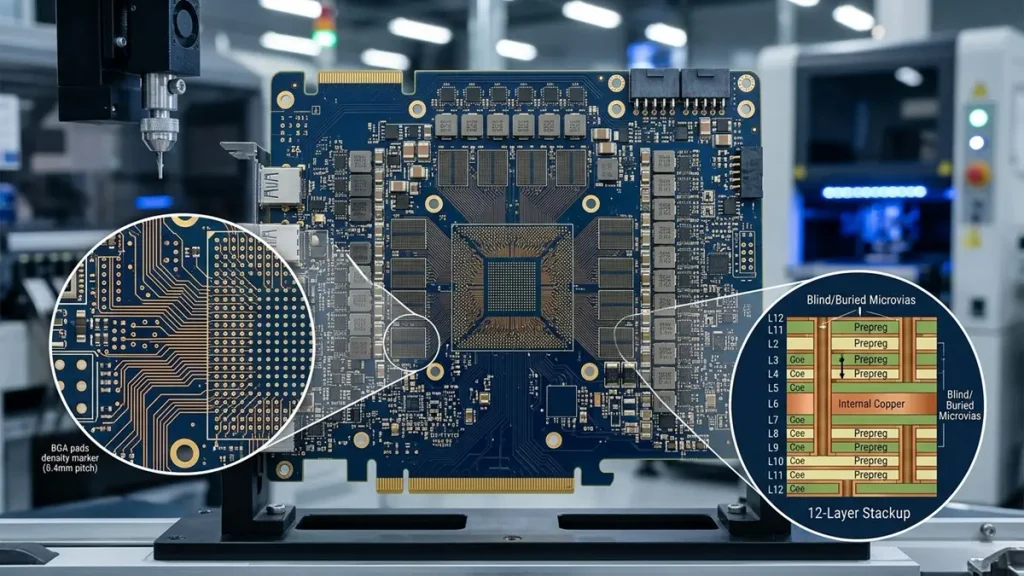
GPU Carrier Board manufacturer HDI and BGA manufacturing capability inspection
A supplier’s general PCB capability list is only the starting point. Buyers need to determine whether the factory can manufacture the specific board structure and maintain the required quality throughout production.
The following areas should be reviewed before placing an order.
| Supplier evaluation area | What buyers should verify | Why it matters |
|---|---|---|
| Board structure | Maximum practical layer count and applicable stackup experience | Confirms whether the proposed construction is manufacturable |
| HDI capability | Microvia structures, sequential lamination and via filling requirements | Supports dense package breakout and complex routing |
| Fine-line fabrication | Finished trace width and spacing under the specified copper conditions | Helps assess routing feasibility |
| Material sourcing | Availability of the specified laminate and copper foil | Reduces material substitution and procurement risks |
| Impedance control | Engineering review, coupon design and measurement reports | Supports compliance with electrical specifications |
| Drilling and backdrilling | Applicable mechanical and laser drilling processes | Helps verify complex via requirements |
| Quality inspection | Electrical testing, AOI, X-ray and microsection capability where applicable | Provides evidence of manufacturing conformity |
| Engineering support | DFM review and technical response before production | Identifies problems before tooling and fabrication |
| Production planning | Prototype, pilot and repeat-order arrangements | Helps control lead time and supply continuity |
A supplier should not simply answer that it can manufacture a particular board. It should explain which requirements are within its established process capability, which require engineering review and which may need design adjustments.
For a deeper look at PCBKR’s advanced manufacturing capabilities for AI server and GPU system boards, see GPU System Board Design.
How Can Buyers Verify a Manufacturer’s HDI and BGA Manufacturing Capabilities?
BGA and HDI requirements are among the most important manufacturing considerations for a complex GPU Carrier Board. However, buyers should avoid judging a supplier solely by its smallest advertised laser-via diameter or finest line-and-space figure.
The relevant question is whether the manufacturer can produce the required structure using the specified materials, copper thickness, layer arrangement and production process.
Before approving a supplier, request clarification on the following:
BGA breakout feasibility: Can the factory manufacture the required pad, via and trace geometry? Does the proposed design need microvias, blind vias, buried vias or via-in-pad structures?
Microvia construction: Can the manufacturer support the specified microvia diameter, depth, aspect ratio and interconnection structure?
Via filling and capping: If the design uses via-in-pad, what filling, planarization and copper-capping process is required?
Layer registration: How does the factory control registration between build-up layers and target pads?
Cross-section verification: Can the supplier provide microsection evidence showing the relevant via and copper structures?
DFM feedback: Can the engineering team identify insufficient annular rings, drill-to-copper clearance problems, unsuitable via structures or other manufacturability risks?
PCBKR provides HDI and microvia manufacturing services for complex PCB designs. Buyers can review the relevant process information through the HDI PCB and Microvia PCB pages.
For GPU Carrier Board projects, the final manufacturing structure should be approved against the actual fabrication data rather than selected from a generic capability table.
What Material and Stackup Information Should Be Confirmed Before Ordering?
Material selection and stackup construction affect manufacturing feasibility, electrical performance, dimensional stability and procurement cost.
Buyers should provide the approved material requirements instead of relying on a supplier’s general description of high-speed or low-loss PCB capability.
The following information should be confirmed before quotation:
| Specification | Information buyers should provide | Supplier’s responsibility |
|---|---|---|
| Layer count | Total number of copper layers | Confirm the proposed construction is manufacturable |
| Laminate | Approved manufacturer and material grade | Confirm material availability and processing compatibility |
| Copper weight | Base and finished copper requirements | Confirm the applicable process and finished thickness |
| Dielectric thickness | Required dielectric spacing | Review stackup feasibility |
| Impedance | Target values and tolerances | Review trace geometry and coupon requirements |
| Board thickness | Finished thickness and tolerance | Confirm lamination and dimensional feasibility |
| Surface finish | Required finish, such as ENIG or another approved option | Confirm process suitability |
| Special structures | Backdrilling, via filling or other specified features | Confirm process capability and inspection method |
If a project specifies Megtron, Isola, Doosan or another high-performance laminate family, the exact grade and construction should be stated in the RFQ.
Equivalent material suggestions should not be accepted automatically. Any substitution should be reviewed and approved by the customer’s engineering team, particularly when it affects impedance, insertion loss, thermal behavior or reliability.
For projects requiring high-speed or high-frequency PCB manufacturing, buyers can also review PCBKR’s High-Speed PCB and High-Frequency PCB capabilities.
The objective is not to specify the most expensive material. It is to ensure that the selected material and stackup meet the board’s actual electrical, mechanical and manufacturing requirements.
Which Manufacturing and Inspection Reports Should a Supplier Provide?
A reliable GPU Carrier Board supplier should be able to explain how it verifies the manufactured PCB against the approved fabrication data and purchase specifications.
Buyers should define the required inspection documents before production begins.
| Report or inspection record | What it helps verify | When buyers should request it |
|---|---|---|
| DFM review | Manufacturing risks and proposed engineering changes | Before production |
| Material confirmation | Specified laminate and copper materials | Before and during production, as agreed |
| Stackup confirmation | Approved layer structure and dielectric construction | Before fabrication |
| Electrical test report | Open and short circuit status | As required by the purchase specification |
| Impedance report | Measured impedance against specified targets | For controlled-impedance designs |
| Microsection report | Internal copper, plating and via structure | For specified critical structures |
| AOI records | Circuit-pattern inspection results | According to the agreed inspection plan |
| X-ray inspection report | Applicable internal structures or assembled joints | When required by the board design or PCBA scope |
| Dimensional inspection | Board outline, thickness and critical dimensions | According to drawing requirements |
| First-article inspection | Initial production conformity | Before pilot or repeat production approval |
Not every GPU Carrier Board requires every inspection method. The acceptance plan should be based on the design’s actual risk areas and the agreed purchase specification.
Buyers should also distinguish between bare PCB inspection and PCBA inspection. Electrical continuity testing of a bare PCB does not establish that an assembled board has passed functional testing. Likewise, an X-ray inspection report is not a substitute for a complete electrical or functional test plan.
PCBKR’s reported inspection and test resources include 3D AOI, X-ray, 4-wire Kelvin flying probe and VNA capability up to 70 GHz. The specific inspection method, test frequency and deliverable report should be agreed for each project.
What Factors Affect GPU Carrier Board PCB Manufacturing Cost?
GPU Carrier Board manufacturing cost depends on the board’s physical construction, materials, process complexity, inspection requirements and order quantity.
A low initial quotation does not necessarily represent the lowest total procurement cost. Missing specifications, unsuitable process assumptions or unapproved material substitutions can lead to engineering changes and additional production expense.
The main cost factors include:
| Cost factor | Potential impact on quotation |
|---|---|
| Layer count | More layers generally require more materials and processing steps |
| Board dimensions | Larger panels and boards affect material utilization and production planning |
| HDI structure | Sequential lamination and microvia processes add manufacturing complexity |
| Material grade | High-performance laminates may have higher procurement costs and longer lead times |
| Copper thickness | Heavy copper can require different etching and plating controls |
| Via structures | Via filling, capping, backdrilling and special drilling increase process requirements |
| Surface finish | Different finishes have different material and process costs |
| Inspection requirements | Additional measurements and reports increase testing effort |
| Order quantity | Setup costs and material utilization differ between prototypes and production lots |
| Delivery schedule | Expedited production may affect planning and cost |
How Can Buyers Compare Quotations Fairly?
When comparing GPU Carrier Board suppliers, buyers should make sure each quotation is based on the same technical assumptions.
Check whether the quotation includes:
- The same layer count and stackup
- The same approved laminate and copper foil
- The same HDI and via construction
- The same surface finish
- The same electrical and impedance testing
- The same inspection reports
- The same order quantity and delivery terms
If one supplier excludes microsection inspection or quotes an alternative laminate without identifying the substitution, the prices are not directly comparable.
For procurement teams, a technically complete quotation is more useful than an unusually low price based on incomplete manufacturing information.
What Documents Are Required for a GPU Carrier Board RFQ?
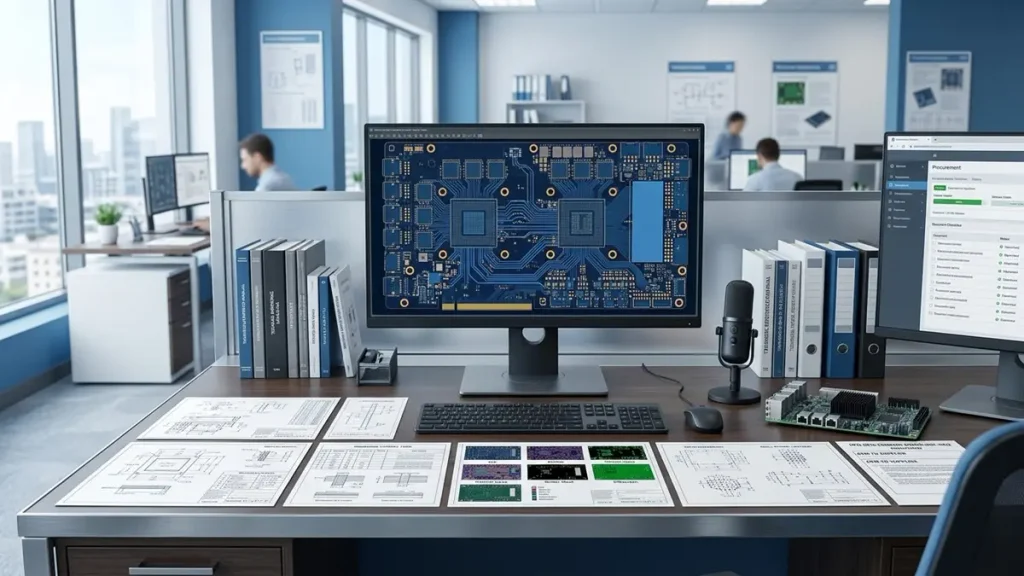
gpu-carrier-board-rfq-required-engineering-documents
A complete RFQ package helps the manufacturer assess feasibility, estimate material requirements and provide a more reliable quotation.
The following documents are recommended.
| RFQ document | Required information |
|---|---|
| Gerber, ODB++ or IPC-2581 | Complete PCB fabrication data |
| Stackup drawing | Layer count, dielectric construction and copper weight |
| Drill files | Mechanical and laser drilling data |
| Backdrill data | Backdrill diameter, depth and residual stub requirements, if applicable |
| Fabrication drawing | Board dimensions, thickness and tolerances |
| Material specification | Laminate manufacturer, material grade and copper foil |
| Impedance requirements | Target impedance, tolerance and coupon requirements |
| HDI details | Microvia structure, via-in-pad, filling and capping requirements |
| Surface finish | Required finish and applicable specifications |
| Quantity forecast | Prototype, pilot and expected repeat-order quantities |
| Delivery requirements | Target lead time and destination |
| Inspection requirements | Electrical, dimensional, impedance and other acceptance criteria |
For PCBA requirements, also provide the BOM, component placement files, assembly drawings and any agreed test requirements.
What If the Design Is Not Yet Complete?
Buyers do not always have a complete manufacturing package at the initial sourcing stage.
If the design is still under development, the manufacturer can begin with the available information, such as:
- Board outline and intended function
- Layer count or preliminary stackup
- Accelerator package and BGA footprint
- Material requirements
- Critical electrical interfaces
- Estimated quantity and target schedule
The manufacturer should identify which missing details prevent an accurate quotation and which can be resolved during engineering review.
Request a GPU Carrier Board DFM Review
Send your available fabrication data and technical requirements to sales@pcbkr.com. PCBKR can review the proposed PCB structure, manufacturing requirements and information needed for quotation.
How Should Buyers Evaluate Prototype and Mass Production Readiness?
A successful prototype does not automatically prove that a supplier can support repeat production. The manufacturing process, materials, inspection criteria and approved design data must remain controlled as the order volume increases.
A practical procurement process should include four stages.
1. Prototype Feasibility Review
Before fabrication, the supplier should review the stackup, drill data, copper requirements, material selection and critical dimensions.
The purpose is to identify design features that may create fabrication risks, unexpected costs or long lead times.
2. First Prototype and Engineering Verification
The first build should be evaluated against the approved drawing and specification.
Depending on the project, this may include:
- Board dimensions and thickness
- Electrical continuity
- Critical via and copper structures
- Impedance coupon results
- Surface finish and visual inspection
- Relevant microsection evidence
Any deviations should be documented and reviewed before the next build.
3. Pilot Production Review
A pilot lot helps buyers evaluate whether the approved process can be repeated beyond a single prototype.
Review the manufacturing records, inspection results, yield information where available, engineering changes and material consistency.
4. Repeat Production Control
Before placing repeat orders, confirm that the supplier has a controlled manufacturing package and clear procedures for managing revisions, materials and process changes.
The approved stackup, fabrication data, inspection criteria and material specifications should be maintained as the production reference.
For OEM buyers, this process helps prevent a common sourcing problem: a prototype that passes initial evaluation but cannot be reproduced consistently under the same technical requirements.
Why Consider PCBKR for Custom GPU Carrier Board Manufacturing?
Selecting a GPU Carrier Board manufacturer requires matching the actual design requirements with the factory’s manufacturing processes, equipment and quality controls.
Shenzhen Hongda Circuit Technology Co., Ltd. provides PCB fabrication and PCBA manufacturing services for customers developing complex electronic hardware.
Relevant manufacturing resources include:
Advanced PCB fabrication: Multilayer, HDI, microvia, high-speed, high-frequency and heavy-copper PCB manufacturing services.
Precision imaging and drilling: SCREEN Ledia LDI, Mitsubishi UV/CO₂ laser drilling and picosecond laser processing for applicable fine-line and microvia requirements.
Multilayer lamination: LAUFFER lamination equipment with configurable pressure and vacuum conditions for applicable multilayer and HDI constructions.
Fine-line processing: Reported mSAP 8/8 μm process capability since Q3 2024, subject to the design and manufacturing conditions.
Inspection and testing: 3D AOI, X-ray, 4-wire Kelvin flying probe and VNA capability up to 70 GHz for applicable inspection and measurement requirements.
These resources support different manufacturing stages. The appropriate process route must be determined from the actual board structure, material system, fabrication data and agreed inspection plan.
For more detailed engineering information about PCBKR’s advanced AI server and GPU board manufacturing work, see GPU System Board Design.
For customers requiring assembly in addition to PCB fabrication, PCBKR also provides SMT, THT and turnkey PCBA services, subject to project review and component availability. See the AI Server Board Turnkey PCBA Solution page for related service information.
Request a GPU Carrier Board Manufacturing Review
If you are sourcing a custom GPU Carrier Board PCB manufacturer for an AI accelerator, GPU server or computing hardware project, PCBKR welcomes your technical inquiry.
Send your available design files, material requirements, target quantity and delivery expectations to:
Shenzhen Hongda Circuit Technology Co., Ltd.
Email: sales@pcbkr.com
Website: https://www.pcbkr.com/
Request a DFM review or quotation for your GPU Carrier Board project.
Frequently Asked Questions About GPU Carrier Board PCB Suppliers
How do I find a reliable GPU Carrier Board PCB manufacturer?
Look for a manufacturer with relevant multilayer and HDI experience, suitable material sourcing, engineering DFM support, defined inspection procedures and the ability to support repeat production. Ask the supplier to review your actual fabrication data and explain how it will manufacture and verify the critical features.
What should I compare when requesting quotes from GPU Carrier Board suppliers?
Compare quotations using the same stackup, laminate, copper thickness, HDI structure, surface finish, testing requirements, inspection documents, quantity and delivery terms. Confirm whether special processes such as via filling, backdrilling or impedance testing are included in the quoted price.
Can a GPU Carrier Board manufacturer support low-volume prototypes?
This depends on the manufacturer’s production planning, material availability and engineering support. Buyers should confirm whether the supplier can manufacture the prototype using a process that can also be evaluated for pilot and repeat production.
How can I verify a GPU Carrier Board manufacturer’s quality before placing a large order?
Request a DFM report, material confirmation, first-article inspection records and applicable electrical, impedance, microsection and dimensional reports. For a critical project, agree on the acceptance criteria and inspection plan before production rather than relying on a general quality assurance statement.
Can one supplier provide both GPU Carrier Board PCB fabrication and PCBA assembly?
Some manufacturers provide both bare PCB fabrication and PCBA services. Buyers should confirm the actual assembly scope, component sourcing arrangements, SMT and THT processes, inspection methods and functional testing requirements. The quotation should clearly distinguish PCB fabrication from assembly and system-level testing.
About Author
David Chen LinkedIn Profile
David Chen is a Senior RF/PCB Process Engineer at Shenzhen Hongda Circuit Technology Co., Ltd., with over 12 years of experience in high-frequency PCB fabrication, impedance-controlled stack-up design, and Rogers/PTFE laminate processing. He also boasts an extensive professional background in PCBA manufacturing, PCBA testing, and PCBA optimization, with specialized expertise in high-precision PCBA fault analysis and rigorous PCBA reliability testing. The author has worked with high-layer-count server PCB fabrication, ultra-low-loss backplane stackups, and thermo-mechanical reliability optimization for AI infrastructure projects involving 112G and 224G PAM4 architectures. Skilled in complex circuit design and cutting-edge advanced PCB manufacturing processes, he delivers solutions that elevate product durability and performance across industrial applications. His technical articles focusing on PCBA manufacturing workflows and testing methodologies are widely cited by industry peers and technical platforms, and have gained attention and recognition from industry colleagues.