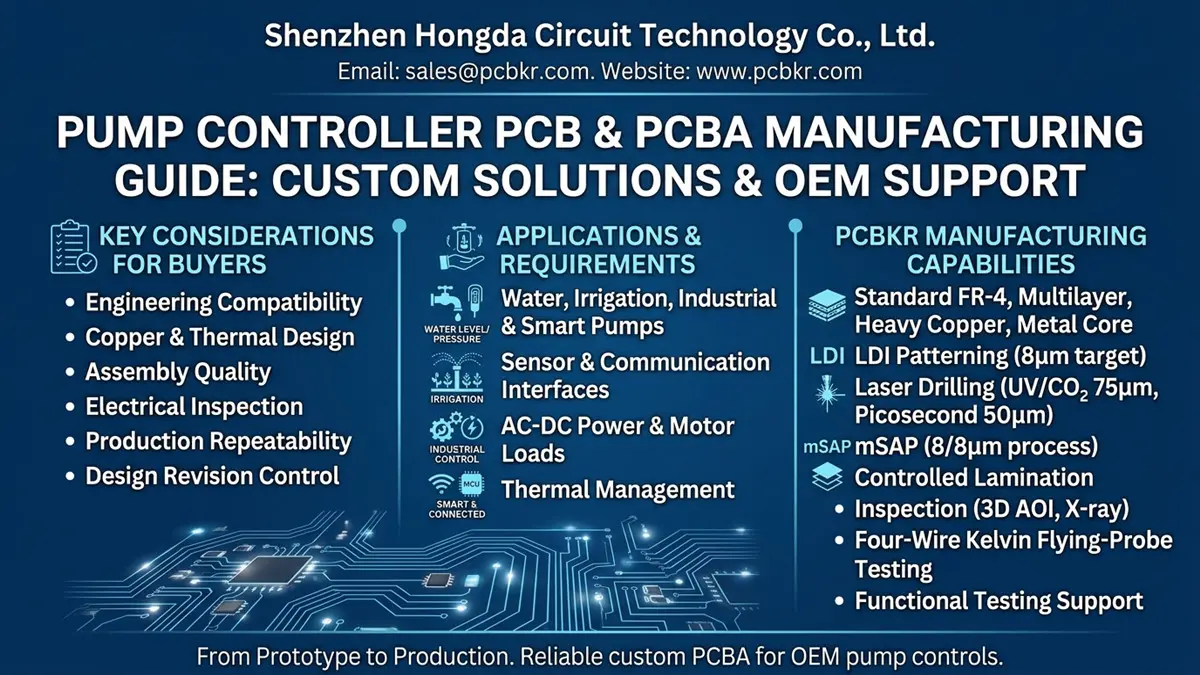
Pump Controller PCB Manufacturer for Custom PCBA
A reliable pump controller PCB manufacturer must do more than fabricate a circuit board to Gerber files. The board must support the required motor-control strategy, switching loads, sensor interfaces, power architecture, and operating environment while remaining manufacturable at the target cost and production volume. Shenzhen Hongda Circuit Technology Co., Ltd. (PCBKR) supports custom PCB fabrication and PCBA manufacturing for OEMs evaluating pump control electronics, from prototype builds to production planning. Share your design files, BOM, annual volume, and test requirements to request a project-specific manufacturing review and quotation.
What Should Buyers Look for in a Pump Controller PCB Manufacturer?
When selecting a pump controller PCB manufacturer, buyers should evaluate engineering compatibility, copper and thermal design, assembly quality, electrical inspection, production repeatability, and the supplier’s ability to work from controlled design revisions.
A supplier quotation is useful only when its scope is clear. Two quotations may appear similar while covering different materials, copper weights, component sourcing, assembly processes, inspection stages, and testing responsibilities.
Before placing an order, confirm the following:
| Procurement requirement | What to clarify before ordering |
|---|---|
| PCB fabrication | Layer count, board dimensions, material, finished thickness, copper weight, surface finish, and tolerances |
| PCBA scope | SMT, through-hole assembly, component sourcing, and customer-supplied parts |
| Power circuit | Continuous current, startup or stall conditions, connector ratings, and thermal constraints |
| Control interfaces | Sensor inputs, relay or driver outputs, communication interfaces, and isolation requirements |
| Inspection | AOI, X-ray where appropriate, bare-board electrical testing, and defined assembly checks |
| Functional verification | Test procedure, fixture ownership, firmware version, operating limits, and pass/fail criteria |
| Production readiness | Approved BOM, component substitutions, revision control, and quality records |
| Commercial terms | Prototype quantity, forecast volume, lead time, tooling or fixture charges, and shipping terms |
For OEM procurement teams, the central question is not simply whether a factory can manufacture a PCB. It is whether the supplier can manufacture the specified revision consistently, identify technical risks before production, and provide evidence that the agreed requirements have been met.
Which Pump Controller PCB Applications Require Different Manufacturing Approaches?
Pump controller boards serve different electrical and environmental requirements. A small domestic water-level controller, an agricultural irrigation controller, and an industrial pump control unit should not automatically be quoted using the same manufacturing assumptions.
Water level and pressure control boards
These designs may receive signals from float switches, pressure sensors, level probes, or other sensing devices. The PCB layout must account for the interface circuitry, connector placement, signal conditioning, and the possibility of electrical noise from switching loads.
For procurement, identify the sensor type, input range, cable arrangement, connector specification, and required response to an open or shorted sensor.
Irrigation and agricultural pump controllers
Irrigation controllers may operate around moisture, condensation, dust, long sensor cables, and outdoor enclosures. The PCB itself is only one part of the protection strategy.
Buyers should clarify the intended enclosure, coating requirements if applicable, connector sealing arrangements, operating temperature and humidity, and the acceptance criteria for environmental validation. Conformal coating should not be treated as a substitute for appropriate enclosure design, spacing, or contamination control.
Industrial pump control boards
Industrial designs may combine sensor interfaces, communication circuits, relays, contactor-control signals, and higher-current power paths. Their manufacturing requirements depend on the actual electrical architecture rather than the application name alone.
For these projects, review the schematic, layer stack-up, component specifications, copper distribution, isolation requirements, and test access before freezing the production files.
Smart and connected pump controllers
Connected controllers may incorporate an MCU, wireless module, display interface, or wired communications. Compact designs can place greater demands on component placement, routing density, return paths, and interference management.
Where the design requires dense interconnections, PCBKR’s HDI PCB manufacturing capabilities may be relevant: https://www.pcbkr.com/hdi-pcb/. The appropriate technology should be selected from the actual routing, pitch, reliability, and cost requirements rather than assumed necessary for every pump controller.
Which PCB Materials, Copper Weights, and Layout Features Matter for Pump Controllers?
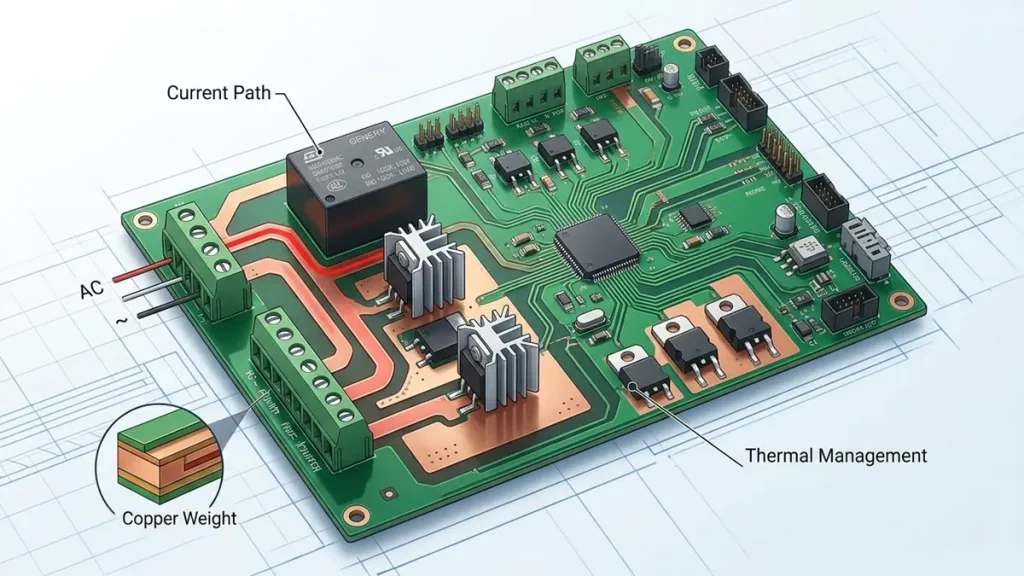
Pump controller PCB design considerations include copper weight, current-carrying paths, component placement, and thermal management.
The appropriate PCB construction depends on current, voltage, heat dissipation, mechanical constraints, environmental exposure, and the required service life. A pump controller should be quoted from its electrical requirements and released design data, not from board dimensions alone.
How should copper weight be selected for pump controller PCBs?
Copper weight affects conductor thickness and can influence current-carrying capability, temperature rise, etching requirements, and manufacturing cost. Common nominal copper weights include:
| Nominal copper weight | Approximate copper thickness | Typical procurement consideration |
|---|---|---|
| 1 oz/ft² | 35 µm | Common starting point for many control and signal boards |
| 2 oz/ft² | 70 µm | May suit designs requiring heavier copper paths |
| 3 oz/ft² | 105 µm | May be considered for higher-current paths where the complete design supports it |
These values are nominal approximations, not a guarantee of current capacity. Actual performance depends on conductor width and length, copper distribution, ambient conditions, allowable temperature rise, layer arrangement, vias, terminal connections, and the relevant design requirements.
For a pump controller with high-current paths, the supplier should review the complete current route, including connector pads, relay contacts or driver connections, copper neck-downs, and transitions between layers. Increasing copper weight alone cannot compensate for an undersized connector or poorly designed thermal path.
For designs that genuinely require heavier copper, PCBKR’s Heavy Copper PCB manufacturing page is a relevant capability reference: https://www.pcbkr.com/heavy-copper-pcb/.
When does a pump controller need thermal-management PCB technology?
Heat can originate from power semiconductors, voltage regulators, resistive elements, relays, and other components. The solution may involve wider copper areas, thermal vias, component spacing, heatsinks, enclosure airflow, or a different PCB construction.
A metal-core PCB may be worth evaluating when concentrated heat and mechanical constraints make it appropriate. It should not be selected merely because the board controls a motor; many pump controllers are better served by a conventional multilayer FR-4 construction and a properly engineered thermal path.
For designs where a metal substrate is justified, see PCBKR’s Metal Core PCB manufacturing capabilities: https://www.pcbkr.com/metal-core-pcb/.
What should be checked for mains-powered pump controllers?
For designs containing mains voltage, the review should include the specified insulation system, creepage and clearance requirements, slots where required, component ratings, connector spacing, and the applicable end-product safety standard.
The necessary spacing cannot be determined from nominal voltage alone. Working voltage, transient conditions, pollution degree, insulation material, and the applicable standard can all affect the requirements.
PCB fabrication does not by itself certify the complete pump controller as a safe end product. Buyers should identify which party is responsible for electrical safety design, compliance assessment, and final product validation.
How Do Advanced PCB Manufacturing Technologies Affect Pump Controller Designs?
Advanced manufacturing technology is valuable when it addresses a specific design constraint. For a conventional pump controller, standard manufacturable geometry may be sufficient. For compact connected controllers, complex sensor interfaces, or higher-density industrial electronics, tighter process control can become more important.
PCBKR’s manufacturing capabilities include the following technologies and equipment. Their relevance to a particular pump controller depends on the released design and its technical requirements.
How does LDI support accurate circuit patterning?
Laser Direct Imaging (LDI) is used to transfer circuit patterns onto PCB manufacturing materials. PCBKR’s SCREEN Ledia LDI capability has a stated 8 µm target with ±10 µm capability parameters.
For a pump controller, the benefit is not that every board needs ultra-fine traces. Rather, controlled patterning can support designs with tighter geometries when the layout, materials, and complete process are qualified for those requirements. Standard power-control boards should still use practical trace widths and spacing appropriate to their current, voltage, and cost targets.
When do laser drilling and mSAP become relevant?
PCBKR’s stated drilling capabilities include Mitsubishi UV/CO₂ laser processing at 75 µm ±5 µm and picosecond laser processing at 50 µm. The company has also stated an mSAP process capability of 8/8 µm since Q3 2024.
These technologies can be relevant to compact, high-density electronic designs that require small interconnect features. They are not automatic requirements for a typical relay-based pump controller. Any use of fine-line processing or microvias must be evaluated against the design’s stack-up, reliability requirements, and cost target.
Why does lamination control matter?
PCBKR uses LAUFFER lamination equipment, with stated process capability parameters including 80, 150, and 200 psi pressure settings and vacuum below 50 mbar.
Controlled lamination is important to multilayer PCB construction, including dielectric bonding and layer registration. For a pump controller, this becomes particularly relevant when the board has multiple layers, heavy copper, demanding dimensional requirements, or a complex stack-up.
The actual process window must be selected for the chosen materials and board construction; equipment specifications alone do not guarantee the performance of every finished board.
How should buyers interpret advanced equipment claims?
Procurement teams should ask whether a claimed capability is relevant to their board and whether it can be demonstrated for the proposed manufacturing route. A machine’s minimum feature size is not equivalent to a guaranteed production tolerance across every material, layer count, and panel size.
A practical supplier review should connect the proposed process to the actual Gerber data, stack-up, copper weight, finished dimensions, inspection plan, and acceptance criteria.
How Should AC-DC Power, Relay Switching, and Sensor Interfaces Be Reviewed?
A pump controller’s power architecture and switching behavior can affect both electrical performance and manufacturing risk. These matters should be reviewed early enough to avoid late PCB revisions, component changes, or unexpected test requirements.
AC-DC power and isolation
If the controller includes an onboard AC-DC supply, the engineering package should identify the input range, output rails, power budget, protective components, insulation requirements, and intended safety standard.
The layout review should examine the separation of primary and secondary circuits, component placement, thermal conditions, and the suitability of slots or other layout measures where required. The final spacing requirements must be established from the applicable design and safety criteria.
Where an external power module is used, confirm its ratings, connector arrangement, grounding approach, and interaction with the controller board.
Relay switching and motor-related loads
Relay contacts, driver circuits, connectors, and copper paths should be reviewed against the actual load specification. Motor startup and stall conditions may differ substantially from normal running current, and inductive loads can create switching transients.
The RFQ package should specify the relevant load conditions, relay or driver part numbers where fixed, connector ratings, protection components, and any required measurements. A PCB manufacturer should not infer a complete load profile from the phrase “water pump controller.”
Sensor and communication integrity
Long sensor cables and switching loads can introduce interference into sensitive inputs. Where the design includes RS-485, wireless communications, or other interfaces, the review should include routing, return paths, connector pinout, grounding strategy, and the specified operating environment.
Manufacturing can help preserve the released layout and identify fabrication concerns. It cannot replace system-level electrical design validation.
What Inspection and Testing Should a Pump Controller PCBA Supplier Provide?
Inspection and testing should be specified according to the design, component packages, expected failure modes, and the buyer’s acceptance criteria. No single inspection method proves that a complete pump controller will operate reliably under every field condition.
PCBKR’s stated inspection and electrical-test resources include 3D AOI, X-ray inspection, and four-wire Kelvin flying-probe testing. The required coverage should be confirmed for each project.
| Method | What it can help verify | Important limitation |
|---|---|---|
| 3D AOI | Visible assembly conditions, component placement, and inspectable solder features | Does not prove full electrical or functional operation |
| X-ray inspection | Selected hidden solder-joint conditions, including suitable bottom-terminated packages | Does not prove complete board functionality |
| Four-wire Kelvin measurement | Low-resistance measurement where the method and test points are suitable | Does not replace a full product test plan |
| Bare-board electrical test | Defined PCB connectivity and isolation requirements | Does not test assembled components or firmware |
| Functional testing | Specified powered behavior, interfaces, and outputs under an agreed procedure | Covers only the functions and conditions actually tested |
A buyer requesting functional testing should provide the test procedure, firmware or programming requirements, fixture expectations, operating conditions, and pass/fail limits. The supplier should confirm feasibility and scope before quotation. Do not assume that visual inspection or a basic power-on check proves dry-run protection, overload response, long-term reliability, or compliance with an end-product safety standard.
For industrial applications, environmental testing or extended operation may also be needed. Such testing should be separately defined and agreed rather than implied by the phrase “quality inspection.”
How Can Buyers Control Pump Controller PCB Cost and Lead Time?
The best way to obtain a comparable quotation is to define the manufacturing scope before comparing unit prices. Cost is influenced by board construction, copper weight, surface finish, panelization, assembly complexity, component availability, test coverage, and order quantity.
The following factors commonly affect the quotation:
- PCB construction: layer count, dimensions, material, thickness, copper weight, and surface finish.
- Assembly scope: SMT and through-hole content, package types, assembly side count, and special process requirements.
- BOM sourcing: component availability, approved manufacturers, lifecycle status, and permitted alternatives.
- Inspection and testing: required AOI or X-ray coverage, electrical testing, programming, fixtures, and reporting.
- Order profile: prototype quantity, pilot build, repeat production volume, and forecast stability.
- Engineering changes: revised Gerbers, BOM changes, substitutions, and changes to test requirements after release.
For lead-time planning, request a schedule that distinguishes engineering review, material procurement, PCB fabrication, assembly, inspection, testing, and shipment. Component lead time or a new functional-test fixture may affect the overall delivery schedule even when PCB fabrication itself is straightforward.
A lower initial quote is not necessarily the lowest total procurement cost. An incomplete BOM, undefined test scope, or late design revision can lead to delays and additional engineering expense.
What Documents Should Be Included in a Pump Controller PCB RFQ?
A complete RFQ allows a supplier to assess manufacturability, identify missing information, and quote the intended scope instead of making assumptions.
Use this checklist when contacting a pump controller PCB manufacturer.
| RFQ item | Information to provide |
|---|---|
| Design files | Gerber or accepted manufacturing data, drill files, and fabrication drawing |
| Stack-up | Layer count, material requirements, finished thickness, and copper weight |
| Assembly package | BOM, centroid/pick-and-place data, assembly drawings, and polarity details |
| Quantity | Prototype quantity, initial production quantity, and expected repeat order volume |
| Electrical requirements | Input/output ratings, current conditions, sensor types, and interface requirements |
| Environmental requirements | Operating temperature and humidity, enclosure assumptions, coating requirements, and relevant environmental criteria |
| Test requirements | Inspection scope, electrical test needs, firmware, functional test procedure, and acceptance limits |
| Quality documents | Required inspection records, material documentation, traceability, and applicable standards |
| Commercial requirements | Target delivery date, shipping destination, packaging, and any required purchasing documentation |
If some information is not yet available, identify it explicitly as an open item. This allows the supplier to distinguish a preliminary budgetary quotation from a production-ready quotation.
Why Work with PCBKR for Pump Controller PCB Manufacturing?
Pump controller projects often combine conventional power circuitry with sensitive control signals, connectors, and application-specific reliability requirements. A useful manufacturing partner should be able to review the complete board package, clarify process constraints, and align fabrication and assembly scope with the buyer’s intended production plan.
Shenzhen Hongda Circuit Technology Co., Ltd. provides PCB manufacturing and PCBA-related manufacturing services under the PCBKR brand. The company’s stated capabilities include LDI patterning, laser drilling, multilayer lamination, mSAP processing, 3D AOI, X-ray inspection, and four-wire Kelvin flying-probe testing.
These capabilities support different classes of PCB projects; not every pump controller requires all of them. The appropriate process and inspection route should be established after reviewing the actual design files and requirements.
For high-current pump controller designs, review the Heavy Copper PCB manufacturing page: https://www.pcbkr.com/heavy-copper-pcb/.
For compact controller designs requiring dense interconnections, review HDI PCB manufacturing: https://www.pcbkr.com/hdi-pcb/.
For designs where thermal constraints justify a metal substrate, review Metal Core PCB manufacturing: https://www.pcbkr.com/metal-core-pcb/.
These links are intended to help buyers evaluate relevant manufacturing technologies. The final construction should be selected from the board’s electrical, mechanical, thermal, and commercial requirements—not from the technology label alone.
Frequently Asked Questions About Pump Controller PCB Suppliers
How do I choose a reliable pump controller PCB manufacturer?
Compare the supplier’s manufacturing capability with your actual PCB construction, copper requirements, component packages, and production volume. Ask for a clear quotation scope, defined inspection methods, agreed test criteria, and a documented approach to design revisions and component substitutions. For industrial applications, confirm who is responsible for product-level safety and functional validation.
What files are required to get a pump controller PCB assembly quote?
Provide Gerber or accepted PCB manufacturing files, drill data, stack-up specifications, BOM, centroid data, assembly drawings, and the required quantity. Include electrical ratings, environmental requirements, inspection needs, firmware or programming requirements, and functional-test criteria where applicable. Missing information should be identified before the quotation is finalized.
Can a pump controller PCB supplier support prototypes and mass production?
This depends on the supplier’s process capability, component sourcing arrangements, production planning, and quality controls. Ask the supplier to quote the prototype and production stages separately where appropriate. Confirm how revisions, approved BOM alternatives, inspection criteria, and test procedures will be controlled when moving from a pilot build to repeat orders.
What affects the cost of a custom pump controller PCBA?
The main factors include PCB size and layer count, copper weight, materials, surface finish, component count and package types, sourcing requirements, assembly complexity, inspection, testing, and order quantity. Special test fixtures, programming, or additional documentation may also affect cost. A complete RFQ makes quotations easier to compare because it defines the same manufacturing and quality scope for each supplier.
What testing should I request for a pump controller PCBA?
Start with the product’s failure risks and required acceptance criteria. AOI can inspect visible assembly conditions, X-ray can assess selected hidden joints, and electrical tests can check defined connectivity or resistance requirements. Functional testing should verify specified inputs, outputs, communications, and operating states under an agreed procedure. Additional safety or environmental validation must be defined separately when required; no single test proves every aspect of product reliability
Request a Pump Controller PCB / PCBA Quote
Planning a new pump controller, revising an existing board, or qualifying a manufacturing supplier? Send PCBKR your design package and procurement requirements for a project-specific review.
To help us assess the request, include:
- Gerber or PCB manufacturing files and the BOM
- Prototype and production quantities
- PCB layer count, copper weight, and material requirements
- Assembly, component sourcing, and inspection scope
- Functional testing requirements and target delivery date
Contact PCBKR
Shenzhen Hongda Circuit Technology Co., Ltd.
Website: https://www.pcbkr.com/
Email: sales@pcbkr.com
Submit your RFQ with the available design data so the required manufacturing scope, open engineering questions, and quotation assumptions can be reviewed before production commitment.
About Author
David Chen LinkedIn Profile
David Chen is a Senior RF/PCB Process Engineer at Shenzhen Hongda Circuit Technology Co., Ltd., with over 12 years of experience in high-frequency PCB fabrication, impedance-controlled stack-up design, and Rogers/PTFE laminate processing. He also boasts an extensive professional background in PCBA manufacturing, PCBA testing, and PCBA optimization, with specialized expertise in high-precision PCBA fault analysis and rigorous PCBA reliability testing. The author has worked with high-layer-count server PCB fabrication, ultra-low-loss backplane stackups, and thermo-mechanical reliability optimization for AI infrastructure projects involving 112G and 224G PAM4 architectures. Skilled in complex circuit design and cutting-edge advanced PCB manufacturing processes, he delivers solutions that elevate product durability and performance across industrial applications. His technical articles focusing on PCBA manufacturing workflows and testing methodologies are widely cited by industry peers and technical platforms, and have gained attention and recognition from industry colleagues.