Standard FR4 vs. High-Tg FR4: A Procurement Engineer’s Guide to Material Selection for High-Reliability PCB Manufacturing
What Is Glass Transition Temperature (Tg) and Why It Dictates PCB Procurement Decisions
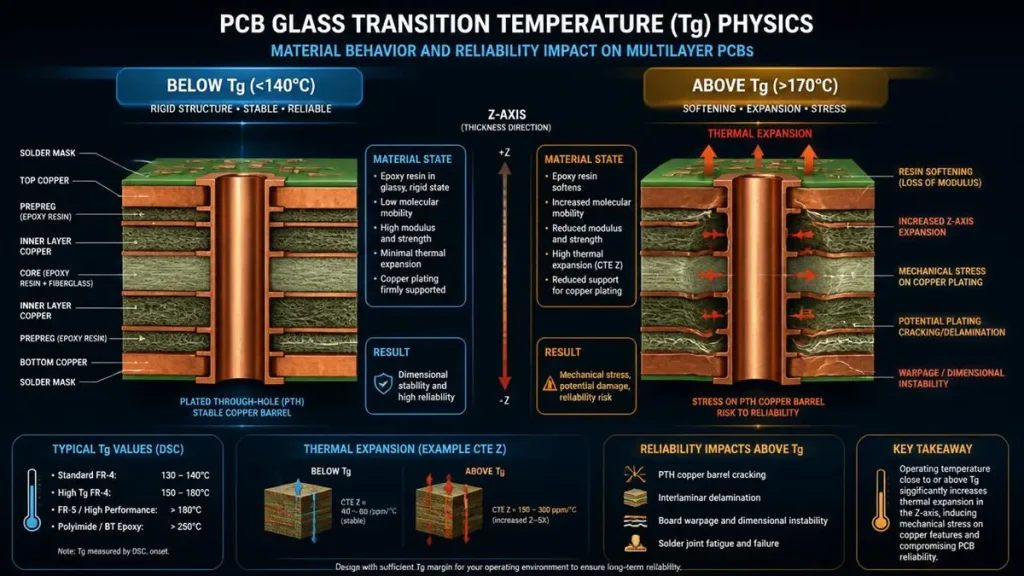
Comparison of PCB layer stackup and PTH barrel stress below Tg (<140°C) versus above Tg (>170°C).
If you are a procurement manager or NPI engineer evaluating PCB suppliers, understanding glass transition temperature (Tg) is not optional—it is the single most predictive metric for whether your boards will survive assembly and field operation.
Tg Physics for Non-Material Scientists
Tg is the temperature at which the epoxy resin matrix inside FR4 transitions from a rigid, glass-like state to a soft, rubber-like state. Below Tg, the fiberglass reinforcement dominates mechanical behavior. Above Tg, the resin softens dramatically, and the Z-axis coefficient of thermal expansion (CTE) can spike from approximately 50–70 ppm/°C to 250–300 ppm/°C.
For procurement teams, this means one thing: if your assembly reflow peak or operating temperature exceeds the material’s Tg, you are buying risk, not boards.
IPC-4101 Slash Sheet Classifications Every Buyer Should Reference
Do not let suppliers sell you “good FR4.” Demand IPC-4101 slash sheet compliance. Here is the procurement-relevant breakdown:
| Material Class | IPC-4101 Slash Sheet | Tg Range | Td (min) | Best Application |
|---|---|---|---|---|
| Standard FR-4 | /21 | 130°C – 140°C | 310°C | Consumer electronics, simple prototyping, low layer count (2–4 layers) |
| Mid-Tg FR-4 | /24 | 150°C – 160°C | 325°C | General industrial, entry-level lead-free assembly |
| High Tg FR-4 | /26, /126 | ≥170°C | 340°C | Multilayer (>6 layers), automotive, servers, IPC Class 3 |
Procurement takeaway: If your design requires lead-free soldering, high layer counts, or automotive qualification, High Tg FR-4 (IPC-4101 /26 or /126) is not an upgrade—it is a baseline requirement.
High Tg FR4 vs Standard FR4: Side-by-Side Material Comparison for Sourcing Teams
When evaluating High Tg FR4 vs standard FR4 for your BOM, procurement decisions must balance unit cost against total cost of ownership (TCO), including yield loss, rework, and field failure liability.
Thermal Performance Benchmarks: Z-CTE, Td, and T288
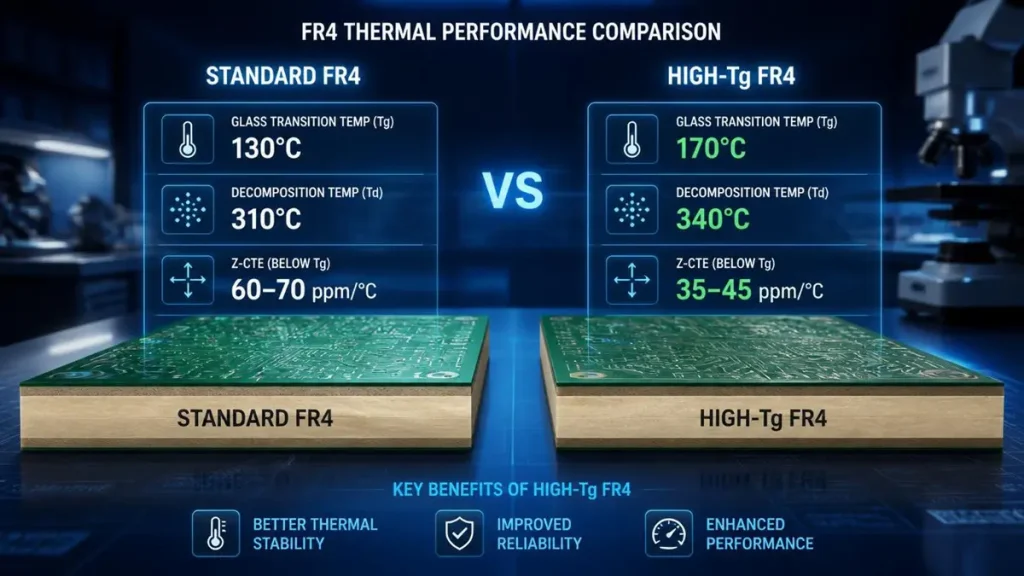
Thermal performance benchmarks: High-Tg FR4 offers higher Tg (170°C), higher decomposition temp (340°C), and lower Z-axis CTE expansion compared to standard FR4
| Property | Standard FR4 | High Tg FR4 | Procurement Impact |
|---|---|---|---|
| Glass Transition Temp (Tg) | 130–140°C | ≥170°C | High Tg survives lead-free reflow peaks of 245–260°C without resin softening |
| Z-Axis CTE (above Tg) | 250–300 ppm/°C | 180–220 ppm/°C | Lower Z-CTE reduces PTH barrel stress during thermal cycling |
| Decomposition Temp (Td) | ~310°C | ~340°C | Higher Td prevents resin carbonization during multiple reflow cycles |
| T288 (time to delam at 288°C) | <5 minutes | >15 minutes | Critical for boards undergoing double-sided reflow + wave solder + rework |
| Max Operating Temp | ~110°C | ~150°C | 20°C safety margin below Tg recommended for reliable operation |
| Relative Material Cost | Baseline | +10–20% | Offset by reduced scrap, fewer field returns, and higher first-pass yield |
Cost-per-Reliability Analysis for Procurement Managers
Standard FR4 costs less per square meter. But if your product runs hot, uses lead-free solder, or requires multiple lamination cycles, the hidden costs of standard FR4 quickly erase that savings:
- Scrap and rework: A study on PCB assembly reliability found that warpage can increase by up to 50% when using standard FR-4 in lead-free reflow processes compared to high Tg materials.
- Field failure liability: Barrel cracks and pad cratering caused by Z-axis expansion above Tg create intermittent opens that are nearly impossible to debug.
- Schedule risk: Delamination during assembly forces respins, delaying NPI timelines by weeks.
The procurement rule: For multilayer boards above 6 layers, High Tg FR4 pays for itself in yield alone. For 10+ layers, it is virtually mandatory.
4 Critical Procurement Triggers That Demand High Tg FR4 Over Standard FR4
As a buyer, you do not need to be a chemist. You need clear decision gates. Here are four sourcing scenarios where standard FR4 becomes a liability.
Lead-Free Reflow Sourcing Requirements and RoHS Compliance
Lead-free solder alloys require reflow peak temperatures of 240–260°C. Standard FR4 with a Tg of 130–140°C enters its rubber transition zone during every reflow cycle. The result? Pad cratering, board bowing, and weakened PTH structures.
Procurement action: If your CM runs RoHS-compliant assembly, specify High Tg FR-4 (Tg ≥170°C) in your PCB fabrication drawing. Do not accept “standard FR4 with lead-free process” as a workaround.
High-Layer Count Multilayer PCB Procurement
Every additional layer increases cumulative Z-axis stress. A 12-layer board with standard FR4 experiences exponentially higher internal stress during thermal cycling than a 4-layer board. The via density in high-layer-count designs amplifies the risk of barrel cracking.
Procurement action: For boards with 6–8+ layers, mandate IPC-4101 /126 High Tg laminates with inorganic fillers to further reduce Z-axis expansion.
Automotive and Industrial Grade PCB Standards
Automotive electronics must withstand temperatures from -55°C to 125°C continuously, with under-hood applications seeing transient spikes well above 150°C. Industrial motor drives and power inverters generate sustained heat loads that standard FR4 cannot endure without dimensional drift.
Procurement action: For automotive (IATF 16949) and industrial applications, require High Tg FR4 with Td ≥340°C and T288 >15 minutes. Validate that your supplier holds IATF 16949 and can provide material lot traceability.
Dense Power Electronics and AI Server Thermal Loads
AI server backplanes, GPU accelerators, and dense power electronics push PCBs into sustained high-temperature operation. The PCB content value of an AI server is nearly ten times higher than a conventional server, making material failure catastrophically expensive.
Procurement action: For power-dense designs, pair High Tg FR4 with heavy copper (2oz–10oz) or metal-core substrates to manage thermal dissipation.
The Hidden Cost of Choosing Standard FR4 for High-Thermal PCB Applications
Procurement teams often face pressure to reduce BOM costs. But selecting standard FR4 for thermally demanding applications is a classic false economy. Here is what failure looks like before it reaches your customer.
PTH Barrel Cracking and Intermittent Field Failure Modes
When PCB temperature exceeds Tg during reflow or operation, the Z-axis expansion rate of FR4 resin becomes 12–15 times greater than the copper barrel plating. This mismatch exerts massive tensile stress on plated through-holes until the copper snaps.
The result is barrel cracking or corner cracking—intermittent opens that pass electrical test but fail in the field under vibration or thermal cycling. These are the most expensive failures because they occur after assembly, after shipment, and often after warranty.
PCB Warpage During Assembly and Component Misalignment
Warpage is not a cosmetic issue. When a board bows during reflow, BGA balls and fine-pitch QFN pads lose co-planarity. This creates solder joint voids, head-in-pillow defects, and reduced long-term reliability. As noted in assembly reliability research, standard FR4 in lead-free reflow can increase warpage by up to 50% versus High Tg alternatives.
CAF and Long-Term Insulation Degradation
When standard FR4 is pushed above its thermal limits repeatedly, the resin matrix begins to degrade. Combined with moisture absorption (0.1–0.2% for FR4), this creates conductive anodic filament (CAF) growth between biased traces, leading to latent short circuits. High Tg FR4 materials with higher decomposition temperatures (Td) resist this degradation pathway.
How Shenzhen Hongda Circuit’s Advanced Manufacturing Capabilities Validate High Tg FR4 Performance
Material selection is only half the battle. The other half is whether your PCB supplier can actually process High Tg FR4 to its full potential. At Shenzhen Hongda Circuit Technology Co., Ltd. , our 2026 manufacturing platform is purpose-built to extract maximum reliability from High Tg laminates.
LDI Precision Imaging for High Tg FR4 Fine-Line Fabrication
High Tg FR4 laminates are harder and more brittle than standard FR4. This makes fine-line imaging more challenging. We solve this with Laser Direct Imaging (LDI) systems that eliminate phototool variability and achieve trace/space resolution down to 25μm (1 mil) with layer-to-layer registration accuracy of ±12μm.
For procurement teams, LDI means:
- No film stretching or dimensional drift during multilayer lamination
- Predictable impedance control (±5% tolerance) on High Tg stackups
- Higher first-pass yield on dense BGA and microvia designs
Laser Microvia Processing and Thermal Cycling Durability
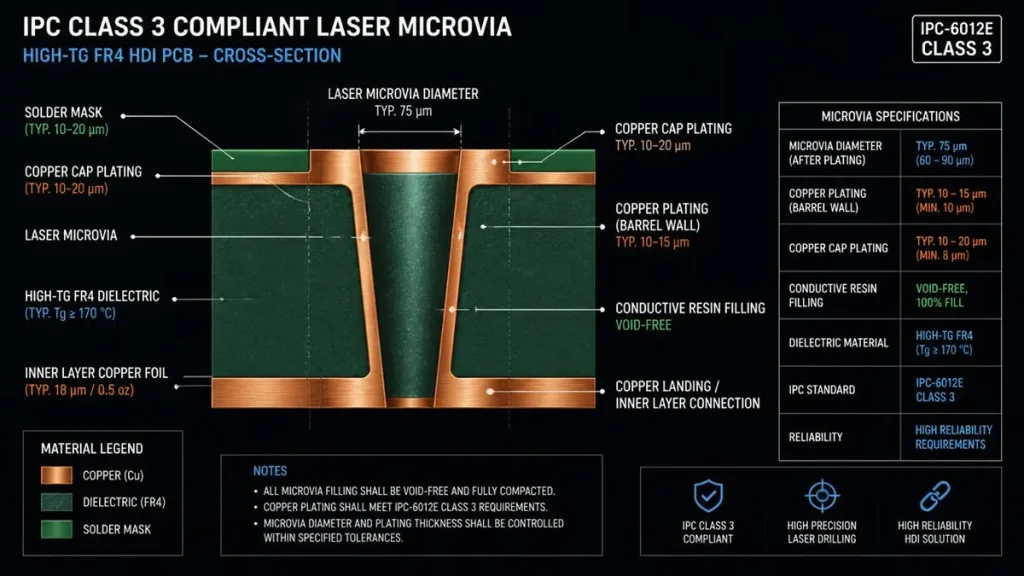
Engineering cross-section diagram of an IPC-6012E Class 3 compliant laser microvia with void-free resin fill and copper cap plating.
High Tg FR4’s value is fully realized only when via structures are optimized for thermal stress. Our laser-drilled microvia capability (50μm minimum diameter) creates blind and buried vias that shorten Z-axis path lengths by 30–50%, reducing the very CTE mismatch that causes barrel cracking.
For High Tg multilayer boards, we support:
- Stacked and staggered microvias with resin filling and copper capping
- Via-in-pad (VIP) structures for dense component mounting
- Sequential lamination up to 120+ layers with ±10μm alignment tolerance
In-House DFM and Material Qualification for IPC Class 3
Not every supplier claiming “High Tg capability” can prove it. At Hongda Circuit, we validate every High Tg laminate lot against IPC-4101 /126 requirements, including:
- DMA (Dynamic Mechanical Analysis) to confirm storage modulus at elevated temperatures
- T288 testing to verify delamination resistance before production release
- Cross-sectioning and SEM analysis of microvia copper plating integrity
Our certifications include ISO 9001, IATF 16949 (Automotive), ISO 13485 (Medical), and UL, ensuring that your High Tg FR4 boards meet the strictest industry standards.
Heavy Copper and Hybrid Stackups for Power Electronics
For applications where High Tg FR4 alone is insufficient, we offer hybrid constructions:
- Heavy copper PCBs (2oz–10oz) on High Tg cores for high-current paths
- Copper coin technology embedded in High Tg substrates to reduce operating temperatures by 15–20%
- Metal-core PCBs (aluminum/copper core, 2.0–4.0 W/m·K) for LED and automotive power modules
Conclusion: Building a Risk-Resilient PCB Material Sourcing Strategy
Standard FR4 remains the workhorse of the electronics industry for a reason: it is cost-effective, widely available, and perfectly adequate for low-stress, low-layer-count designs. But when your procurement scope includes lead-free assembly, multilayer density, automotive qualification, or power electronics, High Tg FR4 is not a luxury—it is risk mitigation.
The procurement decision is not just about price per square meter. It is about:
- First-pass yield at your CM
- Field reliability over the product lifecycle
- NPI schedule protection against respins
- Supplier capability verification (LDI, laser microvia, IPC Class 3)
At Shenzhen Hongda Circuit Technology Co., Ltd., we do not just sell High Tg FR4 PCBs. We validate them through advanced imaging, precision drilling, and rigorous thermal testing—so your procurement team can issue POs with confidence, not hope.
Ready to source High Tg FR4 PCBs with proven manufacturing capability? Send your Gerber files and stackup requirements to sales@pcbkr.com for a 30-minute engineering review and competitive RFQ. Or call +86 0755 23720053 for immediate technical consultation.
FAQ: What PCB Procurement Managers Ask When Evaluating High Tg FR4 Suppliers
How do I verify if a PCB supplier can actually process High Tg FR4 to IPC Class 3 standards?
Demand three things before issuing a PO: (1) Current IPC-4101 /126 material certificates from their laminate vendor (Isola, ITEQ, Shengyi, or Panasonic); (2) Cross-sectional micrographs of plated through-holes and microvias in High Tg material, showing copper thickness and void-free plating; (3) Active IATF 16949 or IPC Class 3 quality system certification. At Shenzhen Hongda Circuit, we provide all three during our DFM review phase—before production begins.
What certifications should I demand when sourcing High Tg FR4 PCBs for automotive applications?
Automotive procurement requires IATF 16949 as a baseline. For medical or aerospace, add ISO 13485 or AS9100. Additionally, require UL recognition for flammability (UL94V-0) and RoHS/REACH material compliance. Do not accept self-declarations; request third-party audit certificates with valid dates. Hongda Circuit maintains IATF 16949, ISO 13485, ISO 9001, ISO 14001, and UL under active surveillance audits.
How does a supplier’s LDI capability affect High Tg FR4 PCB quality and pricing?
LDI (Laser Direct Imaging) eliminates phototool costs and dimensional drift, which is critical for High Tg FR4 because the material is harder and less forgiving than standard FR4. Suppliers with LDI can achieve finer trace/space (down to 25μm) and tighter impedance control (±5%). While LDI-equipped factories may quote 5–10% higher processing fees, the yield improvement and reduced rework typically deliver lower total cost of ownership—especially on multilayer and HDI boards.
What is the realistic lead time difference between Standard FR4 and High Tg FR4 PCB prototypes?
For standard 2–4 layer prototypes, lead times are typically 5–7 days regardless of material. For High Tg FR4 multilayer boards (6–12 layers), expect 8–12 days due to additional lamination cycles and slower drill speeds required for the harder material. At Hongda Circuit, our quick-turn prototype service delivers High Tg FR4 boards in as little as 48–72 hours for urgent NPI builds, supported by in-house laser drilling and automated optical inspection.
How can I audit a Shenzhen PCB manufacturer’s material traceability and counterfeit laminate prevention?
Counterfeit or substandard laminates are a real supply chain risk. During your audit, verify: (1) Direct purchasing agreements with authorized laminate distributors (not gray-market brokers); (2) Incoming material inspection records including Tg and Td test data; (3) Lot traceability from raw material to finished board, typically managed through a Manufacturing Execution System (MES). Hongda Circuit welcomes on-site factory audits with 5 business days’ notice and provides full material genealogy reports upon request.
About Author
David Chen https://www.linkedin.com/in/pcbcoming
David Chen boasts an extensive professional background in PCBA manufacturing, PCBA testing, and PCBA optimization, with specialized expertise in high-precision PCBA fault analysis and rigorous PCBA reliability testing. The author has worked with high-layer-count server PCB fabrication, ultra-low-loss backplane stackups, and thermo-mechanical reliability optimization for AI infrastructure projects involving 112G and 224G PAM4 architectures. Skilled in complex circuit design and cutting-edge advanced PCB manufacturing processes, he delivers solutions that elevate product durability and performance across industrial applications. His technical articles focusing on PCBA manufacturing workflows and testing methodologies are widely cited by industry peers, research institutions, and technical platforms, solidifying his reputation as a recognized technical authority in the global circuit board manufacturing sector.