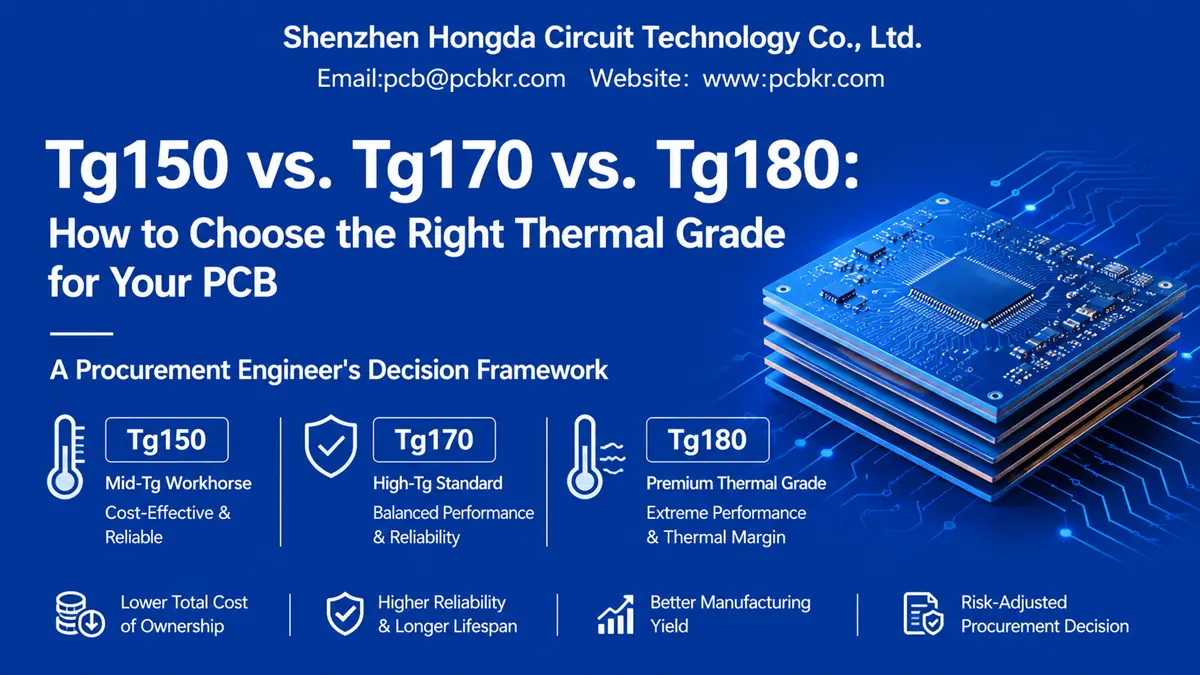
Tg150 vs. Tg170 vs. Tg180: How to Choose the Right Thermal Grade for Your PCB — A Procurement Engineer’s Decision Framework
Tg150 vs. Tg170 vs. Tg180: When procurement teams source multilayer PCBs for automotive, telecom, or industrial systems, material selection is rarely a simple price comparison. The wrong thermal grade triggers latent field failures, while over‑specification inflates BOM costs by 15–40% with no reliability dividend. This guide moves beyond generic datasheets to provide a procurement‑centric decision framework for Tg150, Tg170, and Tg180 FR4 laminates—anchored in real manufacturing constraints, equipment capability, and total cost of ownership (TCO).
Thermal Grades Breakdown: Mid-Tg (Tg150) vs. High-Tg (Tg170/Tg180) for Industrial Procurement
Understanding the thermal hierarchy is the first gate in the procurement decision chain. Glass transition temperature (Tg) marks the point where epoxy resin shifts from rigid to rubbery state, directly governing Z-axis expansion and via integrity under thermal load.
Tg150 FR4 — The Mid-Tg Workhorse for Standard Lead-Free Assembly
Tg150 laminates (IPC-4101 /24) occupy the structural middle ground. With a glass transition threshold of 150–160°C and decomposition temperature (Td) around 325°C, this grade survives dual-sided lead-free reflow without the cost premium of high-Tg variants. Procurement teams should default to Tg150 when:
- Maximum continuous operating temperature remains below 120°C (maintaining the mandatory 25°C safety margin below Tg)
- Board layer count stays within 6–8 layers
- Assembly involves 1–2 reflow passes with minimal rework cycles
- The application targets general industrial controllers, consumer-grade IoT gateways, or non-critical automotive cabin electronics
At Shenzhen Hongda Circuit Technology, our lamination presses handle Tg150 materials with standard press cycles, delivering consistent resin flow and copper peel strength across medium-volume production runs.
Tg170 FR4 — The High-Tg Standard for Demanding Multilayer Designs
Tg170 materials (IPC-4101 /26) represent the industry baseline for high-reliability electronics. With Tg thresholds of 170–175°C and Td values reaching 340–345°C, this grade provides the thermal headroom required for:
- 10–16 layer multilayer PCBs where cumulative Z-axis stress scales with layer count
- Lead-free assembly with 3+ reflow cycles or extensive BGA rework
- Operating environments between 120°C and 145°C
- Automotive ECUs, telecom base stations, and industrial PLCs requiring 10+ year service life
The material cost premium over standard FR4 typically runs 15–25%, but this investment eliminates the hidden costs of field failures, warranty claims, and production yield loss. For procurement managers, Tg170 is the risk-adjusted sweet spot when reliability data and cost targets must balance.
Tg180 FR4 — Premium Thermal Grade for Extreme Applications
Tg180 laminates push thermal performance further, with glass transition at 180–185°C and Td approaching 350–360°C. The Z-axis CTE above Tg drops to 140–165 ppm/°C (versus 160–180 ppm/°C for Tg170), and T288 times exceed 45 minutes—critical for sequential lamination builds. Procurement teams should mandate Tg180 when:
- Layer counts exceed 20 layers or require 3+ sequential lamination cycles
- Operating temperatures sustain above 150°C (automotive under-hood, power inverters)
- The design demands multiple rework cycles without pad cratering or barrel cracking
- Regulatory or customer specifications explicitly require enhanced thermal margins (MIL-PRF-31032, aerospace IPC Class 3)
At Hongda Circuit, our BURKLE lamination systems from Germany and Ende CNC drilling platforms are calibrated for Tg180 processing, accommodating the extended cure cycles and higher drill bit wear this grade demands.
Key Material Parameters Beyond Tg — What Procurement Must Verify on Supplier Data Sheets
Savvy buyers know Tg alone is insufficient. The following parameters separate qualified high-Tg PCB suppliers from catalog merchants:
Td (Decomposition Temperature) and Thermal Endurance
Td indicates when resin weight loss reaches 5%—the point of irreversible chemical breakdown. For lead-free profiles peaking at 260°C, Td must exceed 340°C to prevent charring during reflow or rework. When evaluating high-Tg FR4 PCB materials, always cross-reference Td against your assembly thermal profile. A supplier quoting Tg170 with Td below 330°C is cutting formulation corners.
T260 / T288 — Time to Delamination Under Sustained Heat
These IPC-TM-650 metrics measure how long a laminate survives at 260°C or 288°C before blistering or delaminating. Tg180 materials typically achieve >90 minutes at T260 and >45 minutes at T288, compared to >60 and >30 minutes for Tg170. For procurement teams managing PCB material selection for lead-free soldering with multiple assembly passes, these numbers directly predict manufacturing yield.
CTE (Coefficient of Thermal Expansion) — The Hidden Via Killer
Z-axis CTE above Tg determines plated via barrel stress during thermal cycling. Tg180 FR4 limits total Z-expansion to 2.0–2.5%, versus 2.8–3.2% for Tg170 and 3.5–4.0% for standard FR4. In boards with high aspect-ratio vias (depth-to-diameter >10:1), excessive CTE causes barrel cracks that electrical testing misses until field deployment. Hongda Circuit’s Plasma processing equipment and controlled lamination protocols specifically address CTE mismatch in thick multilayer builds.
H3: Dielectric Stability at Temperature — Signal Integrity Considerations
While Tg primarily governs mechanical behavior, high-Tg formulations often pair with improved dielectric stability. For 5G-Advanced and AI server backplanes running 224Gbps signals, stable Dk and Df across temperature prevent impedance drift. Our high-precision impedance testing equipment verifies that high-Tg stackups maintain ±5% tolerance even after thermal preconditioning.
Engineering Decision Matrix: Which Tg Grade to Choose for Your PCB Stackup
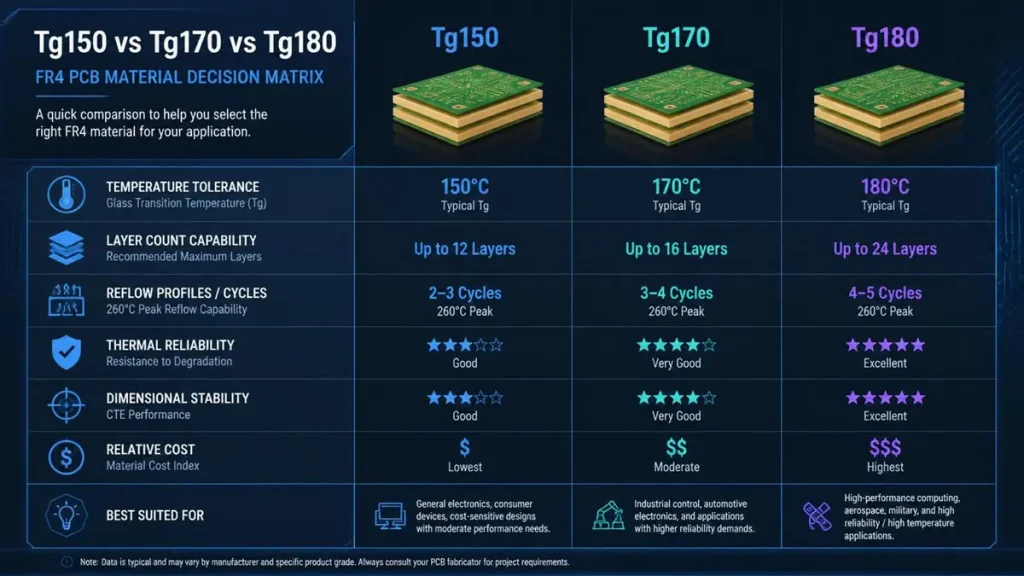
Tg150 vs. Tg170 vs. Tg180 FR4 PCB Material Decision Matrix
The following matrix consolidates thermal physics, manufacturing risk, and procurement economics into actionable selection criteria. Use this during RFQ preparation to align engineering requirements with supplier capability.
| Decision Factor | Tg150 (Mid-Tg) | Tg170 (High-Tg) | Tg180 (Premium High-Tg) |
|---|---|---|---|
| Board Thickness | 0.8–1.6 mm | 1.6–3.2 mm | >3.2 mm or ultra-thin HDI |
| Layer Count | 2–6 layers | 6–16 layers | 16–120+ layers |
| Reflow Cycles | 1–2 passes | 2–3 passes | 3+ passes / heavy rework |
| Max Operating Temp | <100°C | 100–145°C | >145°C sustained |
| Typical Applications | Industrial sensors, LED drivers | Automotive ECUs, telecom hardware | AI servers, aerospace, power modules |
| Relative Material Cost | Baseline (1.0x) | 1.15–1.25x | 1.25–1.40x |
| Manufacturing Complexity | Standard | Moderate (higher lamination T) | High (extended cycles, drill wear) |
| IPC-4101 Slash Sheet | /24 | /26, /126 | /26, /126 with filler enhancement |
Procurement Pro Tip: For 8+ layer boards, Tg170 becomes virtually mandatory regardless of operating temperature. The cumulative Z-axis expansion in thick laminates during lamination alone creates enough stress to fracture vias in Tg150 materials.
Cost vs. Performance Trade-off — Calculating True Procurement Value
Unit price comparison misleads. The real metric is total cost of ownership (TCO), incorporating yield loss, rework, field failure rates, and warranty exposure.
Material Cost Premium vs. Reliability ROI
Raw laminate pricing escalates predictably: Tg150 carries a 5–10% premium over standard FR4; Tg170 adds 15–25%; Tg180 commands 25–40% above baseline. However, manufacturing costs diverge further:
- Extended lamination cycles for Tg180 add 10–15% processing time
- Drill bit consumption increases 15–20% due to harder resin formulations
- AOI false-call rates may rise if inspection systems aren’t calibrated for high-Tg surface characteristics
At Hongda Circuit, our Orbotech AOI systems and AI-driven defect detection algorithms (achieving >99.9% detection accuracy) are specifically trained on high-Tg material signatures, minimizing false rejects and protecting yield.
When Tg150 Is the Economically Rational Choice
For high-volume, low-complexity consumer electronics where operating temperatures stay moderate and product lifecycles are short, Tg150 delivers adequate reliability at the lowest TCO. The 10–15% cost savings against Tg170 compound significantly across 100,000+ unit runs.
When Tg180 Delivers Net Cost Savings
Conversely, in medical devices, aerospace systems, or automotive under-hood controllers where field failure costs dwarf material premiums, Tg180 is the cost-optimized choice. A single warranty recall or safety-critical failure can erase the savings from specifying Tg170—or worse, Tg150. Our 120-layer 5G-Advanced/6G communication boards and mSAP-processed HDI platforms demonstrate that Tg180 investment pays dividends when signal integrity and thermal endurance cannot fail.
Manufacturing Capability Audit — How Procurement Teams Should Evaluate High-Tg PCB Suppliers
Material selection is only half the equation. The supplier’s equipment set and process control determine whether theoretical Tg values translate to real board reliability. Use this audit checklist during supplier qualification:
Lamination Equipment and Thermal Uniformity
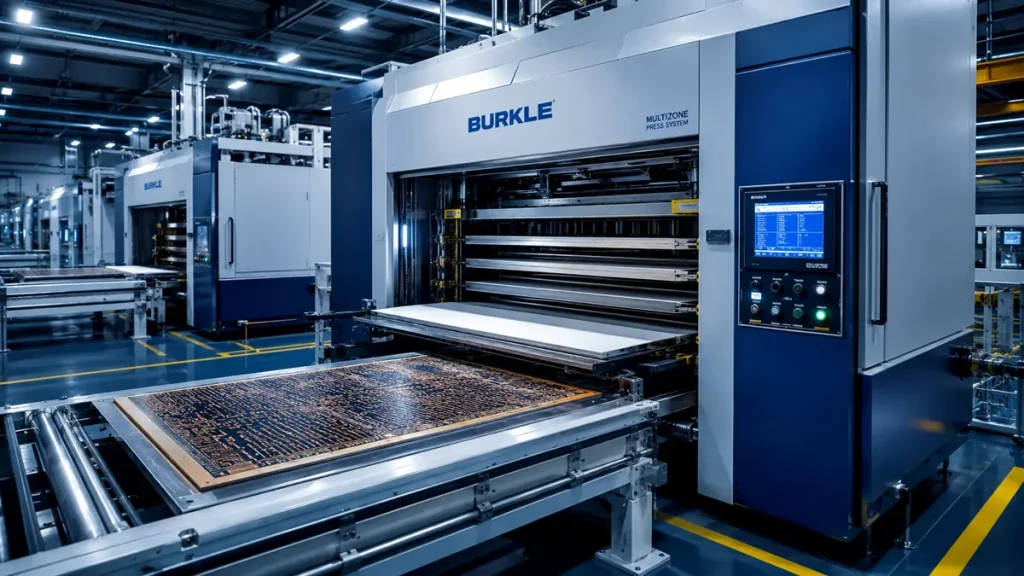
BURKLE Multizone Lamination Press System
High-Tg materials require precise temperature ramps and dwell times during pressing. BURKLE lamination presses—deployed at Hongda Circuit—provide multi-zone thermal control with ±2°C uniformity across the panel, critical for Tg180 full cure without voids or resin starvation. Ask suppliers: What press temperatures can you sustain? What is your temperature uniformity across a 24×18 inch panel?
Laser Direct Imaging (LDI) for Fine-Line High-Tg Designs
High-Tg boards often pair with high-density interconnect (HDI) requirements. Traditional film exposure cannot maintain the ±2 μm alignment accuracy needed for 2/2 mil trace/space on advanced high-Tg builds. LDI machines (such as our Orbotech LDI systems) write circuit patterns directly onto photoresist with red/UV beams, eliminating film stretch and enabling the fine geometries that maximize high-Tg material performance.
Laser Drilling and Microvia Integrity
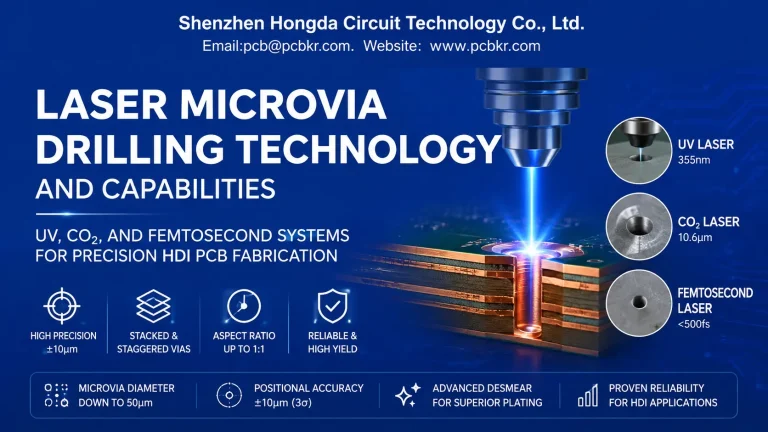
For Tg180 HDI boards with microvias below 0.1 mm, CO₂ and UV laser drilling replace mechanical bits. Our Ende CNC drilling and laser platforms achieve 30 μm via diameters with full positional accuracy—essential for build-up dielectric processing on high-Tg substrates. Suppliers lacking substrate-grade laser drilling capability cannot reliably manufacture advanced high-Tg HDI.
AOI and Reliability Testing Infrastructure
High-Tg materials demand inspection systems calibrated for their distinct optical and thermal signatures. Our AI-enhanced AOI and X-ray inspection systems detect defects below 5 μm, while ion staining testers, anti-stripping strength testers, and hole copper analyzers verify that high-Tg laminates meet IPC-6012 Class 3 requirements before shipment.
Material Traceability and Certificate of Compliance
For automotive (IATF 16949) and medical (ISO 13485) procurement, material traceability is non-negotiable. Hongda Circuit maintains lot-level tracking for all high-Tg laminates—from Shengyi, Isola, Rogers, and Ventec—backed by material certificates verifying IPC-4101 compliance, UL recognition, and RoHS/REACH status.
Summary — Building a Procurement-Grade High-Tg PCB Strategy
Selecting between Tg150, Tg170, and Tg180 is not a materials science exercise alone; it is a supply chain risk management decision. The optimal procurement strategy follows this sequence:
- Define the thermal envelope: Calculate maximum operating temperature, reflow cycles, and rework tolerance. Maintain 25°C margin below Tg.
- Match layer count to material grade: 6+ layers default to Tg170; 16+ layers or sequential lamination mandate Tg180.
- Audit supplier equipment: Verify lamination press capability, LDI accuracy, laser drilling precision, and AOI calibration for high-Tg processing.
- Calculate TCO, not unit price: Factor yield, rework, field failure, and warranty costs into material selection.
- Demand documentation: Insist on IPC-4101 slash sheet compliance, material certificates, and reliability test data.
Shenzhen Hongda Circuit Technology Co., Ltd. manufactures high-Tg PCBs from prototype to mass production, leveraging 224Gbps signal integrity expertise, 120+ layer backplane capability, and mSAP/Any-layer HDI processes to transform material specifications into reliable hardware. Our engineering team provides free DFM reviews to validate your thermal grade selection before fabrication commitment.
Request a High-Tg PCB Quote | Explore Our Advanced PCB Capabilities
Frequently Asked Questions — What Procurement Buyers Ask When Sourcing High-Tg PCB Suppliers
How do I verify that a PCB supplier can actually process Tg180 materials, not just source them?
Ask for equipment specifics. Tg180 requires lamination presses capable of sustained high temperatures (BURKLE or equivalent), LDI exposure tools for fine-line alignment, and laser drilling for microvias. Request material certificates from laminate vendors (Shengyi, Isola, Ventec) and demand IPC-TM-650 test data showing actual Tg, Td, and CTE values from production boards—not just raw material datasheets. At Hongda Circuit, we provide batch-level thermal analysis reports with every high-Tg order.
What is the real lead time difference between Tg150 and Tg180 PCB orders?
Tg150 uses standard press cycles and widely stocked laminates, typically adding no lead time penalty. Tg170 may extend lamination by 10–15% but remains within standard scheduling. Tg180 can add 2–5 days due to extended cure cycles, specialized drill bit requirements, and more frequent AOI calibration. For critical timelines, confirm your supplier maintains dedicated high-Tg production slots. Hongda Circuit offers expedited high-Tg prototyping with 24–72 hour turnaround for qualified designs.
Should I specify Tg180 for all automotive electronics to guarantee reliability?
No—over-specification wastes budget. Automotive cabin electronics (infotainment, body control) operating below 100°C perform reliably with Tg150 or Tg170. Reserve Tg180 for under-hood applications (engine control, inverter boards), 12+ layer designs, or modules requiring extensive rework capability. The correct approach maps operating temperature, layer count, and assembly stress against the 25°C Tg safety margin.
How does high-Tg material selection impact PCBA assembly yield?
High-Tg materials reduce warpage during reflow, improving pick-and-place accuracy and minimizing solder joint defects. Tg180’s lower Z-axis CTE prevents via barrel cracking that can cause intermittent opens during thermal cycling—defects that escape electrical test but fail in the field. However, high-Tg laminates are harder and more abrasive, increasing drill bit wear and potentially raising inner-layer shorts if debris isn’t properly evacuated. Suppliers with advanced CNC drilling and plasma desmear equipment (like Hongda Circuit’s PLASMA processing line) mitigate these risks.
What certifications should I demand from a high-Tg PCB manufacturer for aerospace or medical procurement?
Beyond the baseline ISO 9001, aerospace and medical buyers should verify: IPC-6012 Class 3 (rigid board qualification), IPC-4101 slash sheet compliance for the specific Tg grade, UL recognition for the laminate system, and industry-specific certifications (AS9100 for aerospace, ISO 13485 for medical). For automotive, IATF 16949 is mandatory. Additionally, demand material lot traceability, complete manufacturing records, and thermal stress test documentation (T260/T288 data). Hongda Circuit maintains full traceability systems linking materials, machine parameters, inspection results, and operator actions throughout the manufacturing flow.
About Author
David Chen https://www.linkedin.com/in/pcbcoming
David Chen boasts an extensive professional background in PCBA manufacturing, PCBA testing, and PCBA optimization, with specialized expertise in high-precision PCBA fault analysis and rigorous PCBA reliability testing. The author has worked with high-layer-count server PCB fabrication, ultra-low-loss backplane stackups, and thermo-mechanical reliability optimization for AI infrastructure projects involving 112G and 224G PAM4 architectures. Skilled in complex circuit design and cutting-edge advanced PCB manufacturing processes, he delivers solutions that elevate product durability and performance across industrial applications. His technical articles focusing on PCBA manufacturing workflows and testing methodologies are widely cited by industry peers, research institutions, and technical platforms, solidifying his reputation as a recognized technical authority in the global circuit board manufacturing sector.