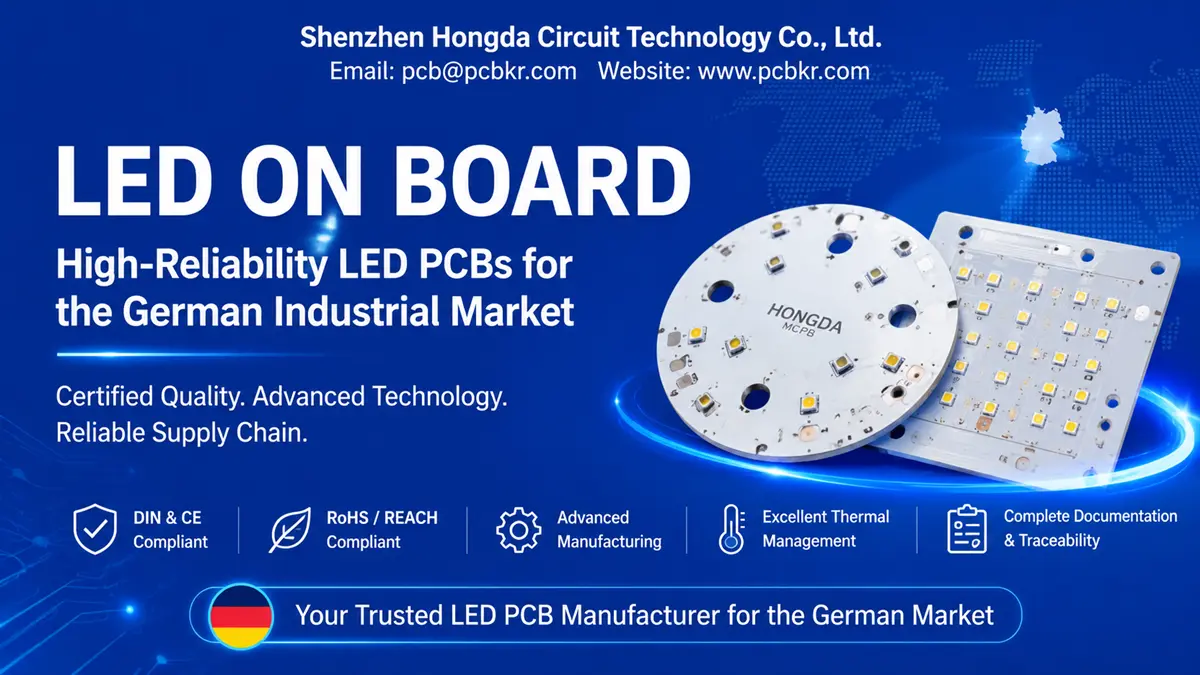
LED on Board — High-Reliability LED Printed Circuit Boards for the German Industrial Market
Choosing the right LED on board partner determines whether your lighting project achieves the required service life, efficiency, and certification. For German B2B buyers, the focus is not only on price and delivery time, but above all on technical reliability, DIN standard compliance, and a supply chain that meets European regulatory requirements. At Shenzhen Hongda Circuit Technology Co., Ltd. (www.pcbkr.com), we understand these requirements — and have aligned our manufacturing specifically to them.
Why German Buyers Must Pay Attention to Quality and Certification in LED Boards
The German market for LED board applications is highly regulated. Whether industrial lighting, automotive displays, or medical devices: an LED printed circuit board must be designed for European deployment from the outset. Many international suppliers underestimate the importance of standards-compliant documentation — with the result that products get stuck in customs clearance or certification processes are delayed by months.
DIN Standards and CE Compliance as a Central Decision Criterion
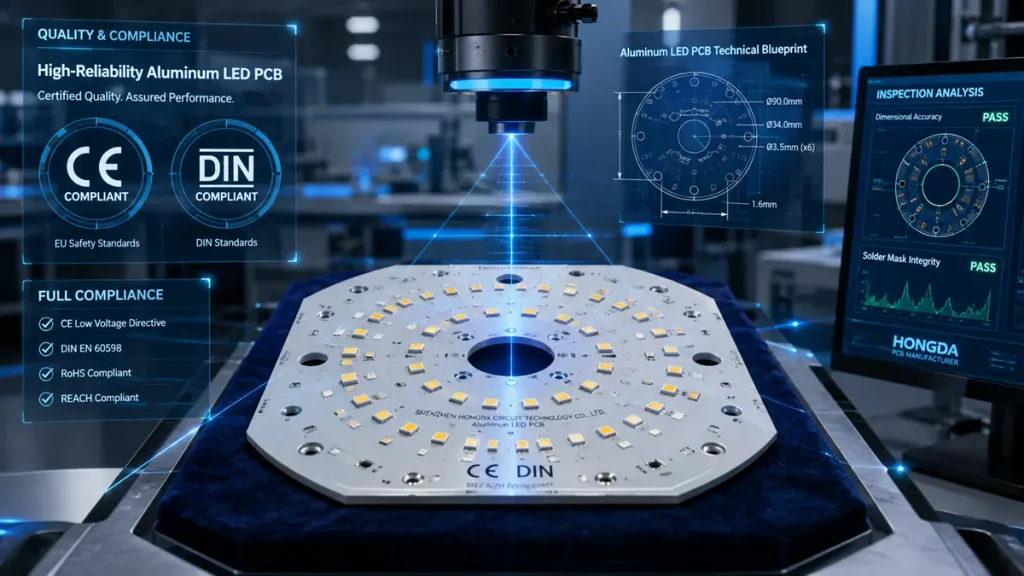
High-Reliability Aluminum LED PCB Quality Inspection & CE/DIN Compliance
When procuring an LED board for Germany, DIN standards must not be treated as an optional extra. Depending on the application, standards such as DIN EN 60598 (luminaires), DIN EN 62031 (LED modules), and EN 55015 (EMC) apply to LED modules. Our manufacturing at Shenzhen Hongda Circuit Technology takes these European specifications into account from the layout phase onward. Every CE-certified LED board leaves our factory with complete technical documentation — including the EU Declaration of Conformity (DoC), test reports from ISO 17025-accredited laboratories, and a technical construction file. This eliminates the risk of subsequent certification bottlenecks for buyers.
RoHS, ErP, and REACH: Legal Certainty from the Start
In addition to the CE marking, the German market requires compliance with the RoHS Directive (2011/65/EU), the ErP Directive for energy-related products, and the REACH Regulation. Particularly with aluminum LED board solutions featuring special dielectrics and surface coatings, material traceability is critical. We use exclusively halogen-free laminate materials and document the complete substance declaration per batch. For the buyer, this means: no surprises during the movement of goods within the EU.
LED Board Manufacturer with State-of-the-Art Manufacturing Technology

AI-Assisted AOI Inspection on High-Precision SMT LED PCB Assembly Line
The quality of an LED on board is determined on the production floor. Anyone who wants to be taken seriously as an LED board manufacturer must today invest in precision exposure, AI-assisted quality control, and thermal simulation. Our production facility in Shenzhen features an equipment park specifically configured for high-reliability requirements for the European market.
LDI Laser Direct Imaging for Structures Down to 30 µm
Conventional film exposure quickly reaches its limits with fine conductor traces. We rely on Laser Direct Imaging (LDI) — a direct exposure technology that operates without photomasks and achieves line/space widths down to 30 µm with excellent edge quality. This is decisive for HDI LED board designs with high packing density, as required in modern display modules and automotive interior lighting. LDI technology also reduces tolerance deviations in multilayer registration to below ±5 µm — a must for designs with blind and buried vias.
AI-Assisted AOI and X-Ray Inspection
Human visual inspection is no longer sufficient given today’s complexity of SMD LED board assemblies. Our production line integrates AI-based Automated Optical Inspection (AOI) with deep learning algorithms that detect surface anomalies overlooked by rule-based systems. For multilayer LED printed circuit board designs, a 3D X-ray inspection system (AXI) is additionally deployed, detecting hidden solder joints, voids in thermal vias, and inner-layer defects with a detection rate of over 99.7%. The result: a defect failure rate that is significantly below the industry average.
High-Performance Aluminum Core PCB (MCPCB) for Thermal Stability
Thermal management capability is the decisive service-life variable for every LED board. LEDs convert only 20–40% of electrical energy into light; the remainder is generated as heat at the p-n junction. Our aluminum LED board solutions (MCPCB — Metal Core Printed Circuit Board) use thermally conductive dielectrics with thermal conductivities of 2.0–3.0 W/m·K, which drastically reduce the thermal resistance between chip and heat sink. Through parametric thermal simulations, we optimize via density, copper thickness, and TIM layer (Thermal Interface Material) before production — typically saving 3–5 hardware iterations and accelerating time-to-market by four to six weeks.
From LED Board Prototyping to Scalable Series Production
The transition from prototype to series is the point at which many LED PCB Germany projects fail. A supplier that delivers prototypes quickly but hits capacity limits in volume production creates delivery bottlenecks that bring entire production lines to a standstill.
Fast LED Board Prototyping with Integrated DFM Optimization
Our LED board prototyping service does not begin with the milling machine, but with a Design for Manufacturability (DFM) review. Buyers send us their Gerber data; our engineering team checks within 24 hours whether trace widths, pad geometries, via-in-pad designs, and stencil apertures are suitable for stable, reproducible SMT processes. Typical DFM errors — conductor traces too narrow for the available etching accuracy, insufficient solder mask openings, or incorrectly dimensioned thermal reliefs — are identified before the first spin. This avoids costly respins and delays.
Scalable SMD Assembly for Complex LED Modules
Our SMT lines are designed for mixed-technology assemblies: fine-pitch SMD components (down to 01005), high-volume power LEDs with high thermal capacity, and through-hole connectors can all be assembled on the same LED board. Placement accuracy is ±25 µm@3σ, and reflow oven profiles are individually thermally simulated and validated for each product. For buyers, this means: whether 500 pieces for a pilot series or 50,000 pieces for a series release — process stability remains identical.
Logistics and Service: Your LED PCB Partner for Germany
Technical excellence is of little use if the supply chain does not function reliably. German buyers are looking for an LED board manufacturer that not only produces, but also ensures the last mile to the factory gate in Munich, Stuttgart, or Hamburg.
European Warehouse Logistics and Customs-Optimized Delivery
We operate a logistics network with European hub warehouses that reduces typical delivery times for standard LED board orders to 7–12 business days. For projects with recurring demand, we offer Vendor-Managed Inventory (VMI) solutions: your LED board series are pre-manufactured and stored intermediately in Europe, and you call them off just-in-time. Customs clearance is fully documented with HS codes, certificates of origin, and REACH declarations — no customs stoppage, no unforeseen import duties.
German-Language Technical Support and Documentation
Communication barriers are one of the most common hidden costs in B2B procurement. Our technical sales team has German-speaking contacts who understand both manufacturing terminology and the specific requirements of the German market. Technical data sheets, test protocols, and change documentation are prepared in German — not translated, but written for the German-language application context. This accelerates internal approval processes and reduces misunderstandings in quality assessment.
Our LED Board Solutions at a Glance
Shenzhen Hongda Circuit Technology Co., Ltd., as a specialized LED board manufacturer, produces a broad range of printed circuit board technologies for lighting applications:
| Product Category | Description | Typical Applications |
|---|---|---|
| LED Module PCB | Standard FR4 and high-Tg laminate for signal and power supply circuits | General lighting, display backlight |
| Aluminum LED Board (MCPCB) | Metal core printed circuit board with thermally conductive dielectric | High-power LEDs, street lighting, industrial lighting |
| Flexible LED Board | Polyimide-based, bendable, for spatially constrained installation locations | Automotive interiors, advertising displays, medical devices |
| Rigid-Flex LED Board | Combination of rigid and flexible zones | Complex 3D lighting geometries |
| High-Voltage LED Board | Heavy-copper design (up to 6 oz) for driver circuits | LED drivers, industrial switch-mode power supplies |
Every LED printed circuit board undergoes a qualification run before series start, comprising temperature cycling tests (-40 °C to +125 °C), solder shock tests, and insulation resistance measurements.
Frequently Asked Questions When Procuring LED Boards (FAQ)
Which DIN standards must an LED board fulfill for the German market?
For deployment in Germany, LED on board solutions must, depending on the application, fulfill DIN EN 60598 (luminaires in general), DIN EN 62031 (LED modules), and EN 55015 (electromagnetic compatibility). For automotive applications, AEC-Q200 requirements are additionally added. We create a project-specific standards checklist for each project and document compliance in the technical construction file.
How does an aluminum LED board differ from a standard LED printed circuit board?
An aluminum LED board (MCPCB) replaces the conventional FR4 substrate with an aluminum core featuring a thermally conductive dielectric. This reduces thermal resistance (Rth) by up to 60% compared to standard FR4. This is essential for high-power LEDs from 1 W power consumption upward, as a lower chip junction temperature (Tj) correlates directly with higher luminous efficacy and longer service life.
How long does delivery of an LED board order to Germany take?
Standard LED board prototypes require 5–7 business days of production time from approval of the DFM report, plus 3–5 days of express shipping. For series orders with European stock warehousing, the available delivery time is reduced to 3–5 business days from warehouse dispatch. Project-related framework orders with VMI processing even enable 48-hour availability.
Do you offer LED board prototyping and sample ordering?
Yes. Our LED board prototyping program is explicitly designed for the validation phase. Buyers can order LED board samples via our web shop at www.pcbkr.com — starting from a minimum lot size of 5 pieces. Every sample is delivered with DFM feedback, measurement protocol, and cross-section analysis. This enables a well-founded qualification before series release without entering into volume commitments.
Which documents do I need for the CE certification of my LED module?
For the CE marking of an LED module, you need the EU Declaration of Conformity (DoC), test reports for LVD (Low Voltage Directive), EMC (Electromagnetic Compatibility), and RoHS compliance certificates. As an LED board manufacturer, we provide the complete technical construction documentation, material declarations (IMDS-compatible on request), and test reports from accredited laboratories. This significantly accelerates your internal certification process
Your Next Step: Request a German Quotation or Order Samples
The decision for an LED on board supplier should be based on verifiable facts — not promises. At Shenzhen Hongda Circuit Technology Co., Ltd., we invite buyers to evaluate us based on concrete data: request free DFM feedback for your existing layout, or test our manufacturing quality with an LED board sample order.
[Request German Quotation] — Receive a project-specific quotation within 48 hours, including delivery time, certification scope, and logistics concept.
[Order Samples] — Order your custom LED board starting from just 5 pieces, and validate manufacturing quality, thermal performance, and solderability before series release.
Shenzhen Hongda Circuit Technology Co., Ltd. | www.pcbkr.com | Your partner for certified LED printed circuit board solutions in the German market.
About Author
David Chen https://www.linkedin.com/in/pcbcoming
David Chen boasts an extensive professional background in PCBA manufacturing, PCBA testing, and PCBA optimization, with specialized expertise in high-precision PCBA fault analysis and rigorous PCBA reliability testing. The author has worked with high-layer-count server PCB fabrication, ultra-low-loss backplane stackups, and thermo-mechanical reliability optimization for AI infrastructure projects involving 112G and 224G PAM4 architectures. Skilled in complex circuit design and cutting-edge advanced PCB manufacturing processes, he delivers solutions that elevate product durability and performance across industrial applications. His technical articles focusing on PCBA manufacturing workflows and testing methodologies are widely cited by industry peers, research institutions, and technical platforms, solidifying his reputation as a recognized technical authority in the global circuit board manufacturing sector.