NVR PCB Manufacturer: How Do You Qualify a Supplier?
A reliable NVR PCB manufacturer should do more than fabricate a bare circuit board. It should review your design, confirm stack-up and component requirements, identify manufacturing risks before production, and agree on inspection and acceptance criteria. PCBKR supports custom PCB manufacturing and PCBA project evaluation for OEM buyers seeking prototype, small-batch, and production supply.
What NVR PCB Manufacturing Services Should an OEM Buyer Look For?
An NVR (Network Video Recorder) motherboard may combine a processor or SoC, memory, Ethernet interfaces, storage connections, video outputs, power regulation, and—in some designs—PoE-related circuitry. The actual configuration depends on the product architecture, channel count, bandwidth, thermal design, and whether PoE circuitry is integrated into the mainboard or placed on separate boards.
For procurement teams, the first decision is whether the supplier can support the required manufacturing scope.
| Required service | What the buyer should confirm |
|---|---|
| Bare NVR PCB fabrication | Layer count, board thickness, copper weight, material, finish, impedance requirements, and tolerances |
| NVR PCBA | SMT/THT capability, component packages, soldering requirements, inspection, and electrical testing |
| Turnkey PCBA | BOM sourcing, approved alternatives, component traceability, and shortage management |
| Prototype and small batches | Engineering review, sample quantity, revision control, and repeatability |
| Production orders | Capacity planning, process controls, inspection records, and change management |
A supplier that only quotes the bare PCB may not be responsible for component sourcing, assembly defects, programming, or board-level functional verification. Define these responsibilities before comparing prices.
PCBKR can review your project scope and manufacturing files to determine which services are appropriate for your NVR design. For a broader overview of our PCB assembly services, specify whether you need bare boards, consigned-component assembly, or turnkey PCBA.
Which PCB Requirements Matter Most for an NVR Motherboard?
The right PCB specification depends on the circuit design—not simply on whether the product is described as a 4-channel, 8-channel, or 16-channel NVR.
How should layer count and stack-up be selected?
Layer count should follow routing density, power distribution, grounding, signal-integrity requirements, and board dimensions. A compact design with a high-pin-count processor and dense memory routing may need a different stack-up from a simpler recorder board.
Before production, review:
- Layer count and finished board thickness.
- Core and prepreg materials, including dielectric thickness.
- Copper weight on each layer.
- Controlled-impedance requirements and target values, where specified.
- Via types, aspect ratios, and any blind or buried microvias.
- Board outline, connector locations, and mechanical tolerances.
For a design with dense routing or microvia requirements, review the feasibility of HDI PCB manufacturing before freezing the layout. HDI should be selected when the electrical and mechanical design justifies it, not added as a marketing feature.
How should high-speed interfaces and signal integrity be reviewed?
NVR designs may include high-speed Ethernet, memory buses, storage interfaces, and video-output signals. The specific interfaces vary by processor and product architecture, so the PCB supplier should work from the actual schematic, layout, stack-up, and interface requirements.
A useful engineering review checks:
- Whether the stack-up supports the required impedance targets.
- Whether differential pairs and reference planes are designed appropriately.
- Whether routing, return paths, and via transitions introduce avoidable discontinuities.
- Whether the material selection is appropriate for the relevant data rates and signal losses.
- Whether impedance coupons or other agreed verification methods are required.
PCBKR’s high-speed PCB manufacturing capability is relevant when the design has controlled-impedance or signal-integrity requirements. The appropriate material and test plan must be confirmed against the customer’s specifications; not every NVR board requires specialized low-loss laminate or high-frequency testing.
How should power, copper weight, and thermal design be evaluated?
Processor power, memory, Ethernet circuitry, and any integrated PoE power stages can create localized heat and current-density concerns. The supplier should review copper weight, trace width, plane allocation, via arrangements, component spacing, and the board’s interface with its enclosure or heat spreader.
Copper weight alone does not establish current capacity. Actual performance depends on copper thickness, trace geometry, temperature-rise limits, airflow, ambient conditions, and the complete power path.
Where the design has demanding current requirements, heavy copper PCB manufacturing may be relevant. It should be evaluated against calculated current and thermal requirements rather than selected automatically.
How Can PCBKR’s Manufacturing Equipment Support NVR PCB Production?
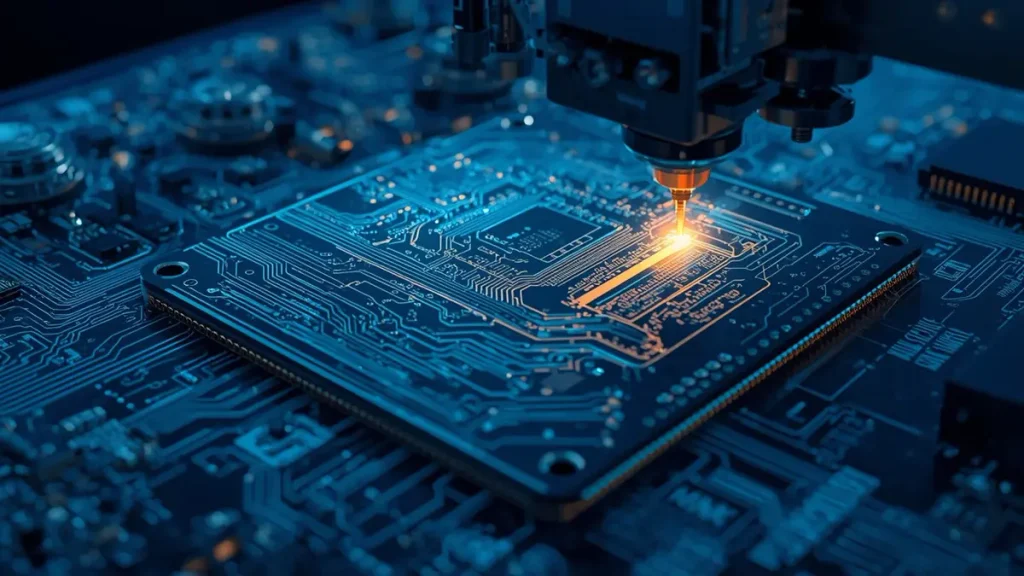
NVR PCB manufacturing equipment for precision multilayer circuit board fabrication
Equipment matters when it addresses a defined design or process risk. It should not be treated as a substitute for design review, process control, or acceptance testing.
PCBKR’s stated manufacturing resources include the following technologies. Their relevance to an NVR project depends on the board files and the manufacturing requirements confirmed during engineering review.
| Manufacturing resource | Potential relevance to an NVR PCB project | Important qualification |
|---|---|---|
| SCREEN Ledia LDI, with an 8 µm target and stated ±10 µm capability | Fine-pattern imaging and accurate layer imaging for demanding designs | Imaging resolution is not the same as a guaranteed finished trace width or spacing |
| LAUFFER lamination equipment, with stated pressure settings of 80, 150, and 200 psi and vacuum below 50 mbar | Multilayer lamination process control | The correct recipe depends on material, stack-up, and product requirements |
| Mitsubishi UV/CO₂ laser processing, stated at 75 µm ±5 µm | Laser-drilled features where the design and process are compatible | The achievable finished feature depends on material and the complete process |
| Picosecond laser processing, stated at 50 µm | Fine-feature laser processing for designs that require it | Feasibility and production yield must be reviewed for the specific design |
| mSAP capability, stated at 8/8 µm since Q3 2024 | Very fine conductor-pattern applications | This is an advanced process capability, not a default specification for every NVR board |
| 3D AOI and X-ray inspection | Optical inspection of accessible features and inspection of suitable hidden structures, including relevant solder joints | Inspection coverage and acceptance criteria should be agreed for the actual assembly |
| Four-wire Kelvin flying-probe testing | Electrical verification where the test method and board design are suitable | The test program and coverage depend on the board and test requirements |
| VNA capability stated up to 70 GHz | Characterization of relevant RF or high-frequency structures when required | It is not a routine requirement for every NVR motherboard |
These technologies can help address fine-feature imaging, multilayer process control, electrical verification, and selected signal-integrity needs. They do not independently prove that a completed NVR motherboard will function correctly in the customer’s recorder system.
For buyers, the practical question is: Which of these capabilities does your design need, and what evidence will the supplier provide to demonstrate compliance? PCBKR can assess the relevant manufacturing requirements from your design package and agreed acceptance criteria.
How Should an NVR PCB Manufacturer Review Design Files Before Production?
A structured pre-production review helps identify manufacturability problems before they become delays, scrap, or assembly rework.
For an NVR PCB or PCBA quotation, prepare as many of the following as are available:
| File or requirement | Why it matters |
|---|---|
| Gerber or other accepted fabrication data | Defines copper patterns, solder mask, silkscreen, and board features |
| NC drill files | Defines hole locations and sizes |
| Stack-up and fabrication drawing | Defines layer construction, thickness, copper, tolerances, and special requirements |
| Bill of materials (BOM) | Identifies components, manufacturer part numbers, quantities, and approved alternatives |
| Pick-and-place file | Defines component placement for assembly |
| Assembly drawings | Clarifies component orientation, polarity, and assembly details |
| IPC or customer-specific acceptance requirements | Establishes the required quality and inspection criteria |
| Test procedure and firmware requirements, if applicable | Defines any agreed programming or board-level functional verification |
| Annual volume and order schedule | Helps assess sourcing, capacity, and production planning |
During engineering review, resolve unclear dimensions, missing drill information, conflicting revisions, unavailable components, and unspecified acceptance criteria before releasing the order.
If your design uses fine-pitch BGAs, dense routing, or controlled-impedance interfaces, highlight these requirements in the RFQ instead of expecting the supplier to infer them from the files.
PCBKR recommends supplying the latest revision of the design package and identifying any changes from previous builds. This helps keep the quotation, manufacturing data, and acceptance requirements aligned.
How Is NVR PCBA Quality Verified?
A credible quality plan defines what is inspected, how defects are detected, and what evidence is retained. No single inspection method detects every possible defect.
For an NVR PCBA project, discuss the following methods according to the component packages, risk profile, and customer requirements.
| Inspection or test | What it can help verify | What it does not establish by itself |
|---|---|---|
| Visual inspection | Visible assembly issues, orientation, workmanship, and obvious damage | Hidden solder-joint integrity or complete electrical functionality |
| AOI | Applicable component-placement and soldering defects visible to the inspection system | Defects hidden beneath components |
| X-ray inspection | Suitable hidden solder joints and internal structures, such as relevant BGA connections | Complete system-level operation |
| Bare-board electrical testing | Electrical connectivity and isolation within the test coverage | Correct assembly, firmware, or NVR application behavior |
| Flying-probe or fixture-based electrical tests | Opens, shorts, and other electrical conditions covered by the test program | Every possible circuit or functional failure |
| Agreed functional testing | Specified board-level functions under the defined test conditions | Performance outside the agreed scope or test environment |
For boards using BGA packages, X-ray inspection may be an important part of the assembly quality plan. AOI and X-ray serve different purposes and should not be presented as interchangeable.
Functional testing requires an agreed procedure, suitable fixtures or test access, power and communication interfaces, and clear pass/fail limits. If the buyer requires Ethernet communication, storage detection, video output, firmware loading, or sustained operation checks, these requirements should be documented and reviewed for feasibility before quotation.
PCBKR can discuss the inspection and verification scope applicable to the project. System-level NVR validation should only be included when the required test equipment, software, interfaces, and acceptance procedure have been agreed.
What Affects NVR PCB Manufacturing Cost and Lead Time?
The lowest unit price is not always the lowest total procurement cost. A quotation that excludes engineering review, component sourcing, inspection, or required testing may not be comparable with a more complete offer.
The main cost and lead-time drivers include:
- Board construction: layer count, material grade, finished thickness, copper weight, and special fabrication requirements.
- Routing density: fine lines and spaces, small holes, microvias, and tight registration requirements can affect process complexity and yield.
- Surface finish: ENIG, HASL, OSP, or another finish should be selected according to solderability, contact requirements, storage, and the design specification.
- Assembly complexity: BGA packages, fine-pitch components, mixed SMT/THT assembly, and special handling requirements affect process planning.
- Component availability: obsolete parts, long-lead-time ICs, allocation, and approved substitutions can become schedule constraints.
- Inspection and testing: X-ray coverage, electrical testing, programming, and functional testing add requirements that should be explicitly scoped.
- Order quantity and revision stability: prototype builds and repeat production have different setup, sourcing, and process-planning considerations.
To compare quotations fairly, ask each supplier to state the same board specification, BOM assumptions, component sourcing scope, inspection coverage, delivery terms, and exclusions.
A realistic lead-time estimate should distinguish bare-board fabrication, component procurement, assembly, testing, and shipping. These stages may overlap, but a delayed critical component can still hold up the complete order.
PCBKR can review the files, target quantity, and required delivery date to identify the main quotation variables. A reliable estimate should follow technical and sourcing review rather than rely on an unsupported standard turnaround promise.
How Do You Qualify a Reliable NVR PCB Manufacturing Supplier?
Supplier qualification should be based on evidence relevant to your product—not just a capability list or a low initial quote.
Use the following checklist during your evaluation:
- Confirm design fit. Ask the supplier to review your layer count, stack-up, copper requirements, hole structures, components, and tolerances.
- Request a documented DFM review. Check whether the supplier identifies specific risks and obtains approval before implementing design changes.
- Clarify the manufacturing scope. Confirm whether the quote covers bare PCBs, assembly, component procurement, programming, testing, and packaging.
- Define quality acceptance. Agree on inspection methods, sampling or coverage, electrical tests, workmanship criteria, and required reports.
- Check component controls. Ask how shortages, substitutions, traceability, and customer approval are managed.
- Plan the prototype-to-production transition. Confirm how revisions, approved process changes, and recurring production requirements will be controlled.
- Request relevant evidence. Where appropriate, ask for capability data, sample inspection records, process documentation, and examples of comparable work that the supplier is permitted to disclose.
Do not rely on a general claim that a factory can manufacture “high-reliability PCBs.” Ask which requirements it can meet for your board, how compliance will be checked, and which records will be available.
For a broader manufacturing assessment, visit PCBKR’s custom PCB manufacturer in China page and provide your project-specific requirements.
How Do You Request an NVR PCB Manufacturing Quote from PCBKR?
To receive a useful quotation, send PCBKR your latest fabrication files, BOM, assembly data, target quantity, and required delivery date. Identify whether you need bare PCBs, PCBA, or turnkey supply, and list any special requirements for impedance, BGA inspection, programming, or functional testing.
Include these details in your RFQ:
- Product type and intended production stage: prototype, pilot run, or mass production.
- Board dimensions, layer count, finished thickness, copper weight, and surface finish.
- Fabrication files, stack-up, drill data, and controlled-impedance requirements.
- BOM with manufacturer part numbers and approved alternatives, if available.
- Assembly drawings and pick-and-place data.
- Required inspection, electrical test, and functional test criteria.
- Prototype quantity, expected recurring order volume, and target delivery schedule.
- Packaging, labeling, traceability, and shipping requirements.
If some files are not ready, state what is missing. PCBKR can first review the available information and identify the items needed to complete the technical assessment.
Request an NVR PCB or PCBA quotation:
Website: https://www.pcbkr.com/
Email: sales@pcbkr.com
A clear RFQ helps both sides identify design risks, scope differences, sourcing constraints, and acceptance requirements before the purchase order is released.
Frequently Asked Questions About NVR PCB Manufacturing
How do I choose a reliable NVR PCB manufacturer?
Choose a supplier that can review your actual design, explain its manufacturing limits, document DFM findings, define inspection and test coverage, and clarify component sourcing and revision control. Ask for relevant evidence rather than relying only on a general capability statement.
What files are required for an NVR PCB assembly quote?
For a PCBA quote, provide fabrication data, NC drill files, the stack-up or fabrication drawing, BOM, pick-and-place file, and assembly drawings. Also specify quantity, required tests, target delivery date, and any approved component alternatives. The supplier can identify missing information during its initial review.
How much does custom NVR PCB manufacturing cost?
Cost depends on board dimensions, layer count, material, copper weight, fabrication tolerances, surface finish, order quantity, and required testing. For assembled boards, component availability, package types, assembly complexity, and sourcing scope also matter. A comparable quotation must use the same specifications and clearly state exclusions.
Can a supplier provide both NVR PCB fabrication and PCBA assembly?
Some suppliers offer bare-board fabrication, SMT/THT assembly, component sourcing, and selected inspection or testing services. Confirm whether these are available under one project scope and who is responsible for component procurement, substitutions, testing, and defect resolution. PCBKR can review your requirements to determine the appropriate manufacturing scope.
Can an NVR PCB prototype be transferred to mass production?
Yes, provided the design, materials, components, manufacturing process, and acceptance criteria remain suitable for repeat production. Before scaling up, resolve prototype defects, freeze the approved revision, confirm component supply, and agree on inspection and change-control procedures. A successful prototype alone does not guarantee production yield without this review.
About Author
David Chen LinkedIn Profile
David Chen is a Senior RF/PCB Process Engineer at Shenzhen Hongda Circuit Technology Co., Ltd., with over 12 years of experience in high-frequency PCB fabrication, impedance-controlled stack-up design, and Rogers/PTFE laminate processing. He also boasts an extensive professional background in PCBA manufacturing, PCBA testing, and PCBA optimization, with specialized expertise in high-precision PCBA fault analysis and rigorous PCBA reliability testing. The author has worked with high-layer-count server PCB fabrication, ultra-low-loss backplane stackups, and thermo-mechanical reliability optimization for AI infrastructure projects involving 112G and 224G PAM4 architectures. Skilled in complex circuit design and cutting-edge advanced PCB manufacturing processes, he delivers solutions that elevate product durability and performance across industrial applications. His technical articles focusing on PCBA manufacturing workflows and testing methodologies are widely cited by industry peers and technical platforms, and have gained attention and recognition from industry colleagues.