What Should You Look for in an Air Conditioner PCB Manufacturer?
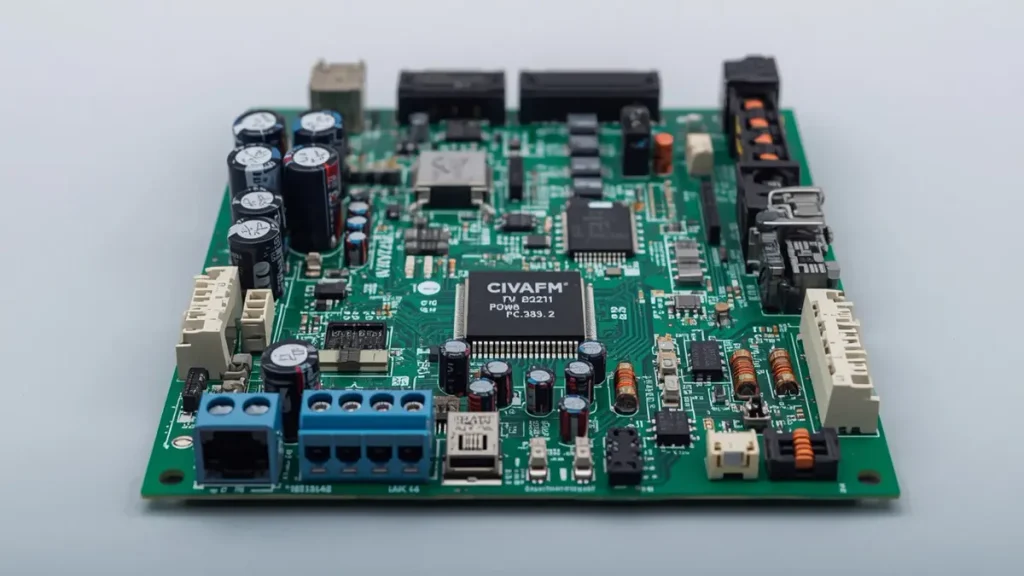
Base Material:FR-4; high-Tg FR-4 as required by thermal design
Layer Count:1–8 Layers, depending on circuit complexity
Board Thickness:1.0–2.0 mm
Copper Thickness:1–3 oz (35–105 μm)
Min. Trace Width / Spacing:0.10 / 0.10 mm
Min. Hole Size:0.20 mm
An air conditioner PCB manufacturer must deliver more than a bare circuit board. Hongda Circuit supports custom Air Conditioner PCB fabrication and PCBA assembly for OEM projects, from prototypes and small batches to volume production. We manufacture according to customer-supplied Gerber files, BOMs, assembly drawings, and inspection requirements. Send your project files to sales@pcbkr.com for a manufacturing review and quotation.
Air Conditioner PCB Applications and Control Board Types
Air conditioner electronics are distributed across several control and power functions. Depending on the product architecture, a system may contain separate indoor and outdoor control boards, inverter drive boards, power supply boards, sensor interfaces, and communication circuits.
For PCB buyers, identifying the intended board function is important before selecting a manufacturing process. A low-voltage indoor control board and a high-current outdoor inverter board can have very different material, copper, assembly, and inspection requirements.
Indoor Unit Control PCB
An indoor unit control PCB typically interfaces with the user control panel, temperature sensors, fan motor, display, communication circuits, and other system components.
Its manufacturing requirements depend on the circuit design and component selection. Common considerations include:
- Reliable SMT placement for microcontrollers, passive components, and interface devices.
- Correct polarity and orientation of diodes, capacitors, and other polarized components.
- Suitable connector placement and solder-joint quality.
- Stable electrical connections for sensor and communication interfaces.
- Consistent PCB dimensions and mounting-hole positions.
For OEM production, the assembly drawing and component orientation data should be reviewed together with the BOM and Gerber files. This helps identify discrepancies before production.
Outdoor Unit Control PCB
Outdoor control boards may interface with compressor drive circuits, fan motors, power conversion stages, protection circuits, and communication connections.
These boards can involve higher electrical and thermal stresses than low-power control boards. The PCB manufacturer should review the specified copper weight, conductor dimensions, insulation requirements, component spacing, and board construction against the supplied design.
High-current terminals, power-device connections, and large components also require appropriate assembly processes and inspection criteria.
Inverter Air Conditioner PCB
An inverter air conditioner may use electronic control and power conversion circuits to regulate compressor motor operation. The PCB assembly can include power semiconductors, gate-drive components, sensing circuits, capacitors, and control interfaces.
The exact circuit architecture varies by product and motor-drive design. It should not be assumed that every inverter board uses the same layer count, copper thickness, or material.
For manufacturing, important review points include:
- Power-device footprints and solder-pad dimensions.
- Copper distribution around high-current paths.
- Thermal interfaces and component clearances.
- Isolation requirements defined by the design.
- Connector and terminal mechanical strength.
- Assembly compatibility with the selected components.
Compressor and Fan Motor Control Boards
Compressor and fan motor control circuits may use different drive methods and component arrangements. Their PCB requirements should therefore be assessed according to the actual electrical design rather than a generic air conditioner PCB specification.
For example, power-device mounting, current-carrying conductors, gate-drive connections, and sensing interfaces may affect PCB construction and PCBA assembly. The manufacturer should identify potential fabrication or assembly constraints during engineering review.
Power Supply and Interface Control Boards
Air conditioner control systems also require power supply and interface circuits. These may include AC-DC conversion, voltage regulation, sensor inputs, communication interfaces, and protection-related connections.
The PCB and PCBA requirements depend on the specified operating voltage, current, insulation design, component package, and environmental conditions.
Main Control Functions of an Air Conditioner PCB
Understanding the functions connected to an air conditioner PCB helps buyers provide the correct manufacturing documentation and define the required inspection scope.
Compressor Control and Inverter Drive Interfaces
The compressor control section may connect the main controller to power switching devices, motor-drive circuitry, current-sensing components, and protection interfaces.
From a manufacturing perspective, the main concerns include:
- Correct placement and soldering of power components.
- Adequate copper geometry for the specified current.
- Reliable connections at high-current terminals.
- Compliance with the customer’s electrical spacing and insulation requirements.
- Consistency between PCB revision, BOM revision, and assembly data.
PCB fabrication cannot compensate for an unsuitable electrical design. If the Gerber data shows insufficient clearances, questionable pad geometry, or manufacturing constraints, these issues should be raised for customer review before production.
Indoor and Outdoor Fan Motor Control
Fan motor interfaces may include drive components, connectors, feedback signals, and control circuits. The PCB manufacturer should pay attention to connector pitch, pad design, solderability, and the mechanical loads associated with wiring and installation.
Where the board uses through-hole connectors or larger power components, a mixed SMT and THT assembly process may be required.
Temperature Sensor Signal Acquisition
Temperature sensors connect to the control circuit through defined electrical interfaces. Their signals may be used by the system controller for operating decisions and protection functions.
For PCBA manufacturing, relevant checks include component value and part-number verification, polarity where applicable, solder quality, connector installation, and electrical continuity.
The sensor calibration method and system-level temperature accuracy must be defined by the product owner. They should not be assumed to be included in ordinary PCB assembly.
Power Conversion and PFC Circuit Interfaces
Some air conditioner designs include power-factor correction (PFC) and other power conversion circuits. These sections may contain inductors, capacitors, power semiconductors, current-sensing components, and high-voltage connections.
Their PCB requirements can differ substantially from those of a low-voltage control board. Copper thickness, thermal management, creepage and clearance, component spacing, and solder-joint reliability should be reviewed against the customer’s design and applicable product requirements.
For projects involving dedicated power supply circuitry, buyers may also review our Power Supply PCB manufacturing capabilities.
Communication and Protection Interfaces
Indoor-outdoor communication and protection interfaces may involve signal conditioning, isolation components, connectors, and monitoring circuits.
Manufacturing checks should include correct component installation, connector orientation, solder quality, and electrical testing according to the approved test plan. Communication protocol verification requires the customer’s test procedure, firmware, and suitable system-level test conditions.
Critical PCB Design and Manufacturing Requirements for Air Conditioner Control Boards
Air conditioner PCBs can combine low-voltage control circuits with power electronics. The required board construction must therefore be determined from the actual circuit, electrical ratings, mechanical constraints, and operating environment.
High-Voltage and Low-Voltage Circuit Separation
High-voltage and low-voltage areas must follow the spacing and insulation requirements defined by the product design and applicable safety standards.
During manufacturing preparation, the Gerber data should be checked for:
- Clearance between specified electrical domains.
- Slot and cutout dimensions where used for insulation.
- Solder-mask and exposed-copper requirements.
- Connector and terminal positioning.
- Board-edge and mounting constraints.
The manufacturer should not independently change electrical clearances or insulation structures without customer approval. Design changes affecting safety or electrical performance require engineering authorization.
Copper Thickness and High-Current Routing
Copper weight and conductor geometry influence the current-carrying capability and thermal behavior of a PCB. High-current areas around power devices, relays, terminals, and connectors require particular attention.
Buyers should provide the specified finished copper thickness rather than relying only on a nominal starting foil value. The fabrication quotation should also identify whether the requested copper construction is available for the selected layer count and board thickness.
The appropriate copper weight depends on current, allowable temperature rise, conductor width, copper distribution, and the customer’s design rules. There is no single copper thickness suitable for every air conditioner PCB.
Thermal Management Around Power Components
Power semiconductors, resistive components, rectifiers, and other heat-generating devices can create localized thermal stress.
Relevant PCB and PCBA considerations include:
- Copper area and thermal spreading specified in the design.
- Thermal vias and heat-transfer structures where required.
- Component footprint and solder-pad compatibility.
- Solder-joint quality around heavy or thermally stressed components.
- Clearance for heat sinks and mechanical interfaces.
Thermal performance should be validated at the product level using the customer’s operating conditions and test method. PCB assembly inspection alone does not establish the thermal performance of the complete air conditioning system.
EMI Control and Grounding Considerations
Switching power circuits and motor-drive electronics can generate electromagnetic interference. PCB layout, return-current paths, grounding, filtering, and separation of sensitive signals from noisy power sections are therefore important design considerations.
For manufacturing, the supplier should preserve the approved copper pattern, stackup, and component placement data. Unapproved changes to ground planes, copper areas, or routing can affect electrical behavior.
Where EMI compliance is required, the customer should specify the applicable test standard, test configuration, and acceptance criteria. System-level EMC certification should not be confused with PCB fabrication or standard PCBA inspection.
PCB Materials, Layer Count, and Board Thickness
The appropriate PCB construction depends on the electrical design, heat dissipation, mechanical dimensions, operating environment, and cost target.
Typical project specifications may include:
| Parameter | Specification basis |
|---|---|
| Base material | FR-4 or another customer-approved material |
| Layer count | Defined by the approved Gerber and stackup |
| Finished board thickness | Based on mechanical and electrical requirements |
| Finished copper thickness | Based on current-carrying and design requirements |
| Minimum trace and spacing | Based on the supplied layout and fabrication capability |
| Minimum finished hole | Based on component, via, and fabrication requirements |
| Surface finish | Selected according to component and soldering requirements |
| Solder mask | Defined by the approved PCB data |
These are project-specific specifications, not universal air conditioner PCB standards. Hongda Circuit reviews the customer’s data to confirm manufacturability and identify any requirements that need clarification before quotation.
Air Conditioner PCB Fabrication Process

Air Conditioner PCB Fabrication、FR-4 PCB Manufacturing、PCB Drilling、Copper Pattern Formation
A reliable air conditioner PCB begins with accurate manufacturing data and controlled fabrication. The production process must preserve the approved design, dimensional requirements, copper structure, and surface finish.
Gerber Review and DFM Engineering
Before fabrication, the manufacturing data should be checked for completeness and consistency.
The review may include:
- Gerber layer definition and file alignment.
- Drill data and finished-hole requirements.
- Board outline, slots, and routing details.
- Copper thickness and stackup information.
- Solder-mask and surface-finish specifications.
- Controlled-impedance requirements, if applicable.
- Panelization and production constraints.
If a discrepancy exists between the Gerber, drill files, drawing, or stackup, it should be clarified before production rather than resolved through an undocumented manufacturing assumption.
Material Selection and Stackup Verification
Material selection should follow the approved design requirements. FR-4 is common in many control-board applications, but the actual material grade and thermal properties must be appropriate for the project.
For multilayer boards, stackup verification should cover layer sequence, dielectric thickness, copper distribution, and finished board thickness. Any proposed material substitution should be submitted for customer approval.
Inner and Outer Layer Imaging
Circuit patterns are transferred to the copper layers through imaging and pattern-forming processes. Layer alignment and pattern definition are important for maintaining the intended conductor geometry.
Hongda Circuit uses SCREEN Ledia laser direct imaging equipment, with an 8 μm target imaging resolution and a stated ±10 μm process target. This is a process capability reference, not a guarantee that every air conditioner PCB requires or achieves that feature size. Actual production limits depend on board construction, copper thickness, design geometry, and process qualification.
Drilling, Plating, and Copper Pattern Formation
Drilling and plating create the interconnections required by the PCB design. Hole diameter, aspect ratio, plating requirements, and board thickness must be evaluated together.
For air conditioner control boards, through-hole connectors, power terminals, and multilayer interconnections may require different hole and plating specifications.
The approved fabrication drawing and customer requirements should define the acceptance criteria for finished holes, copper plating, and electrical connectivity.
Solder Mask, Surface Finish, and Final Inspection
Solder mask protects selected copper areas and defines the exposed pads used for assembly. Surface finish must be compatible with the component packages, storage requirements, and soldering process.
Final PCB inspection should follow the approved quality plan and may include dimensional checks, visual inspection, electrical testing, and verification of specified surface-finish requirements.
Air Conditioner PCBA Assembly and Component Sourcing
Air conditioner PCBA manufacturing combines PCB fabrication, component procurement where required, SMT placement, through-hole assembly, soldering, and inspection.
The exact delivery scope should be agreed before quotation. Some customers provide fully kitted components, while others request partial or turnkey component sourcing.
SMT Assembly for Control and Power Components
SMT assembly is commonly used for microcontrollers, passive components, integrated circuits, and many power-control components.
Assembly preparation should verify:
- BOM part numbers and approved manufacturers.
- Component package and footprint compatibility.
- Polarity and orientation.
- Pick-and-place coordinate data.
- Solder paste and reflow process compatibility.
- Assembly drawing and revision consistency.
Components with large thermal masses or special soldering requirements may need process review before mass production.
THT Assembly for Relays and Connectors
Relays, terminal blocks, connectors, and selected power components may use through-hole mounting.
These parts can experience mechanical loads during installation and operation. Their assembly quality depends on correct hole dimensions, component seating, solder coverage, and process control.
Where mixed-technology assembly is required, the SMT and THT sequence should be planned according to the component design and soldering requirements.
Mixed-Technology Assembly
Many air conditioner control boards combine SMT components with through-hole relays, connectors, and other larger components.
A mixed-technology process must account for component height, soldering sequence, thermal exposure, board support, and inspection accessibility.
The assembly drawing should clearly identify special process requirements, including hand-soldered parts, selective soldering where specified, and any components requiring additional mechanical support.
BOM Verification and Component Traceability
BOM accuracy directly affects purchasing, assembly, and production continuity.
Before ordering components, the manufacturer and customer should confirm:
- Manufacturer part number and approved brand.
- Package, value, tolerance, and voltage rating.
- Lifecycle and availability status.
- Required quantity and procurement lead time.
- Approved alternatives, if any.
- Lot or date-code traceability requirements.
Component sourcing can be included in the agreed PCBA scope. For projects requiring procurement support, see our electronic component sourcing service.
Approved Component Substitution and Revision Control
Component substitutions should never be treated as an automatic purchasing decision.
An alternative part may differ in package, electrical rating, temperature range, pin configuration, footprint, or long-term availability. Even a nominally equivalent component may require engineering review.
For controlled OEM production, the customer should approve substitutions before implementation. BOM revisions, PCB revisions, assembly drawings, and production records should remain aligned.
This is particularly important when an air conditioner control board is manufactured in multiple batches or when a design change occurs during the product lifecycle.
Air Conditioner PCBA Quality Inspection and Reliability Control
Quality inspection should be defined according to the board design, component packages, assembly technology, and customer acceptance criteria. No single inspection method can verify every aspect of PCBA quality.
AOI Inspection and Solder Joint Verification
Automated Optical Inspection (AOI) can identify visible assembly defects such as missing components, incorrect polarity, placement offset, and certain soldering problems.
AOI is useful for monitoring SMT assembly consistency, but it cannot independently verify every hidden solder joint or confirm the complete electrical function of a board.
Inspection criteria should be established according to the component types and the customer’s quality requirements.
X-Ray Inspection for Applicable Hidden Solder Joints
X-ray inspection is useful for examining hidden solder joints that cannot be evaluated through ordinary optical inspection, such as applicable BGA connections.
Not every air conditioner PCB requires X-ray inspection. Its use should be determined by the component package, assembly design, and customer requirements.
Electrical Testing and Short/Open Circuit Verification
Electrical testing can identify open circuits, short circuits, and network connectivity problems.
Hongda Circuit has electrical inspection capabilities including flying-probe testing and four-wire Kelvin measurement for applicable requirements. The selected test method depends on the board design, test coverage, contact access, and customer specification.
A flying-probe test does not replace a system-level functional test. It verifies the electrical conditions covered by the defined test program.
Functional Testing Based on Customer Test Specifications
Functional testing verifies board behavior under a defined set of electrical and operating conditions.
For an air conditioner PCBA, a customer may specify checks for power input, control signals, sensor interfaces, communication, relay operation, or other board-level functions.
To perform meaningful functional testing, the manufacturer needs the relevant test procedure, fixture requirements, firmware or programming files where applicable, and measurable acceptance limits.
Without an agreed test specification, a generic power-on check should not be described as full air conditioner system validation.
Environmental and Thermal Reliability Considerations
Air conditioner electronics may operate in environments involving temperature changes, humidity, vibration, and thermal cycling. The actual exposure depends on whether the board is installed indoors, outdoors, or within a protected enclosure.
Reliability planning should consider:
- Component temperature ratings.
- Solder-joint design and assembly quality.
- PCB material and specified thermal properties.
- Moisture protection requirements.
- Conformal coating, if specified.
- Mechanical support and connector retention.
- Customer-defined environmental qualification tests.
Conformal coating, environmental testing, and system-level qualification should be treated as project-specific requirements rather than assumed standard services.
Air Conditioner PCB Manufacturing Cost and Lead Time
The cost of an air conditioner PCB or PCBA is determined by the board construction, order quantity, component selection, assembly complexity, and required inspection scope.
A meaningful quotation requires more than the board dimensions or a general product description.
PCB Layer Count and Material Cost
Layer count, material grade, finished thickness, and stackup affect material consumption and fabrication complexity.
A multilayer control board may require more processing steps than a simple single- or double-sided board. Special materials or tightly controlled construction requirements can also influence cost.
Copper Weight and Board Thickness
Higher copper weights and thicker boards may require adjustments to imaging, etching, drilling, plating, and other fabrication processes.
The quotation should be based on the specified finished copper thickness and board construction. Buyers should provide these requirements clearly rather than relying on an incomplete description such as standard copper.
Component Selection and BOM Availability
PCBA cost depends significantly on the BOM.
The price and lead time of microcontrollers, power semiconductors, relays, connectors, capacitors, and other critical components may vary according to manufacturer, lifecycle status, availability, and purchasing quantity.
A complete BOM with manufacturer part numbers helps the supplier identify procurement risks before production begins.
Assembly Complexity and Testing Requirements
The number of SMT and THT components, package types, component spacing, special soldering requirements, and test coverage all influence assembly cost.
For example, a board containing high-current connectors, large relays, or hidden solder joints may need additional process planning and inspection.
Prototype, Small-Batch, and Mass-Production Planning
Prototype production is useful for validating fabrication data, component compatibility, and assembly processes before volume manufacturing.
Small-batch production can support engineering validation, pilot builds, and early product releases. Mass production requires consistent approved documentation, component availability, process control, and revision management.
Lead time depends on engineering review, PCB complexity, material availability, component sourcing, production capacity, and testing requirements. A reliable delivery estimate should be provided after reviewing the project files and agreed scope.
Custom Air Conditioner PCB Manufacturing for OEM Projects
Different OEM customers require different supply models. Hongda Circuit can review air conditioner PCB projects according to the required manufacturing and assembly scope.
PCB Fabrication Only
The customer supplies the approved manufacturing data, and the supplier manufactures bare PCBs according to the agreed specifications.
The quotation should identify the board construction, surface finish, quantity, inspection requirements, and packaging conditions.
PCBA Assembly with Customer-Supplied Components
The customer provides the PCB design and components, while the manufacturer performs the agreed assembly and inspection processes.
This model is suitable when the OEM controls component procurement or has an established approved-vendor list.
Partial Turnkey PCBA
The customer supplies selected critical or controlled components, while the manufacturer procures the remaining approved BOM items and completes assembly.
The responsibility for procurement, shortages, substitutions, and material traceability should be agreed before production.
Turnkey PCBA with Approved Component Sourcing
Under an agreed turnkey scope, the manufacturer handles PCB fabrication, component sourcing, assembly, and specified inspection or testing.
The exact scope must be confirmed in the quotation. Programming, firmware loading, functional testing, conformal coating, and additional mechanical assembly should only be included when specifically agreed.
Engineering Changes and Production Revision Management
OEM projects may change during development and production. Common changes include PCB layout revisions, component substitutions, firmware updates, and connector modifications.
A controlled change process should identify the approved revision, effective production batch, affected BOM items, and customer authorization.
This helps reduce the risk of mixing different board revisions or assembling an outdated BOM.
How to Choose an Air Conditioner PCB Manufacturer
Selecting a supplier should involve more than comparing the lowest unit price. Buyers should evaluate whether the manufacturer can meet the required board construction, assembly scope, quality controls, documentation, and production schedule.
Verify PCB Fabrication Capabilities
Review the manufacturer’s actual capability for the required layer count, board thickness, copper weight, minimum features, hole structure, surface finish, and dimensional tolerances.
Ask whether the factory can manufacture the supplied Gerber data without unapproved design changes.
Review SMT and THT Assembly Capabilities
Confirm that the supplier can assemble the specified component packages, relays, connectors, and power components.
For mixed-technology boards, clarify the SMT and THT process sequence and how special components are handled.
Check Quality Inspection and Test Coverage
Ask which inspection methods are included in the quotation and which are optional or project-dependent.
AOI, X-ray, electrical testing, and functional testing serve different purposes. A supplier should be able to explain the coverage and limitations of each method.
Evaluate Component Sourcing and Traceability
For turnkey projects, check how the supplier verifies manufacturer part numbers, approved brands, component availability, and substitutions.
Where traceability is required, confirm the records and identification methods available for the project.
Confirm Prototype-to-Mass-Production Support
A suitable OEM manufacturing partner should be able to review the initial data, identify production issues, support prototype builds, and maintain approved documentation as the project moves into volume production.
Buyers should also confirm communication procedures, engineering-change handling, delivery terms, and the process for resolving quality issues.
Frequently Asked Questions About Air Conditioner PCB Manufacturing
Can an Air Conditioner PCB Be Custom Manufactured for an OEM Project?
Yes. A custom air conditioner PCB can be manufactured according to the OEM’s Gerber files, stackup, material requirements, BOM, assembly drawings, and inspection specifications. The manufacturer should review the design and confirm the fabrication and assembly scope before quotation.
How Much Does Air Conditioner PCB Manufacturing Cost?
The cost depends on layer count, PCB material, finished copper thickness, board dimensions, component selection, assembly complexity, order quantity, and testing requirements. For an accurate quotation, provide the Gerber files, BOM, quantity, and required delivery scope.
What Files Are Required for an Air Conditioner PCBA Quote?
A typical RFQ package includes Gerber files, drill files, PCB specifications or stackup, BOM with manufacturer part numbers, pick-and-place data, assembly drawings, order quantity, and any special inspection or functional-test requirements. Firmware and test procedures may also be required when programming or functional testing is included.
What Quality Tests Are Used for Air Conditioner PCBA?
Depending on the design and customer requirements, inspection may include AOI, applicable X-ray inspection, electrical testing, and functional testing. These methods cover different aspects of assembly and electrical performance. The exact test scope should be agreed before production.
Can an Air Conditioner PCB Manufacturer Support Prototype and Mass Production?
A manufacturer may support prototype, small-batch, and mass-production orders, provided the required board construction, component supply, assembly process, and inspection scope are within its qualified capabilities. Production planning should account for approved revisions, component availability, and the customer’s delivery schedule.
Request an Air Conditioner PCB Manufacturing Quote
Looking for an air conditioner PCB manufacturer for your next OEM project?
Hongda Circuit supports PCB fabrication and PCBA assembly based on customer-approved design and production requirements. Whether you need bare PCB manufacturing, assembly with customer-supplied components, or an agreed turnkey PCBA solution, our team can review your project documentation and manufacturing scope.
Send the following information for a quotation:
- Gerber and drill files.
- PCB stackup, material, thickness, and copper requirements.
- BOM with manufacturer part numbers.
- Pick-and-place data and assembly drawings.
- Prototype or production quantity.
- Required inspection, electrical testing, and functional-test specifications.
- Target delivery schedule and shipping destination.
Contact Hongda Circuit
- Email: sales@pcbkr.com
- Website: https://www.pcbkr.com
Send your Air Conditioner PCB project files to our team for a manufacturing review and quotation.
Air Conditioner PCB – Data Sheet
| Item | Technical Specification |
|---|---|
| Product Type | Air Conditioner Control PCB / PCBA |
| Applications | Indoor Units, Outdoor Units, Inverter Air Conditioners |
| PCB Material | FR-4 / High-Tg FR-4 |
| Layer Count | 1–8 Layers |
| Board Thickness | 1.0–2.0 mm |
| Copper Thickness | 1–3 oz |
| Min. Trace Width / Spacing | 0.10 / 0.10 mm |
| Min. Hole Size | 0.20 mm |
| Surface Finish | HASL, Lead-Free HASL, ENIG, OSP |
| Solder Mask | Green / Black / White / Blue / Other Custom Colors |
| Assembly Technology | SMT / THT / Mixed Technology |
| Key Components | MCU, Relays, Power Semiconductors, Capacitors, Connectors, Sensors |
| PCB Functions | Compressor Control Interface, Fan Motor Control, Power Conversion, Temperature Sensing, Communication |
| Inspection | AOI, X-Ray (where applicable), Electrical Testing |
| Functional Testing | According to Customer Specifications |
| Production Volume | Prototype / Small Batch / Mass Production |
| Manufacturing Scope | PCB Fabrication / PCBA Assembly / Agreed Turnkey PCBA |
Note: Specifications, material selection, component sourcing, inspection methods, and optional functions are subject to Gerber files, BOM, electrical requirements, assembly drawings, and customer specifications. Final manufacturing capability and acceptance criteria are confirmed during engineering review and quotation.
About Author
David Chen LinkedIn Profile
David Chen is a Senior RF/PCB Process Engineer at Shenzhen Hongda Circuit Technology Co., Ltd., with over 12 years of experience in high-frequency PCB fabrication, impedance-controlled stack-up design, and Rogers/PTFE laminate processing. He also boasts an extensive professional background in PCBA manufacturing, PCBA testing, and PCBA optimization, with specialized expertise in high-precision PCBA fault analysis and rigorous PCBA reliability testing. The author has worked with high-layer-count server PCB fabrication, ultra-low-loss backplane stackups, and thermo-mechanical reliability optimization for AI infrastructure projects involving 112G and 224G PAM4 architectures. Skilled in complex circuit design and cutting-edge advanced PCB manufacturing processes, he delivers solutions that elevate product durability and performance across industrial applications. His technical articles focusing on PCBA manufacturing workflows and testing methodologies are widely cited by industry peers and technical platforms, and have gained attention and recognition from industry colleagues.