Can We Manufacture Custom Dishwasher PCBs for OEM Control Systems?
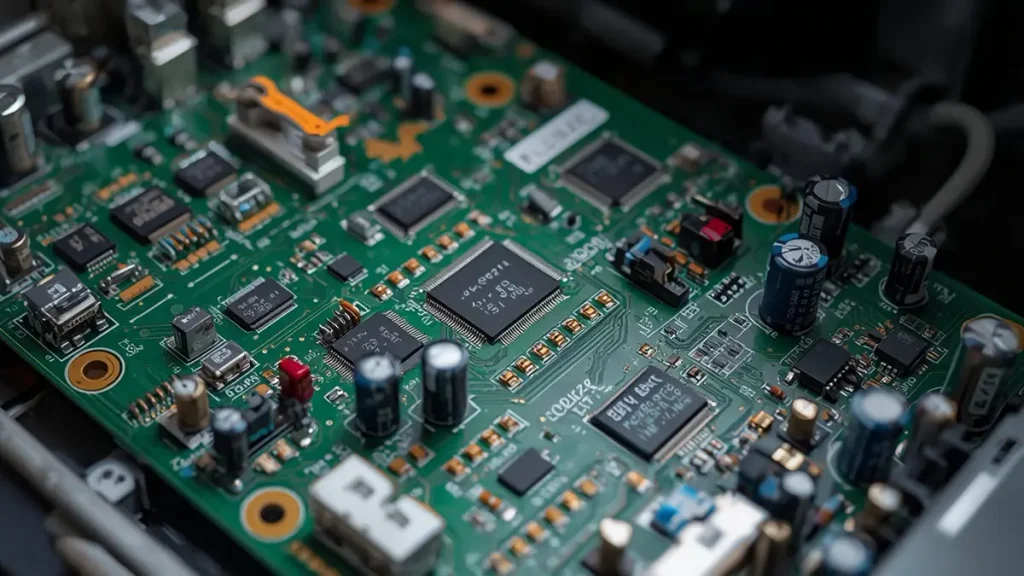
PCB Material: FR-4 (Tg 135–170°C, project-dependent)
Layer Countl: 2–4 Layers
Board Thickness: 1.6 mm (customizable: 1.0–2.0 mm)
Copper Thickness: 1 oz (35 μm), optional 2 oz (70 μm)
Min. Trace Width / Spacing: 0.15 / 0.15 mm
Min. Hole Size: 0.20 mm
Yes. Hongda Circuit provides custom dishwasher PCB manufacturing and PCBA assembly for OEMs, including PCB fabrication, SMT and through-hole assembly, and project-specific inspection and testing. We support prototype, small-batch, and mass-production requirements based on customer drawings, BOMs, and technical specifications. Contact our engineering and sales team at sales@pcbkr.com or visit www.pcbkr.com to discuss your dishwasher control board project.
Dishwasher PCB Manufacturing and Custom PCBA Services
A dishwasher PCB is more than a basic appliance circuit board. It coordinates power distribution, water circulation, heating, temperature monitoring, user input, and operating sequences. Its electrical and environmental requirements depend on the dishwasher architecture, connected loads, operating voltage, and control strategy.
For appliance manufacturers and OEM product developers, selecting a dishwasher PCB manufacturer involves more than comparing board prices. The supplier must understand the relationship between the PCB layout, component selection, assembly process, electrical loading, and the final product’s operating environment.
Hongda Circuit supports custom PCB fabrication and PCBA assembly for home appliance control applications. Depending on the project scope, our manufacturing services can include:
- Custom PCB fabrication: Manufacturing from customer-approved Gerber files, stack-up information, and fabrication specifications.
- SMT assembly: Placement and soldering of surface-mount components according to the approved BOM and assembly data.
- Through-hole assembly: Installation and soldering of applicable connectors, relays, terminals, and other through-hole components.
- Component sourcing: BOM-based component procurement when requested and confirmed in the project quotation.
- Inspection and testing: Applicable AOI, X-ray, electrical inspection, and customer-defined functional testing according to board construction and project requirements.
- Production support: Prototype, small-batch, and volume production planning based on order quantity and process requirements.
The manufacturing scope can be configured for bare PCB supply or assembled PCBA delivery. Firmware programming, component sourcing, and functional testing can be discussed as optional project requirements rather than assumed standard inclusions.
For OEM buyers, this means the manufacturing quotation can be based on the actual product design and required delivery scope instead of a generic appliance-board specification.
Dishwasher Control PCB Architecture and Main Circuit Functions
Dishwasher Control PCB Architecture and Main Circuit Functions
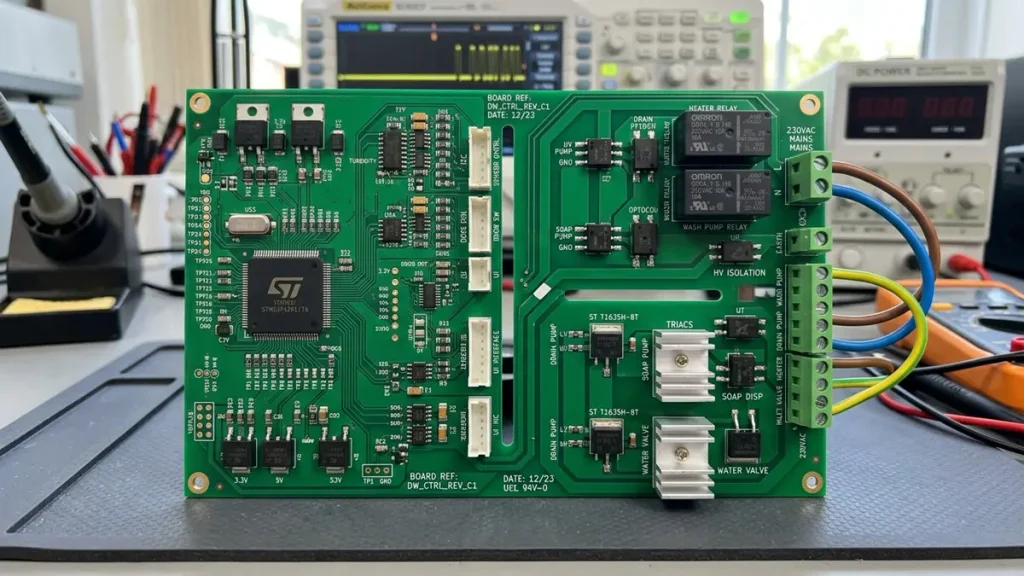
The architecture of a dishwasher control board varies by product platform. A basic appliance controller may use a microcontroller with relay-driven outputs, while a more advanced design may incorporate inverter motor control, additional sensing interfaces, and communication functions.
Understanding the functional blocks helps OEM engineers define the manufacturing requirements before releasing the design for production.
Main control and processing circuit
The microcontroller or control processor executes the programmed washing sequence and coordinates the signals received from sensors and user interfaces.
Typical circuit elements may include:
- Microcontroller and associated clock circuit
- Reset and programming interfaces
- Non-volatile memory, where required
- Signal-conditioning components
- Communication interfaces
- Low-voltage power regulation
From a manufacturing perspective, component package selection, solder-joint accessibility, programming access, and placement around sensitive signal circuits should be reviewed before production.
For fine-pitch ICs and compact control assemblies, PCB pad design, solder paste application, component placement accuracy, and reflow process control all influence assembly quality.
Pump and motor control circuits
Dishwasher platforms may contain circulation pumps, drain pumps, and other motor-driven mechanisms. The control method depends on the motor type and electrical architecture.
Possible circuit configurations include:
- Relay-based motor switching
- Triac-based AC load control
- Dedicated motor-driver circuits
- Inverter or intelligent power module interfaces
These circuits can involve switching currents, inductive loads, and transient voltage conditions. PCB copper sizing, component ratings, thermal paths, connector selection, and clearance requirements must therefore follow the approved electrical design.
A PCB assembler should not independently substitute power components or modify the circuit layout without engineering approval. Changes to relays, triacs, power semiconductors, or protection components may affect electrical safety and operating performance.
Heater control and temperature sensing
Heating functions are often among the higher-power sections of a dishwasher control system. Depending on the product design, the PCB may control a heating element through a relay, contactor interface, triac, or another power-switching arrangement.
Temperature feedback may be provided by an NTC thermistor or another specified sensing device.
Manufacturing considerations include:
- Adequate copper cross-section for the specified current
- Correct relay or switching-device footprint and rating
- Appropriate separation between mains and low-voltage circuits
- Reliable solder joints at high-current terminals
- Correct placement and polarity of sensing components
- Consistent assembly of connectors and terminal interfaces
The required electrical spacing and copper dimensions must be established from the actual voltage, insulation category, pollution degree, material group, and applicable product safety standards. They should not be selected from a generic dishwasher PCB template.
Sensor, door-switch, and user-interface circuits
A dishwasher may use door interlocks, water-level sensors, temperature sensors, leak detection inputs, and user-interface connections.
These signals can be electrically sensitive, particularly when routed near motor, heater, or switching-power sections.
PCB layout and assembly requirements should consider:
- Separation of low-level signals from noisy power circuits
- Connector pin assignment and mechanical retention
- Protection against ESD and electrical transients where required
- Correct orientation of polarized components
- Reliable contact interfaces between the main board and peripheral modules
For OEM production, the approved schematic, Gerber data, BOM, and connector pin definitions should be consistent before manufacturing begins.
Key PCB Design Requirements for Dishwasher Control Boards
Dishwasher control PCBs combine low-voltage processing with circuits that may switch mains-powered loads. The exact requirements depend on the electrical design, but several engineering factors deserve particular attention during DFM review and production preparation.
Mains isolation and electrical spacing
Mains-connected circuits require appropriate creepage and clearance distances. These distances are influenced by working voltage, transient conditions, insulation requirements, pollution degree, and the applicable safety standard.
Relevant PCB design considerations include:
- Separation between primary and secondary power circuits
- Clearance around relay contacts and high-voltage terminals
- Isolation slots where specified by the design
- Correct solder-mask and copper keep-out definitions
- Suitable PCB material and thickness
- Consistent manufacturing registration and dimensional control
Hongda Circuit can manufacture boards according to approved fabrication data and customer-defined electrical spacing requirements. The OEM design authority remains responsible for determining the applicable safety requirements and approving the final layout.
Copper thickness and current-carrying capacity
The required copper thickness depends on current, allowable temperature rise, conductor width, board construction, and the surrounding thermal environment.
Power paths serving heaters, pumps, and other loads should be reviewed separately from low-current sensor and logic circuits.
A production-ready design should identify:
- Finished copper requirements for each relevant layer
- High-current trace and pad dimensions
- Via current-carrying requirements
- Terminal and connector current ratings
- Thermal relief and soldering considerations
- Any local copper reinforcement or special fabrication requirements
A thicker copper specification does not automatically guarantee a reliable power circuit. The complete current path, including vias, pads, connectors, solder joints, and switching components, must be considered.
PCB stack-up and component placement
The layer count and stack-up should be selected according to routing density, power distribution, signal integrity, mechanical dimensions, and cost targets.
For compact appliance controllers, placement constraints can include:
- Separation of power and control sections
- Routing of sensor signals away from switching nodes
- Appropriate return-current paths
- Component spacing for assembly and inspection
- Connector positioning for enclosure integration
- Mounting-hole and board-outline accuracy
Hongda Circuit supports multilayer PCB fabrication and controlled production processes. Our manufacturing preparation can use customer-approved stack-up information, copper requirements, and dimensional tolerances to establish the production process.
Moisture Protection and Thermal Reliability in Dishwasher PCBs
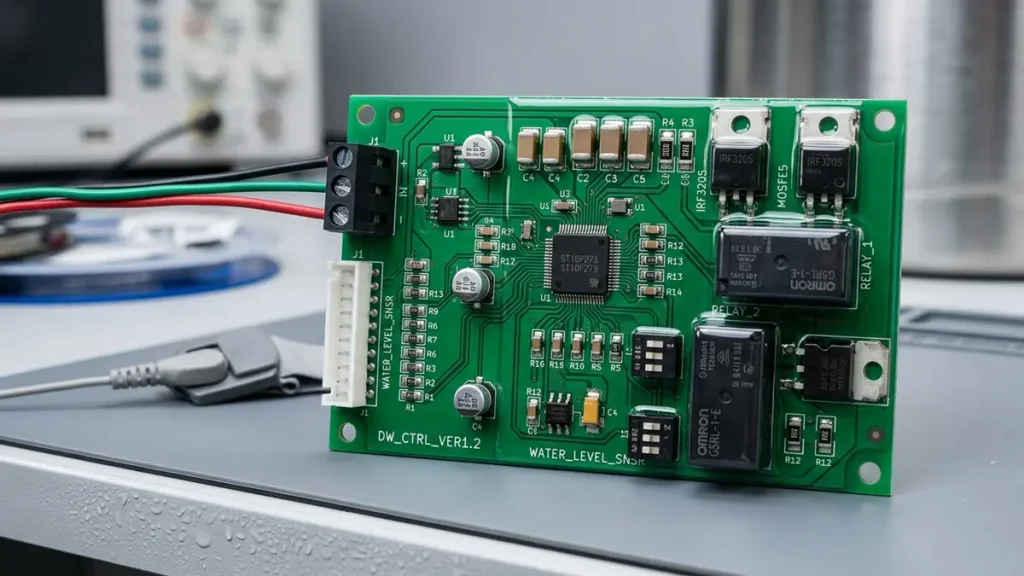
Moisture Protection and Thermal Reliability in Dishwasher PCBs
Dishwashers operate in an environment where heat, water vapor, temperature changes, and possible condensation can affect electronic assemblies. However, the control board’s actual exposure depends on its location, enclosure design, airflow, sealing, and product operating conditions.
Moisture-related failures are not limited to visible water damage. Condensation and contamination can contribute to corrosion, leakage paths, connector degradation, and intermittent electrical behavior.
Moisture and contamination risks
Potential risk areas include:
- Exposed copper or poorly protected conductive surfaces
- Connector interfaces and terminal areas
- Contamination trapped beneath components
- Residues around fine-pitch ICs
- Areas where condensation can accumulate
- Corrosion around damaged solder-mask or coating surfaces
The PCB design and manufacturing process should account for the intended environmental protection method.
Conformal coating, selective coating, potting, or sealed enclosures may be considered by the OEM according to the product’s environmental requirements. These processes should only be included in the manufacturing scope when the coating material, coverage, thickness, keep-out areas, and inspection criteria have been specified and agreed.
A coating process should not be treated as a substitute for correct creepage, clearance, component selection, or enclosure design.
Thermal stress and component reliability
Power-switching components, relays, voltage regulators, and connectors can experience elevated temperatures during operation.
The relevant engineering considerations include:
- Component operating temperature and derating
- Copper area around heat-generating components
- Thermal separation between sensitive components and power devices
- Relay contact and terminal current ratings
- Solder-joint reliability under thermal cycling
- PCB material suitability for the specified operating environment
For production, the BOM and assembly drawings should clearly identify components with temperature-sensitive handling or soldering requirements.
PCBKR manufacturing controls relevant to reliability
Hongda Circuit uses controlled PCB fabrication and assembly processes supported by production equipment and inspection methods. Available process capabilities include:
- LDI exposure: SCREEN Ledia LDI equipment, with an 8 µm target and ±10 µm process target as specified for the relevant process.
- Lamination: LAUFFER lamination equipment supporting defined pressure settings of 80, 150, and 200 psi, with vacuum below 50 mbar.
- Laser drilling: Mitsubishi UV/CO₂ laser processing with a 75 µm ±5 µm process target for applicable structures; picosecond laser processing down to 50 µm for applicable applications.
- Inspection: 3D AOI, X-ray inspection, and four-wire Kelvin flying-probe testing are available for applicable products and inspection plans.
These are manufacturing process capabilities, not automatic specifications for every dishwasher PCB. Actual limits and inspection coverage must be confirmed against the board design, material, layer count, and production requirements.
EMI/EMC Challenges in Dishwasher Control PCBA
Electromagnetic interference is an important consideration in appliance electronics because motors, switching power supplies, relays, and power semiconductors can generate electrical noise.
In a dishwasher control system, switching noise may affect sensor readings, microcontroller operation, communication interfaces, and other low-voltage circuits if the PCB layout and system design do not provide adequate control.
EMI/EMC performance is a system-level result. PCB fabrication and assembly quality are important, but they cannot independently guarantee that the finished dishwasher will pass regulatory EMC testing.
Common sources of electrical noise
Potential noise sources include:
- Motor switching and inductive load transients
- Relay contact switching
- Triac and semiconductor switching
- Switching-mode power supplies
- Long cables connected to motors and external sensors
- Poorly controlled return-current paths
The final noise behavior depends on circuit topology, component selection, PCB layout, enclosure, wiring harness, grounding, and operating conditions.
PCB layout and assembly considerations
During design review, engineers should pay attention to:
- Power and signal separation: Keep sensitive sensor and communication traces away from high-current switching paths where practical.
- Return-current paths: Avoid unnecessary loops and poorly defined return paths.
- Decoupling: Place bypass capacitors according to the IC manufacturer’s layout recommendations.
- Switching-node routing: Minimize unnecessary copper area and routing length around high-frequency switching nodes.
- Protection circuits: Confirm the specified transient protection and filtering components are correctly installed.
- Grounding strategy: Follow the approved grounding and isolation architecture rather than applying generic ground-plane rules.
Hongda Circuit can manufacture the PCB and assemble the specified components according to the approved design. If an OEM requires EMC-related engineering changes or laboratory compliance testing, the scope and responsibility should be separately defined before quotation.
Dishwasher PCB Fabrication and PCBA Assembly Process
A consistent manufacturing process helps reduce assembly defects, improve repeatability, and support the transition from prototype to volume production.
Hongda Circuit provides PCB fabrication and PCBA assembly according to customer-approved technical documentation.
PCB fabrication preparation
Before production, the manufacturing data should be reviewed for completeness and consistency.
Typical inputs include:
- Gerber or other approved fabrication data
- NC drill files
- PCB stack-up and material specification
- Finished board thickness
- Finished copper thickness
- Surface finish
- Solder-mask and legend requirements
- Controlled impedance requirements, if applicable
- Board outline, slots, and mechanical tolerances
DFM review should identify manufacturability concerns such as insufficient spacing, unclear drill definitions, inconsistent layer information, and potential fabrication limitations.
Any proposed change that affects electrical performance, mechanical fit, or product safety should be submitted for customer approval.
SMT and through-hole assembly
The assembly process is established according to the BOM, component packages, board design, and required production volume.
Typical manufacturing steps include:
- BOM and component package review
- Solder-paste printing
- SMT component placement
- Reflow soldering
- Through-hole component installation and soldering, where required
- AOI and other applicable inspection
- Electrical testing according to the agreed test plan
- Final inspection and packaging
For mixed-technology dishwasher control boards, the assembly sequence may require coordination between SMT components, large connectors, relays, terminals, and other through-hole parts.
Component substitutions should not be made solely on the basis of package compatibility. Electrical ratings, temperature characteristics, safety approvals, pin configuration, and lifecycle status must also be considered.
Production documentation and process consistency
For repeat orders, maintaining consistent manufacturing documentation is essential.
The controlled production package should identify the approved PCB revision, BOM revision, assembly drawing, component substitutions, inspection criteria, and any customer-specific test requirements.
This helps reduce the risk of manufacturing different board versions under the same product description.
Dishwasher PCBA Quality Control and Functional Testing
A visually acceptable PCB assembly is not necessarily a functionally correct control board. Quality assurance should cover both assembly workmanship and the electrical characteristics relevant to the customer’s design.
The inspection plan should be determined by board complexity, component technology, electrical requirements, and the customer’s quality expectations.
Assembly inspection
Hongda Circuit has access to several inspection methods that can be applied according to the product and inspection plan.
| Inspection method | Typical purpose |
|---|---|
| 3D AOI | Inspect component presence, placement, polarity, and visible solder-joint conditions where detectable |
| X-ray inspection | Examine hidden solder joints, including applicable BGA and other concealed connections |
| Visual inspection | Check workmanship, component orientation, connector condition, and visible assembly defects |
| Flying-probe testing | Perform electrical continuity and isolation checks on applicable bare PCBs |
| Four-wire Kelvin measurement | Measure low-resistance paths where the test design requires it |
AOI and X-ray inspection do not replace electrical or functional testing. Their coverage and acceptance criteria should be agreed for each product.
Electrical and functional testing
The appropriate test method depends on whether the delivery scope is a bare PCB or an assembled control board.
For a bare PCB, electrical testing may include continuity and isolation verification according to the approved test data.
For an assembled PCBA, additional testing may be specified, such as:
- Power-on verification
- Supply-voltage checks
- Programming or firmware loading, if included in the agreed scope
- Input and output signal checks
- Relay or switching-output verification under defined test conditions
- Sensor-interface checks using approved simulation methods
- Customer-defined functional test procedures
A functional test should use a documented test fixture, defined input conditions, expected outputs, and acceptance limits. Without these details, a supplier cannot reliably quote or guarantee a particular functional test.
Hongda Circuit can discuss customer-defined testing requirements during the quotation and engineering review process.
Traceability and revision control
For OEM production, revision control is as important as the inspection equipment.
The manufacturing package should make it possible to identify the applicable:
- PCB revision
- BOM revision
- Assembly data revision
- Approved component alternatives
- Production lot or batch
- Inspection and test records, where included in the agreed quality documentation
These controls help customers manage engineering changes, repeat orders, and product lifecycle requirements.
Dishwasher PCB Prototype, NPI and Mass Production
A dishwasher PCB project may begin with a prototype and later move into small-batch or mass production. The manufacturing process should support this transition without introducing uncontrolled changes to the design or component configuration.
Prototype manufacturing
Prototype production helps verify the manufacturing data, component availability, assembly feasibility, and initial electrical performance.
Before ordering prototypes, OEM buyers should confirm:
- Whether the PCB design is released or still under development
- Whether the BOM is complete and procurement-ready
- Whether components are customer-supplied or supplier-sourced
- Whether programming or functional testing is required
- The number of prototype units
- The expected delivery date and inspection requirements
Prototype builds should be treated as an opportunity to identify manufacturing issues before volume production, not simply as smaller versions of a mass-production order.
New product introduction
During NPI, design revisions and process requirements should be documented and approved.
Important control points include:
- Gerber and drill-file revision
- Stack-up and fabrication specification
- BOM and approved alternate components
- SMT and through-hole assembly instructions
- Test fixture and test-program revision
- Customer-approved engineering changes
A controlled NPI process reduces the risk of producing different board configurations under an identical part number.
Small-batch and mass production
For repeat and volume orders, production planning should consider component lead times, material availability, process capacity, inspection requirements, and delivery schedules.
Hongda Circuit supports prototype, small-batch, and mass-production requirements. The achievable lead time depends on PCB complexity, material availability, component sourcing, order quantity, and the required inspection or testing scope. A confirmed schedule should be provided after reviewing the project data.
What to Prepare Before Requesting a Dishwasher PCB Manufacturing Quote
A complete RFQ package helps the manufacturer evaluate technical feasibility, material requirements, assembly complexity, and production cost more accurately.
OEM buyers should prepare the following information whenever available:
| RFQ information | Why it matters |
|---|---|
| Gerber files and NC drill data | Defines the PCB fabrication requirements |
| PCB stack-up and material | Determines layer construction and material cost |
| Finished board thickness and copper | Defines mechanical and electrical fabrication requirements |
| BOM with manufacturer part numbers | Supports component availability and sourcing review |
| Assembly drawing and centroid data | Defines component placement and assembly requirements |
| Board quantity | Supports prototype, small-batch, or volume pricing |
| PCB revision and project status | Helps control engineering changes |
| Functional test requirements | Defines fixture, test coverage, and acceptance criteria |
| Required delivery date | Supports production and procurement planning |
| Special environmental or compliance requirements | Identifies coating, material, documentation, or testing needs |
If the design is not yet complete, provide the available schematic, preliminary BOM, board dimensions, electrical requirements, and expected production quantity. The manufacturing team can then identify the information still required for a formal quotation.
For projects involving PCB fabrication and assembly, customers can also review our PCB Assembly Services to understand the broader PCBA manufacturing scope.
Why Choose Hongda Circuit for Dishwasher PCB Manufacturing?
Choosing a dishwasher PCB supplier requires confidence in both manufacturing execution and communication during engineering changes.
Hongda Circuit is a PCB and PCBA manufacturing company supporting customer-defined electronics projects from prototype through production. Our services cover PCB fabrication and SMT or through-hole assembly, with inspection and testing arranged according to the product requirements.
Relevant manufacturing resources include:
- SCREEN Ledia LDI exposure equipment for applicable fine-line PCB processes
- LAUFFER vacuum lamination equipment
- Mitsubishi UV/CO₂ laser processing and picosecond laser capability for applicable drilling structures
- 3D AOI and X-ray inspection
- Four-wire Kelvin and flying-probe electrical testing for applicable products
- PCB fabrication and PCBA assembly coordination
These resources support a range of PCB manufacturing requirements. The specific process window, achievable dimensions, inspection coverage, and production schedule must be confirmed against the actual dishwasher control board design.
For customers developing or sourcing appliance electronics, our Home Appliance Control Board PCBA Manufacturing page provides an overview of the broader home appliance control-board manufacturing scope.
If your project also involves general embedded control electronics, see our Embedded Control Board OEM Manufacturing page.
Request a Dishwasher PCB Manufacturing Quote
Send your Gerber files, BOM, assembly drawings, estimated quantity, and technical requirements to sales@pcbkr.com.
Hongda Circuit can review the available documentation and discuss PCB fabrication, PCBA assembly, inspection, and project-specific testing requirements for your dishwasher control board.
Website: https://www.pcbkr.com/
Email: sales@pcbkr.com
Frequently Asked Questions About Dishwasher PCB Manufacturing
Can Hongda Circuit manufacture custom dishwasher control PCBs from our Gerber files and BOM?
Yes. Hongda Circuit can manufacture custom PCBs and assemble customer-specified components based on approved Gerber files, BOMs, assembly drawings, and technical specifications. The project can be quoted for bare PCB supply or assembled PCBA delivery, depending on the required scope.
Can you provide both dishwasher PCB fabrication and PCBA assembly?
Yes. PCB fabrication and PCBA assembly can be coordinated as a turnkey manufacturing scope. SMT and through-hole assembly are available according to the board design and BOM. Component sourcing and other additional services should be confirmed in the quotation.
What information is required to quote a dishwasher PCB assembly project?
The most useful information includes Gerber files, NC drill data, PCB stack-up, finished copper and board thickness, BOM with manufacturer part numbers, assembly drawings, order quantity, and required testing. If some files are not available, preliminary design information can be submitted for an initial feasibility review.
Can you test dishwasher control board PCBAs before shipment?
Inspection and testing can be arranged according to the board design and agreed quality plan. Available methods include 3D AOI, X-ray inspection, and applicable electrical tests. Functional testing, programming, and specific input/output verification require defined test procedures, fixtures, and acceptance criteria.
Do you support dishwasher PCB prototypes, small batches, and mass production?
Yes. Hongda Circuit supports prototype, small-batch, and mass-production requirements. Lead time and pricing depend on PCB complexity, materials, component availability, order quantity, and inspection or testing requirements. Providing the complete RFQ package helps establish a more accurate quotation and production schedule.
About Author
David Chen LinkedIn Profile
David Chen is a Senior RF/PCB Process Engineer at Shenzhen Hongda Circuit Technology Co., Ltd., with over 12 years of experience in high-frequency PCB fabrication, impedance-controlled stack-up design, and Rogers/PTFE laminate processing. He also boasts an extensive professional background in PCBA manufacturing, PCBA testing, and PCBA optimization, with specialized expertise in high-precision PCBA fault analysis and rigorous PCBA reliability testing. The author has worked with high-layer-count server PCB fabrication, ultra-low-loss backplane stackups, and thermo-mechanical reliability optimization for AI infrastructure projects involving 112G and 224G PAM4 architectures. Skilled in complex circuit design and cutting-edge advanced PCB manufacturing processes, he delivers solutions that elevate product durability and performance across industrial applications. His technical articles focusing on PCBA manufacturing workflows and testing methodologies are widely cited by industry peers and technical platforms, and have gained attention and recognition from industry colleagues.
Dishwasher PCB – Data Sheet
| Item | Specification |
|---|---|
| Product Type | Dishwasher Control PCB / PCBA |
| Application | Dishwasher Electronic Control Systems |
| PCB Material | FR-4 |
| Layer Count | 2–4 Layers |
| Board Thickness | 1.6 mm (Customizable) |
| Copper Thickness | 1 oz / 2 oz |
| Min. Trace Width / Spacing | 0.15 / 0.15 mm |
| Min. Hole Size | 0.20 mm |
| Surface Finish | HASL / Lead-Free HASL / ENIG |
| Control Circuit | MCU-Based Control System |
| Power Management | Power Supply and Voltage Regulation |
| Load Control | Relay / Triac / Motor Driver (Design-Dependent) |
| Sensor Interfaces | Temperature / Water Level / Door Switch |
| Assembly Technology | SMT / Through-Hole Assembly |
| Inspection | 3D AOI / X-ray / Visual Inspection |
| Electrical Testing | Flying Probe / Continuity and Isolation Testing |
| Functional Testing | Available According to Customer Requirements |
| Firmware Programming | Optional |
| Moisture Protection | Conformal Coating (Optional, Project-Dependent) |
| Manufacturing Scope | PCB Fabrication / PCBA Assembly / Turnkey PCBA |
| Production Volume | Prototype / Small Batch / Mass Production |
| Customization | Based on Gerber Files, BOM and Technical Specifications |
Note: All specifications are customizable according to the approved PCB design, electrical requirements, component selection, and application conditions. Final manufacturing parameters, assembly scope, and testing procedures are subject to engineering review and project confirmation.
RFQ Contact: sales@pcbkr.com
Website: https://www.pcbkr.com/