How Can You Source Home Appliance Control Board PCBA Manufacturing?
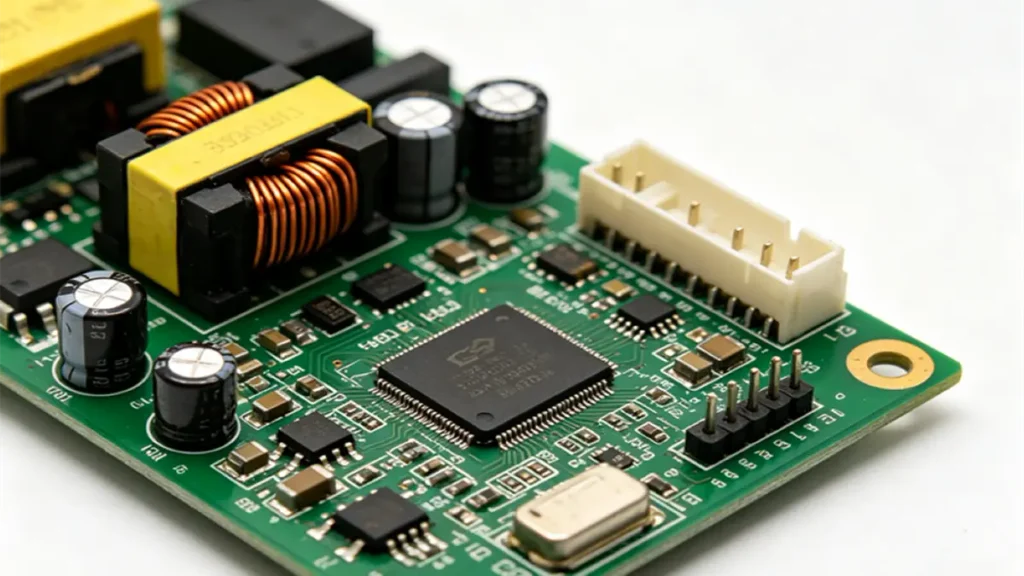
PCB Material:FR-4 / Customer-specified laminate
Layer Count:According to design requirements
Board Thickness:According to design requirements
Copper Thickness:According to current-carrying and design requirements
Min. Trace / Space:According to PCB layout requirements
Min. Hole Size:According to drilling and component requirements
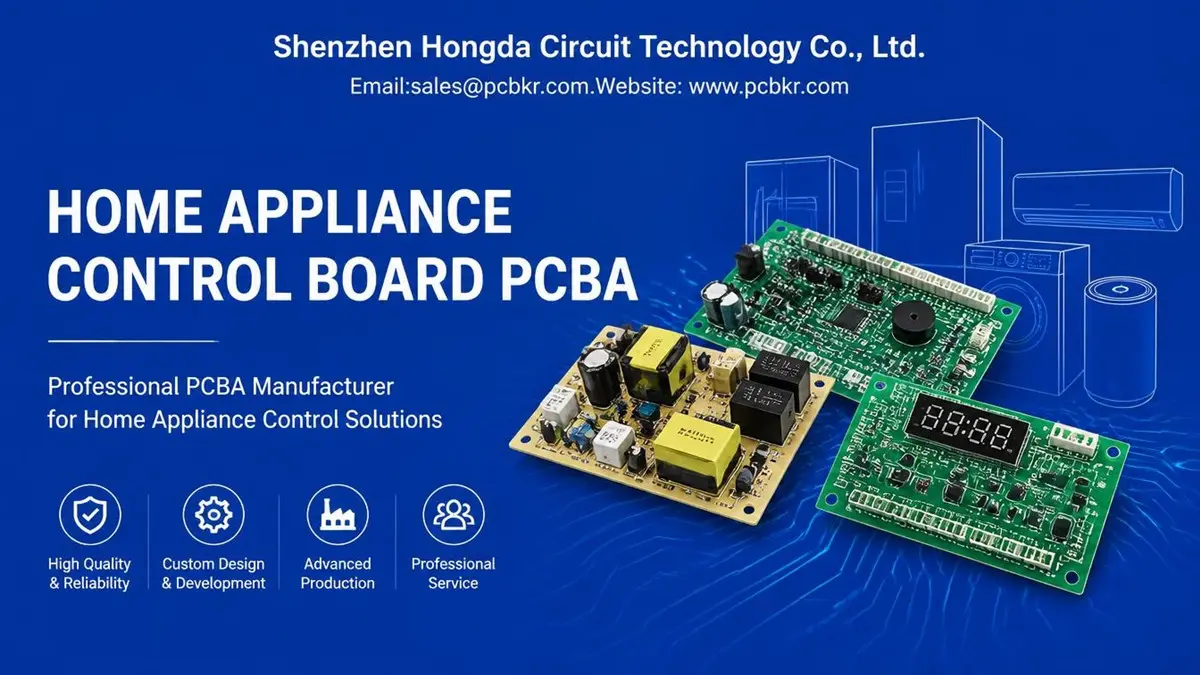
PCBKR supports OEM production of home appliance control board PCBAs through PCB fabrication and SMT/THT assembly. For projects requiring broader manufacturing support, BOM component sourcing, firmware programming, and functional testing are available as optional services. We manufacture for appliance applications including washing machines, refrigerators, air conditioners, dishwashers, and microwave ovens. Send your project files and requirements to sales@pcbkr.com for an engineering and quotation review.
What Types of Home Appliance Control Boards Can Be Manufactured?
Home appliance control boards manage the electronic functions that allow an appliance to operate according to its design. Depending on the product, a control board may process sensor signals, manage user inputs, control electrical loads, and communicate with other electronic modules.
PCBKR has actual production experience with home appliance control board orders covering applications such as:
- Washing machine control boards: Electronic control assemblies used in washing machine systems.
- Refrigerator control boards: PCB assemblies used in refrigerator electronic control systems.
- Air conditioner control boards: Control PCBAs for air conditioning equipment.
- Dishwasher control boards: Electronic assemblies for dishwasher control systems.
- Microwave oven control boards: PCB assemblies used in microwave oven control applications.
- Other home appliance control boards: Custom PCB and PCBA projects based on customer designs.
The actual circuit architecture, component selection, board construction, and assembly requirements depend on the appliance model and the customer’s released design. For dedicated washing machine control board OEM requirements, including PCB fabrication and SMT/THT assembly, see our Washing Machine PCBA Manufacturing page for more specific manufacturing details.
A washing machine controller and an air conditioner controller should not automatically be treated as the same manufacturing product. Their electrical interfaces, load requirements, component selection, mechanical constraints, and validation procedures may differ. A suitable PCBA manufacturing plan therefore starts with the actual design files and application requirements rather than a generic appliance-board specification.
What Functions Must a Home Appliance Control Board Support?
The functional architecture of an appliance control board is determined by the appliance’s electrical and operating requirements. Common circuit sections may include the following, depending on the design.
How Does the Main Control Circuit Manage Appliance Operation?
A microcontroller or other control device may execute the product’s operating logic, process input signals, and coordinate output functions. The PCB layout must accommodate the selected controller, supporting components, clock and reset circuits, power requirements, and programming interface where applicable.
For manufacturing, component orientation, package compatibility, soldering requirements, and access to programming points should be confirmed before assembly.
How Are Sensors and User Interfaces Connected?
Appliance control boards may receive signals from temperature sensors, switches, position sensors, pressure sensors, or other input devices. User interfaces may include buttons, displays, touch controls, indicator LEDs, and communication connections.
The PCB design must account for connector positions, signal routing, electrical noise, and the mechanical interface with the appliance enclosure or control panel.
How Are Motors, Relays, Heaters, and Other Loads Controlled?
Depending on the appliance, output circuits may interface with motors, fans, pumps, compressors, heaters, valves, or relay-controlled loads.
These circuits can introduce different electrical and thermal demands. Power components, connectors, copper design, insulation distances, heat dissipation, and component ratings must follow the released engineering design and applicable product requirements.
PCBKR manufactures the PCB and assembles the specified components. Circuit design, component-rating approval, product-level electrical safety validation, and appliance system certification should remain defined responsibilities within the customer’s project scope unless separately agreed.
How Are Power and Communication Circuits Integrated?
A control board may include power conversion, voltage regulation, protection, wired communication, or wireless modules. The required circuits depend on the appliance architecture and the interfaces specified by the customer.
Where a project includes a dedicated power conversion board or power-management PCB, buyers can also review PCBKR’s PCB manufacturing for power supply applications for related manufacturing requirements.
What PCB Specifications Should Buyers Confirm Before Ordering?
There is no single PCB specification suitable for every home appliance control board. The correct construction depends on the circuit design, operating environment, component package, electrical requirements, mechanical dimensions, and production quantity.
Buyers should confirm the following parameters against the released fabrication data.
| PCB parameter | What should be confirmed? |
|---|---|
| Base material | Required laminate type and material grade |
| Layer count | Actual number of copper layers in the released design |
| Finished board thickness | Required thickness and tolerance |
| Copper thickness | Copper weight or finished copper thickness by layer, where specified |
| Minimum trace width and spacing | Minimum values supported by the design and fabrication requirements |
| Minimum hole size | Finished hole or drill requirements, as applicable |
| Surface finish | Customer-specified finish and solderability requirements |
| Board dimensions | Outline, tolerances, slots, cut-outs, and mounting features |
| Electrical requirements | Impedance, isolation, voltage, or other controlled parameters where applicable |
| Special requirements | Controlled materials, marking, cleanliness, coating, or other specified processes |
These values should be taken from the customer’s Gerber or ODB++ data, fabrication drawing, stack-up, and technical specification. They should not be replaced by generic values copied from another appliance project.
For example, a compact user-interface board and a power-control board may have different copper, insulation, thermal, connector, and mechanical requirements even when they are used in the same appliance.
Why Does PCB Material Selection Matter?
The laminate must be suitable for the board’s electrical, thermal, mechanical, and environmental requirements. Buyers should confirm the required material grade and any restrictions in the fabrication documentation.
Material selection should not be based on appliance category alone. The operating temperature, circuit characteristics, product design, and applicable customer requirements all influence the specification.
Why Must Copper Thickness and Track Geometry Match the Design?
Copper thickness and trace geometry affect current-carrying capability, resistance, temperature rise, and manufacturing feasibility. Power paths and signal paths may have different design constraints.
The manufacturer should review the specified copper construction and minimum geometry against the fabrication files. Any proposed change to copper thickness, trace width, or spacing should be reviewed and approved by the customer before production.
Which Mechanical and Electrical Details Should Be Checked?
Board outline, connector locations, mounting holes, slots, component height, and keep-out areas can affect whether the finished PCBA fits the appliance assembly.
Electrical details such as voltage domains, isolation requirements, grounding, and connector pin assignments should also be clear in the design documentation. These are particularly important when the board interfaces with motors, heating elements, pumps, compressors, or external power sources.
What Assembly Requirements Affect Home Appliance PCBA Quality?
Home appliance control boards may combine surface-mount and through-hole components. The required assembly process depends on the component list, board construction, and customer design.
When Is SMT Assembly Required?
SMT assembly is used for surface-mount components such as microcontrollers, integrated circuits, resistors, capacitors, diodes, transistors, and many connectors.
Important production controls include:
- Correct component part numbers and package specifications.
- Accurate placement data and component orientation.
- Solder paste printing and stencil requirements.
- Reflow profile compatibility with the components and PCB.
- Inspection of solder joints, polarity, and placement.
- Control of component substitutions and BOM revisions.
The assembly process must follow the released BOM and assembly documentation. Unapproved substitutions can create electrical, mechanical, or lifecycle risks for the OEM.
When Is THT Assembly Required?
Through-hole components may be specified for connectors, larger components, power interfaces, or parts requiring mechanical support.
THT assembly requires attention to hole dimensions, lead fit, component orientation, soldering method, and the mechanical strength of the finished joints. Mixed SMT/THT boards also require an assembly sequence appropriate to the component layout and process requirements.
PCBKR supports both SMT and THT assembly for home appliance control board projects.
How Should Mixed-Technology Assemblies Be Managed?
For boards containing both SMT and THT components, the assembly drawing and BOM should identify component locations, assembly sides, polarity, and any special handling instructions.
Buyers should also identify components that require manual installation, special soldering controls, or protection during subsequent process steps. These details help prevent avoidable assembly discrepancies and make quotations more accurate.
What Manufacturing and Supply Options Can PCBKR Provide?
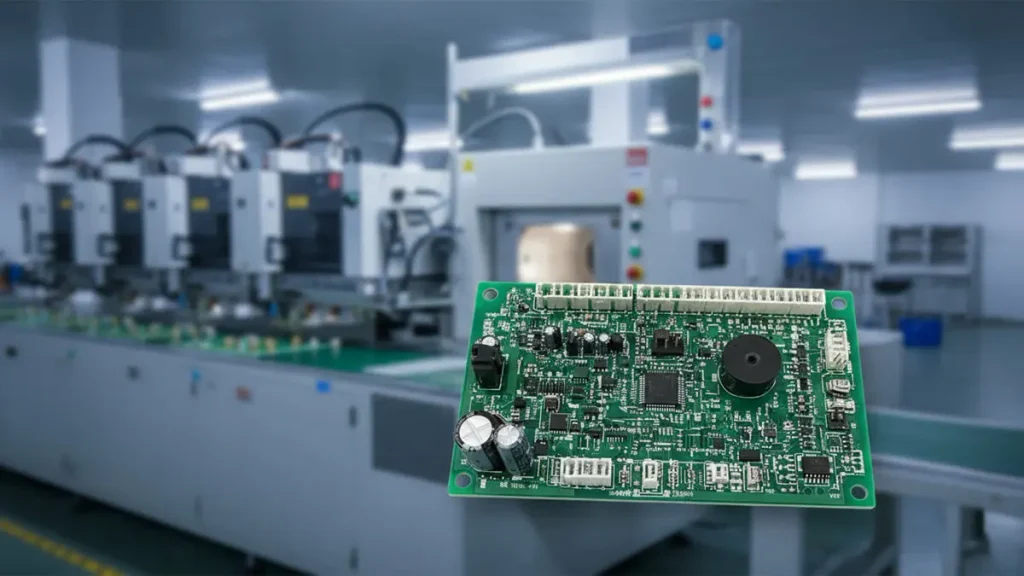
Home Appliance Control Board PCBA Manufacturing Options
The manufacturing scope should be agreed before quotation because different buyers may require different levels of supply-chain and production support.
PCBKR’s confirmed home appliance control board manufacturing scope includes PCB fabrication and SMT/THT assembly. Additional services can be selected according to the project.
| Service | Availability | Scope clarification |
|---|---|---|
| PCB fabrication | Core manufacturing service | Based on customer-approved PCB data |
| SMT assembly | Core manufacturing service | Based on BOM and placement data |
| THT assembly | Core manufacturing service | Where required by the design |
| BOM component sourcing | Optional | Subject to sourcing scope, approved parts, and quotation |
| Firmware programming | Optional | Requires agreed firmware files, programming instructions, and compatible hardware access |
| Functional testing | Optional | Requires agreed test procedures, equipment or fixtures, and acceptance criteria |
Can PCBKR Provide PCB Fabrication and Assembly Together?
Yes. PCBKR can provide PCB fabrication together with SMT and THT assembly for home appliance control board projects.
This arrangement allows the OEM to coordinate bare-board manufacturing and assembly within an agreed production scope. The quotation should identify the PCB revision, assembly revision, BOM version, production quantity, and any special requirements.
Can Buyers Request BOM Component Sourcing?
Yes. BOM component sourcing can be included as an optional project service.
To assess sourcing requirements, buyers should provide the BOM with manufacturer names, exact part numbers, approved alternatives, and any no-substitution restrictions. If the customer has an approved vendor list, it should be included with the RFQ.
Before procurement, the parties should clarify who approves substitutions, how shortages are handled, and whether customer-supplied components will be used for any line items.
A component should not be replaced solely because an alternative has a similar package or nominal value. Electrical characteristics, tolerance, temperature rating, lifecycle status, and application suitability may all matter.
Can Firmware Programming Be Included?
Firmware programming is available as an optional service when the project requires it and the necessary technical inputs are provided.
The RFQ should identify:
- Firmware file and version.
- Target component or programming device.
- Programming interface and connection requirements.
- Required programming sequence or instructions.
- Whether verification or programming-result records are required.
- Firmware revision control for repeat production.
The customer and manufacturer should agree on the firmware version and acceptance method before production. Firmware development, debugging, or application software design should not be assumed to be included in a programming request.
Can Functional Testing Be Added to the PCBA Order?
Yes. Functional testing can be included as an optional service when the test scope is defined and agreed.
A useful functional test specification identifies the test item, test conditions, input and output states, expected results, limits, and pass/fail criteria. If a dedicated fixture or customer-specific test equipment is needed, its supply, development, and cost should be clarified separately.
Functional testing of a PCBA is not automatically equivalent to full appliance testing. A board-level test may verify defined electrical functions, while complete appliance validation may require the enclosure, wiring harness, motors, sensors, loads, mechanical parts, and application environment.
The quotation should state exactly which tests are included and what records will be delivered.
How Are Home Appliance Control Board PCBAs Inspected?
Inspection requirements should reflect the PCB design, component packages, product risks, and customer acceptance criteria. No single inspection method provides complete verification of every possible defect.
Depending on the board and agreed scope, inspection may include the following:
| Inspection or verification method | Typical purpose |
|---|---|
| Visual inspection | Check component presence, orientation, visible workmanship, and obvious damage |
| AOI | Inspect visible component placement and solder-joint features that are accessible to optical inspection |
| X-ray inspection | Examine solder connections that are not visible externally, where the package and board design require it |
| Electrical testing | Verify specified electrical connections or test points when the test method is defined |
| Functional testing | Verify agreed board functions under specified test conditions, when included in the order |
Why Should AOI and X-ray Requirements Be Defined Separately?
AOI and X-ray inspect different features. AOI uses optical inspection to examine visible board areas, while X-ray can help examine certain hidden solder connections, such as those beneath suitable component packages.
The need for each method depends on the component package, board design, process risk, and customer requirements. Buyers should identify critical components and inspection expectations in the RFQ rather than assume every board requires the same inspection combination.
What Should a Functional Test Record Include?
When functional testing is part of the agreed scope, the customer and manufacturer should define the required record format. Depending on the project, records may identify the board model, revision, test procedure, test result, date, and relevant measurement values.
Acceptance criteria should be approved before production. A test result without defined limits or an agreed procedure may not provide sufficient evidence for an OEM’s quality-release process.
How Does PCBKR Manage Real Home Appliance Control Board Production Requirements?
PCBKR has actual production experience with home appliance control board orders, including projects for applications such as washing machines, refrigerators, air conditioners, dishwashers, and microwave ovens.
The confirmed manufacturing scope includes PCB fabrication and SMT/THT assembly. Depending on the individual project, the manufacturing package may also include optional BOM component sourcing, firmware programming, and functional testing.
The technical specification is not identical across all appliance orders. Material, layer count, finished thickness, copper thickness, minimum trace width and spacing, and minimum hole size are determined by the requirements of each product and its released design data.
For project evaluation and production control, PCBKR has access to anonymized manufacturing evidence such as:
- PCB photographs from actual production orders.
- BOM information associated with the relevant project.
- AOI and X-ray inspection records, where applicable.
- Customer acceptance or test records, where available and permitted for disclosure.
These records can help demonstrate the relationship between the design requirements, manufacturing process, inspection method, and delivered PCBA. Customer-confidential information should be removed or protected before any project evidence is shared publicly.
For a related overview of broader embedded control board manufacturing, see PCBKR’s Embedded Control Board OEM Manufacturing page. This home appliance page focuses specifically on appliance applications and the corresponding OEM production requirements.
What Should Buyers Include in a Home Appliance PCBA RFQ?
A clear RFQ helps the manufacturer review the design, identify missing information, and quote the correct manufacturing scope.
Buyers should prepare the following information where available:
| RFQ information | Recommended details |
|---|---|
| Product application | Washing machine, refrigerator, air conditioner, dishwasher, microwave oven, or other appliance |
| PCB fabrication data | Gerber or ODB++ files, drill data, stack-up, and fabrication drawing |
| BOM | Manufacturer part numbers, quantities, reference designators, and approved alternatives |
| Assembly data | Pick-and-place file, assembly drawing, polarity details, and special instructions |
| PCB specifications | Material, layer count, thickness, copper thickness, surface finish, and controlled dimensions |
| Production quantity | Prototype, pilot run, or mass-production quantity |
| Sourcing requirements | Customer-supplied components, turnkey sourcing, approved vendors, and substitution rules |
| Firmware requirements | Firmware file, version, programming interface, and instructions, if programming is requested |
| Testing requirements | Inspection methods, functional test procedure, acceptance limits, and required records |
| Delivery requirements | Target date, packaging, labeling, destination, and other delivery instructions |
If some files are not yet available, buyers can still describe the application, approximate quantity, and required services in the initial inquiry. The missing information can then be identified during the engineering review.
For a more accurate quotation, clearly distinguish between the services required for the order and those that are optional. For example, specify whether the request covers PCB fabrication and assembly only, or whether BOM sourcing, firmware programming, and functional testing should also be quoted.
Why Should OEM Buyers Evaluate More Than the Unit Price?
The lowest quoted PCBA price does not necessarily represent the lowest total procurement cost. Buyers should compare quotations based on equivalent technical and commercial scope.
Before selecting a home appliance control board PCBA manufacturer, confirm:
- Manufacturing scope: Does the quotation include PCB fabrication, SMT, THT, or only selected processes?
- BOM responsibility: Are components customer-supplied or sourced by the manufacturer? Who approves alternatives?
- Revision control: Are PCB, BOM, assembly, and firmware revisions clearly identified?
- Inspection requirements: Which inspection methods are included, and which are optional?
- Functional test scope: Is testing included, and are procedures and acceptance limits defined?
- Production planning: Are prototype, pilot, and repeat-production quantities clearly stated?
- Quality documentation: Which inspection, test, and traceability records will be supplied?
- Quotation exclusions: Are tooling, fixtures, programming, special processes, and packaging identified separately where applicable?
These questions make it easier to compare suppliers on a like-for-like basis and reduce the risk of unexpected costs or unclear delivery responsibilities.
What Questions Do Buyers Commonly Ask About Home Appliance Control Board PCBA?
Can a PCBA manufacturer supply both the PCB and assembled home appliance control board?
Yes. PCBKR can provide PCB fabrication together with SMT and THT assembly for home appliance control board projects. The quotation should specify the PCB revision, BOM, assembly requirements, and production quantity.
Can PCBKR source electronic components according to our BOM?
Yes. BOM component sourcing is available as an optional project service. Buyers should provide manufacturer part numbers, approved alternatives, vendor restrictions, and any components that must not be substituted. The sourcing scope should be confirmed in the quotation.
Can you program firmware and test the assembled appliance control board?
Firmware programming and functional testing can be included as optional services when the project requirements and technical inputs are agreed. Buyers should provide the firmware file, programming instructions, test procedure, and acceptance criteria as applicable. These services are not automatically included in every PCBA order.
What PCB specifications are required for a home appliance control board quotation?
The manufacturer normally needs the PCB fabrication files and relevant specifications, including material, layer count, finished board thickness, copper thickness, minimum trace width and spacing, minimum hole size, surface finish, and board dimensions. The actual values depend on the released design and product requirements.
What files should I send to request a home appliance control board PCBA quote?
A useful RFQ package includes Gerber or ODB++ data, drill files, PCB drawings, BOM, pick-and-place data, assembly drawings, required quantities, and target delivery date. If BOM sourcing, firmware programming, or functional testing is required, include the corresponding sourcing instructions, firmware files, test procedures, and acceptance criteria.
How Can You Request a Home Appliance Control Board PCBA Quote from PCBKR?
PCBKR supports OEM home appliance control board production through PCB fabrication and SMT/THT assembly, with optional BOM component sourcing, firmware programming, and functional testing based on the agreed project scope.
To request a quotation, send the available design files and project information, including:
- Appliance application and board function.
- PCB fabrication files and technical specifications.
- BOM and assembly files.
- Required manufacturing services.
- Estimated quantity and target delivery date.
- Inspection, programming, and functional testing requirements, if applicable.
Contact PCBKR
Company: Shenzhen Hongda Circuit Technology Co., Ltd.
Email: sales@pcbkr.com
Website: https://www.pcbkr.com/
Send your home appliance control board project details to sales@pcbkr.com. PCBKR can review the available files, clarify the required manufacturing scope, and prepare a quotation based on your actual PCB and PCBA requirements.
Data Sheet
| Item | Specification |
|---|---|
| Product Type | Home Appliance Control Board PCBA |
| Applications | Washing Machines, Refrigerators, Air Conditioners, Dishwashers, Microwave Ovens |
| PCB Fabrication | Available |
| Assembly Type | SMT / THT / Mixed Assembly |
| Component Sourcing | Optional |
| Firmware Programming | Optional |
| Functional Testing | Optional |
| Inspection | Visual Inspection / AOI / X-ray, as required |
| Production Volume | Prototype / Pilot Run / Mass Production |
| PCB Specifications | Customized to customer requirements |
| Quality Documentation | Inspection and test records, as agreed |
Data Sheet Note:
Available manufacturing processes and optional services depend on the project requirements and quotation. PCB specifications, inspection methods, firmware programming, and functional testing are confirmed according to customer-approved technical documents.
About Author
David Chen LinkedIn Profile
David Chen is a Senior RF/PCB Process Engineer at Shenzhen Hongda Circuit Technology Co., Ltd., with over 12 years of experience in high-frequency PCB fabrication, impedance-controlled stack-up design, and Rogers/PTFE laminate processing. He also boasts an extensive professional background in PCBA manufacturing, PCBA testing, and PCBA optimization, with specialized expertise in high-precision PCBA fault analysis and rigorous PCBA reliability testing. The author has worked with high-layer-count server PCB fabrication, ultra-low-loss backplane stackups, and thermo-mechanical reliability optimization for AI infrastructure projects involving 112G and 224G PAM4 architectures. Skilled in complex circuit design and cutting-edge advanced PCB manufacturing processes, he delivers solutions that elevate product durability and performance across industrial applications. His technical articles focusing on PCBA manufacturing workflows and testing methodologies are widely cited by industry peers and technical platforms, and have gained attention and recognition from industry colleagues.