How to Audit a PCBA Supplier’s Component Sourcing and Traceability
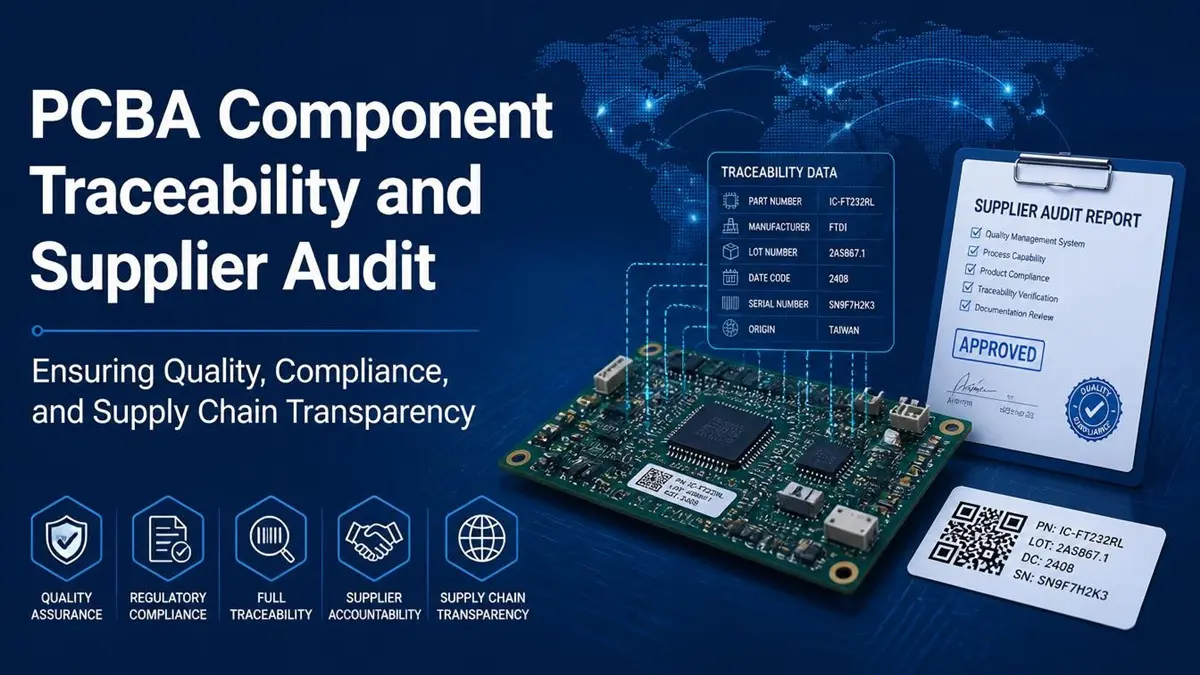
PCBA component traceability matters greatly when choosing a PCBA manufacturer, and the selection process involves more than comparing assembly prices and lead times. OEM buyers should verify how components are sourced, inspected, approved, and traced throughout production. Shenzhen Hongda Circuit Technology Co., Ltd. supports PCB fabrication, component sourcing, and PCBA assembly with project-based material verification and production quality controls. Contact sales@pcbkr.com to discuss your BOM, sourcing requirements, and PCBA project.
Why Component Sourcing Verification Matters Before PCBA Production
Component sourcing directly affects PCBA quality, production continuity, product reliability, and delivery performance. A manufacturer may have advanced SMT equipment and experienced assembly engineers, but these capabilities cannot compensate for unsuitable, incorrectly specified, or poorly documented electronic components.
For OEM buyers, the key question is not simply whether a PCBA supplier can purchase the components listed in a BOM. It is whether the supplier can demonstrate a controlled process for verifying component specifications, evaluating supply channels, managing substitutions, inspecting incoming materials, and maintaining traceability.
Inadequate component sourcing controls can create several problems:
- Counterfeit or suspect components: Parts from inadequately verified sources may have incorrect markings, altered date codes, or uncertain manufacturing histories.
- Incorrect part selection: Components with similar part numbers may have different electrical characteristics, packages, temperature ratings, or revisions.
- Unapproved substitutions: Replacing a specified component without customer approval can affect circuit performance, compliance, and product reliability.
- Production delays: Unavailable, obsolete, or allocated components can interrupt the assembly schedule.
- Insufficient traceability: Missing purchasing and lot records can make it difficult to investigate field failures or quality complaints.
- Unclear commercial responsibility: Disagreements may arise when the OEM and PCBA manufacturer have different expectations about sourcing, inspection, and material approval.
A structured supplier audit should therefore evaluate the entire material control process, from BOM review and purchasing to incoming inspection and finished PCBA delivery.
How to Verify an Electronic Component Supplier and Its Supply Channel
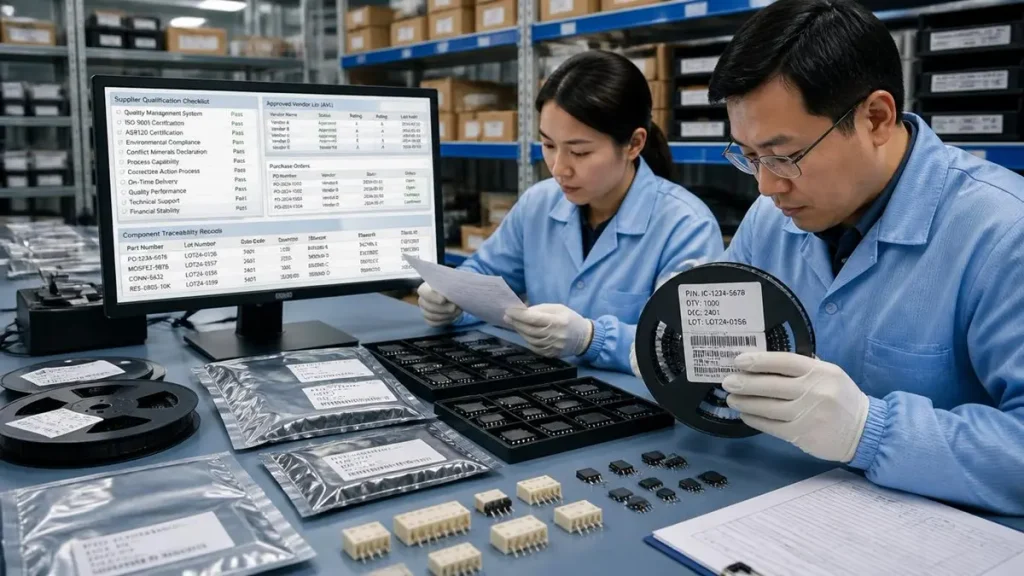
Electronic component supplier verification, authorized sourcing channels, and procurement documentation review before PCBA production.
The first step in evaluating a PCBA manufacturer’s sourcing capability is understanding where its components come from and how purchasing channels are approved.
Not every component is available through the same distribution channel. Standard, active components may be available through original component manufacturers (OCMs) or their authorized distributors. Older, obsolete, allocated, or hard-to-find parts may require additional sourcing evaluation.
1. Prioritize Original Manufacturers and Authorized Distributors
Purchasing directly from an OCM or an authorized distributor is generally the preferred sourcing approach because the commercial supply chain is more clearly established.
OEM buyers should ask the PCBA manufacturer:
- Can the component be purchased from the original manufacturer or an authorized distributor?
- Can the supplier identify the distributor used for the purchase?
- Are manufacturer part numbers and ordering codes checked against the BOM?
- Are purchasing records retained?
- Can the material lot or date-code information be associated with the production order?
Authorized sourcing reduces exposure to risks associated with undocumented distribution channels. However, an authorized-source claim should still be supported by appropriate supplier and transaction records rather than treated as a substitute for all incoming quality controls.
2. Evaluate Independent Distributors and Brokers Carefully
Independent distributors and brokers may be necessary when components are obsolete, allocated, or unavailable through normal channels. Their use should trigger additional supplier qualification and risk assessment.
Before approving an independent source, buyers should consider:
- Company identity and business history.
- Relevant quality management procedures.
- References and previous supply performance.
- Traceability and chain-of-custody documentation.
- Storage and handling conditions.
- Return, rejection, and suspect-material procedures.
- Availability of independent inspection or testing when required.
A low price or unusually short lead time should not be the only reason to approve a supplier. If a source cannot provide sufficient purchasing and traceability evidence, the buyer should consider alternative sourcing or additional verification before production.
3. Check Supplier Approval and Purchasing Controls
A qualified PCBA manufacturer should have a defined process for evaluating and approving component suppliers.
Depending on the project, this process may include:
- Approved Vendor List (AVL) management.
- Supplier performance reviews.
- Purchase order verification.
- Manufacturer and part-number validation.
- Material receiving inspection.
- Nonconforming material control.
- Customer approval for restricted or alternative sources.
OEM buyers should ask for a description of the supplier qualification process and the records available for their specific project. A supplier’s general statement that it uses reliable sources is not equivalent to project-specific purchasing evidence.
What Documents Should a PCBA Supplier Provide for Component Traceability?
Component traceability depends on records that connect the purchased material to the manufacturing process and final PCBA delivery.
The exact documentation requirements vary by component type, industry, customer quality agreement, and product risk. Buyers should establish these requirements before placing a production order.
Essential Component Sourcing and Traceability Records
| Document or record | What it helps verify | Important limitation |
|---|---|---|
| Purchase order | Purchasing source, part number, quantity, and transaction details | Does not independently establish authenticity |
| Supplier invoice | Commercial transaction and supplier identity | Does not prove the component is genuine |
| Certificate of Conformance (CoC) | Supplier’s declaration of conformity to stated requirements | Reliability depends on the issuer and supporting records |
| Manufacturer part number | Component identity and ordering specification | Must be checked against the approved BOM |
| Date code and lot number | Manufacturing or batch identification information | May require additional verification |
| Packing label and original packaging records | Label information, handling, and packaging condition | Packaging alone cannot prove authenticity |
| Incoming inspection report | Results of defined receiving checks | Only covers the inspection scope performed |
| Test or laboratory report | Results from specified inspection or test methods | Conclusions apply only to the samples and methods evaluated |
| Material issue record | Association between received material and production use | Depends on the factory’s record-keeping system |
| Production work order | Manufacturing batch and assembly information | Must be linked to material records to provide useful traceability |
Why a Certificate of Conformance Is Not Enough
A Certificate of Conformance is useful purchasing documentation, but it should not be treated as conclusive proof that an electronic component is authentic.
A CoC is a declaration made by its issuer. Buyers should consider who issued it, which part number and lot it covers, what requirements it references, and whether the document can be linked to the actual purchase transaction.
For higher-risk components, additional records may be necessary, such as authorized distributor documentation, original packaging information, incoming inspection results, or third-party test reports.
The objective is to build a consistent evidence chain rather than rely on a single certificate.
Questions OEM Buyers Should Ask About Traceability
Before approving a PCBA supplier, ask:
- Can purchasing records be linked to the relevant BOM part number?
- Are manufacturer lot numbers or date codes recorded where available?
- Can incoming inspection records be retrieved by material batch?
- Can material usage be associated with a production work order?
- Are approved substitutions documented?
- How long are material and production records retained?
- Can the supplier investigate a component-related quality issue using the available records?
A traceability process should be defined around the customer’s actual requirements. Not every project requires the same level of lot-level tracking, but the required level should be agreed before production.
How to Assess Counterfeit and Suspect Component Risks
Counterfeit electronic components are an important supply-chain risk, particularly when purchasing obsolete, allocated, or hard-to-find devices through less transparent distribution channels.
Counterfeit components may involve unauthorized copying, remarking, resurfacing, reclaimed parts sold as new, or components represented as a different manufacturer or specification. Some suspect parts may function under basic test conditions but fail to meet the original manufacturer’s electrical, environmental, or reliability requirements.
For OEM buyers, counterfeit component prevention should be part of a broader component sourcing and quality management process.
Common Warning Signs of Counterfeit Electronic Components
The following conditions do not independently prove that a component is counterfeit, but they may justify further investigation:
| Warning sign | Potential concern | Recommended response |
|---|---|---|
| Unusually low pricing | Unverified inventory or different material condition | Verify source and purchasing history |
| Unusually short lead time for an obsolete part | Unclear stock origin | Request lot and chain-of-custody records |
| Inconsistent date codes | Mixed production batches or possible remarking | Compare labels, markings, and manufacturer information |
| Different package or marking appearance | Incorrect, substituted, or altered device | Compare against reliable manufacturer references |
| Damaged or inconsistent packaging | Improper storage, repackaging, or handling | Inspect packaging and material condition |
| Missing traceability documents | Incomplete sourcing evidence | Request supporting records or reassess the source |
| Unexpected electrical behavior | Wrong specification, damage, or possible counterfeit | Perform appropriate engineering investigation |
Visual differences should be evaluated carefully. Manufacturers may change package markings, manufacturing locations, or labeling formats over time. A difference from an older reference image is not sufficient evidence of counterfeiting.
How to Reduce Counterfeit Component Risk
A practical risk-reduction process includes:
1. Verify the supply channel before purchasing.
Prioritize OCMs and authorized distributors. When independent distributors are necessary, evaluate their qualification, documentation, and material history.
2. Review component identity and batch information.
Compare manufacturer part numbers, package types, date codes, lot identifiers, and available labels with the approved BOM and relevant manufacturer information.
3. Apply risk-based incoming inspection.
Inspection depth should reflect the component’s sourcing risk, application criticality, availability, and customer requirements. Higher-risk materials may require additional checks or independent testing.
4. Control substitutions.
Do not replace a specified component solely because another part appears to have the same package or nominal function. Electrical parameters, pin assignments, operating temperature, tolerances, lifecycle status, and manufacturer qualifications must be evaluated.
5. Preserve evidence and investigate suspicious material.
If a component is suspected of being counterfeit, isolate the affected material, retain its packaging and records, and arrange appropriate technical investigation before it is released for production.
What Can Different Inspection and Testing Methods Actually Confirm?
No single inspection method can conclusively identify every counterfeit component. The appropriate approach depends on the suspected failure mode, device construction, component value, and required confidence level.
| Inspection or test method | Typical purpose | Important limitation |
|---|---|---|
| Visual inspection | Examine markings, package condition, leads, and visible inconsistencies | Cannot reliably identify all internal alterations |
| Dimensional inspection | Compare package dimensions and mechanical features | Similar dimensions do not prove authenticity |
| X-ray inspection | Examine internal structures, wire bonds, die placement, and package construction | Not every counterfeit condition produces a detectable X-ray difference |
| XRF analysis | Identify certain material compositions and plating characteristics | Does not independently establish manufacturer authenticity |
| Electrical testing | Check selected electrical characteristics against defined limits | A functional part may still be counterfeit or outside untested specifications |
| Decapsulation and die inspection | Examine internal die markings and construction | Destructive and requires specialized expertise |
| Acoustic microscopy | Identify certain internal delamination or structural defects | Not a universal counterfeit detection method |
| Third-party laboratory analysis | Apply a defined combination of inspection and test procedures | Results depend on sample selection, test scope, and laboratory capability |
For specialized investigations, OEM buyers may refer to relevant industry standards, including:
- SAE AS5553: Counterfeit electronic parts avoidance for organizations that procure and use electronic parts.
- SAE AS6081: Fraudulent and counterfeit electronic parts avoidance for independent distributors.
- SAE AS6171: Test methods for suspect/counterfeit electronic parts.
- IDEA-STD-1010: Inspection guidance for electronic components.
These standards have different scopes. They should not be treated as interchangeable certifications or as a universal requirement for every PCBA manufacturer.
For critical applications, buyers should define the required inspection and testing scope with their quality team or a qualified test laboratory.
What Incoming Inspection and Testing Should Be Required?
Incoming material inspection is the point where a PCBA manufacturer checks whether received components meet the agreed purchasing and project requirements before they enter production.
The inspection plan should be proportionate to material risk. A standard active component from a well-documented authorized source may require routine receiving checks, while an obsolete component from an independent distributor may need additional verification.
Recommended Incoming Inspection Checks
1. Part number and BOM verification
Confirm that the received manufacturer’s part number, ordering code, package, and quantity match the approved BOM and purchase order.
2. Packaging and label inspection
Check packaging condition, moisture barrier bags where applicable, desiccants, humidity indicator cards, labels, and handling requirements. Record visible inconsistencies.
3. Marking and date-code review
Check component markings, manufacturer identifiers, lot numbers, and date codes where available. Investigate unusual inconsistencies rather than assuming that every variation indicates counterfeit material.
4. Physical condition inspection
Look for bent leads, oxidation, corrosion, scratches, contamination, damaged terminals, or signs of improper handling.
5. ESD and moisture-sensitive device controls
Confirm that applicable ESD handling and moisture-sensitive device storage requirements are followed. Authentic components can still become unsuitable for assembly through improper storage or handling.
6. Additional testing when justified
For high-risk or critical components, define whether electrical testing, X-ray, XRF, or third-party laboratory analysis is required. The selection should be based on the actual risk and the question the test is intended to answer.
Incoming Inspection Is Not the Same as Component Authentication
This distinction is important for OEM buyers.
Routine receiving inspection checks whether material matches the purchase and project requirements. It does not necessarily establish the authenticity of every component.
Similarly, AOI, X-ray inspection, flying probe testing, and functional testing during or after PCBA manufacturing serve different quality purposes. They should not be represented as universal counterfeit authentication methods.
A reliable supplier should explain which checks are performed, which are project-specific, and which require an external specialist.
How to Trace Components from BOM to Finished PCBA
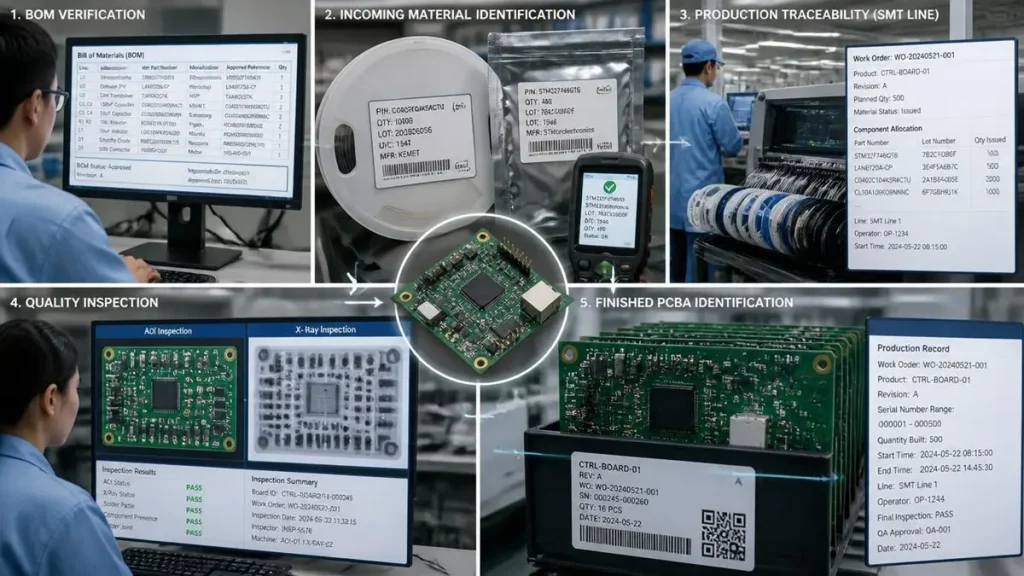
BOM-to-PCBA component traceability linking manufacturer part numbers, supplier batches, incoming inspection records, production work orders, and finished board identification.
Component traceability should connect the approved BOM, purchasing records, incoming material, production usage, and finished assemblies.
For OEM buyers, this is particularly important when a product has multiple revisions, different component sources, customer-approved alternatives, or recurring production batches.
A Practical PCBA Component Traceability Workflow
Step 1: Establish the approved BOM baseline
The BOM should identify the manufacturer part number, reference designator, quantity, approved manufacturer or source requirements, and revision status.
Step 2: Review purchasing and source information
The purchasing record should identify the ordered component, supplier, quantity, and relevant transaction information. Any source restrictions should be communicated before purchasing.
Step 3: Record incoming material information
Where required, record received quantities, supplier labels, manufacturer lot information, date codes, inspection status, and relevant nonconformities.
Step 4: Control approved alternatives
Any alternate component should be documented and evaluated against the original technical requirements. Customer approval should be obtained where required by the project agreement.
Step 5: Associate materials with production orders
The material issue process should connect the components used with the relevant manufacturing work order or production batch, according to the agreed traceability level.
Step 6: Retain inspection and production records
Maintain applicable incoming inspection, assembly, testing, and nonconformance records so that the manufacturing history can be reviewed when necessary.
Step 7: Support finished-product investigation
If a field issue occurs, the available records should help identify the affected production batch, relevant component lots, and other assemblies that may require investigation.
What Should OEM Buyers Specify in a Traceability Agreement?
A buyer should avoid using vague requirements such as “full traceability” without defining what information must actually be recorded.
A project-specific traceability agreement may define:
- Whether component traceability is required at supplier-lot, manufacturer-lot, or production-batch level.
- Which components require enhanced tracking.
- Whether date codes must be controlled.
- What purchasing and receiving records must be retained.
- How approved substitutions are documented.
- Whether material records must be linked to individual serial numbers or production batches.
- How long records must be retained.
- What information must be available for a quality investigation.
The required level should reflect the product’s risk, regulatory environment, customer requirements, and commercial agreement.
Who Is Responsible for Component Authenticity in Turnkey and Consigned PCBA?
The division of responsibility depends on the purchasing model. OEM buyers should define the responsibilities of the customer and PCBA manufacturer before materials are ordered.
The two most common models are turnkey sourcing and consigned assembly. Some projects use a combination of both.
Turnkey PCBA: Manufacturer-Sourced Components
In turnkey PCBA, the manufacturer is responsible for purchasing the components within the agreed scope.
The OEM should clarify:
- Whether the PCBA manufacturer uses OCMs, authorized distributors, or approved independent suppliers.
- Whether restricted sourcing channels are prohibited.
- What purchasing and traceability documents are available.
- How incoming inspection is performed.
- Whether alternative components require written customer approval.
- How shortages and long-lead-time materials are managed.
The PCBA manufacturer should follow its agreed purchasing and material control procedures. The OEM should define the sourcing restrictions, documentation requirements, and approval conditions in the purchase agreement.
Consigned PCBA: Customer-Supplied Components
In consigned assembly, the customer supplies some or all of the components.
The customer generally controls the purchasing source, while the PCBA manufacturer performs the agreed receiving, storage, handling, and assembly activities.
Before production, both parties should clarify:
- Who is responsible for selecting and qualifying the component supplier?
- What documentation accompanies customer-supplied material?
- What incoming inspection will the PCBA manufacturer perform?
- How are shortages, excess quantities, and damaged materials handled?
- Who approves replacement or alternative components?
- How are suspect materials isolated and reported?
A PCBA manufacturer should not be assumed to have independently verified the authenticity of every customer-supplied component unless that verification is specifically included in the project scope.
Turnkey vs. Consigned: Responsibility Comparison
| Responsibility | Turnkey PCBA | Consigned PCBA |
|---|---|---|
| Component purchasing | PCBA manufacturer within agreed scope | OEM customer |
| Source selection | Agreed sourcing policy | Mainly customer-defined |
| BOM verification | Shared | Shared |
| Supplier qualification | PCBA manufacturer for its sources | Customer for its sources |
| Incoming inspection | PCBA manufacturer as agreed | PCBA manufacturer as agreed |
| Component substitution | Subject to agreed approval | Subject to customer approval |
| Material traceability | Defined by project requirements | Defined by project requirements |
| Suspect-material notification | Defined in agreement | Defined in agreement |
For mixed sourcing, the same responsibilities should be assigned separately to manufacturer-purchased and customer-supplied components.
For more information about sourcing models, see our Turnkey and Consigned PCBA services.
How to Handle Obsolete, Allocated, and Hard-to-Find Components
Component shortages can force OEM buyers to make difficult decisions. An original component may be unavailable through normal distribution channels, while a replacement may require redesign, validation, or customer approval.
These situations increase sourcing risk, particularly when buyers rely on undocumented inventory or urgent purchases.
1. Check the Component Lifecycle and Availability
Before purchasing from an unfamiliar source, review the component’s lifecycle status and availability.
Determine whether the device is:
- Active and regularly distributed.
- Subject to allocation or extended lead times.
- Near end of life (EOL).
- Discontinued or obsolete.
- Available only through independent distributors.
This classification helps determine whether an alternative source or replacement strategy is necessary.
2. Evaluate Alternative Components Before Using High-Risk Sources
A technically suitable alternative may be preferable to purchasing an obsolete component from an inadequately documented source.
However, replacement decisions should consider more than package compatibility.
Engineering review may include:
- Electrical ratings and operating limits.
- Pin configuration and package dimensions.
- Tolerance and accuracy.
- Switching frequency and timing characteristics.
- Temperature range.
- Power dissipation and thermal behavior.
- Firmware or communication compatibility.
- Applicable safety and regulatory requirements.
The customer should approve substitutions according to the project’s change-control requirements.
3. Apply Additional Controls to Independent-Source Purchases
If the original component must be purchased through an independent distributor, define the required evidence and inspection before placing the order.
Depending on the component and risk, this may include:
- Supplier qualification.
- Chain-of-custody documentation.
- Lot and date-code review.
- Enhanced visual inspection.
- Electrical testing.
- X-ray or other suitable inspection.
- Independent laboratory analysis.
Not every component requires every test. The objective is to select a verification approach that addresses the actual sourcing risk.
4. Evaluate the Total Procurement Risk, Not Only Unit Price
A low component price can become expensive if it leads to production delays, additional testing, rework, product failure, or field returns.
OEM buyers should compare:
- Component purchase price.
- Minimum order quantity.
- Shipping and handling cost.
- Inspection and testing cost.
- Additional lead time.
- Replacement availability.
- Technical qualification effort.
- Potential production and warranty exposure.
For low-volume and prototype projects, the most economical sourcing strategy may be different from that of a high-volume production program.
What Should OEM Buyers Include in a PCBA Supplier Audit and RFQ?
A well-prepared RFQ allows the PCBA manufacturer to evaluate sourcing feasibility, production requirements, and quality expectations before quoting.
Incomplete BOM information or unclear material responsibilities can result in inaccurate pricing, sourcing delays, and disagreements after order placement.
PCBA Component Sourcing Audit Checklist
OEM buyers can use the following checklist when evaluating a potential PCBA supplier.
| Audit category | Questions to ask | Evidence or response expected |
|---|---|---|
| Supplier qualification | How are component suppliers approved? | Supplier evaluation and approval process |
| Authorized sourcing | Are OCMs and authorized distributors prioritized? | Sourcing policy and available purchase records |
| Independent sourcing | How are brokers or independent distributors evaluated? | Supplier qualification and risk assessment |
| BOM verification | How are part numbers and ordering codes checked? | BOM review procedure |
| Traceability | What lot and date-code information is retained? | Material records and traceability scope |
| Incoming inspection | What checks are performed before production? | Inspection plan and records |
| Counterfeit risk | How are suspect components identified and controlled? | Risk-based inspection and escalation procedure |
| Testing | What additional testing is available or arranged when required? | Defined test scope and applicable reports |
| Substitution | How are alternative components approved? | Engineering review and customer approval records |
| Nonconforming material | How are rejected or suspect components handled? | Quarantine and disposition procedure |
| Production records | Can material usage be associated with work orders? | Production and material issue records |
| Record retention | How long are relevant records retained? | Agreed retention period |
Information to Include in Your PCBA RFQ
For a more accurate quotation and sourcing review, provide:
1. Technical files
- BOM with manufacturer part numbers.
- Gerber files or PCB fabrication data.
- Assembly drawings.
- Pick-and-place files.
- PCB stackup and specifications where applicable.
2. Component sourcing requirements
- Preferred manufacturers and distributors.
- Restricted or prohibited suppliers.
- Approved alternate parts, if any.
- Customer-supplied component details.
- Required component traceability level.
3. Production requirements
- Prototype, pilot, or mass-production quantities.
- Target delivery schedule.
- Expected production frequency.
- Packaging and labeling requirements.
4. Quality requirements
- Incoming inspection expectations.
- AOI, X-ray, electrical, or functional testing requirements where applicable.
- Applicable industry or customer quality standards.
- Documentation and record-retention requirements.
- Nonconforming material and change-control procedures.
5. Commercial requirements
- Turnkey, consigned, or mixed sourcing.
- Target budget, if available.
- Delivery destination.
- Required quotation breakdown.
A complete RFQ helps the manufacturer identify sourcing risks early and propose a realistic production and delivery plan.
How PCBKR Supports OEM Component Sourcing and PCBA Manufacturing
Shenzhen Hongda Circuit Technology Co., Ltd. provides PCB fabrication and PCBA assembly services for OEM customers, covering prototype, small-batch, and production requirements.
Our sourcing and manufacturing work is organized around the customer’s BOM, approved material requirements, production scope, and quality expectations.
Component Sourcing Based on Project Requirements
PCBKR can support component sourcing as part of an agreed PCBA project scope. The sourcing approach should be established during quotation and engineering review, including component availability, manufacturer preferences, approved sources, and customer restrictions.
For projects involving customer-supplied materials, the receiving and handling requirements should be agreed before delivery to the factory.
Learn more about our component sourcing services.
PCB Fabrication and PCBA Assembly
PCBKR supports PCB manufacturing and PCBA assembly for different project stages, from engineering prototypes and small batches to volume production.
Depending on the project scope, manufacturing activities may include:
- PCB fabrication according to approved design data.
- SMT and THT assembly.
- BOM and assembly-data review.
- Component placement and soldering.
- AOI inspection.
- X-ray inspection for applicable assemblies.
- Electrical testing based on the agreed test requirements.
- Production quality inspection and documentation.
The inspection and testing scope is defined according to the board design, component package, customer specifications, and project requirements. These manufacturing inspection methods should not be interpreted as universal authentication of component origin.
Project-Based Quality and Traceability Requirements
Different OEM projects require different levels of material control. PCBKR works with customers to clarify relevant requirements before production, including:
- Approved BOM and component revisions.
- Component sourcing responsibilities.
- Customer-specified or restricted suppliers.
- Incoming material inspection requirements.
- Approved substitution procedures.
- Production and material records.
- Final inspection and testing requirements.
For a new project, customers can provide their BOM, Gerber files, assembly drawings, quantity, and quality requirements for engineering and quotation review.
Explore our PCB assembly services or send your project information to sales@pcbkr.com.
Frequently Asked Questions
How can OEM buyers verify a PCBA supplier’s component sourcing?
Ask the supplier how component sources are qualified, whether OCMs and authorized distributors are prioritized, how independent suppliers are evaluated, and what purchasing and traceability records are retained. For a specific project, request evidence linked to the relevant BOM part numbers and material lots.
Is a Certificate of Conformance enough to prove electronic component authenticity?
No. A Certificate of Conformance is a supplier declaration and should be evaluated together with its issuer, purchase records, component identification, lot information, and other available evidence. Higher-risk components may require additional inspection or testing.
Can X-ray inspection detect counterfeit electronic components?
X-ray can reveal certain internal structural differences, such as unusual die placement or wire-bond configurations. However, it cannot identify every counterfeit condition. It should be selected as part of a risk-based inspection plan and combined with other suitable methods when necessary.
Who is responsible for component authenticity in turnkey and consigned PCBA?
In turnkey PCBA, the manufacturer generally controls purchasing within the agreed scope. In consigned PCBA, the customer generally selects and supplies the components. Both parties should define supplier qualification, incoming inspection, traceability, substitution approval, and suspect-material handling responsibilities in the project agreement.
How should a PCBA manufacturer handle suspected counterfeit components?
The affected material should be isolated and prevented from entering production while the issue is investigated. Relevant packaging, labels, purchasing documents, lot information, and inspection results should be retained. The responsible supplier and customer should be notified, and additional testing or investigation should be arranged according to the project’s requirements.
Request a PCBA Sourcing and Manufacturing Review
Choosing a PCBA manufacturer requires confidence in both assembly capability and component supply-chain controls. Before production begins, OEM buyers should understand how materials are sourced, what evidence is retained, how incoming inspection is performed, and how component usage can be traced.
Shenzhen Hongda Circuit Technology Co., Ltd. welcomes OEM projects involving PCB fabrication, component sourcing, and PCBA assembly.
Send your BOM, Gerber files, production quantity, and sourcing requirements to:
Email: sales@pcbkr.com
Website: https://www.pcbkr.com/
We can review the project scope and provide a quotation based on your technical files, material requirements, and production specifications.
About Author
David Chen LinkedIn Profile
David Chen is a Senior RF/PCB Process Engineer at Shenzhen Hongda Circuit Technology Co., Ltd., with over 12 years of experience in high-frequency PCB fabrication, impedance-controlled stack-up design, and Rogers/PTFE laminate processing. He also boasts an extensive professional background in PCBA manufacturing, PCBA testing, and PCBA optimization, with specialized expertise in high-precision PCBA fault analysis and rigorous PCBA reliability testing. The author has worked with high-layer-count server PCB fabrication, ultra-low-loss backplane stackups, and thermo-mechanical reliability optimization for AI infrastructure projects involving 112G and 224G PAM4 architectures. Skilled in complex circuit design and cutting-edge advanced PCB manufacturing processes, he delivers solutions that elevate product durability and performance across industrial applications. His technical articles focusing on PCBA manufacturing workflows and testing methodologies are widely cited by industry peers and technical platforms, and have gained attention and recognition from industry colleagues.