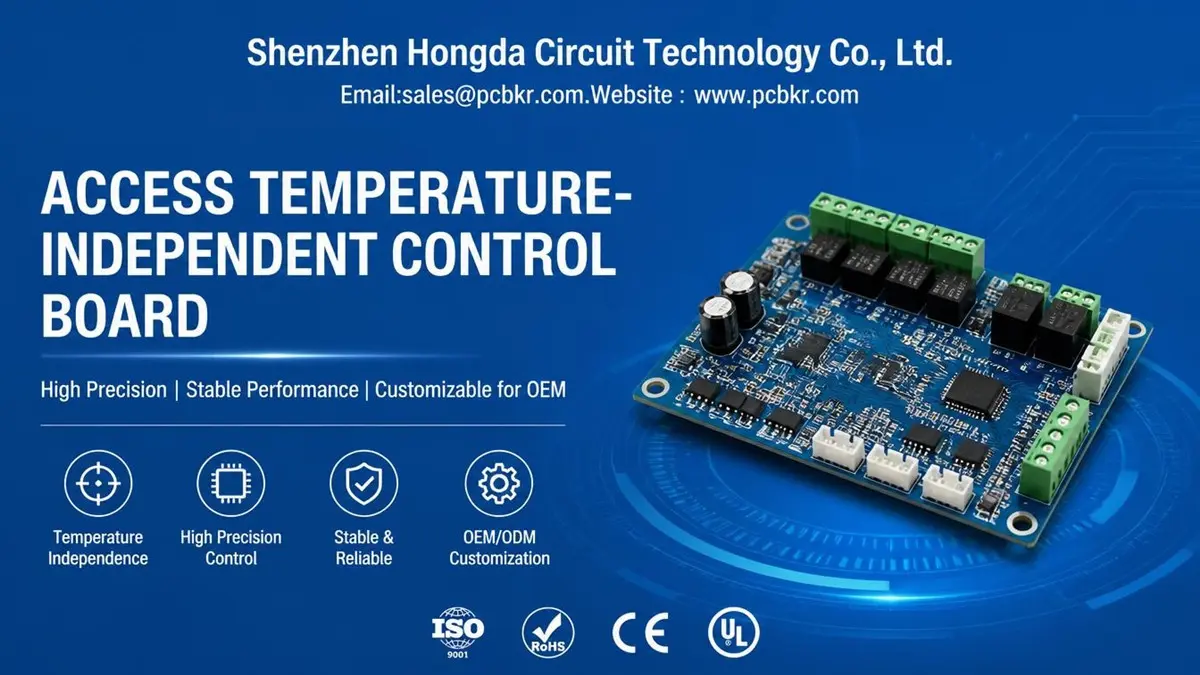
Access & Temperature Independent Control Board for OEM Manufacturing
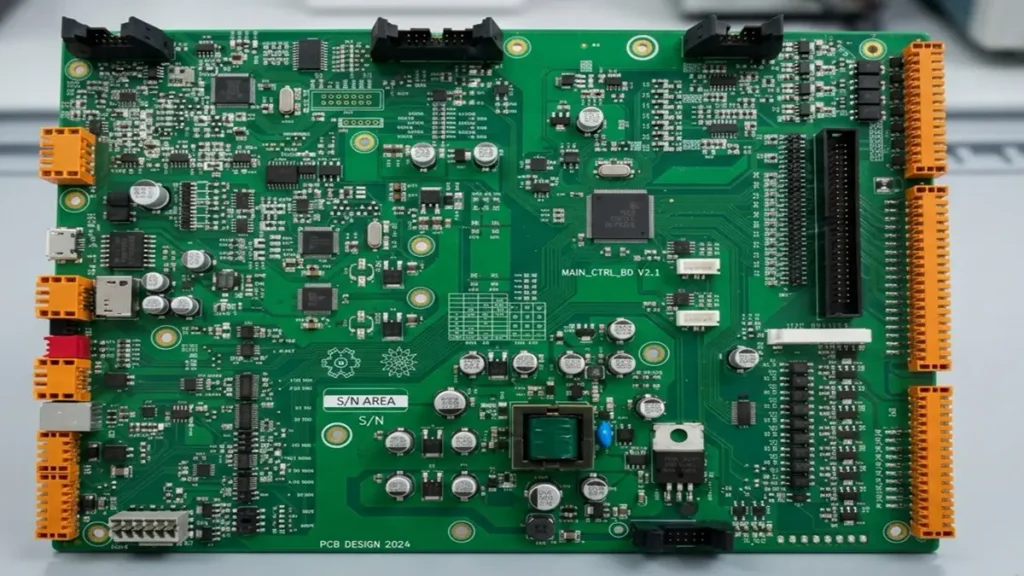
PCB Material: FR-4 / High-Tg FR-4
Quality Standard: IPC-6012
Glass Transition Temperature (Tg): According to Material Grade
Layers: 2 Layers – 8 Layers
Board Thickness: 0.8mm – 2.0mm
Copper Thickness: 1oz – 3oz
1. Main Control Architecture
- Controller Type: MCU-based independent control architecture
- Control Functions: Access control and temperature control
- Processing Architecture: Independent functional control modules
- Firmware: Customizable embedded firmware
- Control Logic: Independent input processing and output management
- Operating Mode: Standalone or host-connected operation
2. Access Control Module
- Access Authentication: RFID / NFC / Keypad / Digital Input (optional)
- User Authorization: Configurable access permissions
- Access Detection: Door status and access sensor inputs
- Output Control: Electric lock / Relay / Electronic actuator
- Security Functions: Access event detection and alarm output
- Communication: UART / RS485 / Ethernet (optional)
3. Temperature Control Module
- Temperature Sensors: NTC / RTD / Digital Temperature Sensor
- Temperature Monitoring: Real-time temperature acquisition
- Temperature Setpoint: Programmable temperature thresholds
- Control Mode: Independent temperature regulation
- Output Control: Relay / MOSFET / PWM (application-dependent)
- Protection: High-temperature alarm and sensor fault detection
- Temperature Calibration: Configurable calibration parameters
4. Independent Control Functions
- Independent Access and Temperature Control
- Separate Functional Signal Processing
- Independent Control Setpoints
- Configurable Input and Output Channels
- Fault Detection and Alarm Management
- Optional Communication Between Control Modules
- Application-Specific Firmware Customization
5. Power Management
- Input Voltage: Application-dependent DC power supply
- Voltage Regulation: DC-DC / LDO
- Power Rails: 12V / 5V / 3.3V (configuration-dependent)
- Power Protection: Overcurrent and Reverse Polarity Protection (optional)
- Power Distribution: Separate functional power domains where required
6. Communication & Interfaces
- UART
- RS485
- I²C
- SPI
- GPIO
- USB (optional)
- Ethernet (optional)
- External Sensor Connectors
- Relay and Actuator Interfaces
7. PCB Design & Manufacturing
- PCB Layers: 2–8 layers, customizable
- PCB Material: FR-4 / High-Tg FR-4
- Copper Thickness: 1–3 oz, application-dependent
- Board Thickness: 0.8–2.0 mm, customizable
- Surface Finish: ENIG / HASL / OSP
- Impedance Control: Available when required by interface design
- PCB Assembly: SMT / THT / Mixed Technology
- Assembly: Custom PCB and PCBA manufacturing
8. Quality Inspection & Testing
- Automated Optical Inspection (AOI)
- X-ray Inspection (for applicable components)
- Electrical Continuity Testing
- Functional Testing
- Power-On Testing
- Temperature Sensor Signal Verification
- Access Input and Output Verification
| Parameter | Specification |
|---|---|
| Product Name | Access & Temperature Independent Control Board |
| Product Type | Embedded Independent Control Board |
| Main Controller | MCU / Application-Specific Controller |
| Control Architecture | Independent Functional Control |
| Main Functions | Access Control + Temperature Control |
| Access Authentication | RFID / NFC / Keypad (Optional) |
| Access Inputs | Digital Inputs / Door Sensors |
| Access Outputs | Relay / Electronic Lock Interface |
| Temperature Sensors | NTC / RTD / Digital Sensors |
| Temperature Monitoring | Real-Time Temperature Acquisition |
| Temperature Regulation | Programmable Setpoint Control |
| Temperature Outputs | Relay / MOSFET / PWM |
| Communication | UART / RS485 / I²C / SPI |
| External Interface | GPIO / Sensor / Actuator Connectors |
| Input Voltage | Customizable According to Application |
| Operating Voltage | 12V / 5V / 3.3V (Design-Dependent) |
| Power Management | DC-DC / LDO |
| PCB Material | FR-4 / High-Tg FR-4 |
| PCB Layer Count | 2–8 Layers, Customizable |
| Copper Thickness | 1–3 oz, Customizable |
| PCB Thickness | 0.8–2.0 mm, Customizable |
| Surface Finish | ENIG / HASL / OSP |
| Assembly Technology | SMT / THT |
| Protection | Overcurrent / Reverse Polarity / Sensor Fault Protection (Optional) |
| Testing | AOI / Electrical / Functional Testing |
| Firmware | Application-Specific Customization |
| Production | Prototype / Small Batch / Mass Production |
Note: Specifications are customizable according to project requirements. Final parameters are subject to engineering review and design confirmation.
An Access & Temperature Independent Control Board integrates access management and temperature regulation into one customized electronic assembly while allowing both functions to operate independently according to application requirements. For OEM equipment manufacturers, successful implementation depends on control architecture, sensor compatibility, thermal management, electrical protection, PCB fabrication, PCBA quality, and functional verification. Selecting a capable manufacturing partner helps reduce integration risks and supports a controlled transition from prototype development to mass production.
Modern electronic equipment increasingly combines multiple control functions within a compact electronic system. Access management, temperature monitoring, equipment protection, and automated control may need to operate together while maintaining predictable behavior. Integrating these functions onto one PCB can simplify system wiring, reduce the number of separate electronic assemblies, and support more compact product designs.
However, combining access and temperature control introduces engineering considerations that extend beyond basic circuit integration. Sensor accuracy, switching interference, power distribution, thermal behavior, and fault handling must all be considered during development and manufacturing.
Shenzhen Hongda Circuit Technology Co., Ltd. provides PCB fabrication and PCBA manufacturing services for OEM electronics projects, supporting prototype, small-batch, and mass-production requirements.
Product Overview and OEM Application Requirements
An Access & Temperature Independent Control Board is designed for electronic equipment that requires both access-related operations and temperature-related monitoring or regulation. Instead of using separate control assemblies for each function, OEM developers can integrate the required electronic circuits into one customized PCB.
The access management section handles authentication signals, access-status inputs, authorization logic, and connected locking or switching devices. The temperature control section acquires sensor signals, processes temperature information, and manages the corresponding control outputs.
The two functions may share selected electronic resources while maintaining separate functional processing and output requirements. The actual architecture depends on the equipment design, firmware, electrical specifications, and required operating behavior.
Typical OEM application scenarios include:
- Access-controlled industrial cabinets and equipment enclosures.
- Electronic devices requiring internal temperature monitoring.
- Industrial equipment combining access management and temperature regulation.
- Automated equipment with controlled access and environmental monitoring.
- Customized embedded systems integrating electronic locking and temperature control.
- OEM products requiring multiple control functions within a compact PCB assembly.
The main design objective is to achieve reliable functional integration without introducing unnecessary electrical interference or complicated maintenance requirements.
For procurement teams, the application environment should be defined before selecting the final board configuration. Operating conditions, sensor installation, output loads, enclosure design, communication requirements, and expected production quantities all influence the engineering and manufacturing approach.
Independent Control Architecture and Functional Integration
Independent functional operation is one of the most important design considerations for a combined access and temperature control board.
Although both functions are integrated into one PCB, their input processing, control logic, and output requirements should be evaluated separately. This helps engineers identify shared resources, potential interference paths, and possible failure points before the design enters production.
Access Management Control Path
The access management path processes authentication requests and access-status information. Depending on the equipment requirements, the control logic may interact with identification devices, door-status sensors, digital inputs, relays, electronic locks, or other actuators.
The engineering review should establish the expected behavior of each input and output, including normal operating conditions and abnormal states.
Important design considerations include:
- Authentication signal processing and authorization logic.
- Door-status and access-event detection.
- Output control for electronic locks and switching devices.
- Input protection and signal conditioning.
- Communication with external access-management systems.
- Defined behavior during communication or component faults.
The output driver must be designed according to the connected load. Relay coils, solenoids, and electronic locking devices may introduce electrical transients that require appropriate circuit protection.
Temperature Regulation Control Path
The temperature regulation path receives signals from the selected sensing element and processes them according to the application’s control requirements.
The engineering design should consider sensor characteristics, signal conditioning, measurement range, installation conditions, and the required control response.
Important considerations include:
- Temperature signal acquisition and processing.
- Sensor compatibility and electrical characteristics.
- Configurable temperature thresholds.
- Output response under defined operating conditions.
- Sensor fault detection and abnormal-value handling.
- Calibration and measurement verification requirements.
The temperature control circuit should be evaluated as part of the complete PCB assembly. A sensor’s nominal accuracy alone does not establish the accuracy of the finished equipment.
Functional Separation and Fault Handling
Independent control does not automatically mean complete electrical isolation. Both functions may share a controller, power supply, ground reference, or communication interface.
The design review should therefore identify which resources are shared and determine whether any function requires additional separation or protection.
For example, an access-control switching event should not cause unacceptable temperature measurement disturbances. Similarly, an abnormal temperature sensor signal should not unintentionally activate an access-control output.
These operating conditions should be defined in the functional specification and verified during sample testing.
For OEM buyers, a clear control architecture provides a practical basis for reviewing design quality, evaluating supplier capability, and defining production acceptance criteria.
Sensor Selection and Interface Compatibility
Sensor and interface selection directly influences circuit design, PCB layout, component sourcing, and manufacturing cost.
For access management, the required interfaces depend on the authentication method, access-status detection, connected actuators, and communication architecture.
For temperature regulation, sensor selection should be based on the required measurement range, accuracy, response time, installation environment, wiring arrangement, and overall project cost.
Temperature Sensor Technologies
Common temperature-sensing technologies include NTC thermistors, resistance temperature detectors, and digital temperature sensors.
NTC thermistors
NTC thermistors are commonly considered for cost-sensitive temperature monitoring and control applications. Their resistance changes with temperature, so the acquisition circuit must be designed to convert the measured electrical signal into temperature information.
The selected thermistor, resistance characteristics, signal-conditioning circuit, and calibration method all influence the final measurement performance.
RTD sensors
RTD sensors, including PT100 and PT1000 types, may be appropriate for applications requiring specific measurement characteristics and stability.
Their implementation requires consideration of excitation current, wiring configuration, signal conditioning, and the measurement circuit. Two-wire, three-wire, and four-wire arrangements have different implications for lead-resistance compensation and system design.
Digital temperature sensors
Digital temperature sensors provide measurement information through a digital interface. Their suitability depends on the sensor’s specified operating characteristics, communication requirements, installation conditions, and system architecture.
The selected sensor should be compatible with the controller and the expected operating environment.
Interface and Electrical Compatibility
The complete interface definition should include sensor connections, access inputs, output devices, communication ports, and external connectors.
Communication technologies such as UART, RS485, I²C, SPI, and GPIO serve different purposes. Selection should consider communication distance, noise environment, controller resources, system compatibility, and firmware requirements.
For OEM projects, connector placement and electrical protection should be reviewed together with the mechanical installation requirements.
The manufacturer should receive the relevant interface specifications before production evaluation. This helps reduce the risk of connector changes, incorrect pin assignments, and manufacturing revisions after prototype assembly.
PCB Thermal Management and Temperature Measurement Reliability
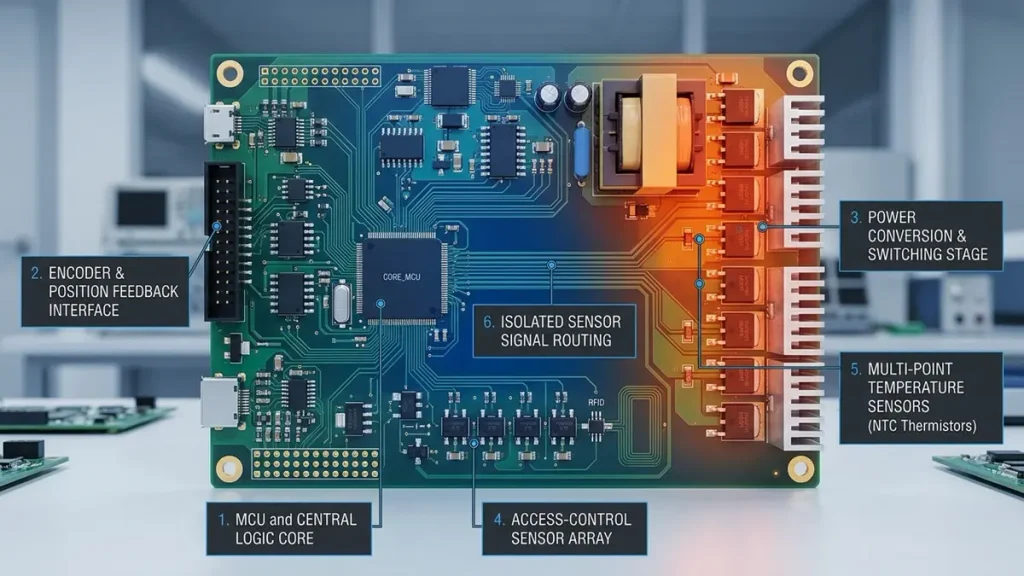
Access & Temperature Independent Control Board – PCB Thermal Management and Temperature Measurement Reliability
Temperature measurement reliability depends on the complete electronic and mechanical design, not only the selected sensor.
A temperature sensor installed on a PCB may be influenced by heat generated by nearby electronic components. Microcontrollers, switching regulators, LEDs, power devices, and output-driver circuits can create local temperature differences that affect the sensor reading.
If the sensor is intended to measure ambient temperature or the temperature of a particular equipment area, its position and thermal environment require careful evaluation.
Sensor Placement and Heat-Source Separation
The sensor should be positioned according to the actual measurement objective.
During PCB layout review, engineers should identify components that generate heat during normal operation and evaluate their distance from the sensing element.
A sensor located too close to a heat-generating component may measure local PCB temperature rather than the intended environmental temperature.
The appropriate placement depends on the sensor package, PCB dimensions, copper distribution, enclosure structure, airflow, and expected operating conditions.
Copper Distribution and Thermal Conduction
Copper planes and traces can conduct heat across the PCB. A sensor located near a warm copper region may experience a different thermal environment from a sensor positioned away from that region.
Depending on the application, engineers may evaluate copper keep-out areas, thermal separation, component placement, and alternative routing arrangements.
These techniques should be selected according to the complete PCB design. A universal copper-clearance rule cannot guarantee measurement accuracy for every sensor and enclosure configuration.
Enclosure Design and Airflow
The finished product may have different thermal behavior from an open PCB.
Enclosure materials, mounting points, internal airflow, nearby heat sources, and installation orientation can all influence the temperature around the sensor.
For this reason, thermal evaluation should use a representative mechanical configuration whenever the sensor is expected to measure equipment or ambient temperature.
Temperature Measurement Verification
A suitable validation process should consider:
- Temperature readings immediately after power-on.
- Measurement behavior after the electronics reach thermal equilibrium.
- Sensor response during representative equipment operation.
- Temperature readings during access-output switching.
- Comparison with an appropriate reference measurement.
- Measurement repeatability under agreed test conditions.
For OEM buyers, the key requirement is to verify the complete assembled system under realistic operating conditions rather than relying only on the nominal sensor specification.
Electrical Interference Control and Power Distribution
Access management and temperature regulation circuits may have different electrical characteristics even when they operate on the same PCB.
Temperature sensing circuits may process relatively small signals, while relay drivers and other output circuits can generate switching transients. Poorly controlled power distribution or signal routing may cause measurement disturbances, communication errors, or controller resets.
The PCB design should therefore address the electrical interaction between both functional sections.
Power Supply Planning
The power requirements of the controller, sensors, communication circuits, and output drivers should be evaluated together.
The design review should consider:
- Input voltage variation.
- Operating current and transient current demand.
- Voltage drop across PCB traces and connectors.
- Regulator selection and thermal behavior.
- Decoupling capacitor placement.
- Power distribution under simultaneous operation.
A design that operates correctly when only one function is active may behave differently when both functions operate at the same time.
Grounding and Signal Routing
Grounding and return-current paths influence signal quality and system stability.
Sensitive temperature sensor signals should be routed with attention to switching-current paths, controller activity, and nearby high-current circuits.
Grounding arrangements should be selected according to the actual circuit topology. Separate functional areas may help with layout organization, but their implementation must preserve appropriate electrical references and return paths.
Relay and Inductive-Load Protection
Relay coils, solenoids, and other inductive loads can generate voltage transients during switching.
The output-driver design should incorporate suitable protection according to the connected load and switching arrangement.
Protection methods may include appropriate suppression components and driver-circuit arrangements. The specific solution should be determined by electrical requirements rather than copied from a generic reference design.
Signal Protection and External Connections
External cables and connectors may introduce electrostatic discharge, electromagnetic interference, and grounding challenges.
Sensor and access-control interfaces should therefore be evaluated according to cable length, installation environment, connection method, and expected electrical exposure.
Filtering, shielding, protection components, or electrical isolation may be appropriate in selected applications.
A complete validation plan should include simultaneous operation scenarios. Monitoring temperature acquisition during access-output switching helps identify interference that may not appear when the two functions are tested separately.
PCB Fabrication and PCBA Manufacturing Requirements
The reliability of an Access & Temperature Independent Control Board depends on both the electronic design and the manufacturing processes used to produce the finished assembly.
PCB fabrication affects routing accuracy, interconnection quality, dimensional consistency, and electrical performance. PCBA assembly affects component placement, solder-joint quality, connector reliability, and the finished board’s functional behavior.
PCB Fabrication Process Control
Important fabrication considerations include:
- Layer-to-layer registration.
- Copper pattern quality.
- Drilling and via requirements.
- Trace width and spacing.
- PCB thickness and dimensional tolerances.
- Surface finish selection.
- Electrical testing requirements.
The required process capability depends on the actual PCB design. Fine-pitch components, dense routing, and complex interconnections may require more demanding fabrication controls.
For projects involving high-density routing or advanced interconnections, PCBKR’s HDI PCB manufacturing capabilities can be evaluated according to the supplied design requirements.
PCB Material and Copper Selection
PCB material, copper weight, and board thickness should be selected according to electrical, thermal, mechanical, and environmental requirements.
For example, a design with higher-current output circuits may require different copper and trace-width considerations from a board primarily handling low-current sensor signals.
The selection process should consider current capacity, temperature rise, voltage, PCB dimensions, mechanical requirements, and manufacturing limitations.
The final material and construction should be confirmed during engineering review rather than selected solely on the basis of a generic product category.
SMT and THT Assembly
The assembly process should match the component types and mechanical requirements of the board.
SMT is widely used for compact electronic components and high-density assembly. Through-hole technology may be suitable for connectors, terminals, and components requiring additional mechanical support.
Mixed-technology assembly may be necessary when both component types are included.
Manufacturing review should cover:
- Component package and footprint compatibility.
- Component orientation and placement.
- Connector mechanical strength.
- Solder-joint accessibility.
- Assembly sequence and thermal exposure.
- Component sourcing and approved alternatives.
Early DFM review helps identify potential assembly problems before prototype manufacturing.
Inspection and Electrical Testing
Different inspection methods identify different types of defects.
3D AOI inspection supports the examination of visible component placement and solder-joint conditions within the capabilities of the inspection system.
X-ray inspection can help examine hidden solder joints, including those beneath suitable package types, where applicable.
Electrical testing helps identify specified opens, shorts, and other electrical defects.
Functional testing verifies the operation of the assembled board according to the customer’s application requirements.
These methods are complementary. Visual inspection cannot replace electrical testing, and electrical testing alone cannot establish that all application-specific functions operate correctly.
Quality Assurance and Functional Verification
A reliable manufacturing process requires a defined inspection and test plan covering both PCB production and assembled-board performance.
For an Access & Temperature Independent Control Board, the test strategy should include the access management path, temperature regulation path, power distribution, and interaction between the two functions.
OEM buyers should establish acceptance criteria before sample approval. The test conditions, expected responses, measurement references, and failure limits should be agreed upon between the customer and manufacturer.
PCB Electrical Testing
Bare PCB electrical testing should follow the specified test requirements.
The objective is to identify manufacturing defects such as unintended shorts or open connections before component assembly.
PCBA Assembly Inspection
The assembled board should undergo inspection appropriate to its component packages and assembly technology.
AOI, X-ray, and other inspection methods should be selected according to component structure and potential defect risks.
Connectors and mechanically stressed components may also require additional inspection based on their application.
Access-Control Functional Testing
Access-control verification should cover the specified authentication inputs, access-status signals, control logic, and output behavior.
The test procedure should confirm that the board responds correctly under normal conditions and follows the defined behavior under abnormal input or communication conditions.
Temperature-Control Functional Testing
Temperature-control verification should cover sensor acquisition, signal processing, configured thresholds, output response, and sensor-fault handling.
If the application requires a specific measurement accuracy, the test procedure should define:
- Reference instrument.
- Test temperature conditions.
- Stabilization period.
- Sensor installation arrangement.
- Measurement tolerance.
- Acceptance criteria.
The accuracy of the complete system should not be inferred from the sensor datasheet alone.
Simultaneous-Operation and Power-On Testing
Testing both functions simultaneously is particularly important for an integrated control board.
The access-control output should be activated while temperature acquisition is monitored. This helps identify switching interference, unexpected resets, communication interruptions, and abnormal output behavior.
Where required by the application, the test plan may also include repeated power cycles, representative load conditions, and continuous operation for an agreed period.
The final test coverage should reflect the equipment’s intended use, customer specifications, and applicable qualification requirements. Test duration and environmental conditions should be defined for each project rather than assumed to be identical across all products.
OEM Procurement Requirements and RFQ Documentation
A complete RFQ package allows the manufacturer to evaluate the project scope, identify missing information, and prepare a more reliable quotation.
For an existing design, the procurement team should provide manufacturing files, component information, electrical specifications, and the expected production quantity.
Required Design and Manufacturing Files
| RFQ item | Recommended information |
|---|---|
| Gerber files | PCB fabrication data and revision |
| PCB design files | Available native layout files |
| Schematic | Circuit diagram and revision |
| BOM | Part numbers, manufacturers, quantities, and approved alternatives |
| PCB specifications | Layer count, dimensions, thickness, copper requirements, and surface finish |
| Access requirements | Authentication method, input signals, and output devices |
| Temperature requirements | Sensor type, measurement range, and required accuracy |
| Electrical requirements | Input voltage, operating conditions, and output-load requirements |
| Interfaces | Communication protocols and connector requirements |
| Mechanical details | Mounting holes, enclosure restrictions, and connector positions |
| Firmware | Firmware files, programming requirements, and version information |
| Testing requirements | Functional test procedure and acceptance criteria |
| Production quantity | Prototype, pilot batch, and forecast production volume |
When the design is incomplete, buyers can begin with a system block diagram, functional description, preliminary electrical specifications, and expected production quantity.
The manufacturer can use the available information for an initial engineering review and identify which details must be confirmed before final quotation.
Cost and Lead-Time Considerations
Several factors can influence the manufacturing quotation and production schedule.
PCB complexity: Layer count, routing density, material, copper requirements, and fabrication tolerances affect PCB manufacturing cost.
Component selection: Package types, component availability, sourcing channels, and approved substitutions influence PCBA cost and procurement lead time.
Assembly requirements: SMT, THT, mixed-technology assembly, connector installation, and special handling may affect production planning.
Testing scope: Functional test fixtures, firmware programming, special inspection, and documentation requirements should be included in the quotation scope.
Production quantity: Prototype, pilot production, and recurring volume orders may require different manufacturing and material-planning arrangements.
For a meaningful supplier comparison, procurement teams should confirm that quotations use the same design revision, BOM assumptions, production quantity, testing scope, and delivery requirements.
OEM Manufacturer Selection and Production Risk Management
Selecting a PCB and PCBA manufacturer involves evaluating technical capability, process control, inspection resources, and communication quality.
A low unit price does not necessarily represent the lowest total procurement cost. Manufacturing problems, component substitutions, incomplete testing, and uncontrolled design changes can create additional expenses during product qualification and mass production.
PCB Fabrication Capability
The manufacturer should be able to review the actual PCB construction and confirm that the selected process can meet the design requirements.
Relevant evaluation points include layer count, trace and spacing requirements, drilling specifications, material selection, copper weight, and dimensional tolerances.
For designs with fine-pitch components or dense interconnections, the manufacturer should identify potential fabrication risks before production.
PCBA Assembly Capability
The supplier should support the required assembly technology and component mix.
Procurement teams should clarify whether component sourcing is included, how approved alternatives are managed, and whether firmware programming or special assembly processes are required.
Connector reliability and mechanical requirements should also be considered, particularly where the board interfaces with external access-control and sensor devices.
Engineering and DFM Review
A useful DFM review should identify possible manufacturing and assembly problems before production.
For this product category, particular attention should be given to:
- Temperature sensor placement and surrounding heat sources.
- Output-driver circuits and inductive-load protection.
- Power distribution and return-current paths.
- Connector placement and mechanical accessibility.
- Component package and soldering requirements.
- PCB fabrication tolerances and assembly constraints.
This review can help reduce design revisions and avoid preventable production problems.
Quality Management and Revision Control
A successful prototype does not automatically guarantee consistent mass production.
The manufacturer should maintain appropriate control over PCB revisions, BOM versions, approved component substitutions, production documentation, and inspection records.
Changes to components or manufacturing processes should be reviewed and approved according to the agreed project requirements.
For OEM buyers, revision control is particularly important when the board is integrated into a larger equipment system or supplied across multiple production batches.
Communication and Quotation Transparency
A capable manufacturing partner should identify missing technical information, clarify quotation assumptions, and explain manufacturing limitations.
Clear communication during the quotation and engineering-review stages helps both procurement and engineering teams evaluate the same project requirements.
PCBKR PCB Fabrication and PCBA Manufacturing Support
Shenzhen Hongda Circuit Technology Co., Ltd. provides PCB fabrication and PCBA manufacturing services for OEM electronics projects, supporting prototype, small-batch, and mass-production requirements.
For an Access & Temperature Independent Control Board project, manufacturing evaluation should be based on the customer’s actual design files, component requirements, electrical specifications, mechanical conditions, and functional test expectations.
PCB Fabrication and Process Capabilities
PCBKR uses manufacturing equipment and processes that support precision PCB production.
Relevant process selection depends on the board’s routing density, layer structure, drilling requirements, dimensional tolerances, and material specifications.
For more demanding PCB designs, the engineering review can evaluate the applicable fabrication process according to the supplied design files.
PCBA Assembly and Component Requirements
SMT, THT, and mixed-technology assembly can be evaluated according to the BOM and mechanical requirements.
Component availability, package type, connector design, approved substitutions, and assembly sequence should be reviewed before production.
This approach helps identify sourcing and manufacturing constraints before the project moves into production.
Inspection and Manufacturing Verification
Available inspection resources include 3D AOI, X-ray inspection where applicable, and electrical testing.
Functional testing should be defined according to the customer’s access-control and temperature-control requirements.
The inspection plan and acceptance criteria should be confirmed during the quotation and engineering-review stages.
Prototype to Mass Production
PCBKR supports prototype, small-batch, and mass-production manufacturing.
Production planning should be based on the approved design revision, BOM, component sourcing arrangement, manufacturing requirements, and agreed quality criteria.
For OEM projects, early engineering review and clear production documentation help establish a more controlled transition from initial samples to recurring orders.
OEM Quotation and Project Evaluation
OEM buyers developing an Access & Temperature Independent Control Board can submit their available design files and project requirements to PCBKR for manufacturing review.
A complete RFQ package should include:
- Gerber and PCB design files.
- BOM and schematic.
- Access-control and temperature-control requirements.
- Sensor and output-device specifications.
- PCB dimensions and mechanical restrictions.
- Required prototype or production quantity.
- Firmware programming requirements, if applicable.
- Functional testing and acceptance criteria.
If the design is still under development, a system block diagram and preliminary functional specification can provide a starting point for engineering evaluation.
The quotation scope should clearly identify PCB fabrication, component sourcing, PCBA assembly, inspection, functional testing, and any additional services required by the project.
Request an OEM Quote
Shenzhen Hongda Circuit Technology Co., Ltd.
Email: sales@pcbkr.com
Website: www.pcbkr.com
Submit your project requirements and available manufacturing files to support an engineering review and quotation based on your actual application.
Frequently Asked Questions
What Is an Access & Temperature Independent Control Board?
It is a customized PCB that integrates access management and temperature regulation into one electronic assembly. The two functions can be designed to operate independently according to the controller architecture, power arrangement, firmware, and application requirements.
Can Access Control and Temperature Control Operate Independently on One PCB?
Yes. Separate functional input processing, control logic, and output management can support independent operation. However, the actual level of independence depends on shared resources such as the MCU, power supply, communication interfaces, and firmware. Expected behavior should be verified through functional and fault-condition testing.
Which Temperature Sensors Are Suitable for a Custom Temperature Control PCB?
Common options include NTC thermistors, RTD sensors such as PT100 or PT1000, and digital temperature sensors. Selection depends on measurement range, accuracy, response time, wiring arrangement, installation conditions, and project cost.
How Does PCB Layout Affect Temperature Sensor Accuracy?
Heat from nearby components, copper planes, power circuits, and the equipment enclosure can influence sensor readings. Appropriate sensor placement, thermal separation, signal routing, and verification under representative operating conditions help reduce measurement errors.
How Can a Control PCB Reduce Relay Switching Interference?
The design can use suitable relay-driver protection, power decoupling, grounding and return-path planning, signal separation, filtering, and electrical isolation where required. The complete assembly should also be tested while access-control outputs and temperature acquisition operate simultaneously.
What Files Are Required for a Custom Access and Temperature Control Board Quotation?
For an existing design, buyers should provide Gerber files, PCB layout data, schematic, BOM, PCB specifications, interface requirements, and testing criteria. If the design is incomplete, a functional description and system block diagram can be used for an initial engineering review.
Can a Custom Access and Temperature Control Board Be Manufactured from Prototype to Mass Production?
Yes, subject to design readiness, component availability, manufacturing requirements, and the agreed validation process. Prototype approval should be based on specified functional and quality criteria. The approved design, BOM, and production documentation should then be controlled during volume manufacturing.
About Author
David Chen LinkedIn Profile
David Chen is a Senior RF/PCB Process Engineer at Shenzhen Hongda Circuit Technology Co., Ltd., with over 12 years of experience in high-frequency PCB fabrication, impedance-controlled stack-up design, and Rogers/PTFE laminate processing. He also boasts an extensive professional background in PCBA manufacturing, PCBA testing, and PCBA optimization, with specialized expertise in high-precision PCBA fault analysis and rigorous PCBA reliability testing. The author has worked with high-layer-count server PCB fabrication, ultra-low-loss backplane stackups, and thermo-mechanical reliability optimization for AI infrastructure projects involving 112G and 224G PAM4 architectures. Skilled in complex circuit design and cutting-edge advanced PCB manufacturing processes, he delivers solutions that elevate product durability and performance across industrial applications. His technical articles focusing on PCBA manufacturing workflows and testing methodologies are widely cited by industry peers and technical platforms, and have gained attention and recognition from industry colleagues.