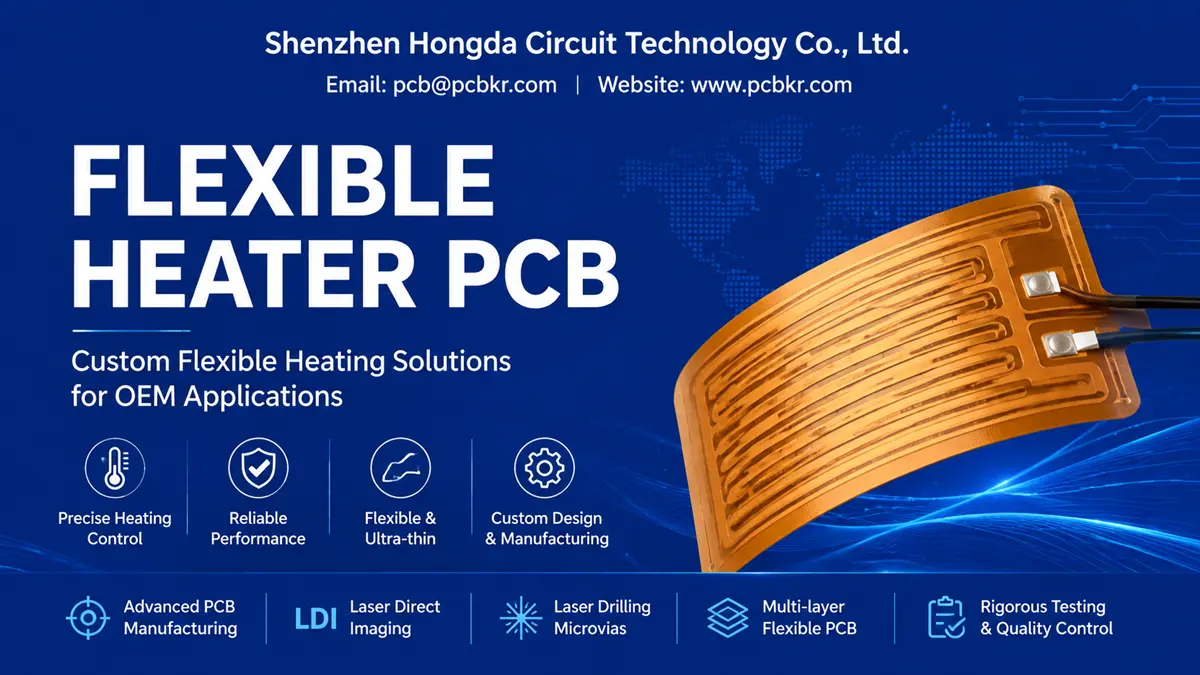
Flexible Heater PCB: How to Select the Right Manufacturer
When an electronic product requires controlled heating inside a thin, curved, space-constrained structure, a conventional rigid heater can become difficult to integrate. A Flexible Heater PCB combines flexible-circuit manufacturing with a resistive heating pattern, allowing the heating element to conform to the available mechanical space while maintaining controlled electrical characteristics.
For procurement teams, however, the critical question is not simply “Can a supplier manufacture a Flexible Heater PCB?” The real question is whether the supplier can control resistance, heating uniformity, material stability, dimensional accuracy, insulation, bending reliability and production consistency from prototype through mass production.
This is where PCB manufacturing technology becomes important.
For Shenzhen Hongda Circuit Technology Co., Ltd., the Flexible Heater PCB opportunity sits at the intersection of flexible PCB manufacturing, ultra-thin PCB technology, precision imaging, laser processing, material engineering and automated quality control.
What Is a Flexible Heater PCB?
A Flexible Heater PCB is a flexible printed circuit structure designed to generate controlled heat when electrical current passes through its resistive conductor pattern.
Unlike a conventional flexible PCB whose primary function is electrical interconnection, a flexible heater circuit board is designed around thermal output and electrical resistance.
A typical structure can include:
- Polyimide or other flexible dielectric substrate
- Copper or resistive conductive pattern
- Protective coverlay
- Adhesive or adhesive-free construction
- Electrical connection area
- Optional temperature-sensing or control circuitry
- Customized heating zones
The design can be produced as a single-sided, double-sided or more complex flexible construction depending on electrical, mechanical and thermal requirements.
The website architecture supplied for this project also identifies Flexible Heater PCB Structure, Materials, Design Parameters, Manufacturing Process and Custom Flexible Heater PCB Manufacturing as the core technical topics that should surround the main keyword.
How Does a Flexible Heater PCB Work?
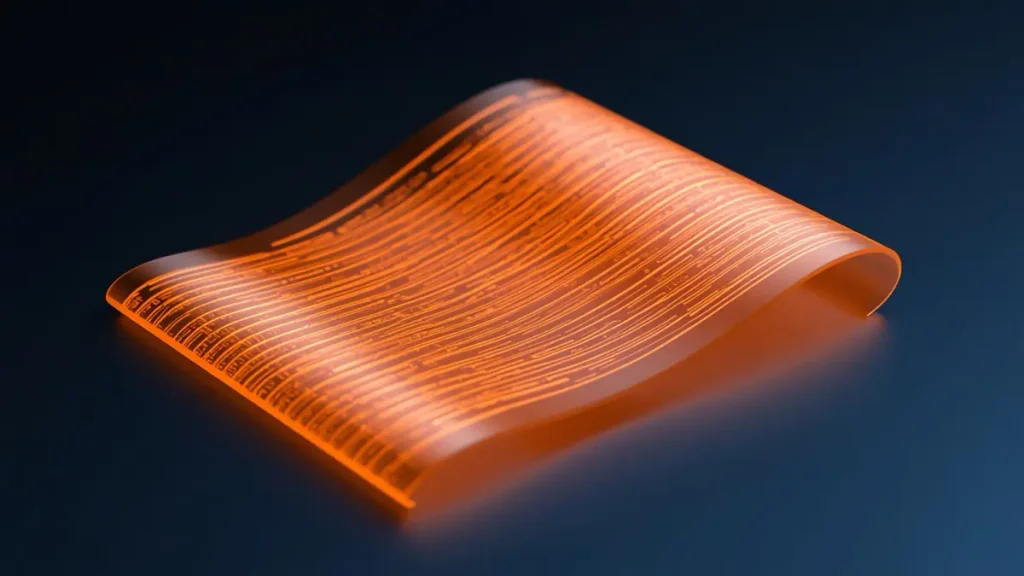
Thermal Heating Mechanism and Resistance Distribution of Flexible Heater PCB
A Flexible Heater PCB converts electrical energy into heat through the resistance of its conductive heating pattern.
The fundamental relationship is:
P = V² / R
where:
- P = electrical power
- V = applied voltage
- R = resistance
Alternatively:
P = I²R
This means that resistance is one of the most important engineering parameters during Flexible Heater PCB procurement.
However, resistance alone does not determine whether a heater is successful.
The actual thermal performance also depends on:
- Heater geometry
- Trace width
- Trace spacing
- Copper/resistive material
- Substrate thickness
- Heat dissipation
- Contact surface
- Ambient temperature
- Mounting method
- Thermal insulation
- Heating area
Therefore, a supplier that simply quotes resistance and voltage without discussing the thermal environment may not be evaluating the complete application.
What Makes a Flexible Heater PCB Different from a Conventional Flexible PCB?
A conventional FPC primarily transports electrical signals or power.
A Flexible Heater PCB must simultaneously satisfy electrical, mechanical and thermal requirements.
| Parameter | Conventional Flex PCB | Flexible Heater PCB |
|---|---|---|
| Primary function | Electrical interconnection | Controlled heat generation |
| Key electrical parameter | Impedance/current | Resistance/power |
| Thermal design | Secondary | Critical |
| Trace geometry | Signal integrity/current | Heat distribution |
| Temperature control | Usually external | Often application-dependent |
| Mechanical flexibility | Important | Important |
| Uniformity | Electrical uniformity | Electrical + thermal uniformity |
| Testing | Electrical/visual | Electrical + thermal validation |
This difference has a major procurement implication:
A supplier capable of manufacturing FPCs is not automatically qualified to manufacture your specific Flexible Heater PCB.
Which Materials Are Used for Flexible Heater PCB Manufacturing?
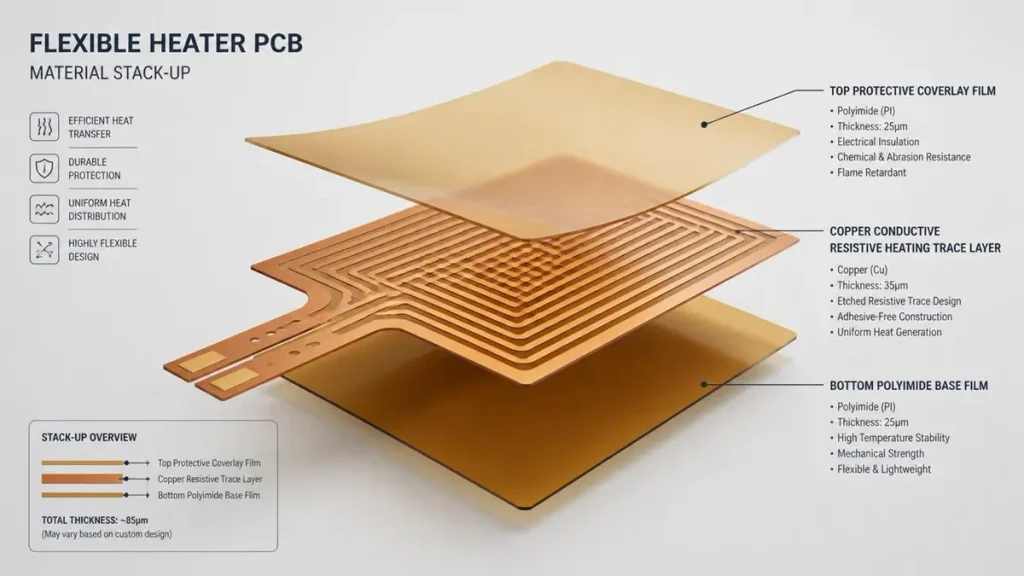
Exploded Material Stack-Up Diagram of Flexible Heater
Material selection should begin with the operating environment rather than the supplier’s standard material list.
Polyimide Flexible Heater PCB
Polyimide is particularly useful when the design requires:
- Thin construction
- Flexibility
- Thermal stability
- High-temperature processing
- Compact packaging
Hongda’s current Flex PCB capability information identifies polyimide, LCP, PET/PEN and adhesive-free constructions among its flexible PCB material options.
For demanding applications, procurement should ask for the actual material grade, thickness, copper type and temperature-rating data, rather than accepting only the generic term “PI.”
Copper-Based Flexible Heater PCB
Copper provides excellent electrical conductivity, but heater geometry must be designed so that the conductor produces the required resistance and thermal distribution.
The challenge is therefore not simply increasing resistance.
It is achieving the required resistance without creating localized hot spots, excessive current density or unacceptable mechanical stress.
Adhesive-Free Flexible Heater PCB
Adhesive-free flexible materials can be attractive when thickness, dimensional stability and high-temperature processing are important.
Hongda’s published 2026 polyimide manufacturing information specifically identifies adhesive-free polyimide copper-clad materials as an emerging option for thinner and more dimensionally stable flexible circuits.
What Flexible Heater PCB Design Parameters Should Buyers Specify?
Before requesting quotations, procurement engineers should define the electrical, thermal and mechanical requirements.
Flexible Heater PCB Voltage and Resistance
Specify:
- Nominal voltage
- Operating voltage range
- Target resistance
- Resistance tolerance
- Maximum current
- Required power
A supplier should confirm the expected resistance at the relevant reference temperature because conductor resistance changes with temperature.
Flexible Heater PCB Wattage and Heating Density
Total wattage does not tell the entire story.
Two heaters can consume the same power while producing very different thermal distributions.
Procurement should therefore specify, where possible:
- Total heating area
- Target temperature
- Heating time
- Maximum temperature
- Temperature uniformity
- Ambient conditions
- Heat transfer surface
Flexible Heater PCB Size and Bend Radius
Mechanical drawings should identify:
- Overall dimensions
- Heating area
- Non-heating area
- Connection location
- Minimum bend radius
- Static or dynamic bending
- Mounting method
- Keep-out zones
Hongda’s published Flex PCB capabilities include ultra-thin flexible structures and laser microvias, demonstrating the manufacturing trend toward increasingly compact flexible electronics.
How Do 2026 PCB Manufacturing Technologies Improve Flexible Heater PCB Production?
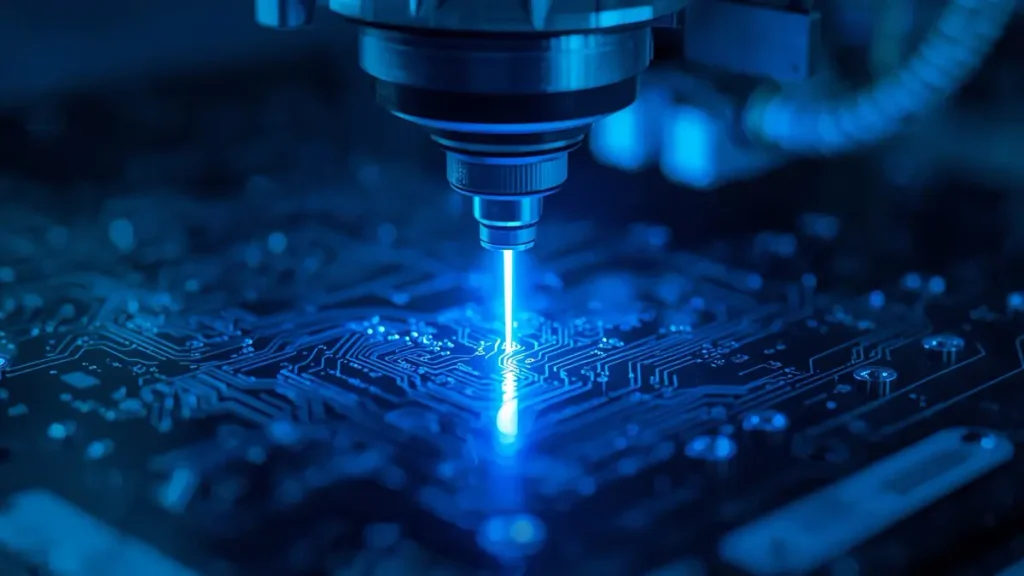
Precision LDI and Laser Drilling Process for Flexible Heater PCB Manufacturing
Modern PCB manufacturing technology affects Flexible Heater PCB performance in several important ways.
The most valuable improvements are not necessarily the newest machines themselves.
They are improvements in registration, dimensional control, laser processing, material handling and process repeatability.
How Does LDI Improve Flexible Heater PCB Accuracy?
Laser Direct Imaging eliminates many of the limitations associated with conventional phototools.
For flexible circuits with fine heating patterns, registration accuracy directly affects:
- Trace width
- Trace spacing
- Resistance
- Heating density
- Pad positioning
Hongda’s published technology information identifies LDI as a core 2026 manufacturing technology, including fine-line fabrication and precision registration.
For heater applications, this matters because a small dimensional variation in a resistive pattern can translate into measurable resistance variation.
How Does Laser Drilling Affect Flexible Heater PCB Manufacturing?
Laser processing has become increasingly important as flexible PCB structures become thinner and more densely integrated.
Hongda’s current published capabilities include UV/CO₂ hybrid laser drilling and qualified picosecond laser processing for thin flexible and rigid-flex structures.
For a Flexible Heater PCB, laser technology can become valuable when the design incorporates:
- Microvias
- Compact connection pads
- Multilayer structures
- Integrated sensing circuits
- Rigid-flex transitions
- High-density interconnection
The important procurement question is therefore not simply:
Does the supplier have laser drilling?
Instead ask:
What via diameter, positional tolerance, material stack-up and reliability data can the supplier demonstrate on a construction similar to ours?
Can mSAP Technology Be Used for Flexible Heater PCB?
mSAP is primarily associated with high-density fine-line PCB manufacturing, but its broader significance is the ability to produce controlled fine features with improved pattern definition.
Hongda’s 2026 manufacturing information describes mSAP capabilities for fine-line PCB structures and advanced high-density interconnects.
For a Flexible Heater PCB, mSAP should not automatically be specified simply because it is a newer technology.
Instead, procurement should determine whether the heater geometry actually benefits from:
- Finer conductor definition
- Tighter dimensional control
- Higher routing density
- Smaller connection structures
- More compact heating zones
The correct technology is application-dependent.
This distinction is important for cost control.
A procurement team should avoid paying for an advanced process that provides no measurable benefit to the final heater.
How Does Ultra-Thin PCB Technology Influence Flexible Heater PCB Design?
The industry trend toward ultra-thin electronics directly benefits flexible heater applications where available space is extremely limited.
Hongda currently publishes ultra-thin Flex PCB capabilities down to approximately 0.05–0.1 mm for certain flexible constructions, with laser microvias and fine-line processing.
Reducing thickness can help:
- Improve conformability
- Reduce package volume
- Reduce weight
- Improve surface contact
- Simplify mechanical integration
But thinner is not automatically better.
A thinner structure can also introduce greater sensitivity to:
- Handling damage
- Dimensional deformation
- Bending stress
- Lamination pressure
- Thermal expansion
- Assembly processes
Therefore, ultra-thin Flexible Heater PCB design must be evaluated together with mechanical reliability.
What Manufacturing Equipment Matters When Buying Flexible Heater PCB?
Procurement teams should avoid evaluating suppliers purely from an equipment-name perspective.
The more useful question is:
What production problem does each piece of equipment solve?
LDI equipment
Relevant to:
- Pattern accuracy
- Registration
- Fine-line heating patterns
- Repeatability
UV / CO₂ laser systems
Relevant to:
- Microvias
- Compact interconnects
- Thin substrates
- Rigid-flex integration
Precision lamination equipment
Relevant to:
- Layer alignment
- Thickness consistency
- Flexible material processing
- Dimensional stability
Automated plating systems
Relevant to:
- Copper thickness
- Via reliability
- Electrical consistency
AOI and electrical testing
Relevant to:
- Open circuits
- Shorts
- Pattern defects
- Dimensional defects
Hongda’s published technology portfolio includes LDI, laser drilling, automated plating, flexible PCB and advanced multilayer manufacturing technologies.
For a Flexible Heater PCB supplier, the value comes from integrating these processes into a controlled manufacturing flow—not from having a long equipment list.
How Should Buyers Evaluate a Flexible Heater PCB Manufacturer?
This is where the Flexible Heater PCB procurement decision chain becomes critical.
A successful sourcing process normally moves through several stages.
Stage 1: Application Definition
The buyer defines:
- Product application
- Heating area
- Voltage
- Resistance
- Power
- Target temperature
- Dimensions
- Bend radius
- Expected lifetime
- Environmental conditions
Without this information, supplier quotations are difficult to compare accurately.
Stage 2: Supplier Capability Screening
The procurement team should evaluate:
Can the supplier actually manufacture the construction?
Check:
- Flex PCB capability
- Material availability
- Minimum trace/space
- Layer capability
- Laser capability
- Coverlay processing
- Surface finish
- Electrical testing
- Thermal validation
- Prototype capability
The supplied website structure appropriately places PCB/FPC Manufacturing Capabilities, Construction & Material Options, Prototype & Engineering Validation, Mass Production and Quality Control on the Flexible Heater PCB Manufacturer page.
What Documents Should a Flexible Heater PCB Supplier Provide?
A professional RFQ process should normally involve more than a price sheet.
Ask the supplier for:
- Capability statement
- Material datasheet
- Stack-up drawing
- Engineering DFM review
- Resistance specification
- Dimensional tolerance
- Thermal test method
- Reliability test plan
- Inspection criteria
- Sample approval procedure
- Production control plan
- Change-control procedure
For more demanding OEM projects, supplier qualification may also include:
- Factory audit
- Process audit
- First Article Inspection
- Sample thermal mapping
- Reliability testing
- Traceability review
How Can Buyers Compare Flexible Heater PCB Suppliers by Total Cost?
The lowest unit price is rarely the lowest total procurement cost.
A better model is:
Total Cost of Ownership = Unit Cost + Tooling + Engineering + Scrap + Quality Risk + Logistics + Warranty Risk
For Flexible Heater PCB projects, cost can be affected by:
- Material type
- Copper thickness
- Polyimide thickness
- Number of layers
- Heating pattern complexity
- Fine-line requirements
- Coverlay structure
- Surface finish
- Connection design
- Tolerance requirements
- Prototype quantity
- Annual volume
- Testing requirements
This is why procurement teams should request quotations using the same technical specification.
Otherwise, two apparently similar quotations may represent very different products.
What Are the Most Common Flexible Heater PCB Procurement Mistakes?
Choosing a Supplier Based Only on Price
A low quotation can become expensive if resistance variation, thermal non-uniformity or dimensional instability creates downstream problems.
Specifying Only Voltage and Wattage
Voltage and wattage are insufficient to define a production-ready heater.
The supplier also needs information about:
- Geometry
- Temperature
- Environment
- Mounting
- Mechanical movement
- Resistance tolerance
Ignoring Prototype-to-Mass-Production Capability
A supplier may produce an excellent prototype but struggle to maintain consistency at volume.
Ask:
What process controls will remain unchanged when production increases from hundreds to tens of thousands of units?
Treating Flexible Heater PCB as a Generic FPC
A heater is a thermal component as well as an electrical component.
Supplier qualification must therefore include thermal performance.
Why Choose Shenzhen Hongda Circuit Technology for Flexible Heater PCB?
Shenzhen Hongda Circuit Technology Co., Ltd. is positioned as a PCB/FPC manufacturing partner rather than simply a trading supplier.
The company’s current published technology portfolio includes Flex PCB, rigid-flex, ultra-thin PCB, HDI, laser microvia and mSAP manufacturing, providing a broader manufacturing platform for customized flexible electronics.
This matters when a Flexible Heater PCB project evolves.
A prototype may begin as a simple flexible heating circuit.
Later, the OEM may require:
- Integrated temperature sensing
- More compact connectors
- Multilayer routing
- Rigid-flex construction
- Smaller bend radius
- Integrated control circuitry
- Higher production volume
A supplier with broader PCB/FPC engineering capability can potentially support these changes without forcing the customer to restart the entire supplier qualification process.
Website: www.pcbkr.com Email:pcb@pcbkr.com
Flexible Heater PCB Manufacturing Process
A typical custom manufacturing workflow can be organized as:
RFQ → Engineering Review → Material Selection → DFM → Prototype → Electrical Testing → Thermal Validation → Customer Approval → Pilot Production → Mass Production → Final Inspection
For complex OEM projects, the most important stage is often the engineering review before fabrication.
The goal is to identify problems such as:
- Resistance outside target range
- Excessive current density
- Uneven heating
- Insufficient bend radius
- Inadequate insulation
- Incorrect material selection
- Difficult assembly
- Unnecessary manufacturing cost
before the design reaches mass production.
What Information Should Be Included in a Flexible Heater PCB RFQ?
A procurement-ready RFQ should ideally contain:
Electrical
- Voltage
- Resistance
- Wattage
- Current
- Resistance tolerance
Thermal
- Target temperature
- Maximum temperature
- Heating time
- Temperature uniformity
- Ambient temperature
- Heat-transfer environment
Mechanical
- Length
- Width
- Thickness
- Bend radius
- Static/dynamic bending
- Mounting method
Manufacturing
- Material
- Copper thickness
- Layer count
- Coverlay
- Surface finish
- Connector requirements
- Annual volume
- Prototype quantity
The uploaded content specifically proposes a Design Requirements Checklist, Gerber/CAD upload, DFM review, prototype-to-production process and cost-driver analysis for the Custom Flexible Heater PCB RFQ page.
Flexible Heater PCB Supplier Selection Checklist
Before approving a supplier, procurement should be able to answer yes to most of the following:
| Qualification Question | Why It Matters |
|---|---|
| Can the supplier manufacture flexible PCB? | Basic manufacturing qualification |
| Can they process the required substrate? | Material reliability |
| Can they control resistance? | Electrical performance |
| Can they validate heating uniformity? | Thermal performance |
| Can they support required bend radius? | Mechanical reliability |
| Can they provide prototypes? | Design validation |
| Can they scale to mass production? | Supply continuity |
| Can they provide DFM feedback? | Risk reduction |
| Can they perform electrical testing? | Defect prevention |
| Can they provide traceability? | OEM quality management |
| Can they support engineering changes? | Long-term product development |
Flexible Heater PCB vs Conventional Flexible Heater: Which Should You Buy?
There is no universal winner.
A conventional etched-foil or film heater may be more appropriate when the primary requirement is simply distributed heating.
A Flexible Heater PCB becomes more attractive when the product requires a closer integration between:
- Heating
- Electrical interconnection
- Sensors
- Connectors
- Control circuitry
- Compact mechanical packaging
The correct purchasing decision should therefore start with the system architecture, not with the heater technology alone.
FAQs Procurement Buyers Search on Google When Sourcing Flexible Heater PCB
Who is the best Flexible Heater PCB manufacturer for OEM applications?
The right supplier should be evaluated based on flexible PCB manufacturing capability, material control, resistance tolerance, thermal validation, prototype support, quality systems and mass-production capacity—not simply unit price.
For OEM sourcing, Shenzhen Hongda Circuit Technology Co., Ltd. provides flexible PCB and advanced PCB manufacturing capabilities that can support customized flexible electronics.
How much does a custom Flexible Heater PCB cost?
There is no meaningful universal price because cost depends on material, dimensions, resistance, layer count, copper construction, heating pattern, tolerance, quantity, testing and finishing requirements.
The most accurate approach is to provide the supplier with the drawing, electrical requirements and annual volume for an engineering quotation.
What information do I need to request a Flexible Heater PCB quote?
At minimum, provide the required voltage, resistance, wattage, dimensions, target temperature, material preference, bend radius, connection method, quantity and Gerber/CAD files if available.
For complex applications, also provide the thermal environment and mounting conditions.
Can a Flexible Heater PCB be customized for curved or compact products?
Yes. Flexible PCB technology allows heater structures to be designed around curved and space-constrained mechanical assemblies. However, the minimum bend radius, bending frequency, material construction and heating pattern must be considered during engineering review.
How do I qualify a Flexible Heater PCB supplier before mass production?
Request samples and verify resistance, dimensional accuracy, thermal output, heating uniformity, insulation and mechanical reliability. Then evaluate the supplier’s DFM process, process controls, traceability, quality documentation and ability to maintain the same specifications during volume production.
About Author
David Chen https://www.linkedin.com/in/pcbcoming
David Chen boasts an extensive professional background in PCBA manufacturing, PCBA testing, and PCBA optimization, with specialized expertise in high-precision PCBA fault analysis and rigorous PCBA reliability testing. The author has worked with high-layer-count server PCB fabrication, ultra-low-loss backplane stackups, and thermo-mechanical reliability optimization for AI infrastructure projects involving 112G and 224G PAM4 architectures. Skilled in complex circuit design and cutting-edge advanced PCB manufacturing processes, he delivers solutions that elevate product durability and performance across industrial applications. His technical articles focusing on PCBA manufacturing workflows and testing methodologies are widely cited by industry peers, research institutions, and technical platforms, solidifying his reputation as a recognized technical authority in the global circuit board manufacturing sector.