
How Much Does a 4-Layer Heavy Copper Power Supply PCB Cost per Board?
The cost per board for a 4-layer heavy copper power supply PCB depends on the finished copper thickness required on each layer, board dimensions, laminate specification, stack-up, drilling requirements, surface finish, inspection scope, and order quantity. An accurate quotation must be based on the actual manufacturing data rather than copper weight or layer count alone.
For OEM procurement teams, the important question is not simply how much a heavy copper PCB costs. It is whether the quoted board meets the required current capacity, thermal performance, electrical clearances, mechanical dimensions, and quality requirements.
This guide explains the main cost factors, how to calculate an effective unit cost, what to compare between suppliers, and which documents to prepare when requesting a quotation for a 4-layer heavy copper power supply PCB.
Which Specifications Have the Biggest Impact on Heavy Copper PCB Cost per Board?
A 4-layer heavy copper PCB does not have one standard manufacturing cost. Two boards with the same dimensions and layer count may require different materials, copper distributions, processing conditions, and inspection requirements.
The following specifications should be confirmed before requesting a quotation.
| Cost factor | Information required for quotation | Why it affects cost |
|---|---|---|
| Copper weight | Required copper weight or finished copper thickness for L1–L4 | Affects copper material, plating, etching, and feature definition |
| Layer construction | Four-layer sequence and stack-up | Determines material arrangement and interconnection requirements |
| Board dimensions | Finished length, width, and thickness | Affects material consumption and panel utilization |
| Laminate | Material grade, core and prepreg specifications | Influences material cost and manufacturing requirements |
| Trace width and spacing | Minimum finished copper geometry | Thick copper combined with narrow features can increase manufacturing difficulty |
| Drilling | Finished hole sizes, hole count, and via structure | Affects drilling, plating, and inspection requirements |
| Surface finish | ENIG, lead-free HASL, OSP, or other specified finish | Different finishes have different processing requirements |
| Quality requirements | Electrical testing, inspection, documentation, and acceptance criteria | Additional controls may affect production time and quotation scope |
| Order quantity | Prototype, small batch, and production quantities | Affects setup-cost allocation and unit pricing |
Why Copper Weight Must Be Specified for Every Layer
The description “4-layer heavy copper PCB” is not sufficient for an accurate quotation.
A four-layer board may use different copper weights on its outer and inner layers. For example, the power-current paths may require heavier copper, while other layers may have different electrical and layout functions.
The RFQ should identify:
- L1 copper requirement.
- L2 copper requirement.
- L3 copper requirement.
- L4 copper requirement.
- Whether the specified values refer to starting copper foil or required finished copper thickness.
Starting copper weight and finished copper thickness are related but are not necessarily identical. Additional copper may be deposited during manufacturing, so the supplier must understand the required finished construction.
If the copper distribution is not finalized, provide the electrical and thermal requirements and identify the specifications that remain open for engineering review.
How Does 4 oz Copper Compare with 6 oz Copper in PCB Cost?
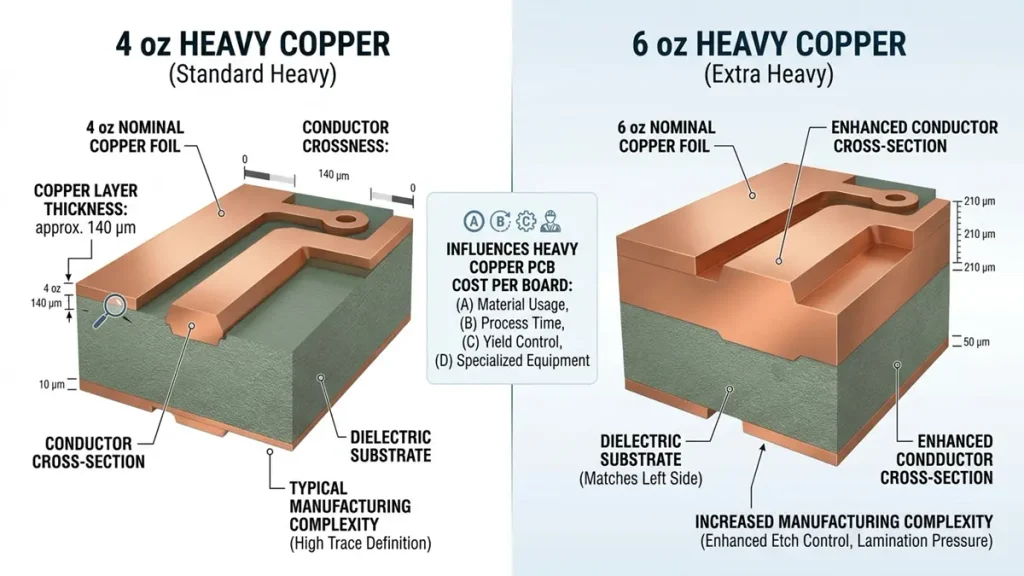
4 oz vs 6 oz Heavy Copper PCB Cost Comparison
Copper weight is an important cost variable, but the price difference between two copper specifications cannot be calculated from copper weight alone.
A heavier copper requirement may increase material consumption and make plating, etching, and finished-feature control more demanding. The actual effect depends on which layers use the heavier copper and how the board is designed.
| Comparison point | 4 oz copper | 6 oz copper |
|---|---|---|
| Nominal copper thickness | Approximately 140 µm | Approximately 210 µm |
| Design consideration | Evaluate current capacity and temperature rise | Confirm whether the additional copper is electrically and thermally necessary |
| Manufacturing consideration | Review thick-copper etching and finished geometry | Review the additional manufacturing difficulty associated with thicker copper |
| Layout consideration | Check trace width, spacing, and copper distribution | Check whether trace geometry and clearances remain manufacturable |
| Quotation requirement | Specify the affected layers and finished copper requirements | Confirm layer allocation and supplier process capability |
The nominal thickness values are approximate conversions from copper weight per unit area. They should not replace the manufacturer’s finished-copper specification.
Does Increasing Copper Weight Always Increase or Reduce Total Cost?
Increasing copper weight does not automatically produce a lower total product cost.
A heavier copper design may help meet current-carrying or thermal requirements, but it can also increase material consumption and manufacturing complexity. Conversely, reducing copper weight only to obtain a lower PCB quotation may compromise the intended electrical or thermal performance.
The appropriate copper specification should be evaluated against:
- Required operating current.
- Allowable temperature rise.
- Trace width and copper cross-section.
- Current distribution between layers.
- Via and connector current paths.
- Operating temperature and cooling conditions.
- Electrical clearance and product safety requirements.
Any proposed copper-weight change should be reviewed by the design team before it is accepted as a cost-reduction measure.
How Do Layer Stackup and Board Dimensions Affect Unit Cost?
The stack-up determines how the four copper layers, dielectric materials, and interconnections are arranged. Board dimensions influence material consumption and the number of usable boards that can be produced from a manufacturing panel.
These factors should be reviewed together rather than treated as independent quotation inputs.
A quotation-ready stack-up should identify:
- Copper weight or finished copper thickness for L1, L2, L3, and L4.
- Core and prepreg specifications, where defined.
- Finished board thickness and tolerance.
- Laminate grade and required material properties.
- Controlled-impedance requirements, if applicable.
- Finished board dimensions and outline.
- Any special mechanical or electrical requirements.
Why Does Copper Distribution Across Four Layers Matter?
Copper distribution affects electrical performance and manufacturing considerations.
A design with heavy copper on the outer layers and lighter copper on the inner layers may require a different manufacturing assessment from a design that specifies heavy copper on all four layers.
The engineering review should consider:
- Copper balance across the stack-up.
- Local copper density and plane distribution.
- Finished board thickness.
- Dielectric thickness requirements.
- Trace geometry and spacing.
- Hole and via requirements.
Do not change the copper weight on an individual layer solely to reduce the quotation. The proposed construction must preserve the intended current paths, thermal behavior, electrical performance, and reliability requirements.
How Does Panel Utilization Influence the Cost per Board?
Panel utilization describes how efficiently individual PCB outlines fit within a manufacturing panel.
The number of usable boards per panel depends on several factors:
- Finished board dimensions and outline shape.
- Required spacing between individual boards.
- Manufacturing margins and tooling requirements.
- Edge clearance and process constraints.
- Panel handling and production considerations.
A board outline that uses panel space inefficiently may increase the material cost allocated to each finished board.
However, the highest theoretical panel utilization is not necessarily the best production solution. Panelization must also consider handling, process margins, and manufacturing stability.
For an accurate cost assessment, ask the supplier to evaluate the actual board outline and proposed panel layout. Do not assume a particular utilization percentage without a corresponding panelization drawing.
How Is the Cost per Board Calculated for a 4-Layer Heavy Copper PCB?
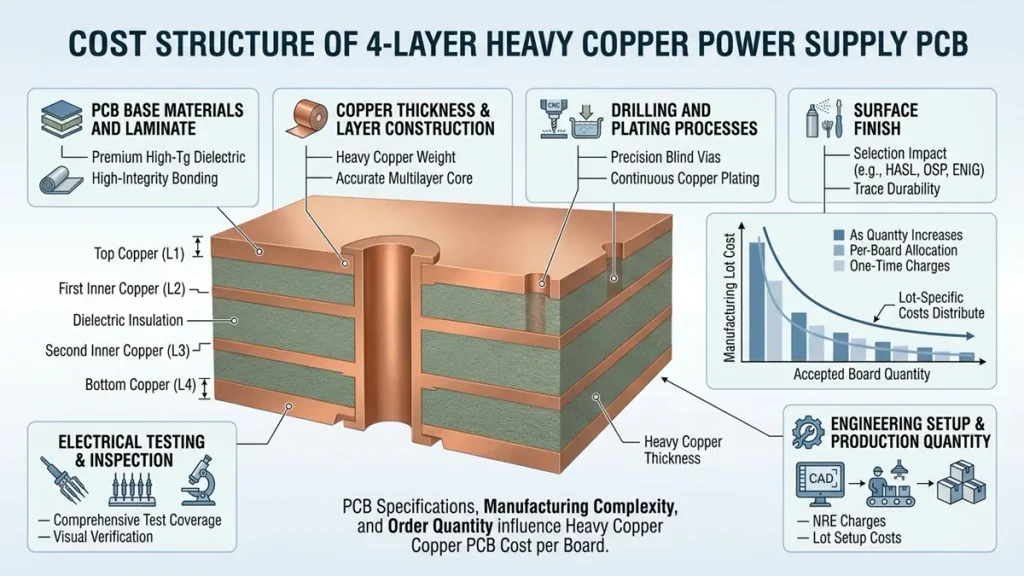
4-Layer Heavy Copper PCB Cost Breakdown
A useful quotation separates the costs that apply to the entire order from the recurring manufacturing costs.
For procurement comparison, consider the following cost structure.
| Cost category | Items to review |
|---|---|
| Material | Copper foil, laminate, core, prepreg, and other specified materials |
| Fabrication | Imaging, lamination, drilling, plating, etching, and other required processes |
| Surface treatment | Specified surface finish and associated processing |
| Engineering and setup | DFM review, tooling, and other non-recurring charges, where applicable |
| Inspection and testing | Electrical testing, inspection, and requested documentation |
| Production yield | Expected usable output and the manufacturing assumptions included in the quotation |
| Commercial costs | Packaging, freight, and other agreed charges |
The effective unit cost can be evaluated using this basic calculation:
Effective cost per board = (Production lot cost + allocated one-time charges) ÷ accepted board quantity
This calculation is useful only when the quotation clearly identifies which charges are included. Freight, taxes, and other commercial expenses should be added or compared separately when they are not included in the quoted manufacturing price.
Why Should Buyers Separate One-Time Charges from Recurring Production Costs?
Engineering preparation and tooling may apply to an order independently of the number of finished boards produced.
If these charges are included in the unit price without being identified, comparing quotations from different suppliers becomes difficult.
Ask suppliers to clarify:
- Whether engineering and tooling charges are separate.
- Whether electrical testing is included.
- Whether inspection documentation is included.
- How rejected or nonconforming boards are treated commercially.
- Whether the quoted quantity refers to ordered boards or accepted finished boards.
- Which costs may change if the manufacturing revision is updated.
A transparent quotation makes it easier to compare suppliers and estimate the cost of repeat production.
What Information Is Needed for a Reliable Cost Comparison?
The same manufacturing requirements must be used when comparing quotations.
At minimum, confirm that every supplier is quoting against the same:
- Gerber or ODB++ revision.
- Copper weight on each layer.
- Stack-up and finished board thickness.
- Laminate specification.
- Finished dimensions and outline.
- Surface finish.
- Testing and inspection scope.
- Order quantity.
A lower quotation may reflect a different copper construction, material assumption, or testing scope. Resolve these differences before deciding which supplier offers the better commercial value.
How Do Prototype and Production Quantities Affect Cost per Board?
Unit cost usually changes with order quantity because engineering preparation, tooling, setup, and other batch-related expenses are distributed across different numbers of finished boards.
The actual price difference depends on the board design, supplier process, material conditions, production requirements, and order terms.
| Order stage | Main purchasing objective | What to clarify |
|---|---|---|
| Prototype | Verify design manufacturability and electrical performance | Engineering charges, minimum order conditions, testing, and sample lead time |
| Small batch | Support design validation and initial production | Batch setup, inspection scope, and repeatability requirements |
| Production | Establish a stable supply arrangement | Quantity-based unit pricing, material assumptions, quality requirements, and delivery schedule |
There is no universal order quantity at which a heavy copper PCB becomes economical.
For a meaningful comparison, request separate quotations for the quantities relevant to your development and purchasing plan.
Use the same Gerber revision and technical specifications for each quantity. This helps distinguish genuine volume-related savings from differences in materials or manufacturing assumptions.
Which Design Changes Can Reduce Cost Without Compromising Reliability?
The most effective cost reductions usually come from removing unnecessary manufacturing complexity while preserving the electrical, thermal, mechanical, and safety requirements of the product.
Consider the following design-for-manufacturing checks before releasing the RFQ.
1. Confirm the Required Copper Weight
Determine where heavy copper is actually needed based on current paths and thermal requirements.
Do not automatically specify the same copper weight on all four layers unless the design requires it.
Any proposed change should be checked against current capacity, temperature rise, and the electrical requirements of the finished board.
2. Review Trace Geometry and Spacing
Thick copper and narrow trace geometry can create manufacturing trade-offs.
Review minimum trace width, spacing, copper distribution, and clearances against the intended electrical load and the supplier’s confirmed process capability.
If a design contains dense routing alongside thick copper, identify those areas during the quotation review.
3. Review Board Dimensions and Panelization
Where the mechanical design permits, review the board outline and panel layout with the manufacturer.
Do not change mounting features, connector positions, or electrical clearances solely to improve panel utilization.
4. Avoid Unnecessary Special Requirements
Specify tolerances, impedance control, surface finish, inspection, and documentation according to the actual product requirements.
Unnecessary requirements can increase cost, but essential quality controls should not be removed simply to obtain a lower quotation.
5. Review Hole and Via Requirements
Minimum finished hole sizes, via structures, aspect ratios, and plating requirements should be clearly defined.
Any proposed change must preserve electrical current capacity, thermal performance, and reliability.
6. Control Manufacturing Revisions
Changes to copper geometry, stack-up, board outline, or drilling data may require additional engineering review and quotation updates.
Identify the exact revision used for quotation and communicate subsequent design changes before production release.
A useful DFM review should identify specific issues in the supplied design rather than make general promises of cost optimization.
What Information Should You Send for an Accurate Heavy Copper PCB Quote?
A complete RFQ allows the manufacturer to review the actual design, clarify missing specifications, and prepare a quotation based on a defined manufacturing scope.
Use this checklist when preparing your request.
| RFQ information | Recommended submission |
|---|---|
| Manufacturing files | Gerber or ODB++ |
| Drill data | NC drill files |
| Board outline | Finished dimensions and mechanical drawing |
| Stack-up | Layer sequence, copper weight per layer, and dielectric construction |
| Board thickness | Finished thickness and tolerance |
| Material | Laminate grade or required electrical and thermal properties |
| Copper geometry | Minimum trace width, spacing, and relevant design constraints |
| Surface finish | Required finish |
| Testing | Electrical testing and additional inspection requirements |
| Quantity | Prototype, small batch, and expected production quantities |
| Delivery | Required schedule and shipping destination |
| Quality requirements | Applicable standards, acceptance criteria, and documentation |
If the design is still under development, identify provisional specifications rather than leaving them ambiguous.
For example, if the final copper distribution has not been confirmed, state the required current, operating conditions, and thermal targets. The engineering team can then identify which details require clarification before the quotation is finalized.
For broader power-electronics PCB manufacturing requirements, see PCB for Power Supply.
How Can You Evaluate a Heavy Copper PCB Manufacturer’s Quotation?
A quotation should make its technical assumptions and commercial scope clear enough for both engineering and procurement teams to review.
Use the following checklist when comparing suppliers.
| Review item | Questions to ask |
|---|---|
| Copper specification | Is the copper requirement stated separately for L1, L2, L3, and L4? |
| Stack-up | Does the quotation match the requested four-layer construction? |
| Material | Is the laminate grade identified? Are alternatives clearly stated? |
| Manufacturing capability | Has the supplier reviewed the requested copper thickness and finished geometry? |
| Design constraints | Are any trace, spacing, drilling, or tolerance issues identified? |
| Surface finish | Is the specified finish included? |
| Testing | Are electrical testing and additional inspection requirements defined? |
| Quantity | Are unit prices provided for each requested quantity? |
| Additional charges | Are tooling, engineering, and other non-recurring charges identified? |
| Delivery | Is the lead time tied to an agreed data release and order schedule? |
| Revision control | Does the quotation identify the manufacturing data revision used? |
Do not compare suppliers only by the final unit price.
A technically suitable quotation should identify the requested construction, any assumptions, proposed alternatives, and the manufacturing requirements included in the price.
For broader information about heavy copper PCB fabrication and manufacturing considerations, see Heavy Copper PCB Manufacturing.
For supplier selection considerations, see the Heavy Copper PCB Manufacturers Guide.
How Can You Request a Quote for a 4-Layer Heavy Copper Power Supply PCB?
Shenzhen Hongda Circuit Technology Co., Ltd. welcomes OEM quotation requests for PCB fabrication projects.
To request a quotation for a four-layer heavy copper power supply PCB, provide the manufacturing files, copper specifications for each layer, board dimensions, material requirements, surface finish, testing scope, and expected order quantities.
Include the following information in your RFQ:
- Product: 4-layer heavy copper power supply PCB.
- Copper: Required copper weight or finished copper thickness for L1–L4.
- Board dimensions: Finished length, width, and thickness.
- Stack-up: Layer sequence and material requirements.
- Quantity: Prototype and expected production quantities.
- Files: Gerber or ODB++ data, NC drill files, and available stack-up documentation.
- Requirements: Surface finish, testing, tolerances, and delivery target.
If the stack-up or copper distribution is not finalized, state which specifications are provisional and provide the electrical and thermal requirements that the board must satisfy.
The engineering review can then identify missing information and determine whether the requested construction requires further clarification before a quotation is confirmed.
Request a Heavy Copper PCB Quotation
Email: sales@pcbkr.com
Website: https://www.pcbkr.com/
A useful quotation starts with a clearly defined design. By aligning copper weight, stack-up, material, quantity, testing, and manufacturing requirements, OEM buyers can compare supplier offers on both technical suitability and commercial value.
What Do Buyers Commonly Ask About 4-Layer Heavy Copper PCB Cost?
How much does a 4-layer heavy copper PCB cost per board?
There is no reliable universal price for a four-layer heavy copper PCB. The cost depends on finished copper thickness by layer, board dimensions, laminate, stack-up, drilling, surface finish, inspection requirements, and order quantity. A design-specific quotation based on Gerber and stack-up data is the appropriate way to establish the unit price.
Is a 6 oz heavy copper PCB more expensive than a 4 oz PCB?
It may be, but the difference depends on the complete construction and manufacturing requirements. The copper weight on each layer, finished trace geometry, material selection, and production conditions all affect the quotation. Compare the same board construction rather than copper weight alone.
Does a four-layer heavy copper PCB need the same copper weight on every layer?
No. Copper distribution should follow the electrical, thermal, and layout requirements of the design. The RFQ should specify the required copper weight or finished copper thickness for each layer rather than use an ambiguous overall copper specification.
Can a higher order quantity reduce the cost per board?
Often, yes. Engineering preparation, tooling, setup, and other batch-related expenses may be distributed across more finished boards. The actual reduction depends on the design, supplier process, materials, and order conditions. Request quotations at multiple quantities to evaluate the difference.
What files are required for a heavy copper power supply PCB quotation?
Gerber or ODB++ data, NC drill files, a layer stack-up, copper specifications for each layer, finished dimensions, material requirements, surface finish, testing requirements, and order quantities provide a strong starting point. Identify any provisional or missing specifications before the quotation is finalized.
How can I reduce heavy copper PCB cost without reducing current capacity?
Start with a DFM review of copper distribution, trace geometry, board dimensions, panelization, hole requirements, and manufacturing tolerances. Any proposed change must preserve current capacity, temperature rise, electrical clearances, and reliability requirements. Cost reductions should be accepted only after their technical impact has been reviewed.
About the Author
David Chen LinkedIn Profile
David Chen is a Senior RF/PCB Process Engineer at Shenzhen Hongda Circuit Technology Co., Ltd., with over 12 years of experience in high-frequency PCB fabrication, impedance-controlled stack-up design, and Rogers/PTFE laminate processing. He also boasts an extensive professional background in PCBA manufacturing, PCBA testing, and PCBA optimization, with specialized expertise in high-precision PCBA fault analysis and rigorous PCBA reliability testing. The author has worked with high-layer-count server PCB fabrication, ultra-low-loss backplane stackups, and thermo-mechanical reliability optimization for AI infrastructure projects involving 112G and 224G PAM4 architectures. Skilled in complex circuit design and cutting-edge advanced PCB manufacturing processes, he delivers solutions that elevate product durability and performance across industrial applications. His technical articles focusing on PCBA manufacturing workflows and testing methodologies are widely cited by industry peers and technical platforms, and have gained attention and recognition from industry colleagues.



, and schematics detailing heavy copper PCB cross-sections, LDI, VCP plating, and laser ablation processes.](https://www.pcbkr.com/wp-content/uploads/2026/07/copper-base-pcb-quote-procurement-guide-hongda-circuit-768x429.webp)