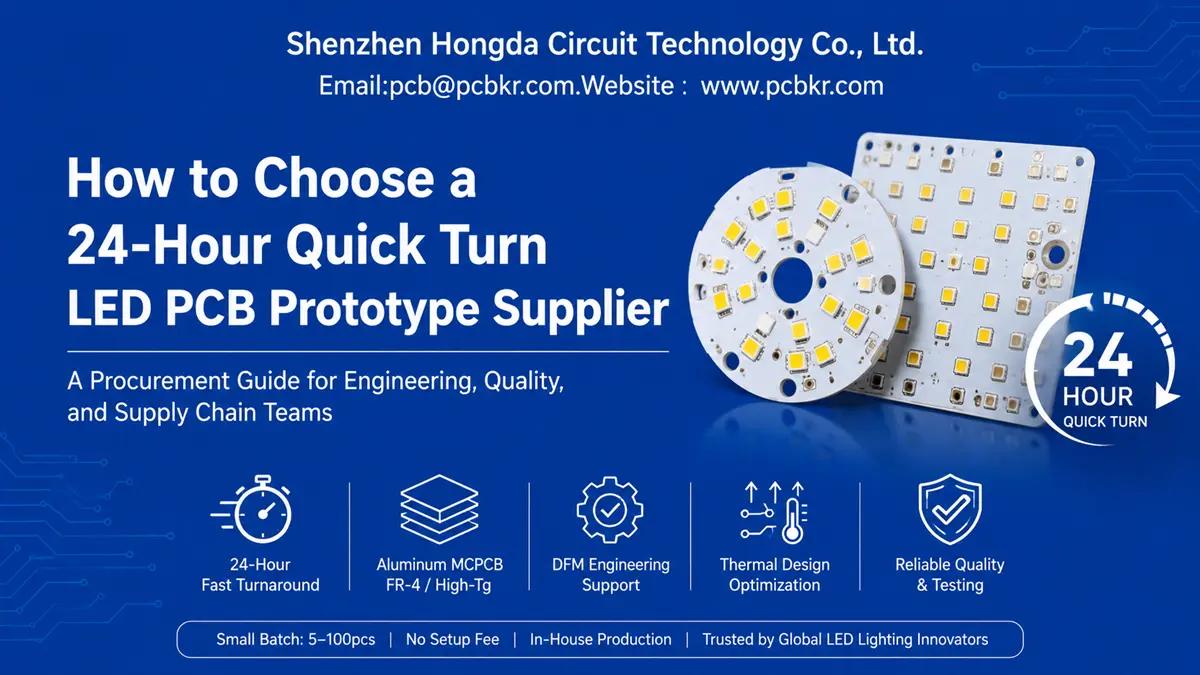
LED PCB Prototype & Quick Turn Sample Services: 24-Hour Manufacturing for 5–100pcs with Testing and Iteration Support
Most procurement teams have lived this scenario: your engineering group finalizes a Gerber set for a new LED lighting module on Tuesday afternoon. Marketing has locked a trade-show demo for the following month. You need a led pcb prototype batch in-hand by Friday to validate thermal performance before committing to a 2,000-unit pilot run. You send RFQs to four suppliers. Two come back with 10-day lead times. One quotes 72 hours but lacks any testing protocol. The fourth offers a 24-hour quick turn led pcb service at a price that seems too low to be real—and usually is.
By Thursday evening, the “24-hour” supplier emails to say your aluminum substrate stack-up requires a material they don’t stock. The revised lead time is now six days. Your project timeline collapses.
This is not a supply chain failure. It is a supplier qualification failure. At Shenzhen Hongda Circuit Technology Co., Ltd., we have spent twenty-five years manufacturing PCBs for customers across automotive lighting, commercial display, and industrial LED sectors. The buyers who avoid these traps share one trait: they evaluate led pcb sample suppliers against a procurement decision chain that prioritizes verifiable capability over headline price.
This guide walks through that decision chain—from identifying what you actually need, to verifying whether a quick turn led pcb manufacturer can deliver it, to managing design iterations without burning your NPI budget.
What Procurement Teams Actually Need from a Quick Turn LED PCB Manufacturer
The gap between what a buyer asks for and what they actually need is where most led pcb prototype projects derail. A purchase order for “10 pieces, 24 hours, aluminum base” captures almost none of the technical or commercial risk embedded in that request.
The 24-Hour Promise vs. Reality: Why Most Quick Turn LED PCB Services Miss Deadlines
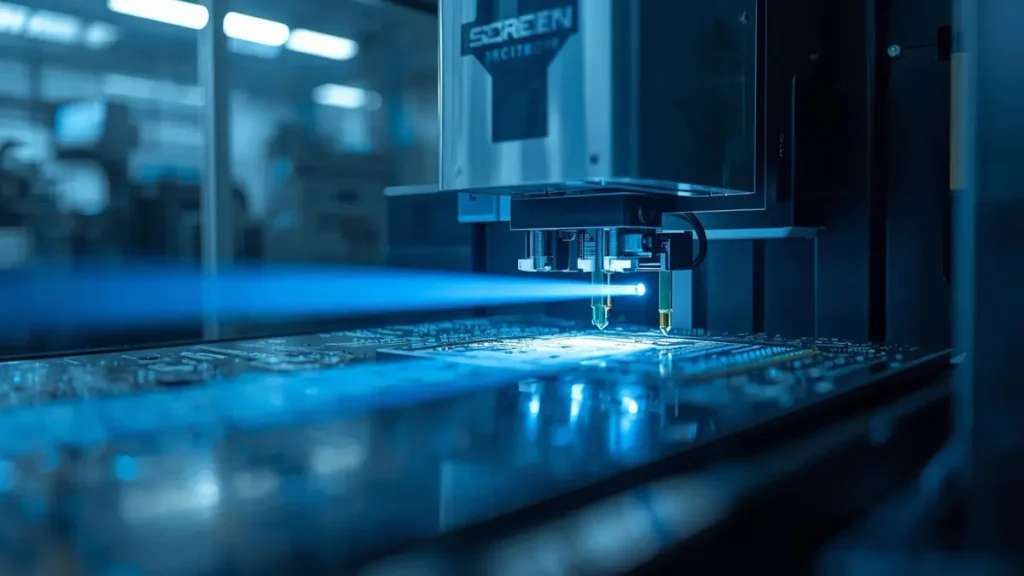
SCREEN Ledia LDI Exposure Machine for 24-Hour LED PCB Prototype Fabrication
Speed sells. Every fabricator claims fast turnaround. The difference lies in what happens after you upload your Gerber files.
A genuine 24 hour led pcb prototype service china requires three things most commodity fabs cannot offer: pre-stocked substrate materials, in-house direct imaging, and an engineering review that happens before the job hits the production floor. Without these, “24 hours” is a marketing number that gets revised the moment your design includes a non-standard dielectric thickness or a thermal via array that their drilling equipment cannot handle.
At Shenzhen Hongda Circuit Technology, our Baoan facility stocks aluminum core substrates from 1.0 W/m·K through 3.0 W/m·K thermal conductivity, standard FR-4 grades, and ceramic-filled high-Tg laminates. When your stack-up calls for a 2.0 W/m·K aluminum base with 2oz copper and a white solder mask, we do not pause production to source material. We pull it from inventory and route the panel to our SCREEN Ledia LDI Exposure Machine within the same hour. That is how a 24-hour commitment survives first contact with a real design.
Small Batch LED PCB Manufacturing: When 5pcs Sample Orders Make More Sense Than 100pcs
Engineering teams often over-order prototypes. They request 50 or 100 units “just in case,” then discover that 40 of them sit in a cabinet because the first five revealed a trace width error that required a respin.
Small batch led pcb manufacturing exists to prevent this waste. A properly scoped 5pcs led pcb sample order online should accomplish three goals: validate electrical connectivity, confirm thermal performance under operating load, and produce enough units for parallel testing (electrical, environmental, and optical). For most LED driver boards and aluminum-backed lighting modules, five to twenty units achieves this. Ordering one hundred only makes sense when you are running statistical process control studies or supplying multiple test labs.
Our production system accepts low volume led pcb production 5 to 100pcs without imposing setup fees or material surcharges. The same equipment that processes your five-piece aluminum LED prototype handles our 10,000-unit automotive lighting programs. No outsourcing. No third-party brokers. Your led pcb board sample supplier should be able to say the same—and prove it with a factory audit or video walkthrough.
Engineering Partnership Beyond the Purchase Order
The transactional model—upload Gerber, pay invoice, receive box—works for simple two-layer boards. It fails for LED applications where junction temperature, copper balancing, and dielectric breakdown voltage determine whether your product survives its warranty period.
A custom led pcb prototype service worth its quotation should include pre-production DFM feedback. At Shenzhen Hongda Circuit Technology, every led pcb prototype for lighting engineers undergoes an engineering review that checks thermal via density against your LED package datasheet, verifies copper weight compatibility with your current draw, and flags soldermask color choices that could affect reflectance in your optical assembly. This review typically turns around within 60 minutes of Gerber submission. It is not an upsell. It is quality insurance.
How We Deliver 24-Hour LED PCB Prototypes Without Cutting Corners
Buyers are right to be skeptical of 24-hour promises. The only way to honor them consistently is to remove the variables that cause delays: material procurement, engineering queries, and inspection bottlenecks.
Inside Our 2026 Equipment Line: SCREEN Ledia LDI and Mitsubishi UV/CO₂ Laser Drilling
Phototool-based exposure is the silent killer of quick-turn schedules. Film degradation, registration drift, and manual artwork handling add hours—or days—to jobs that cannot tolerate deviation. We eliminated this bottleneck entirely.
Our SCREEN Ledia LDI Exposure Machine images soldermask and etch resist directly from your digital files. No films. No alignment pins. No degradation between panels. For rapid led pcb fabrication, this means the first panel of your five-piece prototype receives the same dimensional accuracy as the hundredth panel of a production run. LDI also enables rapid layer-to-layer registration down to ±25 μm, which matters when your LED array uses 0.4 mm pitch packages and thermal vias must land precisely beneath the thermal pad.
For microvia formation—critical in multi-layer LED driver boards and COB substrates—we run Mitsubishi UV/CO₂ Laser Drilling systems capable of 0.075 mm microvias with positional accuracy that manual mechanical drilling cannot approach. When your design routes power and thermal management through blind vias under high-power LED footprints, this equipment determines whether your quick turn led pcb arrives functional or arrives scrap.
The Production Workflow That Actually Supports Rapid LED PCB Fabrication
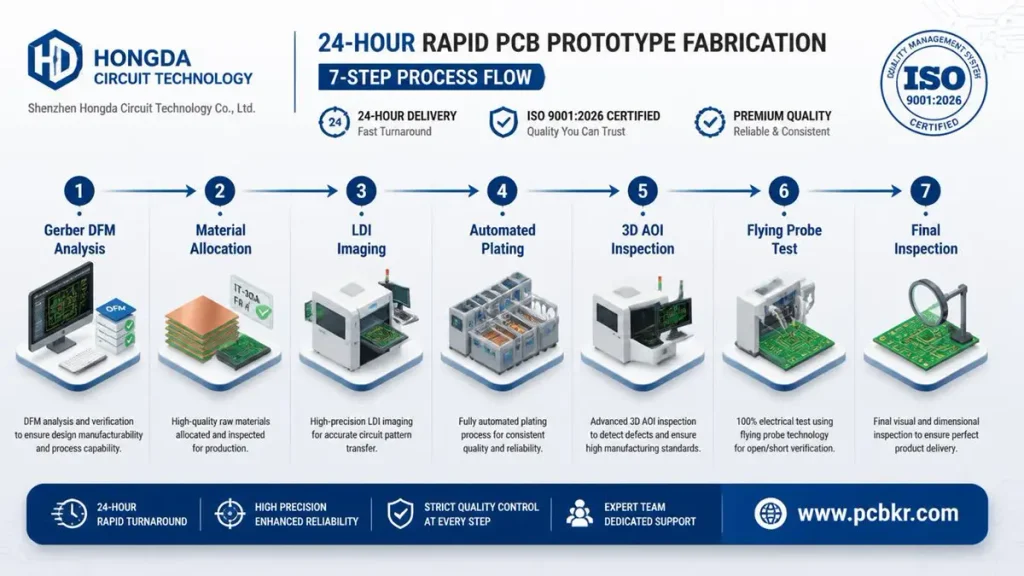
Shenzhen Hongda Circuit 24-Hour Rapid LED PCB Prototype Fabrication Process Flowchart
Speed without process control is just fast failure. Our workflow for fast led pcb sample with dfm review follows this sequence:
- Gerber intake and automated DFM screening (15 minutes): Our engineering software flags trace-to-pad clearances, annular ring violations, and thermal relief issues before a human engineer reviews the file.
- Material allocation and panelization (30 minutes): Pre-stocked aluminum or FR-4 substrates are pulled and panelized for our LAUFFER lamination system.
- LDI imaging and laser drilling (4–6 hours): Parallel processing on multiple machines prevents single-point delays.
- Plating and etching (6–8 hours): Our HX automated plating line maintains copper thickness within ±10% across the panel, monitored by real-time chemical analysis.
- Automated optical inspection (2 hours): 3D AOI catches opens, shorts, and solder mask defects before electrical test.
- Flying probe testing (1–2 hours): 100% electrical verification without fixture lead time.
- Final inspection and ship (2 hours): IPC-A-600 Class 3 visual standards, packed with test report.
This is not theoretical. It is the daily production reality for our quick turn led pcb manufacturer operations in Shenzhen.
Small Batch LED PCB Production: From 5pcs Validation to 100pcs Pre-Production
Not every prototype batch serves the same purpose. Understanding the difference between a five-piece first article and a hundred-piece pre-production run changes how you spec the job—and how much you pay.
Aluminum LED PCB Prototypes for High-Power Thermal Management
High-power LED designs—street lighting, automotive headlamps, industrial flood fixtures—live or die by thermal resistance. Standard FR-4 with a bolt-on heatsink is often the wrong starting point for a prototype because it masks the true thermal behavior of your final architecture.
An aluminum led pcb prototype built on a 1.5 mm aluminum core with thermally conductive dielectric (2.0–3.0 W/m·K) gives you data that translates directly to production. When we manufacture these prototypes, we match the copper weight (typically 2oz–4oz for power traces), thermal via array density, and dielectric thickness that your production design will use. This eliminates the surprise of discovering, at pilot-run stage, that your FR-4 prototype ran 30°C cooler than the aluminum production board will.
Our facility processes single-sided, double-sided, and multi-layer aluminum substrates. For automotive led pcb sample programs requiring thermal cycling validation, we maintain dedicated production lanes under IATF 16949 process controls.
FR-4 vs. Aluminum vs. Ceramic: Substrate Selection for Your LED PCB Sample
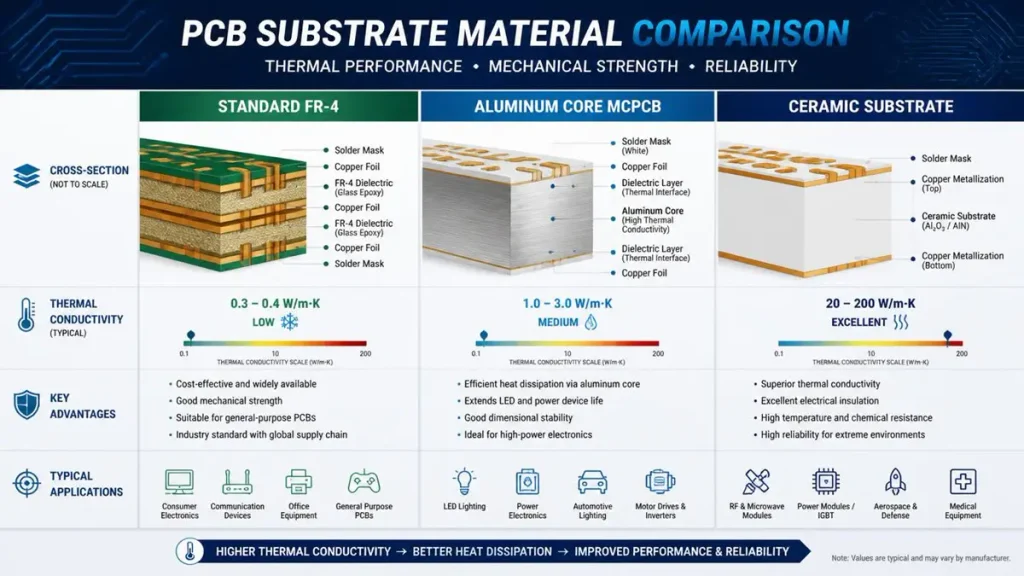
PCB Substrate Material Comparison: Standard FR-4 vs. Aluminum MCPCB vs. Ceramic Substrate
Procurement teams often inherit substrate decisions from engineering without questioning whether the prototype substrate matches the production intent. This is a costly assumption.
| Substrate | Best For | Thermal Conductivity | Prototype Cost Indicator |
|---|---|---|---|
| Standard FR-4 | Low-power indicator LEDs, signal boards | 0.3 W/m·K | Baseline |
| Aluminum MCPCB | General lighting, 1–10W LEDs, automotive | 1.0–3.0 W/m·K | Moderate premium |
| Ceramic (Al₂O₃/AlN) | UV LEDs, COB arrays, extreme power density | 24–170 W/m·K | Higher investment |
If your engineering team specifies aluminum for production but you prototype on FR-4 to save money, you are not saving money. You are buying a data set that does not predict production behavior. Our engineering team reviews every custom led pcb prototype service request to flag these mismatches before tooling begins.
LED PCB Testing and Validation Support That Protects Your NPI Investment
A prototype without validation data is a guess with copper layers. Procurement teams should treat testing not as an optional add-on, but as the primary deliverable of any led pcb prototype with testing engagement.
Electrical Testing Protocols: Flying Probe, Continuity, and Hi-Pot for LED Circuit Boards
Every led pcb sample that leaves our facility undergoes 100% electrical testing. For small batches, we use flying probe testers rather than bed-of-nails fixtures. The economics are straightforward: a fixture costs more than your five-piece prototype order. Flying probe testing verifies netlist continuity, isolation resistance, and short-circuit conditions without tooling overhead.
For LED driver boards with high-voltage sections, we add Hi-Pot testing (up to 3,000 VAC) to verify isolation between primary and secondary circuits. This is non-negotiable for UL-listed lighting products, and skipping it at the prototype stage means discovering a clearance violation during safety certification—a $50,000 mistake that a $50 test would have caught.
Thermal Performance Verification for Aluminum and Metal-Core LED PCBs
Electrical pass/fail data tells you whether the board works. It does not tell you whether it will survive 5,000 hours in a sealed fixture at 60°C ambient.
For led pcb thermal testing and validation, we offer infrared thermography mapping and thermocouple-based junction temperature measurement. When you send us your LED component specifications and operating current, our engineers can validate whether your thermal via array and copper spreading geometry keep junction temperature within the LED manufacturer’s rated limits. For aluminum substrate prototypes, we cross-section thermal vias to verify plating thickness and dielectric integrity—data points that procurement teams can archive for supplier qualification files.
Design Iteration and DFM Engineering: Closing the Prototype-to-Production Gap
The most expensive prototype is the one you build twice because the first version could not scale.
Pre-Tooling DFM Reviews That Eliminate Costly Respins
Our DFM review for every led pcb design iteration support engagement covers six failure modes we see repeatedly in LED designs:
- Insufficient thermal via density under high-power LED footprints (< 8 vias/cm² for >3W LEDs)
- Copper imbalance on aluminum substrates causing lamination warpage (>0.2 mm bow risks assembly failure)
- Trace width violations on long power feeds creating voltage drop and luminance variation across arrays
- Soldermask over thermal pads blocking heat transfer to the aluminum core
- Annular ring violations on microvias that compromise plating reliability
- White soldermask reflectance mismatched to optical assembly requirements
These reviews are completed within one hour of Gerber submission. They are not automated checklists. Our engineers apply IPC-2221, IPC-6012, and application-specific criteria (automotive thermal cycling, medical isolation) to flag issues that software alone cannot detect.
Multi-Revision LED PCB Prototype Support for Rapid Design Optimization
LED products rarely reach production on the first revision. Driver circuits get tweaked. LED binning changes. Thermal requirements shift when the industrial designer shrinks the housing.
Our led pcb prototype to production transition workflow maintains revision-controlled tooling and process parameters across iterations. When you submit Revision B two weeks after Revision A, we do not start from zero. We reference the DFM notes, material approvals, and test data from the first build, then highlight what changed and what risks those changes introduce. This discipline cuts typical iteration cycles from two weeks to four days.
Certifications and Quality Systems Procurement Teams Should Verify
A supplier’s equipment list means nothing without the quality infrastructure to control it. When you evaluate a led pcb board sample supplier, demand evidence of these systems.
IPC-6012 Class 3, ISO 13485, and IATF 16949: What They Mean for LED Projects
- IPC-6012 Class 3 / Class 3A: High-reliability requirements for products where failure is not acceptable. Automotive LED modules, medical surgical lighting, and aerospace cabin lighting fall here. We maintain Class 3 process controls on dedicated production lanes.
- ISO 13485: Medical device quality management. If your LED product targets surgical or diagnostic lighting, your supplier must demonstrate traceability from raw material lot to finished board serial number.
- IATF 16949: Automotive sector quality standard. This is not a checkbox. It requires statistical process control, defect containment, and customer-specific requirements integration—capabilities that separate automotive-grade suppliers from generalists.
- AS9100D: For LED applications in aerospace and defense, this certification governs risk management and configuration control.
Our certifications are audited and current. We provide certificate numbers and audit bodies upon request. Any supplier who hesitates to share this information should be removed from your AVL.
AI-Driven Process Control and Traceability on Every LED PCB Sample
In 2026, manual inspection alone is insufficient for the tolerances that modern LED designs demand. Our facility deploys AI-driven SPC process control on critical processes: plating thickness, impedance uniformity, and soldermask registration. The Nordson DAGE X-Ray Tester performs 3D void analysis on plated through-holes and microvias before they reach electrical test. XRF spectrometers verify gold and nickel thickness on ENIG finishes with NIST-traceable calibration.
For procurement teams, this means your led pcb sample arrives with documented evidence of conformance—not just a packing slip.
Frequently Asked Questions from LED PCB Buyers
How do I verify a quick turn LED PCB manufacturer can actually deliver in 24 hours?
Ask for their material stock list, not their marketing brochure. A real 24 hour led pcb prototype service china maintains pre-stocked aluminum substrates, high-Tg laminates, and common copper weights in-house. Request a video of their LDI imaging and laser drilling equipment in operation. If they rely on film exposure or mechanical drilling for prototype work, their 24-hour claim depends on everything going perfectly—which it rarely does. At Shenzhen Hongda Circuit Technology, we publish our equipment list and welcome virtual factory audits because our capability is verifiable, not theoretical.
What is the minimum order quantity for LED PCB prototypes, and is 5pcs enough for validation?
Five pieces is sufficient for most electrical and thermal validation workflows. You need one unit for cross-section analysis, two for parallel electrical testing, one for thermal profiling, and one reserve for destructive analysis or customer demonstration. Our 5pcs led pcb sample order online accepts quantities from 5 to 100 pieces without minimum order penalties. If your program requires statistical validation (Cpk studies, DOE analysis), we recommend 20–50 pieces. We will tell you when 5pcs is enough and when it is not—before you place the order.
Should I choose FR-4 or aluminum substrate for my LED PCB prototype?
If your production design uses aluminum, prototype on aluminum. FR-4 prototypes for aluminum production designs generate misleading thermal data and hide assembly issues like warpage or dielectric breakdown under high-temperature operation. For LED power levels below 1W per die, FR-4 is acceptable. Above 3W per die, aluminum led pcb prototype substrates are mandatory for meaningful validation. Our engineering team reviews your LED datasheet and current specifications to recommend the correct substrate before you commit to tooling.
What testing should I require from an LED PCB sample supplier before approving production?
At minimum: 100% electrical testing (flying probe or ICT), visual inspection to IPC-A-600 Class 2 or Class 3 depending on your end market, and dimensional verification of critical features. For aluminum LED boards, add thermal via cross-section and dielectric thickness verification. For driver boards with high-voltage sections, require Hi-Pot isolation testing. We provide a comprehensive test report with every led pcb prototype with testing shipment, including impedance coupons, microsection photographs, and thermal imaging data on request.
How do I manage design iterations when my LED PCB prototype needs multiple revisions?
The critical factor is revision control and DFM continuity. Your supplier should maintain a living file of DFM notes, material approvals, and process parameters from Revision A through Revision N. When you submit Revision B, the engineering review should explicitly address what changed and whether those changes introduce new manufacturability risks. Our led pcb design iteration support includes revision-controlled tooling and a dedicated engineering contact who tracks your project history. This prevents the “start from zero” problem that turns a two-day engineering review into a two-week delay.
Ready to Validate Your LED Design? Start With a Supplier That Engineers Before Manufacturing
The procurement decision for led pcb prototype and quick turn led pcb services is not a price comparison. It is a capability verification. At Shenzhen Hongda Circuit Technology Co., Ltd., we manufacture LED PCB prototypes on the same equipment that builds our 224G PAM4 backplanes and automotive radar substrates—because precision is not a function of volume.
Upload your Gerber files to sales@pcbkr.com for a complimentary DFM review and detailed quotation. Our engineering team responds within 60 minutes during Shenzhen business hours. For complex thermal or substrate requirements, request an Engineer Consultation and we will schedule a technical call within 24 hours.
Company: Shenzhen Hongda Circuit Technology Co., Ltd.
Website:www.pcbkr.com
Email:sales@pcbkr.com | pcb@pcbkr.com
Phone: +86 0755 23720053
Address: Room 1608-1610, Research Development Comprehensive Building, Baoyunda Logistics Center, Baoan, Shenzhen, China
Certifications: ISO 9001:2026 | AS9100D | IPC-6012 Class 3/3A | ISO 13485 | IATF 16949
Unified Social Credit Code: 91440300MA5F6CA091
About Author
David Chen https://www.linkedin.com/in/pcbcoming
David Chen boasts an extensive professional background in PCBA manufacturing, PCBA testing, and PCBA optimization, with specialized expertise in high-precision PCBA fault analysis and rigorous PCBA reliability testing. The author has worked with high-layer-count server PCB fabrication, ultra-low-loss backplane stackups, and thermo-mechanical reliability optimization for AI infrastructure projects involving 112G and 224G PAM4 architectures. Skilled in complex circuit design and cutting-edge advanced PCB manufacturing processes, he delivers solutions that elevate product durability and performance across industrial applications. His technical articles focusing on PCBA manufacturing workflows and testing methodologies are widely cited by industry peers, research institutions, and technical platforms, solidifying his reputation as a recognized technical authority in the global circuit board manufacturing sector.