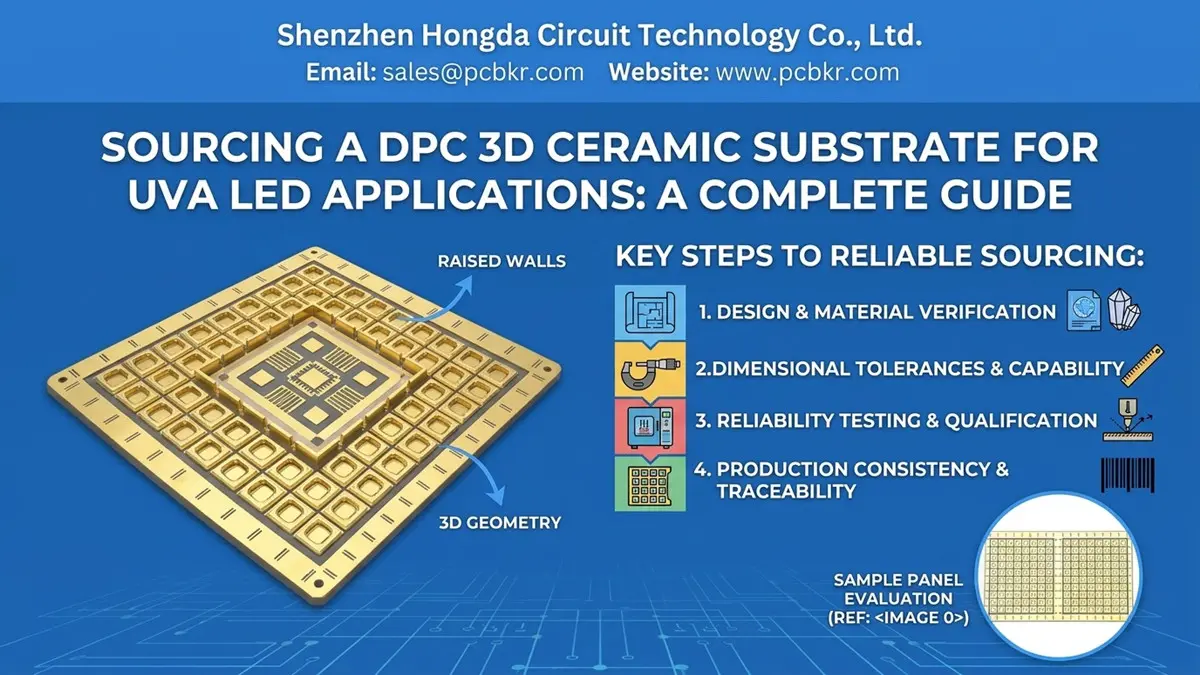
How Do You Source a DPC 3D Ceramic Substrate for UVA LED Applications?
A DPC 3D ceramic substrate for UVA LED applications must combine suitable ceramic material, precisely patterned copper, controlled three-dimensional geometry, and reliable thermal and electrical performance. Choosing the right manufacturer requires more than comparing material specifications: buyers should verify design feasibility, dimensional tolerances, metallization quality, inspection methods, and production consistency before approving samples or placing a volume order.
For OEMs developing UVA LED modules, optical devices, and high-power UV systems, the most effective sourcing process starts with a complete engineering drawing and a supplier review based on measurable acceptance criteria. PCBKR supports ceramic PCB and AlN substrate project evaluation through its DPC ceramic PCB and AlN prototype manufacturing page.
What Defines a DPC 3D Ceramic Substrate for UVA LEDs?
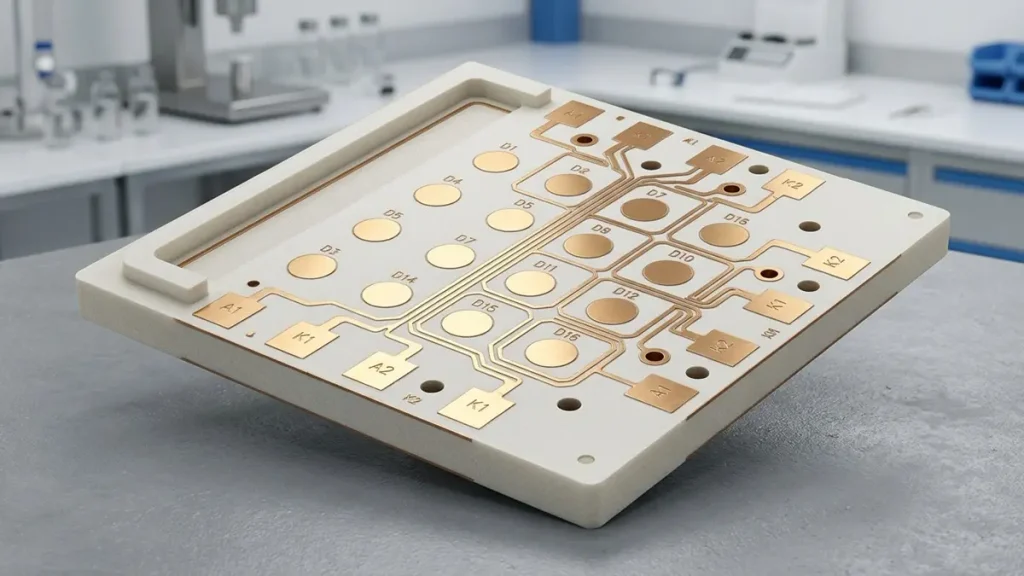
DPC 3D Ceramic Substrate for UVA LED Packaging
A DPC (Direct Plated Copper) ceramic substrate combines a ceramic insulating base with patterned copper conductors formed through a direct metallization process. In a three-dimensional package, the design may also include raised walls, dams, stepped surfaces, or other features that help define the package geometry.
For UVA LED applications, the substrate is part of the thermal, electrical, mechanical, and optical package—not simply a circuit carrier. Its geometry and surface quality can affect die attachment, interconnection, encapsulation, and heat transfer.
Buyers should distinguish three requirements before requesting a quotation:
- Electrical requirements: conductor layout, pad dimensions, isolation spacing, current paths, and connection interfaces.
- Thermal requirements: heat flow from the LED junction through the die attach, metallization, ceramic body, and downstream cooling structure.
- Packaging requirements: dam geometry, mounting height, flatness, edge quality, and compatibility with the intended assembly process.
The term “3D ceramic substrate” does not identify one universal manufacturing specification. A supplier must review the actual geometry, copper pattern, material, and tolerance requirements to determine feasibility.
How Should Buyers Select the Ceramic Material and DPC Metallization Process?
Aluminum nitride (AlN) and alumina are common ceramic substrate candidates, but they serve different thermal and cost requirements. AlN is frequently considered for high-power packages because of its relatively high thermal conductivity, while alumina may be suitable where thermal demands, electrical insulation, mechanical requirements, and budget permit.
The correct choice depends on the complete package design rather than thermal conductivity alone.
| Selection factor | What buyers should confirm |
|---|---|
| Ceramic material | AlN, alumina, or another specified ceramic; grade and supplier data |
| Thermal conductivity | Material grade, test method, and relevant operating temperature |
| Ceramic thickness | Nominal thickness, tolerance, flatness, and mechanical constraints |
| Copper pattern | Trace width, spacing, pad geometry, and copper thickness |
| Metallization adhesion | Required acceptance criteria and agreed verification method |
| Electrical insulation | Operating voltage, creepage and clearance requirements, and test conditions |
| Surface finish | Compatibility with die attach, soldering, wire bonding, or other assembly processes |
DPC is often considered when a design needs patterned copper and relatively fine circuit features on a ceramic base. However, suitability depends on the supplier’s actual process capability, design rules, and the specified copper thickness and geometry.
Do not compare DPC and DBC solely by their process names. DBC may be preferred for some thicker-copper or high-current applications, while DPC may suit other circuit-pattern and packaging requirements. The final decision should be based on the drawing, current density, thermal path, feature dimensions, and reliability requirements.
For an initial supplier review, see PCBKR’s DPC ceramic PCB and AlN prototype manufacturing capabilities. Share your drawing and technical requirements so the proposed material and process can be evaluated against the intended application.
Which Dimensions and Tolerances Must Be Confirmed Before Production?
Three-dimensional ceramic packages require coordinated control of the ceramic body, copper features, and any raised or stepped structures. A nominal dimension alone is insufficient when the substrate must fit an LED die, optical package, housing, or automated assembly fixture.
Before approving a quotation, buyers should identify the dimensions that directly affect assembly and performance.
Critical dimensions to specify include:
- Overall length, width, and ceramic thickness
- Copper pattern dimensions, including trace width and spacing
- Die-attach pad size, position, and alignment reference
- Dam height, width, corner geometry, and positional tolerance, if applicable
- Flatness, coplanarity, and surface-height requirements
- Edge quality and allowable chipping
- Hole, notch, step, or other 3D feature dimensions
- Copper thickness and surface-finish requirements
- Datum scheme and measurement method
Tolerances should reflect functional needs and demonstrated process capability. Overly tight tolerances can increase manufacturing cost, inspection effort, and scrap risk without improving the finished device.
For example, a dam-height tolerance may be important when controlling encapsulant volume, while pad position and flatness may be more critical to die attachment. The drawing should identify which characteristics are critical to quality rather than assigning the tightest tolerance to every dimension.
For custom 3D DPC substrates, request a design-for-manufacturing (DFM) review before tooling or production approval. The review should identify features that may need modification, clarify measurement references, and confirm whether the proposed tolerances can be inspected consistently.
How Can Thermal Performance and UVA LED Package Reliability Be Evaluated?

UVA LED Ceramic Substrate Thermal Performance Evaluation
Thermal performance depends on the complete heat-transfer path, not on the ceramic material’s conductivity value in isolation. Heat must travel from the LED junction through the die attach, copper features, ceramic substrate, interface materials, and cooling assembly.
A substrate with high-conductivity ceramic may still underperform if the die-attach layer, contact area, interface flatness, or downstream cooling design introduces excessive thermal resistance.
When evaluating a proposed substrate, buyers should confirm:
- The expected operating power and thermal boundary conditions.
- The ceramic material grade and relevant thermal data.
- The die-attach method, contact area, and interface requirements.
- The substrate’s mounting interface and the intended cooling arrangement.
- The thermal measurement method and acceptance criteria for the assembled product.
Reliability evaluation should also reflect the actual application. Depending on the product, the qualification plan may address thermal cycling, temperature exposure, copper adhesion, electrical insulation, solderability, ceramic integrity, and assembly-related damage.
These tests are not interchangeable. A supplier’s material data sheet does not prove that a completed package will pass the customer’s operating-life requirements. Likewise, a successful initial sample inspection does not automatically establish long-term reliability.
Before ordering, agree on the test method, sample size, acceptance limits, reporting format, and responsibility for each test. If system-level UVA output, optical uniformity, or lifetime is a requirement, define whether it will be validated by the substrate supplier, the package assembler, or the final product manufacturer.
What Quality Evidence Should a DPC Ceramic Substrate Supplier Provide?
A credible supplier qualification process should establish whether the manufacturer can interpret the design, control the relevant process steps, inspect critical features, and provide traceable evidence. A general statement that a factory has “advanced equipment” is not enough.
Ask the supplier to provide evidence appropriate to the project, such as:
- A DFM review identifying critical dimensions and manufacturability risks
- Material identification and applicable material data
- An agreed inspection plan for ceramic dimensions, copper patterns, and 3D features
- Dimensional inspection results for critical-to-quality characteristics
- Copper adhesion or other metallization verification when required by the specification
- Electrical insulation results where applicable
- A defined method for evaluating ceramic cracks, chips, and surface defects
- Lot identification and material traceability
- Documented handling of nonconforming products and engineering changes
- Sample approval criteria and controls for subsequent production lots
For a custom 3D structure, buyers should also ask how the supplier measures the geometry. A feature can be difficult to control consistently if the drawing does not specify its datum, inspection location, or measurement method.
Where production volume is expected to increase, request a clear explanation of how the approved sample will be translated into repeatable production. The supplier should identify which process parameters and inspection records will be controlled and what happens when a material, design, or process change is proposed.
Only accept certifications, test reports, and performance claims that can be verified and that apply to the relevant manufacturing site, product, or process.
What Determines Custom DPC Ceramic Substrate Cost and Lead Time?
The price of a custom DPC 3D ceramic substrate depends on the complete manufacturing specification. Two substrates with similar outside dimensions can have significantly different costs if their materials, copper patterns, 3D features, tolerances, inspection requirements, or expected yields differ.
The main cost and lead-time factors include:
| Factor | Potential effect on cost or schedule |
|---|---|
| Ceramic material and grade | Material availability, cost, and procurement time |
| Substrate size and thickness | Material usage and processing requirements |
| Copper pattern complexity | Process difficulty, yield, and inspection effort |
| Copper thickness and fine features | Metallization requirements and process constraints |
| 3D dam or stepped geometry | Additional process steps and dimensional-control needs |
| Tight tolerances | More demanding process control and measurement |
| Surface finish and assembly interface | Additional process or compatibility requirements |
| Qualification and testing | Sample preparation, test time, and documentation |
| Order quantity | Setup allocation, material purchasing, and production planning |
| Packaging and handling | Protection against contamination, chipping, or damage |
A low unit price is not necessarily the lowest total procurement cost. A substrate that requires repeated rework, causes assembly failures, or arrives with inconsistent dimensions can create higher costs downstream.
For a meaningful comparison, ask suppliers to quote against the same drawing revision, material grade, copper specification, tolerance set, inspection plan, and order quantity. Request separate clarification for tooling or setup charges, sample costs, recurring unit price, qualification costs, and shipping assumptions.
Lead time should be confirmed for the specific project. Material availability, design approval, process development, sample inspection, and customer qualification may all affect the schedule. Avoid relying on a generic lead-time promise before the supplier has reviewed the complete specification.
How Should Buyers Prepare an RFQ for a Custom UVA LED Ceramic Substrate?
A complete request for quotation (RFQ) helps suppliers assess feasibility and reduces the risk of receiving prices based on different assumptions. The most useful RFQ includes a dimensioned drawing, material requirements, functional context, quality criteria, and a clear production forecast.
RFQ checklist
- 2D engineering drawing and, if available, a 3D CAD model
- Ceramic material and grade, or permission to propose alternatives
- Overall dimensions and ceramic thickness
- Copper layout, thickness, trace width, spacing, and pad details
- Dam, wall, step, or other 3D geometry, including critical tolerances
- Intended UVA LED package configuration and assembly method
- Operating power, thermal conditions, and electrical requirements
- Surface finish and die-attach or interconnection requirements
- Inspection criteria, required tests, and reporting expectations
- Prototype quantity, initial production quantity, and annual demand estimate
- Target sample date and production schedule
- Packaging, handling, and traceability requirements
If some specifications are not yet fixed, identify them as open items rather than leaving them ambiguous. A supplier can then flag assumptions, propose feasible options, and identify the information needed before a firm quotation.
For PCBKR supplier evaluation, start with the existing DPC ceramic PCB and AlN prototype manufacturing page. Submit the drawing, target quantity, material preference, and critical requirements for a project-specific review. Any specialized 3D geometry or UVA LED packaging requirement should be confirmed against the actual design before manufacturing capability or delivery commitments are made.
Frequently Asked Questions About Sourcing DPC 3D Ceramic Substrates for UVA LEDs
How Do I Choose a Reliable DPC Ceramic Substrate Manufacturer?
Choose a manufacturer that can review your drawing, explain the proposed process, identify critical tolerances, and provide relevant inspection and material records. Before approving mass production, agree on sample acceptance criteria, traceability, change control, and the evidence required to demonstrate repeatability. Ask for project-specific capability confirmation rather than relying only on general marketing claims.
Is AlN Better Than Alumina for UVA LED Ceramic Substrates?
AlN is often considered when high thermal conductivity is a major design requirement. Alumina may be suitable for applications with less demanding thermal needs or different cost and mechanical priorities. The best material depends on power dissipation, package construction, electrical insulation, mechanical constraints, and the complete cooling path. Compare material grades and relevant data rather than relying on the material name alone.
What Information Is Needed for a Quote for a Custom 3D DPC Ceramic Substrate?
Provide a dimensioned drawing or 3D model, ceramic material and thickness, copper layout and thickness, critical tolerances, 3D feature dimensions, surface-finish requirements, inspection criteria, and expected quantities. Include the intended assembly method and operating conditions where they affect design feasibility. If some details are undecided, identify them so the supplier can list assumptions and open technical questions.
How Can I Verify Copper Adhesion and Thermal Reliability Before Mass Production?
Define the required verification method and acceptance criteria before sample production. Depending on the application, the qualification plan may include metallization adhesion evaluation, thermal cycling, electrical insulation checks, dimensional inspection, and assembly trials. Ask for results tied to the relevant sample or production lot. The test methods and limits should be agreed by both parties; one test alone cannot establish every aspect of long-term reliability.
What Affects the Price and Lead Time of a UVA LED DPC Ceramic Substrate?
The main factors include ceramic material, substrate dimensions, copper thickness and pattern complexity, 3D geometry, tolerance requirements, surface finish, inspection and qualification needs, order quantity, and material availability. To compare quotations fairly, use the same drawing revision and acceptance criteria for each supplier. Request separate clarification of sample costs, setup charges, unit pricing, qualification activities, and delivery assumptions.
Request a DPC Ceramic Substrate Engineering Review
If your UVA LED project requires a custom AlN ceramic substrate, fine copper circuitry, or a three-dimensional package structure, begin with a drawing-based feasibility review rather than a price comparison alone.
Send your engineering drawing or CAD file, material preference, expected quantity, critical dimensions, and quality requirements to sales@pcbkr.com. PCBKR can review the information provided and clarify which requirements need further technical validation before a quotation or manufacturing commitment is made.
Visit the DPC ceramic PCB and AlN prototype manufacturing page to begin the discussion.
About Author
David Chen LinkedIn Profile
David Chen is a Senior RF/PCB Process Engineer at Shenzhen Hongda Circuit Technology Co., Ltd., with over 12 years of experience in high-frequency PCB fabrication, impedance-controlled stack-up design, and Rogers/PTFE laminate processing. He also boasts an extensive professional background in PCBA manufacturing, PCBA testing, and PCBA optimization, with specialized expertise in high-precision PCBA fault analysis and rigorous PCBA reliability testing. The author has worked with high-layer-count server PCB fabrication, ultra-low-loss backplane stackups, and thermo-mechanical reliability optimization for AI infrastructure projects involving 112G and 224G PAM4 architectures. Skilled in complex circuit design and cutting-edge advanced PCB manufacturing processes, he delivers solutions that elevate product durability and performance across industrial applications. His technical articles focusing on PCBA manufacturing workflows and testing methodologies are widely cited by industry peers and technical platforms, and have gained attention and recognition from industry colleagues.