Washing Machine PCBA: How to Choose the Right OEM Manufacturing Partner?
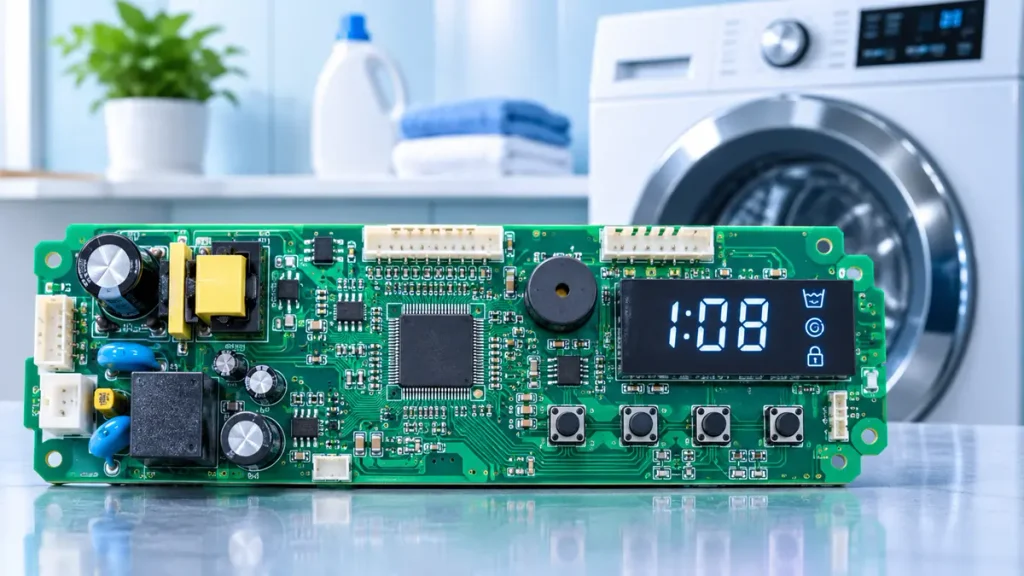
Base Material: FR-4, High-Tg FR-4 (as required)
Number of Layers: 2–6 Layers
Board Thickness: 1.0–2.0 mm
Copper Thickness: 1–3 oz
Min. Trace Width: 0.10 mm
Min. Trace Spacing: 0.10 mm
Min. Hole Size: 0.20 mm
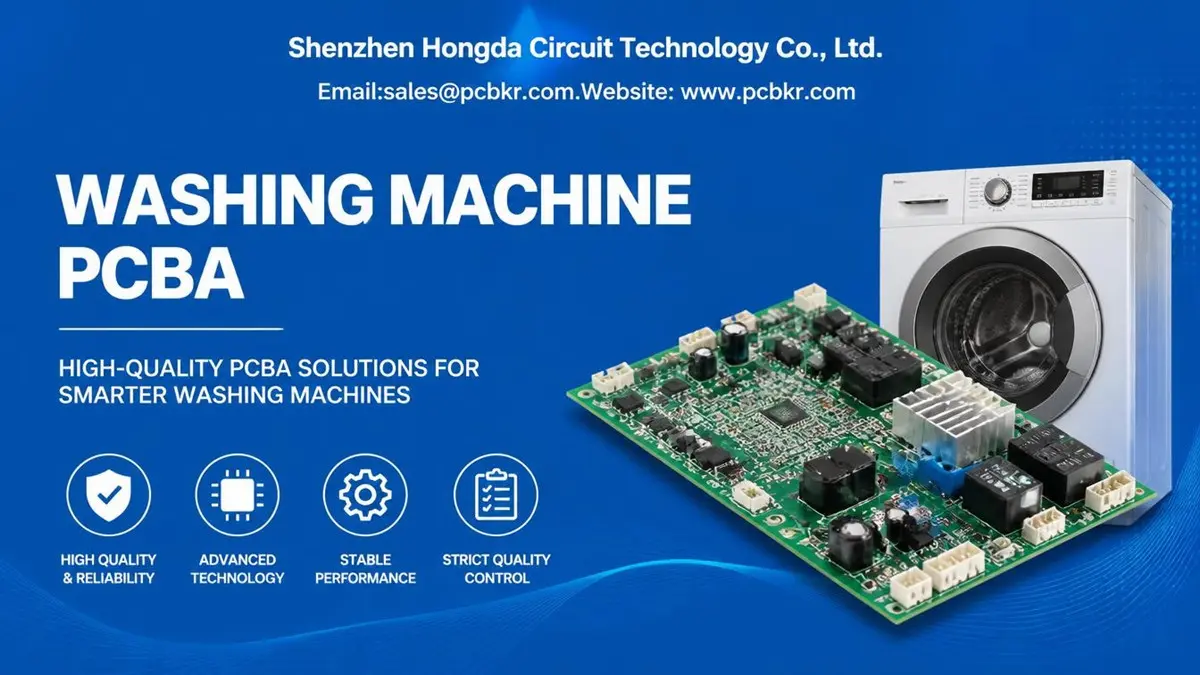
Washing machine PCBA manufacturing requires reliable PCB fabrication, SMT and THT assembly, and controlled inspection for electronic boards operating in humid, vibration-prone environments. Hongda Circuit supports OEM customers with PCB fabrication and PCBA assembly, from prototype and small batches to volume production. For a project quotation, contact sales@pcbkr.com or visit www.pcbkr.com.
For a broader overview of our PCB fabrication and PCBA assembly services across different appliance categories, visit our home appliance control board PCBA manufacturing page.
Washing Machine PCBA Manufacturing for OEM Applications
A washing machine control board is not simply a general-purpose electronic assembly. It must operate reliably while controlling electrical loads, receiving sensor signals, and communicating with other functional modules inside an appliance exposed to moisture, temperature changes, and mechanical vibration.
For OEM manufacturers, the quality of a washing machine PCBA depends on more than component placement and soldering. PCB material selection, copper design, connector reliability, assembly consistency, component availability, and inspection requirements all influence production performance.
Hongda Circuit provides PCB fabrication and PCBA assembly for washing machine control board projects. Depending on the customer’s product architecture and production requirements, the manufacturing scope can include:
- PCB fabrication based on approved Gerber data and manufacturing specifications.
- SMT assembly for surface-mount components.
- THT assembly for through-hole components and connectors.
- PCB and component procurement according to the approved BOM and sourcing scope.
- AOI, X-ray, and electrical inspection where applicable to the assembly.
- Project-specific functional testing when the customer provides the test requirements, procedures, or agreed test specifications.
- Prototype, pilot production, and volume manufacturing support.
The manufacturing scope is agreed during technical review and quotation. Firmware programming and functional testing can be discussed as project-specific options rather than assumed to be included in every PCBA order.
For OEM buyers comparing suppliers, the key question is whether the manufacturer can control the complete PCB and assembly process against the approved technical documentation—not simply whether it has an SMT production line.
What Types of Washing Machine Control Boards Can Be Manufactured?
A washing machine may use several electronic boards, depending on its control architecture, motor technology, and user-interface configuration. These boards have different electrical functions and assembly requirements.
| Board type | Main function | Manufacturing considerations |
|---|---|---|
| Main control board | Coordinates washing programs, operating sequences, and peripheral control | Mixed signal circuits, power supply, connectors, and control interfaces |
| Motor control board | Controls motor operation and drive-related functions | Power components, current paths, thermal management, and electrical isolation |
| Display and user-interface board | Handles buttons, indicators, displays, and user input | Fine-pitch components, connectors, LEDs, and interface consistency |
| Power supply board | Converts incoming power into required operating voltages | Power components, insulation requirements, heat dissipation, and solder quality |
| Sensor interface board | Connects and processes signals from sensors and switches | Signal integrity, connector reliability, and noise control |
Not every washing machine uses separate boards for these functions. Some designs integrate the main controller, power supply, and motor-control circuits on one PCB, while others use multiple interconnected assemblies.
This distinction matters when preparing an RFQ. A supplier should evaluate the actual circuit design, component list, PCB layout, and test requirements instead of quoting against the generic description “washing machine control board.”
Use genuine PCBKR production photographs and identify the board type accurately. Do not label a general control board as a motor inverter board unless the actual project confirms that function.
What Manufacturing Requirements Matter Most for Washing Machine PCBA?
Washing machine PCB assemblies combine low-voltage control circuits with power-related circuits and external connections. Their manufacturing requirements should therefore be reviewed according to the actual circuit function and operating environment.
High-voltage and power-circuit assembly
Power-related sections may contain switching devices, rectification components, transformers, relays, and other components that carry significant electrical loads.
The manufacturing review should consider:
- PCB copper thickness and current-carrying requirements.
- Trace width and spacing specified by the approved design.
- Creepage and clearance requirements in high-voltage areas.
- Solder joint quality for power components and connectors.
- Component polarity and orientation.
- Thermal conditions around power devices.
- Connector and terminal retention requirements.
A PCB assembler should not independently change creepage distances, trace dimensions, or component specifications to reduce cost. Such changes require engineering review and customer approval.
Mixed SMT and THT assembly
Washing machine control boards may combine surface-mount components with through-hole connectors, terminals, relays, transformers, and other mechanically demanding parts.
The production process must account for the actual component mix and assembly sequence.
SMT process control includes solder paste printing, component placement, reflow profile management, and inspection. THT assembly requires attention to hole dimensions, lead insertion, solder filling, polarity, and the mechanical stability of larger components.
Where SMT and THT processes are both required, the assembly plan should define:
- Which components are assembled through SMT.
- Which components require THT or selective soldering.
- Whether manual soldering is required for specific parts.
- Which components need additional mechanical inspection.
- How the completed assembly will be inspected and tested.
The correct process depends on the PCB layout, component package types, and customer specifications.
Connector and terminal reliability
Connectors are often the interface between the control board and motors, sensors, pumps, valves, door-lock systems, and other appliance components.
Incorrect connector orientation, insufficient solder filling, poor mechanical support, or inconsistent component placement can create assembly defects that may not be detected by a simple visual check.
For OEM projects, connector part numbers, pin definitions, polarity, insertion direction, and mechanical requirements should be included in the controlled production documentation.
How Should PCB Fabrication Be Controlled for Washing Machine Control Boards?
PCB fabrication determines the foundation on which the complete assembly is built. A board may pass basic electrical testing but still create assembly or reliability problems if its dimensions, material properties, surface finish, or copper features do not match the approved design.
The fabrication review should cover the following areas.
| PCB specification | Why it matters |
|---|---|
| Base material and Tg | Must match the design’s thermal and mechanical requirements |
| Layer count | Determines routing structure and electrical connectivity |
| Board thickness | Affects mechanical fit, connector mounting, and assembly compatibility |
| Copper thickness | Influences current-carrying capacity and thermal behavior |
| Minimum trace and spacing | Must match the design and fabrication capability |
| Minimum finished hole size | Affects component lead fit and plated-through-hole reliability |
| Surface finish | Must be compatible with component solderability and assembly requirements |
| Board outline and tolerances | Determines mechanical compatibility with the appliance enclosure |
| Solder mask and legend | Supports insulation, identification, and assembly orientation |
A quotation should not use generic assumptions for these parameters. The actual requirements must be taken from the Gerber files, fabrication drawing, stack-up, and customer specifications.
For example, a control board with high-current output paths may require different copper and thermal considerations from a low-voltage display board. Similarly, a multilayer design with controlled impedance requirements should be reviewed differently from a conventional two-layer control PCB.
For projects involving more complex embedded control architecture, see our broader embedded control board OEM manufacturing capabilities.
How Do Moisture, Condensation, and Corrosion Affect Washing Machine PCBA Reliability?
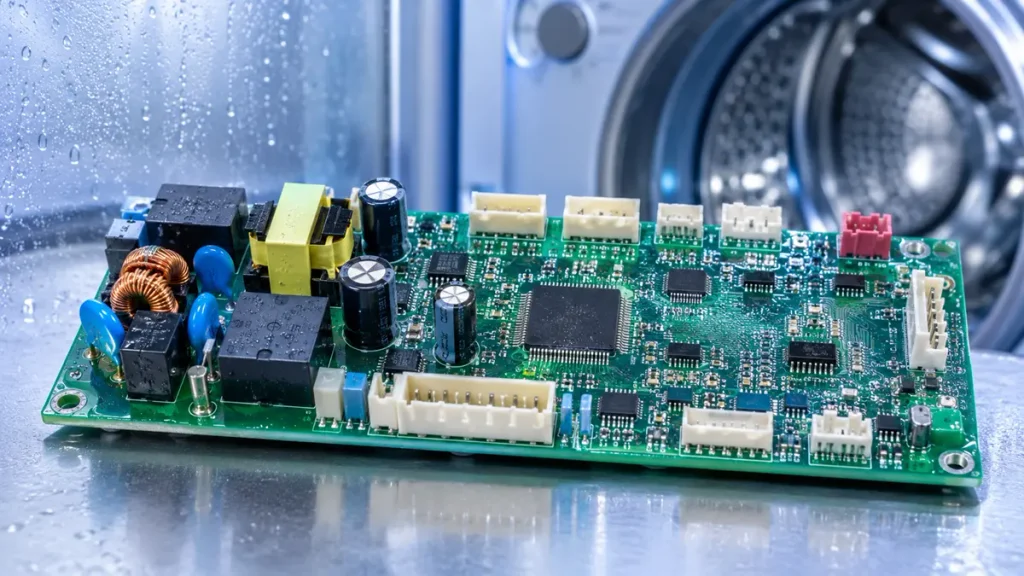
Washing Machine PCBA Moisture and Corrosion Protection
Moisture exposure is an important consideration in washing machine electronics. Although the PCB assembly is normally installed inside the appliance, its operating environment may involve humidity, temperature variation, condensation, detergent-related contamination, and exposure to moisture through the enclosure or cable interfaces.
Moisture can affect PCB insulation properties and contribute to corrosion or electrical leakage under unsuitable conditions. IPC technical material also identifies moisture absorption as a factor that can influence PCB electrical, thermal, and mechanical performance. electronics.org
For OEM manufacturers, the appropriate response is not automatically to apply conformal coating to every board. Protection requirements should be determined by the product environment, enclosure design, circuit voltage, component selection, and customer reliability specifications.
Conformal coating and protection requirements
Conformal coating may help protect an assembly against environmental contamination when correctly selected and applied. However, coating introduces additional process considerations.
Before specifying coating, the engineering team should clarify:
- Which PCB areas require protection.
- Whether connectors and contact surfaces must remain uncoated.
- Whether test points need to remain accessible.
- Which coating material is approved.
- Required coating thickness and coverage.
- Whether masking is needed around sensitive components.
- How coating inspection and rework will be handled.
Potting and encapsulation are more restrictive than conformal coating. They can affect heat dissipation, repairability, and component replacement. They should only be included when the product design and customer specifications require them.
Do not use generic factory coating photographs as proof that a particular washing machine board has received the process.
How Does Hongda Circuit Control SMT and THT Assembly Quality?
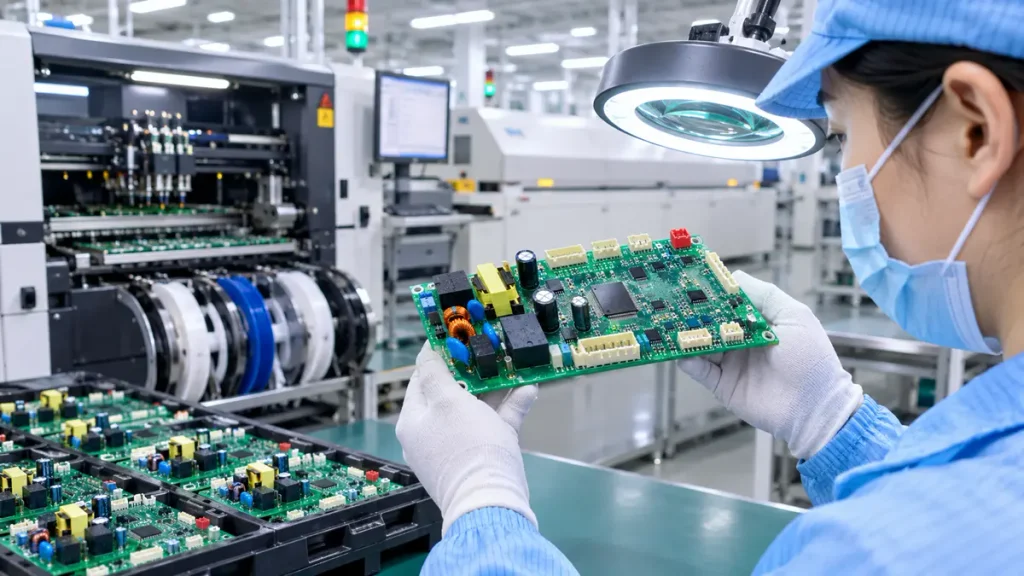
Washing Machine PCBA SMT and THT Assembly Quality Control
Assembly quality depends on consistent control of the process parameters and inspection criteria specified for the product.
For washing machine PCBA projects, the production process may include:
- Incoming PCB and component verification.
- Solder paste printing and inspection.
- SMT component placement.
- Reflow soldering.
- THT component insertion and soldering.
- Visual and automated inspection.
- Electrical inspection where required.
- Functional testing according to the agreed project scope.
- Final inspection and packaging.
The exact sequence depends on the board design and assembly technology.
Inspection methods and their limitations
Different inspection methods detect different types of defects. Buyers should avoid treating AOI, X-ray, electrical testing, and functional testing as interchangeable services.
| Inspection method | What it can help identify | Important limitation |
|---|---|---|
| AOI | Component presence, placement, polarity, visible solder defects | Cannot verify every hidden solder joint or circuit function |
| X-ray | Hidden solder connections, such as applicable leadless or BGA joints | Does not replace functional testing |
| Flying probe / electrical test | Opens, shorts, and specified electrical connectivity | Does not prove the complete appliance operating sequence |
| ICT | Electrical characteristics at accessible test points, depending on fixture and coverage | Requires suitable test-point access and fixture development |
| Functional test | Board behavior against an agreed test procedure | Coverage depends on the test fixture, software, loads, and customer-defined acceptance criteria |
The inspection plan should be agreed before production. For example, an AOI inspection may be appropriate for checking component placement, while X-ray may be considered for packages with hidden solder connections.
Functional testing requires a separate discussion. A manufacturer needs the appropriate test procedure, fixture, firmware or test software, and acceptance limits to verify the functions that the customer expects.
A board-level electrical inspection should not be described as a complete washing machine system test.
Only show equipment and test processes that are actually available and relevant to the quoted project.
How Should OEM Buyers Manage BOM Obsolescence and Component Substitutions?
Component availability is a long-term manufacturing concern for washing machine OEM programs. A control board may remain in production for years, while semiconductor, power, relay, connector, and passive component availability can change during that period.
A component substitution that appears electrically similar may still affect:
- Electrical ratings and operating margins.
- Package dimensions and PCB footprint compatibility.
- Thermal performance.
- Switching characteristics.
- Soldering process requirements.
- Regulatory or customer qualification requirements.
- Firmware compatibility or circuit behavior.
For this reason, component substitution should be treated as a controlled engineering change, not an informal purchasing decision.
A practical BOM management process should include:
1. Approved component identification
The BOM should identify manufacturer part numbers, descriptions, package types, and approved alternatives where applicable.
2. Component availability review
The purchasing team should identify potential supply risks, lead-time concerns, and parts with limited sourcing options.
3. Alternative component evaluation
Any proposed substitute should be reviewed against electrical specifications, package compatibility, circuit function, and customer requirements.
4. Customer approval
Changes affecting the approved BOM should be submitted for customer review and approval before implementation.
5. Revision control
The approved BOM, Gerber data, pick-and-place file, assembly drawings, and test documents should carry consistent revision information.
For OEM buyers, this process reduces the risk of receiving assemblies produced with undocumented component changes.
How Does Washing Machine PCBA Move from Prototype to Mass Production?
A successful prototype does not automatically guarantee consistent mass production. The transition requires a controlled process for reviewing design data, confirming assembly methods, checking inspection coverage, and managing production revisions.
A typical OEM manufacturing workflow includes the following stages.
OEM PCBA manufacturing workflow
- RFQ and technical reviewReview Gerber files, BOM, PCB specifications, assembly drawings, quantities, and testing requirements.
- Engineering and sourcing reviewCheck PCB manufacturability, component availability, assembly requirements, and any open technical questions.
- Prototype manufacturingBuild initial samples using the approved design data and agreed process requirements.
- First article and pilot buildReview assembly quality, inspection results, and any agreed functional test results before volume release.
- Mass productionManufacture against the approved revisions, BOM, process instructions, and inspection criteria.
- Final inspection and deliveryComplete the agreed quality checks, confirm quantity and packaging requirements, and prepare shipment.
For each stage, OEM buyers should define the required deliverables. These may include first-article inspection records, material information, electrical test results, functional test records, or production traceability documents.
The exact documentation depends on the customer’s quality system and purchase requirements.
How Should Buyers Evaluate a Washing Machine PCBA Manufacturer?
Choosing a supplier based only on unit price can create additional costs during engineering changes, production ramp-up, and long-term procurement.
A more useful supplier evaluation compares technical capability, production control, quality evidence, and communication.
| Supplier evaluation point | What OEM buyers should verify |
|---|---|
| PCB fabrication | Material, layer count, copper thickness, dimensional tolerance, and surface finish |
| SMT/THT capability | Whether the supplier can assemble the actual component mix |
| Component sourcing | Approved sources, traceability, lead-time management, and substitution approval |
| Inspection capability | AOI, X-ray, electrical testing, and other methods appropriate to the design |
| Functional testing | Whether the supplier can follow the customer’s defined test procedure |
| Engineering communication | Ability to identify incomplete data and resolve manufacturability questions |
| Revision control | Control of Gerber, BOM, pick-and-place, drawings, and test-document revisions |
| Production scalability | Ability to manage prototype, pilot, and volume production requirements |
| Quality documentation | Availability of agreed inspection and production records |
A supplier’s equipment list is not enough. OEM buyers should ask which inspection methods will be applied to their specific board and what records will be provided with the shipment.
For supplier qualification, IPC’s guidance for OEMs recommends a structured process that includes assessing technical capability, requesting quotations, reviewing supplier facilities, testing products, and approving suppliers. electronics.org
What Information Should You Prepare for a Washing Machine PCBA RFQ?
A complete RFQ helps the manufacturer assess technical feasibility, component sourcing, assembly requirements, and production cost.
For a PCB fabrication and PCBA assembly quotation, prepare the following information where available:
| RFQ information | Details required |
|---|---|
| Gerber files | Complete and current PCB fabrication data |
| PCB specifications | Material, layer count, thickness, copper weight, surface finish, and tolerances |
| BOM | Manufacturer part numbers, quantities, approved alternatives, and sourcing preferences |
| Pick-and-place file | Component coordinates, rotation, and reference designators |
| Assembly drawing | Component polarity, special assembly notes, and mechanical requirements |
| Testing requirements | AOI, X-ray, electrical test, functional test, or customer-specific procedures |
| Quantity | Prototype quantity, pilot quantity, order quantity, and estimated annual demand |
| Revision information | Current PCB, BOM, and assembly-document revisions |
| Quality requirements | Applicable inspection criteria, documentation, and customer-specific standards |
| Delivery requirements | Target delivery date, destination, and packaging instructions |
If some files are not available, buyers can initially send the current PCB files, BOM, estimated quantity, and project description. The engineering team can identify missing information during the quotation review.
For a more complete RFQ, component alternates, consigned components, first-article requirements, and test-fixture responsibilities should also be clarified. These are common quotation considerations in electronic manufacturing RFQ checklists
Frequently Asked Questions About Washing Machine PCBA
For a complete quotation, provide Gerber files, PCB specifications, BOM, pick-and-place data, assembly drawings, and testing requirements. Also specify the required quantity, target delivery date, and whether components will be supplied by the customer or sourced by the manufacturer.
If the test procedure or some technical documents are not yet available, the supplier can review the existing files and identify the missing information before confirming the quotation scope.
Can one manufacturer handle both washing machine PCB fabrication and PCBA assembly?
Yes. A manufacturer with both PCB fabrication and PCBA assembly capabilities can coordinate bare-board production and component assembly within one manufacturing workflow.
This can simplify communication about PCB specifications, assembly requirements, engineering changes, and production schedules. However, buyers should confirm whether PCB fabrication, component sourcing, SMT, THT, inspection, and testing are all included in the specific quotation.
What is the difference between a washing machine main control board and a motor control board?
The main control board coordinates washing programs, operating sequences, and communication with other appliance modules. A motor control board focuses on motor operation and associated drive circuits.
Some washing machines integrate these functions into one PCB, while others use separate assemblies. The actual manufacturing requirements depend on the circuit architecture, voltage levels, power components, and control interfaces.
Does a washing machine PCBA require conformal coating?
Not every washing machine PCBA requires conformal coating. The decision depends on the expected humidity, condensation exposure, enclosure protection, contamination risk, circuit design, and customer reliability requirements.
If coating is required, the manufacturer should confirm material selection, coverage areas, masking requirements, thickness, and inspection criteria. Coating should not be applied automatically without reviewing the design and application.
How are washing machine PCB assemblies tested?
Testing may include AOI, X-ray inspection, flying probe or other electrical testing, and functional testing.
Each method serves a different purpose. AOI checks visible assembly conditions, X-ray helps inspect applicable hidden solder joints, and electrical testing checks specified circuit connectivity. Functional testing verifies defined operating behavior against an agreed procedure.
The required test coverage should be agreed with the OEM customer before production.
What factors affect washing machine PCBA manufacturing cost?
The main cost factors include PCB layer count, material, copper thickness, board dimensions, component types, BOM availability, SMT/THT assembly complexity, special processes, inspection requirements, and order quantity.
Component lifecycle and sourcing risks can also affect total procurement cost. A quotation based on complete Gerber, BOM, and assembly data is generally more reliable than one based only on a board photograph or estimated dimensions.
Can a washing machine PCBA manufacturer support prototypes, small batches, and mass production?
A manufacturer should confirm its ability to support the required production stages, including prototype builds, pilot runs, and volume production.
The transition between stages should use controlled PCB and BOM revisions, agreed inspection criteria, and documented approval of engineering changes. Buyers should also confirm capacity, material availability, and lead time for their expected order quantities.
How are BOM changes and component substitutions managed during production?
BOM changes should be managed through a documented engineering-change and approval process. The manufacturer should identify the affected component, evaluate the proposed alternative, check electrical and mechanical compatibility, and obtain customer approval where required.
The approved BOM revision and associated production documents should then be updated consistently. Unapproved substitutions should not be introduced into production simply because the original component is unavailable.
Washing Machine PCBA – Data Sheet
| Item | Specification |
|---|---|
| Product Type | Washing Machine Control Board PCBA |
| Application | Washing Machine Electronic Control Systems |
| PCB Base Material | FR-4 / High-Tg FR-4 |
| PCB Layer Count | 2–6 Layers |
| PCB Thickness | 1.0–2.0 mm |
| Copper Thickness | 1–3 oz |
| Min. Trace Width | 0.10 mm |
| Min. Trace Spacing | 0.10 mm |
| Min. Hole Size | 0.20 mm |
| PCB Assembly | SMT / THT / Mixed Assembly |
| Component Sourcing | Customer-Supplied or Optional BOM Sourcing |
| Inspection | AOI / X-ray / Electrical Testing (as required) |
| Functional Testing | Available Based on Project Requirements |
| Surface Finish | HASL / Lead-Free HASL / ENIG (as specified) |
| Production Volume | Prototype / Small Batch / Mass Production |
Note: Specifications, materials, optional processes, and testing scope are subject to Gerber files, BOM, electrical requirements, and customer specifications. Final manufacturing feasibility will be confirmed during engineering review.
Request a Washing Machine PCBA Manufacturing Quote
Hongda Circuit supports OEM customers with PCB fabrication and PCBA assembly for washing machine control board projects. Whether your project requires a main control board, motor-control PCB, display board, or another appliance electronic assembly, the manufacturing scope can be reviewed against your actual design files and production requirements.
Send your Gerber files, BOM, assembly data, and estimated order quantity for technical review.
Contact Hongda Circuit
- Email: sales@pcbkr.com
- Website: www.pcbkr.com
- Company: Shenzhen Hongda Circuit Technology Co., Ltd.
Request a quotation for your washing machine PCBA project.
About Author
David Chen LinkedIn Profile
David Chen is a Senior RF/PCB Process Engineer at Shenzhen Hongda Circuit Technology Co., Ltd., with over 12 years of experience in high-frequency PCB fabrication, impedance-controlled stack-up design, and Rogers/PTFE laminate processing. He also boasts an extensive professional background in PCBA manufacturing, PCBA testing, and PCBA optimization, with specialized expertise in high-precision PCBA fault analysis and rigorous PCBA reliability testing. The author has worked with high-layer-count server PCB fabrication, ultra-low-loss backplane stackups, and thermo-mechanical reliability optimization for AI infrastructure projects involving 112G and 224G PAM4 architectures. Skilled in complex circuit design and cutting-edge advanced PCB manufacturing processes, he delivers solutions that elevate product durability and performance across industrial applications. His technical articles focusing on PCBA manufacturing workflows and testing methodologies are widely cited by industry peers and technical platforms, and have gained attention and recognition from industry colleagues.