How to Evaluate a Reliable PCB & PCBA Manufacturer in 2026?
Choosing a reliable PCB & PCBA manufacturer requires more than comparing quotations, advertised production capacity, or certification logos. Buyers need to verify whether a factory can manufacture their specific board structure, control critical production processes, inspect assembled products, manage component sourcing, and maintain consistent requirements from prototype to repeat production. A practical supplier evaluation should examine manufacturing evidence, engineering review, quality records, testing methods, and delivery assumptions before a purchase order is released. Shenzhen Hongda Circuit Technology Co., Ltd. supports PCB fabrication and PCBA assembly for prototype, small-batch, and production projects, with engineering review based on each customer’s design files and acceptance requirements.
Why PCB & PCBA Manufacturer Qualification Matters in 2026
A PCB supplier does more than manufacture a copper-patterned board. Its manufacturing processes affect electrical performance, dimensional accuracy, solderability, thermal behavior, and the reliability of the finished electronic assembly.
For OEM buyers, supplier selection also determines how efficiently engineering changes are handled, how component availability is managed, and whether the same approved design can be reproduced consistently across production batches.
The risks are different for PCB fabrication and PCBA assembly.
| Procurement area | Potential risk | What buyers should verify |
|---|---|---|
| PCB fabrication | Layer misregistration, dimensional variation, unsuitable materials | Stack-up, material specifications, process capability, inspection records |
| HDI manufacturing | Microvia defects, via registration problems, insufficient copper integrity | Via structure, laser drilling, filling process, cross-section inspection |
| Controlled impedance | Impedance deviation and signal-integrity problems | Stack-up calculation, impedance coupons, measurement reports |
| PCBA assembly | Incorrect polarity, solder defects, component misplacement | SMT/THT process controls, AOI, X-ray where applicable |
| Component sourcing | Obsolete, unavailable, or incorrectly substituted components | BOM review, part-number verification, substitution approval |
| Production management | Revision conflicts and inconsistent repeat orders | Document control, change approval, production records |
A reliable PCB & PCBA manufacturer should be able to explain how these risks are identified, which controls apply to the specific project, and what evidence can be provided to the customer.
1. Verify Actual PCB Manufacturing Capabilities
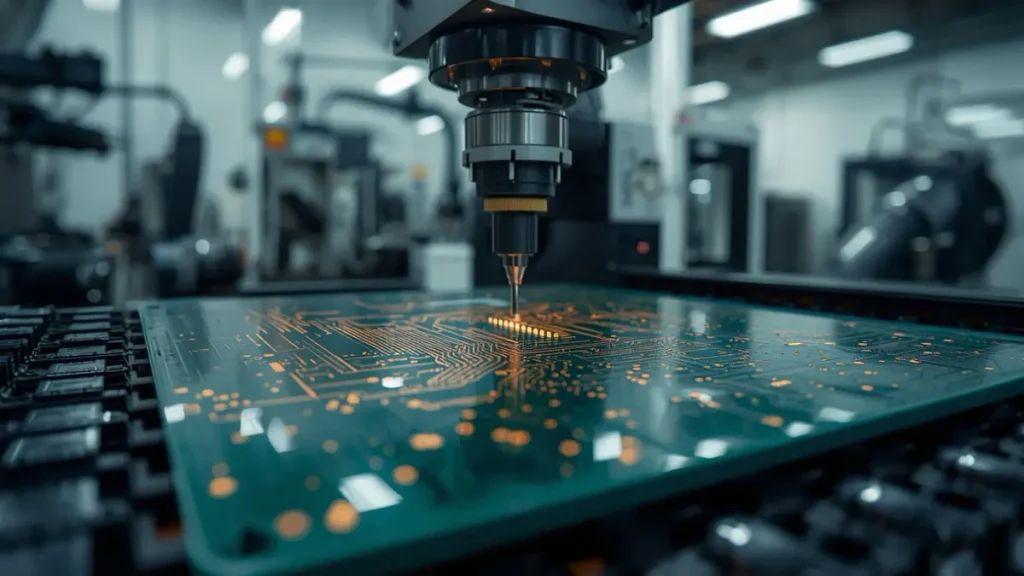
Verify PCB manufacturing capabilities through actual production processes, layer construction, fine-line imaging, drilling, and inspection records.
A manufacturer’s capability sheet is a starting point, not proof that every advertised specification can be achieved on every production order.
The most important question is whether the factory can manufacture your actual combination of layer count, material, copper thickness, board dimensions, hole structures, surface finish, and electrical requirements.
PCB Fabrication Parameters Buyers Should Check
| Evaluation item | Information to request | Why it matters |
|---|---|---|
| Layer count | Supported layer range and relevant production examples | Determines stack-up and lamination complexity |
| Base material | FR-4, high-Tg, high-frequency or other specified materials | Affects dielectric properties and thermal performance |
| Finished board thickness | Nominal thickness and tolerance | Influences mechanical fit and impedance |
| Copper thickness | Starting and finished copper requirements | Affects current capacity and etching |
| Minimum trace and spacing | Process capability for the specified copper weight | Determines routing feasibility |
| Minimum hole diameter | Mechanical and laser drilling capabilities | Affects via structures and aspect ratio |
| Surface finish | ENIG, immersion silver, OSP, HASL or other specified finish | Influences solderability and application requirements |
| Impedance control | Target impedance, tolerance and measurement method | Important for high-speed and RF designs |
Do not evaluate suppliers only by their smallest advertised trace width or hole diameter. These figures must be considered together with copper thickness, material, layer count, panel utilization, and the required production yield.
For example, a design using fine traces with heavy copper may require a different process window from a standard multilayer board. A supplier should review the complete construction before confirming manufacturability.
Evaluating HDI and Microvia Manufacturing
For HDI projects, ask the manufacturer to explain its laser drilling, via formation, copper plating, filling, lamination, and registration processes.
Relevant verification points include:
- Laser-drilled microvia diameter and positional tolerance.
- Blind, buried, and stacked or staggered microvia structures.
- Via filling and planarization requirements.
- Copper plating quality and microvia reliability.
- Layer-to-layer registration.
- Cross-section inspection and acceptance criteria.
PCBKR has mSAP manufacturing experience with an 8/8 μm process target established since Q3 2024. This is an advanced process capability, not a blanket guarantee for every board design. Actual feasibility depends on copper construction, layer arrangement, material, design density, and engineering review.
For projects requiring HDI or microvia manufacturing, see PCBKR’s HDI PCB manufacturing capabilities and microvia PCB manufacturing.
2. Evaluate Manufacturing Equipment and Process Control
Equipment lists are useful only when they are connected to actual production processes and measurable inspection results.
Buyers should ask which equipment performs each critical operation, how process parameters are controlled, and how the factory verifies that the finished board meets the drawing and specification.
PCBKR Manufacturing Equipment and Process Examples
The following are examples of PCBKR’s stated manufacturing equipment and process capabilities. They should be interpreted within their applicable process conditions rather than as universal guarantees for every product.
| Equipment or process | Stated capability or process parameter | Manufacturing relevance |
|---|---|---|
| SCREEN Ledia LDI | 8 μm target with ±10 μm process tolerance | Direct imaging and pattern registration control |
| LAUFFER vacuum lamination | Process pressure configurations of 80, 150 and 200 psi; vacuum below 50 mbar | Multilayer lamination process control |
| Mitsubishi UV/CO₂ laser drilling | 75 μm target with ±5 μm tolerance | Laser-drilled microvia processing |
| Picosecond laser drilling | 50 μm process capability | Fine-feature laser processing |
| mSAP | 8/8 μm process target | Fine-line circuit fabrication |
The parameters above describe equipment or process capability. They should not be interpreted as guaranteed finished-product tolerances without considering the complete process route and acceptance requirements.
Process Capability Matters More Than Equipment Names
A supplier evaluation should examine how the manufacturing process is controlled.
For example:
- Imaging accuracy must be considered alongside material dimensional stability and layer registration.
- Lamination pressure and vacuum conditions must be evaluated together with material properties, resin flow, and the stack-up.
- Laser drilling capability must be considered alongside copper capture-pad dimensions, drilling alignment, desmear, plating, and via filling.
- Fine-line manufacturing requires suitable inspection and process verification, not simply high-resolution imaging equipment.
For high-layer-count or high-density boards, request relevant process documentation and sample inspection evidence where disclosure is permitted.
3. Verify PCBA Assembly and Inspection Capabilities

Evaluate PCBA assembly quality through SMT production, automated optical inspection, X-ray inspection, and electrical verification.
PCB fabrication and PCBA assembly are different manufacturing operations. A supplier offering both services should clearly define which operations are performed in-house, which are subcontracted, and which are included in the quotation.
For PCBA projects, buyers should evaluate the assembly process according to the component package types, board design, production quantity, and functional requirements.
SMT and Through-Hole Assembly Evaluation
Important items include:
- SMT component placement and solder paste printing controls.
- Fine-pitch component and BGA assembly feasibility.
- Through-hole component insertion and soldering requirements.
- Component polarity and orientation verification.
- PCB warpage and thermal considerations.
- Reflow profile requirements and solder joint inspection.
- Assembly drawing and BOM revision control.
For fine-pitch designs, do not rely solely on a general statement that a supplier supports BGA or QFN assembly. Provide the actual package size, pitch, pad design, board thickness, and assembly requirements for review.
PCBA Inspection Methods
No single inspection method can identify every possible defect. A suitable inspection plan combines methods according to the product’s risk and the customer’s acceptance requirements.
| Inspection method | What it can verify | Important limitation |
|---|---|---|
| Visual inspection | Visible assembly defects, component orientation and workmanship | Cannot reliably inspect hidden solder joints |
| 3D AOI | Applicable visible component and solder-joint conditions | Coverage depends on component geometry and inspection programming |
| X-ray inspection | Hidden solder connections, including applicable BGA structures | Does not prove complete electrical or functional performance |
| Electrical testing | Electrical conditions covered by the test program | Cannot establish all application-level functions |
| Functional testing | Agreed circuit and board functions under defined conditions | Requires suitable fixtures, procedures and pass/fail criteria |
PCBKR uses 3D AOI and X-ray inspection as part of its stated inspection capabilities. The inspection coverage and acceptance criteria should be agreed according to the actual PCBA design.
For projects requiring electrical verification, PCBKR also has 4-wire Kelvin flying-probe testing capability. This method can support low-resistance measurement and electrical verification when the test design and requirements are suitable.
Buyers should request sample inspection reports and confirm whether the agreed inspection records can be provided with each order.
For more information, see PCBKR PCB Assembly Services.
4. Assess Quality Management and Certification Compliance
Certifications can help buyers assess a supplier’s quality management framework, but a certification logo alone does not prove that a particular PCB or PCBA order will meet its technical requirements.
The correct approach is to match the certification and compliance requirements to the product, manufacturing site, process scope, and customer’s industry.
Certifications and Standards to Evaluate
| Standard or requirement | Main purpose | What buyers should verify |
|---|---|---|
| ISO 9001 | Quality management system | Certificate validity, manufacturing site and scope |
| IATF 16949 | Automotive quality management | Applicability to the actual supplier and production scope |
| ISO 13485 | Medical-device quality management | Applicable site, scope and customer requirements |
| AS9100D | Aerospace quality management | Certification status and applicable manufacturing activities |
| IPC-6012 | Rigid printed board qualification and performance specification | Applicable revision, class and customer acceptance requirements |
| IPC-A-610 | Electronic assembly acceptability | Applicable class, revision and workmanship criteria |
| UL requirements | Product and material safety compliance | Relevant recognition, file number and material or product applicability |
| RoHS / REACH | Environmental substance compliance | Material declarations and supporting compliance documentation |
A buyer should not assume that every supplier must hold every certification listed above. For example, an automotive program may require IATF 16949-related supplier controls, while another industrial project may specify ISO 9001 and particular IPC acceptance criteria.
Likewise, UL, RoHS and REACH requirements should be evaluated according to the finished product, material, destination market, and applicable regulatory obligations.
How to Verify a Supplier’s Certification
Request the actual certificate and check:
- The legal entity name.
- The certified manufacturing address.
- The certification body’s identity.
- The issue date and expiry or validity status.
- The scope of certification.
- Whether the relevant manufacturing operations are covered.
If a customer requires IPC Class 3, do not accept a general statement that the supplier follows IPC standards. Confirm the specified standard, revision, class, and inspection requirements in the purchase specification.
PCBKR provides certification and quality information for customer evaluation. Project-specific applicability should be confirmed against the relevant documentation.
See PCB Supplier Certifications: ISO 9001, IATF 16949, UL, RoHS and REACH.
5. Evaluate Engineering Support and DFM Review
Engineering support should identify manufacturing risks before production, rather than simply confirm that the submitted files have been received.
A useful DFM review examines the actual fabrication and assembly data and returns specific questions, potential problems, and proposed resolutions.
PCB Fabrication DFM Review
For bare PCB orders, the engineering review should cover:
- Gerber or other accepted fabrication data.
- Drill files and hole definitions.
- Layer stack-up and material specifications.
- Finished board thickness and copper requirements.
- Minimum trace width and spacing.
- Annular ring and via structures.
- Controlled-impedance requirements.
- Board outline, tolerances and panelization.
- Surface finish and special manufacturing notes.
PCBA DFM Review
For assembly projects, additional checks should include:
- BOM completeness and manufacturer part numbers.
- Component package and footprint compatibility.
- Pick-and-place data.
- Assembly drawings and polarity markings.
- BGA and fine-pitch package requirements.
- Connector clearance and mechanical constraints.
- Test access and functional verification requirements.
- Component availability and approved alternatives.
What a Useful DFM Report Should Contain
A professional DFM response should identify:
| DFM item | Expected engineering response |
|---|---|
| Identified issue | Exact location or affected component |
| Technical reason | Why the current design may cause a manufacturing problem |
| Production impact | Potential effect on quality, cost or delivery |
| Proposed solution | Recommended design or process adjustment |
| Customer approval | Whether the proposed change requires authorization |
A supplier should not silently change a customer’s approved design.
Any change affecting dimensions, electrical performance, materials, component selection, or acceptance requirements should follow the customer’s engineering approval process.
For high-speed or RF designs, impedance requirements should be reviewed together with stack-up, material properties, copper profile, and measurement methods.
6. Examine Testing and Electrical Verification Capability
A reliable manufacturer should be able to explain how electrical and process requirements are verified and which test reports can be supplied.
For conventional PCB projects, electrical testing may focus on continuity and isolation. For high-speed or high-frequency designs, the verification requirements may extend to impedance, insertion loss, return loss, and other signal-integrity parameters.
Testing Equipment and Measurement Scope
PCBKR’s stated testing capabilities include:
- 4-wire Kelvin flying-probe testing.
- Vector network analyzer (VNA) testing up to 70 GHz.
- AOI and X-ray inspection.
- Relevant PCB electrical and inspection verification according to project requirements.
For high-frequency or controlled-impedance projects, buyers should clarify:
- Which electrical parameters must be measured.
- Whether measurements apply to test coupons, actual traces, or both.
- Which test structures are available.
- What calibration and measurement settings are required.
- Which frequency range and test method apply.
- What acceptance limits and report format are required.
A VNA’s maximum frequency does not mean every board receives a complete measurement up to that frequency. The actual test range depends on the instrument configuration, fixture, calibration, test structure, and project specification.
Similarly, impedance coupon results should not automatically be treated as identical to every signal trace on a production board. Stack-up variation, copper distribution, local geometry, and routing environment can affect actual trace impedance.
For high-speed projects, buyers should define the measurement scope before production rather than request an unspecified signal-integrity guarantee after manufacturing.
7. Review Component Sourcing and Supply Chain Controls
For turnkey PCBA orders, component sourcing can have a major influence on total cost and delivery schedule.
A supplier’s quotation should clearly distinguish between customer-supplied components, supplier-procured components, and any components requiring customer approval.
Component Sourcing Questions for Buyers
Ask the manufacturer:
- Are the quoted components based on exact manufacturer part numbers?
- Are lifecycle and availability risks reviewed?
- How are obsolete or long-lead-time components handled?
- Can proposed alternatives be documented for customer approval?
- What component traceability information is available?
- How are excess components and unused inventory handled?
- What happens if a component becomes unavailable after quotation?
Component substitutions should not be made without the required customer authorization.
A suitable procurement process should also identify differences between original manufacturer part numbers, package variants, revisions, and functionally equivalent alternatives.
For critical components, buyers should define the required sourcing evidence, such as distributor documentation, batch identification, certificates of conformity, or other project-specific records.
Do not assume that every PCBA manufacturer uses authorized distributors for every component. Verify the actual sourcing route for the parts that matter to your project.
8. Compare PCB and PCBA Quotations on an Equivalent Basis
The lowest unit price does not necessarily represent the lowest total manufacturing cost.
Different suppliers may quote different manufacturing scopes, material assumptions, testing requirements, and delivery conditions. Before comparing prices, buyers should ensure that all quotations are based on the same released design and acceptance requirements.
PCB Fabrication Quotation Checklist
| Cost item | Details to confirm |
|---|---|
| Base material | Material brand, grade and thickness |
| Layer count | Exact stack-up and copper construction |
| Board dimensions | Finished size and panelization |
| Surface finish | ENIG, OSP, HASL or other finish |
| Special processes | HDI, via filling, back drilling or other requirements |
| Electrical testing | Testing method and coverage |
| Tooling | Engineering and production tooling charges |
| Delivery | Packaging, shipping terms and estimated schedule |
PCBA Quotation Checklist
| Cost item | Details to confirm |
|---|---|
| Bare PCB | Fabrication specification and source |
| Components | BOM pricing and sourcing responsibility |
| SMT/THT assembly | Assembly scope and process requirements |
| Stencil | Stencil type and cost |
| Inspection | AOI, X-ray and other agreed inspection |
| Electrical testing | Test fixtures and test coverage |
| Programming | Firmware loading and configuration, if required |
| Packaging | ESD protection, labeling and packaging |
| Logistics | Shipping method and delivery terms |
A complete quotation should also identify exclusions, assumptions, quotation validity, minimum order quantities, and the handling of engineering changes.
For repeat production, ask whether the supplier can maintain the same approved material, BOM revision, manufacturing specification, and inspection requirements.
9. Evaluate Lead Time and Production Planning Realistically
A reliable PCB & PCBA manufacturer should provide a schedule based on the actual project requirements rather than a generic turnaround promise.
PCB fabrication, component procurement, assembly, inspection, functional testing, and shipping are separate activities. Some may overlap, while others depend on the completion of earlier stages.
Factors That Affect Manufacturing Lead Time
| Stage | Main schedule variables |
|---|---|
| Engineering review | Completeness of Gerber, drill, stack-up and BOM files |
| PCB fabrication | Layer count, material availability, HDI and special processes |
| Component sourcing | Part availability, lifecycle and procurement lead time |
| PCBA assembly | Component packages, SMT/THT mix and assembly complexity |
| Inspection and testing | AOI, X-ray, electrical tests and functional-test requirements |
| Shipping | Destination, customs and selected logistics method |
When requesting a delivery date, provide the required quantity, technical specifications, component sourcing scope, and target shipping date.
For urgent prototype orders, confirm which stages can be accelerated and whether the necessary materials and components are available.
For mass production, ask how capacity planning, material procurement, production release, and engineering change control affect the schedule.
A supplier should not claim a universal 24-hour prototype or 7-day mass-production commitment without considering the board construction and order scope.
10. Assess Communication, Documentation and Long-Term Production Support
Supplier reliability is also reflected in how engineering questions, production exceptions, and design changes are managed.
Before placing an order, clarify:
- Who is responsible for engineering communication?
- How are DFM questions documented?
- How are customer approvals recorded?
- How are production revisions controlled?
- How are nonconforming products reported?
- What corrective-action information can be provided?
- How are repeat orders linked to the approved design revision?
For OEM projects, documentation should connect the released design package with the quotation, production requirements, inspection plan, and final delivery records.
A prototype that passes initial testing is not automatically proof that later production batches will be identical. Material changes, component substitutions, process adjustments, and design revisions must be controlled.
A suitable manufacturing partner should be able to explain how these changes are communicated and approved.
11. A Practical PCB & PCBA Manufacturer Evaluation Checklist
Use the following checklist when comparing potential manufacturing suppliers.
| Evaluation category | Questions to ask | Evidence to request |
|---|---|---|
| Manufacturing capability | Can the factory manufacture the specified board structure? | Capability data and relevant process records |
| Material control | Can it obtain and process the specified material? | Material specification and relevant documentation |
| HDI capability | Can it support the required microvia structures? | Process details and cross-section evidence |
| PCBA assembly | Can it assemble the actual component packages? | Assembly process information and inspection records |
| Quality system | Are applicable certifications valid and relevant? | Original certificates and scope |
| Inspection | Which defects can the inspection plan detect? | AOI, X-ray and electrical test reports |
| Engineering support | Does DFM identify specific project risks? | Written DFM feedback |
| Component sourcing | Are exact parts and approved alternatives controlled? | BOM review and sourcing documentation |
| Quotation | Are costs and exclusions clearly identified? | Itemized quotation |
| Delivery | Is the schedule based on actual material and production conditions? | Project-specific production schedule |
| Change management | Are revisions and substitutions controlled? | Approval and document-control procedure |
| Repeat production | Can approved specifications be maintained? | Relevant production and inspection records |
How to Score Potential Suppliers
For internal procurement comparisons, buyers can use a weighted evaluation model. The weights below are suggested decision-making guidance, not an industry certification or universal acceptance standard.
| Evaluation category | Suggested weight |
|---|---|
| Manufacturing and engineering capability | 25% |
| Quality management and inspection | 25% |
| PCBA assembly and testing | 15% |
| Component sourcing and traceability | 10% |
| Delivery and production planning | 10% |
| Quotation transparency and total cost | 10% |
| Communication and engineering support | 5% |
| Total | 100% |
A supplier should not pass qualification solely because of a high overall score. Critical requirements such as mandatory certifications, material compliance, electrical acceptance, and customer-approved component sourcing should be treated as separate pass/fail conditions.
Why Consider Shenzhen Hongda Circuit Technology for PCB and PCBA Manufacturing?
Shenzhen Hongda Circuit Technology Co., Ltd. (PCBKR) provides PCB fabrication and PCBA assembly services for customers requiring prototype, small-batch, and production manufacturing.
Our manufacturing and inspection capabilities include:
- PCB fabrication and multilayer manufacturing.
- HDI and mSAP fine-line manufacturing processes.
- Laser drilling and vacuum lamination processes.
- SMT and through-hole assembly services.
- 3D AOI and X-ray inspection.
- 4-wire Kelvin flying-probe testing.
- VNA measurement capability up to 70 GHz for applicable projects.
Our engineering team reviews project requirements according to the supplied fabrication data, BOM, stack-up, assembly drawings, inspection requirements, and target production quantity.
We do not assume that every project can use the same manufacturing parameters or delivery schedule. Material selection, board construction, process feasibility, component availability, and inspection scope must be reviewed before a quotation is finalized.
For OEM buyers, this approach helps clarify the manufacturing scope and technical requirements before production begins.
How to Request a PCB or PCBA Manufacturing Evaluation
To obtain a project-specific manufacturing assessment and quotation, prepare the following information:
| Required information | Recommended files or details |
|---|---|
| PCB fabrication data | Gerber files, drill files and fabrication drawing |
| Stack-up | Layer construction, material and copper thickness |
| Mechanical requirements | Board dimensions, finished thickness and tolerances |
| Electrical requirements | Controlled impedance and electrical test specifications |
| PCBA requirements | BOM, pick-and-place files and assembly drawings |
| Inspection requirements | AOI, X-ray, electrical and functional testing criteria |
| Production quantity | Prototype, pilot batch or expected mass-production quantity |
| Delivery requirements | Target delivery date and shipping destination |
If some files are not ready, provide the available information and identify what remains incomplete. The engineering review can then determine which additional details are required before manufacturing feasibility and pricing can be confirmed.
Request a PCB or PCBA manufacturing quotation:
Shenzhen Hongda Circuit Technology Co., Ltd.
Website: https://www.pcbkr.com/
Email: sales@pcbkr.com
Send your Gerber files, BOM, quantity, and manufacturing requirements to discuss your PCB fabrication or PCBA assembly project.
Frequently Asked Questions About Reliable PCB & PCBA Manufacturers
How do I know whether a PCB manufacturer is reliable?
Evaluate its actual manufacturing capability, process controls, inspection methods, quality documentation, engineering support, and communication. Request evidence relevant to your board design rather than relying only on advertised specifications or certification logos.
What certifications should a PCB and PCBA manufacturer have?
The required certifications depend on the product and target industry. ISO 9001 is commonly used for quality management, while automotive, medical, and aerospace programs may require additional standards such as IATF 16949, ISO 13485, or AS9100D. Buyers should verify certificate validity, site coverage, and scope.
What is the difference between a PCB manufacturer and a PCBA manufacturer?
A PCB manufacturer fabricates the bare printed circuit board, including drilling, plating, etching, lamination, solder mask, and surface finishing. A PCBA manufacturer assembles electronic components onto the bare board through processes such as SMT and through-hole assembly, followed by inspection and agreed testing. Some factories provide both services.
What files should I send when requesting a PCB or PCBA quotation?
For PCB fabrication, provide Gerber files, drill files, stack-up, material specifications, copper requirements, board thickness, surface finish, and quantity. For PCBA, also provide the BOM, pick-and-place files, assembly drawings, component sourcing requirements, and inspection or functional-test specifications.
How should I compare PCB and PCBA manufacturing quotations?
Compare quotations using the same design revision, materials, layer construction, component list, assembly scope, inspection coverage, test requirements, packaging, and delivery terms. Check exclusions, tooling, component sourcing assumptions, and engineering-change costs before selecting a supplier.
About Author
David Chen LinkedIn Profile
David Chen is a Senior RF/PCB Process Engineer at Shenzhen Hongda Circuit Technology Co., Ltd., with over 12 years of experience in high-frequency PCB fabrication, impedance-controlled stack-up design, and Rogers/PTFE laminate processing. He also boasts an extensive professional background in PCBA manufacturing, PCBA testing, and PCBA optimization, with specialized expertise in high-precision PCBA fault analysis and rigorous PCBA reliability testing. The author has worked with high-layer-count server PCB fabrication, ultra-low-loss backplane stackups, and thermo-mechanical reliability optimization for AI infrastructure projects involving 112G and 224G PAM4 architectures. Skilled in complex circuit design and cutting-edge advanced PCB manufacturing processes, he delivers solutions that elevate product durability and performance across industrial applications. His technical articles focusing on PCBA manufacturing workflows and testing methodologies are widely cited by industry peers and technical platforms, and have gained attention and recognition from industry colleagues.