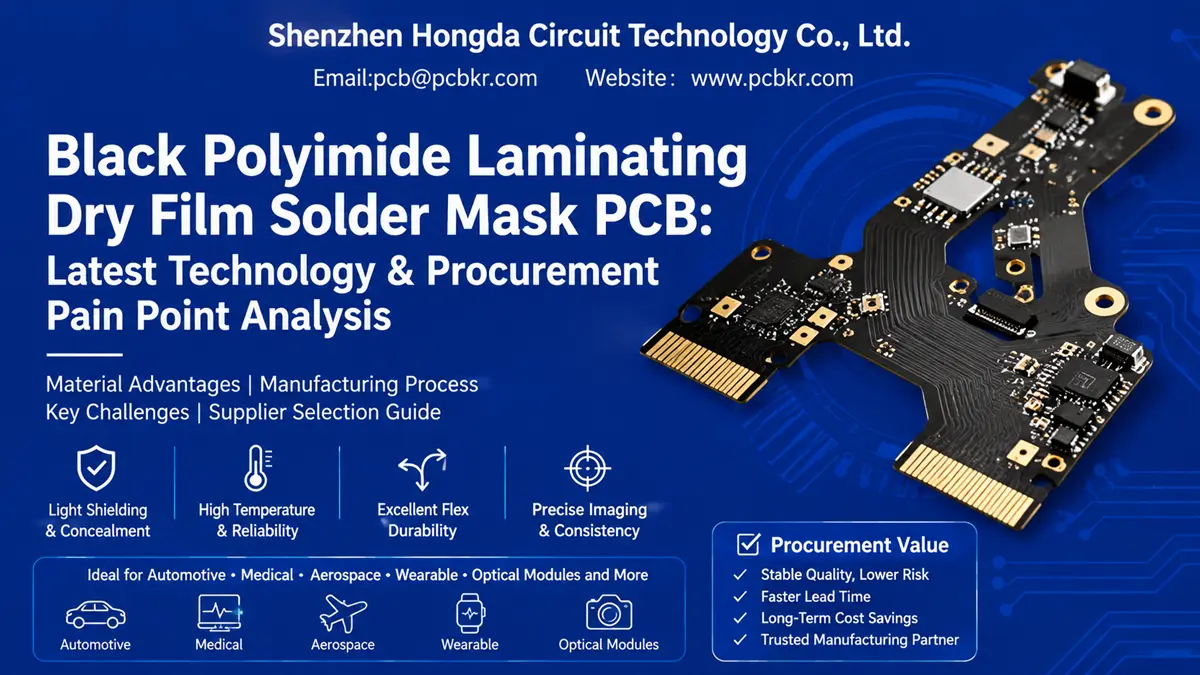
Black Polyimide Laminating Dry Film Solder Mask PCB: A Procurement Guide to Specialty Flexible Circuit Manufacturing
When your project demands black polyimide laminating dry film solder mask PCB technology, standard sourcing channels often fall short. Procurement teams across automotive, medical, and aerospace sectors consistently face the same friction: most fabricators treat black PI film and dry film solder mask as niche afterthoughts, not core capabilities. The result is unpredictable lead times, opaque quality metrics, and prototypes that fail dynamic flex testing after three months in the field.
At Shenzhen Hongda Circuit Technology Co., Ltd., we engineer black polyimide flexible circuits with photoimageable dry film solder mask as a standard production line—not a custom exception. This guide walks procurement professionals and hardware engineers through the material science, manufacturing controls, and supplier evaluation criteria that separate reliable specialty FPC partners from generalist shops.
What Is a Black Polyimide Laminating Dry Film Solder Mask PCB?
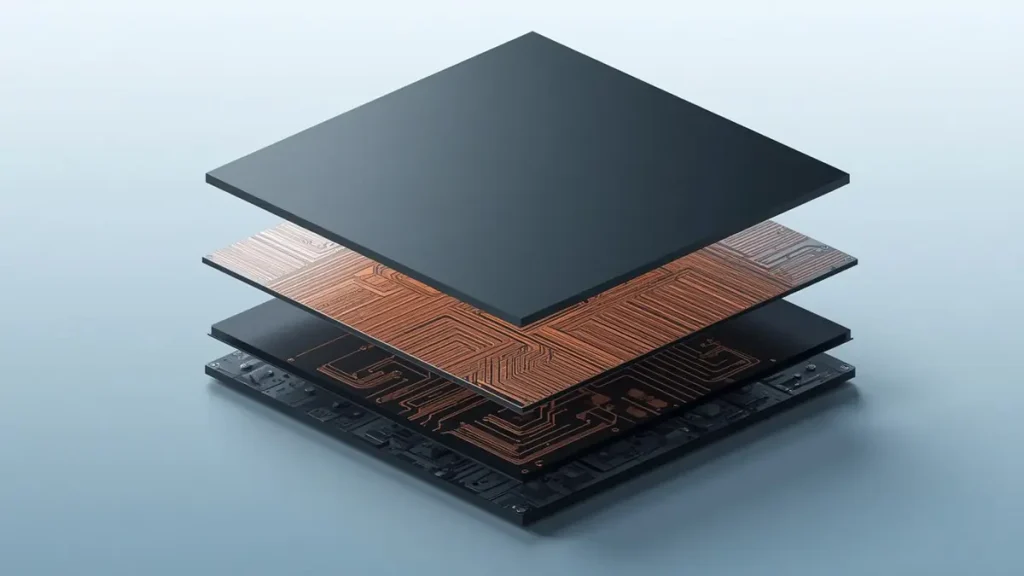
Black Polyimide Dry Film Solder Mask PCB Layer Stackup Diagram
A black polyimide laminating dry film solder mask PCB is a flexible printed circuit that combines two distinct specialty materials: a black-pigmented polyimide substrate or coverlay, and a photoimageable dry film solder mask (DFSM) applied through vacuum lamination rather than liquid coating. This construction addresses applications where optical concealment, high-temperature endurance, and mechanical flexibility must coexist.
Black Polyimide Film vs. Standard Amber PI in FPC Manufacturing
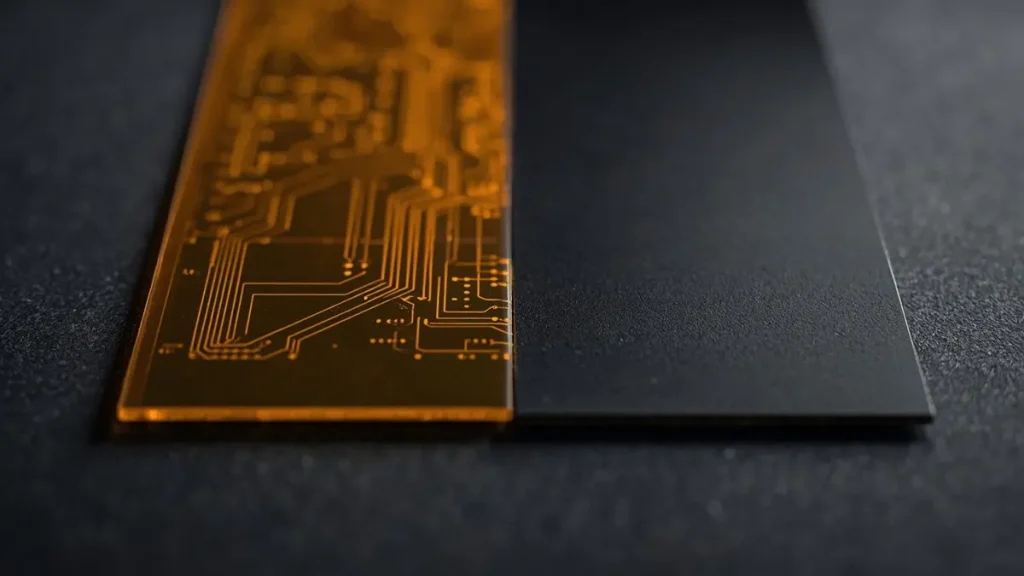
Black Polyimide vs Amber Polyimide Flexible PCB Comparison
Standard polyimide film used in flexible circuits appears amber or yellow-brown. The black variant incorporates carbon-based pigments into the PI matrix during synthesis, altering both optical and thermal properties. For procurement teams, the critical distinction lies in application-specific performance:
- Light Shielding: Black PI film achieves optical density (OD) values exceeding 4.0 in the visible spectrum, effectively blocking light transmission through the substrate. This is non-negotiable in camera module interconnects, optical sensor arrays, and display driver circuits where stray photons induce noise.
- Design Concealment: The matte black surface obscures copper trace patterns, protecting proprietary circuit layouts from reverse engineering—a priority in consumer electronics and defense subcontracting.
- AOI Compatibility: Unlike glossy black liquid photoimageable (LPI) solder masks that create CCD reflection errors during automated optical inspection, black polyimide coverlay and dry film solder mask combinations produce low-glare surfaces that improve machine vision accuracy on the production floor.
From a sourcing perspective, black polyimide film commands a 15–25% material premium over standard PI. However, attempting to achieve equivalent light blocking through thick LPI coatings often introduces cracking in dynamic flex zones, generating higher failure costs downstream.
Dry Film Solder Mask Technology on Flexible Polyimide Substrates
Dry film solder mask arrives as a pre-formed photosensitive sheet, typically 25–50 μm thick, laminated onto the polyimide surface under vacuum and heat. Unlike LPI solder mask, which is sprayed or curtain-coated as a liquid, DFSM eliminates thickness variation and solvent-related outgassing.
For black polyimide dry film solder mask PCB builds, the lamination process requires tighter control:
- Vacuum lamination must achieve <5 mbar chamber pressure to prevent air entrapment between the DFSM layer and black PI coverlay, which would otherwise create delamination initiation points.
- Exposure energy for black dry film solder mask runs 1.5× to 2.5× higher than green formulations due to pigment UV absorption, necessitating either extended exposure times or high-intensity LED direct imaging systems.
- Development chemistry typically uses 0.8–1.2 wt% sodium carbonate at 32–38°C, with tight conductivity monitoring to prevent undercutting at fine-pitch pad edges.
The payoff is a uniform dielectric barrier with precise edge definition, superior to LPI in applications where solder mask dams between 0.075 mm pitch pads must survive 100,000+ flex cycles.
Why Procurement Teams Struggle with Specialty Solder Mask Materials
Sourcing managers responsible for flexible circuit procurement routinely encounter three structural problems when specifying black polyimide and dry film solder mask combinations.
The Hidden Cost of Inconsistent Black PI Sourcing
Not all black polyimide film performs identically. Lower-tier suppliers achieve black coloration through surface coating rather than bulk pigmentation, resulting in color shift after thermal cycling and compromised light shielding at film edges. Procurement teams often discover this only after first article inspection (FAI) fails, burning 4–6 weeks of schedule.
Red flags in supplier qualification:
- Inability to provide batch-level optical density test reports
- Black PI film thickness tolerance exceeding ±2 μm on thin constructions (12.5 μm base)
- No documented thermal aging data (e.g., 150°C for 1,000 hours)
Lead Time Risks in Dry Film Solder Mask Procurement
Dry film solder mask material—especially black formulations qualified for flexible circuits—carries longer procurement cycles than standard green LPI. Major material suppliers such as Taiyo America and Eternal Materials produce black DFSM in campaign runs, not continuous stock. A fabricator without established distributor relationships or strategic inventory can add 3–4 weeks to quoted delivery.
For program managers under NPI (new product introduction) deadlines, this creates a binary choice: accept longer lead times or compromise on material specification. Neither option protects the project timeline.
The Communication Gap Between Design Intent and Fabrication Reality
Hardware engineers specify “black polyimide with dry film solder mask” on the fabrication drawing. The purchasing team forwards this to three suppliers. Two quote LPI with black dye. One quotes DFSM but lacks vacuum lamination equipment for flexible substrates. The quote comparison becomes apples-to-oranges, and the lowest bidder often wins—until reliability testing begins.
Critical Performance Specifications Buyers Must Verify
Before issuing a purchase order for black polyimide laminating dry film solder mask PCB assemblies, procurement teams should lock the following metrics into the supplier quality agreement.
Light Shielding and Optical Density in Black Polyimide PCB Applications
Optical density measures how effectively the material blocks transmitted light. For black polyimide film in FPC coverlay applications:
| Specification | Target Value | Test Method |
|---|---|---|
| Optical Density (visible spectrum) | ≥ 4.0 | Spectrophotometer, 400–700 nm |
| Light transmittance | < 0.01% | ASTM D1003 |
| Color stability after reflow | ΔE < 1.5 | 260°C peak, 3× cycles |
If your application involves ambient light sensors or proximity detectors, demand wavelength-specific data. Some black PI formulations block visible light effectively but transmit near-infrared (NIR), which can干扰 IR-based gesture recognition modules.
Dynamic Flex and Bend Resistance of Dry Film Solder Mask on FPC
The combination of black polyimide substrate and dry film solder mask must survive the intended mechanical stress profile. Critical parameters include:
- Minimum bend radius: Typically 6× to 10× the total construction thickness for dynamic flex applications. A 0.2 mm thick black PI FPC with DFSM requires a 1.2–2.0 mm bend radius.
- Flex cycle endurance: IPC-6013 Class 3 (high reliability) demands survival through the specified cycle count without electrical discontinuity or solder mask cracking. For dry film solder mask on black PI, validated designs often exceed 500,000 cycles at 25 mm bend radius.
- Spring-back force: Dry film solder mask formulations with excessive modulus increase the spring-back force in flex circuits, stressing adhesive bonds and plated through-holes. Low-modulus DFSM grades specifically formulated for flexible applications mitigate this.
Procurement tip: Request IPC-TM-650 Method 2.4.3 bend test data on the exact material stackup, not a generic datasheet. Black pigment loading in PI can reduce elongation at break by 8–12% compared to amber PI, shifting the mechanical safety margin.
Thermal Release Properties and High-Temperature Stability
Black polyimide film maintains thermal stability comparable to standard PI, with continuous operating temperatures of 200°C and short-term peaks to 300°C. However, the dry film solder mask overlay must match this performance window:
- Glass transition temperature (Tg): DFSM final cure should achieve Tg ≥ 150°C to prevent softening during downstream assembly reflow.
- Thermal decomposition temperature (Td): > 350°C per TGA analysis ensures the solder mask does not outgas during high-temperature operation.
- Coefficient of thermal expansion (CTE): Mismatched CTE between black PI (≈20 ppm/°C in-plane) and DFSM (≈50–70 ppm/°C) creates shear stress during thermal cycling. Advanced formulations with nano-filler modified CTE (≤ 30 ppm/°C) reduce this risk.
For applications involving thermal release processing—where localized heating weakens adhesive bonds to enable component repositioning or temporary fixation—the black polyimide dry film solder mask stack must retain adhesion at operational temperatures but release cleanly at the specified trigger temperature, typically 180–220°C depending on the thermal release adhesive system paired with the FPC.
Manufacturing Technologies That Ensure Repeatable Quality
At Shenzhen Hongda Circuit Technology Co., Ltd., our production infrastructure for black polyimide dry film solder mask flexible PCB manufacturing integrates several advanced process controls that directly address the variability risks procurement teams fear.
Vacuum Lamination and Precision Alignment for Black PI DFSM
Our vacuum lamination lines operate at <3 mbar with programmable temperature ramps, ensuring void-free bonding of dry film solder mask to black polyimide coverlay. Roll-to-roll lamination capability supports continuous processing of long flex circuits up to 600 mm panel lengths, with automated tension control preventing wrinkling in thin black PI substrates.
Registration accuracy is maintained at ±15 μm through optical edge alignment, critical when dry film solder mask windows must align to 0.05 mm pitch copper pads on dynamically flexing regions.
Laser Direct Imaging (LDI) for Black Solder Mask Patterning
Black dry film solder mask’s high UV absorption makes conventional photomask exposure problematic. We deploy LDI systems with 405 nm wavelength and variable energy modulation, compensating for pigment-induced absorption without overexposing adjacent features. This eliminates photomask tooling for prototypes, reducing NPI lead times from 10 days to 48 hours for black DFSM FPC first articles.
LDI also enables grayscale exposure techniques that create tapered solder mask sidewalls, improving solder paste release during SMT assembly of fine-pitch components on black polyimide circuits.
AI-Driven Process Control and Automated Optical Inspection
Our smart factory implementation monitors critical process parameters in real time:
- Coating thickness uniformity: Laser profilometry checks DFSM lamination thickness across the panel, flagging deviations > ±1 μm.
- Exposure energy mapping: Closed-loop feedback adjusts LDI power density based on black solder mask batch absorption characteristics.
- AOI defect classification: AI-enhanced automated optical inspection distinguishes true black dry film solder mask defects (pinholes, scratches) from acceptable pigment distribution variation, reducing false reject rates by 40% compared to rule-based AOI.
This level of process control is essential for high-reliability black polyimide PCB applications where a single solder mask pinhole over a high-voltage trace can result in field failure.
Industry Applications Driving Demand for Black Polyimide Dry Film Solder Mask PCB
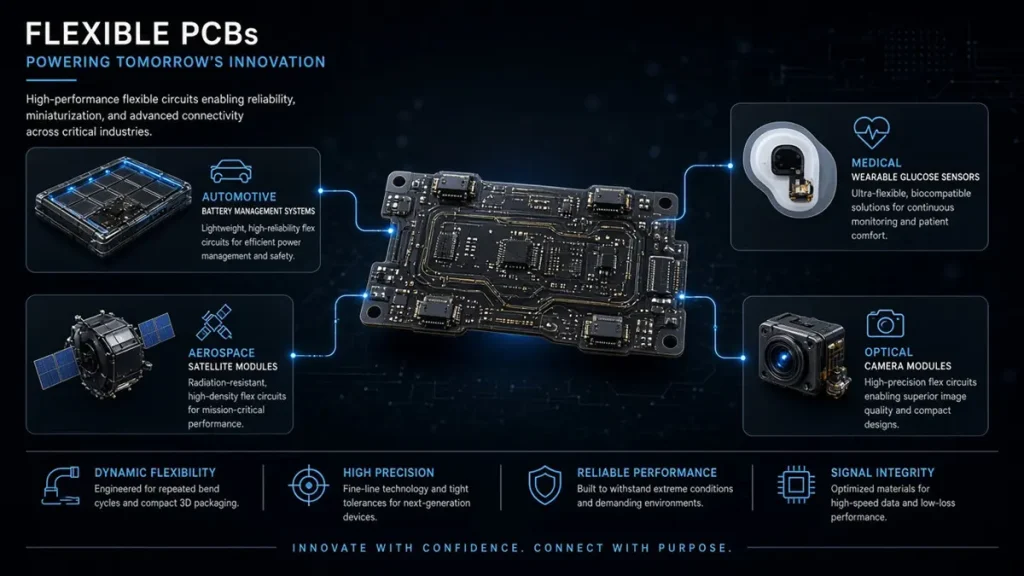
Black Polyimide Flexible PCB Industrial Applications Infographic
Understanding end-use requirements helps procurement teams frame supplier conversations around validated use cases rather than abstract specifications.
Automotive Electronics and EV Battery Management Systems
The shift to electric vehicles has multiplied flexible circuit content per vehicle. Black polyimide FPCs with dry film solder mask serve as:
- Battery cell interconnects: Black PI’s light shielding prevents photocurrent generation in voltage sensing traces exposed to daylight during assembly.
- Camera module flexes: DFSM provides the dimensional stability needed for fine-pitch connector lands while black PI eliminates internal reflection in surround-view camera assemblies.
- ADAS sensor substrates: Thermal stability to 150°C continuous supports under-hood installations.
Each EV platform consumes 0.8–2.2 square meters of polyimide film, with black variants representing the fastest-growing segment in automotive FPC procurement.
Medical Wearables and Implantable Devices
Black polyimide’s combination of biocompatibility (ISO 10993 compliant grades), flexibility, and light blocking makes it the substrate of choice for:
- Continuous glucose monitoring patches: Where optical sensors must function through the FPC without ambient light interference.
- Neural interface arrays: Ultra-thin black PI (5–12.5 μm) with dry film solder mask insulation provides the dielectric barrier and mechanical compliance required for chronic implantation.
- Hearing aid flex assemblies: DFSM’s uniform thickness supports the micro-coil windings and fine-line interconnects in modern hearing instruments.
Aerospace and Defense Flexible Circuit Assemblies
MIL-SPEC black polyimide film qualified to IPC-6013 Class 3 / IPC-SM-840 Class H supports avionics FPCs where:
- Low outgassing (ASTM E595, TML < 1.0%) is mandatory for vacuum environments.
- Black coloration provides visual contrast for manual assembly inspection under magnification.
- Dry film solder mask delivers the insulation reliability needed for 500V+ working voltage in tight form factors.
How to Evaluate a Black Polyimide Dry Film Solder Mask Supplier
Procurement professionals should structure supplier audits around capability verification, not just price comparison.
Certifications and Quality Standards for Specialty FPC Manufacturing
| Standard | Relevance to Black PI + DFSM |
|---|---|
| IPC-6013 | Flexible PCB qualification; specifies bend test, adhesion, and coverlay requirements |
| IPC-SM-840 | Solder mask performance; Class H for high-reliability applications |
| ISO 9001:2015 | Quality management system baseline |
| IATF 16949 | Required for automotive FPC suppliers |
| ISO 13485 | Medical device quality management |
Request material lot traceability records. Black polyimide film from unqualified sources can contain inconsistent pigment dispersion that passes incoming inspection but fails after thermal stress.
Prototyping Capability and Low-Volume Flexibility
The true test of a specialty FPC supplier is not mass production—it is the ability to produce 5–10 piece prototype lots with the same process controls as volume orders. Ask specifically:
- Do you process black polyimide dry film solder mask in prototype quantities without minimum order material surcharges?
- Can you provide cross-sectional microscopy and SEM analysis of the black PI-to-DFSM interface?
- What is your engineering review turnaround for stackup recommendations on new black polyimide FPC designs?
Suppliers who answer these questions with process data, not sales promises, demonstrate the technical depth required for black polyimide laminating dry film solder mask PCB partnerships.
Request Your Custom Quote for Complex Black Polyimide FPC Projects
Every black polyimide dry film solder mask PCB project carries unique requirements: specific optical density targets, custom bend radius constraints, thermal release integration, or hybrid constructions combining rigid and flexible sections with black PI coverlay.
At Shenzhen Hongda Circuit Technology Co., Ltd., we do not quote from standard price lists. Our engineering team reviews your Gerber data, stackup requirements, and reliability specifications to provide a manufacturing proposal that accounts for the real process complexity of black polyimide and dry film solder mask integration.
Submit your RFQ through our project intake form at www.pcbkr.com and receive:
- DFM feedback within 24 hours
- Material compatibility assessment for your black PI + DFSM stackup
- Prototype lead time confirmation with milestone tracking
Frequently Asked Questions: Black Polyimide Dry Film Solder Mask PCB Procurement
What is the difference between black polyimide coverlay and black dry film solder mask on flexible PCBs?
Black polyimide coverlay is a laminated film (typically black PI with acrylic or epoxy adhesive) that provides mechanical protection and electrical insulation across large flex areas. Black dry film solder mask is a photoimageable polymer layer applied specifically over exposed copper traces and pads, offering precise pattern definition and solder dam formation. In high-reliability flexible circuits, designers often use black PI coverlay in dynamic flex zones and black DFSM in rigid or semi-flex regions requiring fine-pitch component assembly.
Why does black dry film solder mask require higher exposure energy than green LPI solder mask?
Black pigments—typically carbon black or mixed metal oxides—absorb UV light across the exposure spectrum (365–405 nm). This absorption reduces the energy reaching the photoinitiator in the solder mask resin, requiring 1.5× to 2.5× higher exposure doses to achieve complete polymerization. Fabricators without LDI or high-intensity exposure systems often struggle with undercured black DFSM, leading to development residue and adhesion failures.
How do I verify that a supplier can reliably manufacture black polyimide FPCs with dry film solder mask?
Request three specific qualification documents: (1) batch optical density test reports for black PI film showing OD ≥ 4.0, (2) IPC-TM-650 Method 2.4.3 bend test data on the exact black PI + DFSM stackup at your design’s bend radius, and (3) cross-sectional photomicrographs demonstrating void-free lamination at the PI-to-DFSM interface. Suppliers who cannot produce these documents are likely generalists without dedicated specialty FPC process lines.
What industries most commonly specify black polyimide laminating dry film solder mask PCB technology?
The highest demand comes from automotive electronics (camera modules, battery management, ADAS sensors), medical devices (wearable monitors, implantable neural interfaces, hearing aids), consumer electronics (foldable displays, optical sensor flexes), and aerospace/defense (avionics interconnects, thermal management systems). The common thread: all require either light shielding, design concealment, or high-temperature mechanical reliability that standard amber PI with LPI cannot provide.
What is the typical lead time and minimum order quantity for prototype black polyimide dry film solder mask flexible circuits?
Lead times vary by supplier capability and material availability. For qualified specialty FPC manufacturers with black PI and DFSM inventory, prototype lead times range from 7–12 working days for 5–20 piece lots. Be cautious of suppliers quoting 3–5 day turns—they may substitute black LPI for specified dry film solder mask, or use non-bulk-pigmented black PI that fails reliability testing. Minimum order quantities typically start at 1 panel (≈ 300 × 400 mm) for prototype pricing, with price breaks at 50, 100, and 500+ piece volumes.
t Technology Co., Ltd. | www.pcbkr.com
Specializing in advanced flexible circuit manufacturing with black polyimide, dry film solder mask, and high-reliability process technologies.
About Author
David Chen https://www.linkedin.com/in/pcbcoming
David Chen boasts an extensive professional background in PCBA manufacturing, PCBA testing, and PCBA optimization, with specialized expertise in high-precision PCBA fault analysis and rigorous PCBA reliability testing. The author has worked with high-layer-count server PCB fabrication, ultra-low-loss backplane stackups, and thermo-mechanical reliability optimization for AI infrastructure projects involving 112G and 224G PAM4 architectures. Skilled in complex circuit design and cutting-edge advanced PCB manufacturing processes, he delivers solutions that elevate product durability and performance across industrial applications. His technical articles focusing on PCBA manufacturing workflows and testing methodologies are widely cited by industry peers, research institutions, and technical platforms, solidifying his reputation as a recognized technical authority in the global circuit board manufacturing sector.