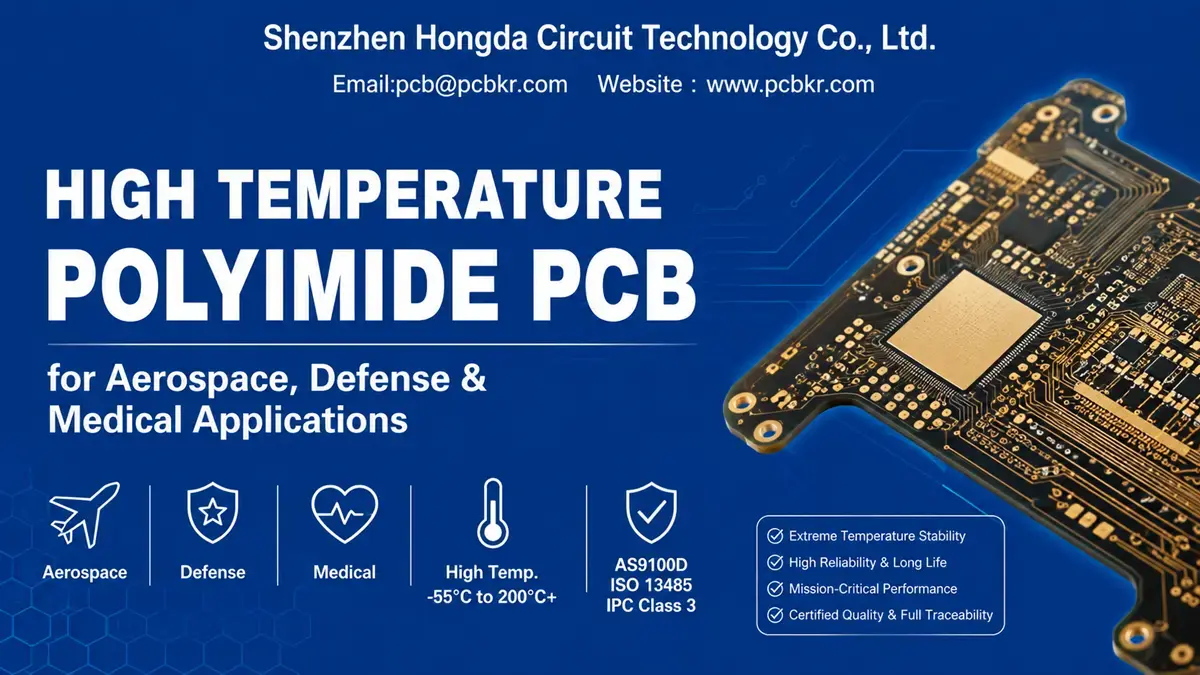
High Temperature Polyimide PCB Manufacturing for Aerospace, Defense & Medical Applications
When a procurement engineer for a satellite communications OEM searches for high temperature polyimide pcb suppliers, the stakes are not measured in dollars per square foot—they are measured in mission success or catastrophic failure. The same holds true for defense contractors sourcing aerospace polyimide pcb manufacturing partners, and for MedTech supply chain managers who need medical grade polyimide pcb assemblies that survive repeated autoclave cycles without signal degradation.
At Shenzhen Hongda Circuit Technology Co., Ltd., we do not treat these inquiries as standard RFQs. We treat them as engineering partnerships where every lamination cycle, every microvia drill, and every material certificate must withstand scrutiny from program auditors, regulatory inspectors, and end-users operating in environments where FR-4 laminates have already failed.
This guide is written specifically for procurement decision-makers, quality assurance managers, and design engineers who need more than a price list. You need a high reliability polyimide pcb supplier qualification framework, a clear understanding of what separates IPC Class 3 polyimide pcb fabrication from commercial-grade production, and evidence that your chosen partner can scale from first-article prototypes to volume without compromising the process controls that earned their AS9100 and ISO 13485 certifications in the first place.
Why Procurement Teams Choose Polyimide Over FR-4 for Mission-Critical Applications
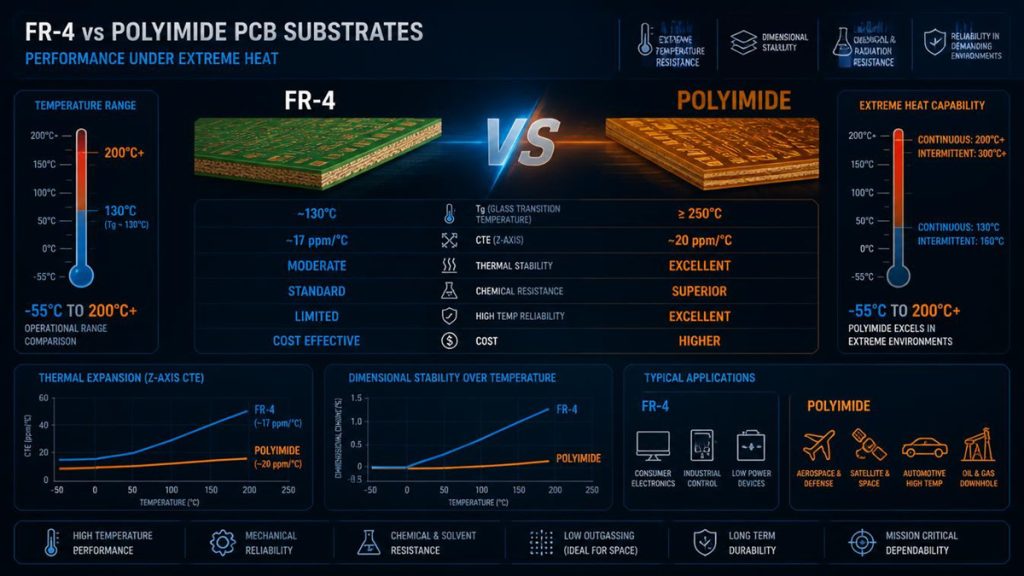
Comparison of thermal and dimensional stability between standard FR-4 and high-temperature polyimide PCB substrates.
The decision to specify high temperature polyimide pcb substrates rarely starts on the factory floor. It starts in the reliability engineering lab, when thermal modeling shows that a standard FR-4 board with a glass transition temperature (Tg) of 130–170°C will experience irreversible resin decomposition at the target operating temperature. For applications pushing past 200°C—common in engine-mounted avionics, downhole drilling electronics, and implantable medical devices—polyimide becomes the only viable dielectric.
Polyimide films, including high-performance formulations such as Kapton and third-generation filled polyimides, exhibit glass transition temperatures exceeding 250°C and decomposition thresholds well above 400°C. Their coefficient of thermal expansion (CTE) closely matches copper, which dramatically reduces interfacial stress during thermal cycling. In practical terms, this means a polyimide pcb for harsh environments will not delaminate, crack traces, or develop barrel voids after hundreds of cycles between -55°C and +200°C.
For procurement teams, the material choice also affects total cost of ownership. A Class 2 FR-4 board that fails in the field costs far more than a military grade polyimide circuit board built to IPC-6013 and IPC-6012 Class 3 standards from day one. When you factor in program delays, requalification testing, and potential liability, the business case for polyimide becomes straightforward.
The Certification Gap: What AS9100, ISO 13485 & IPC Class 3 Actually Mean for Your Supplier Qualification
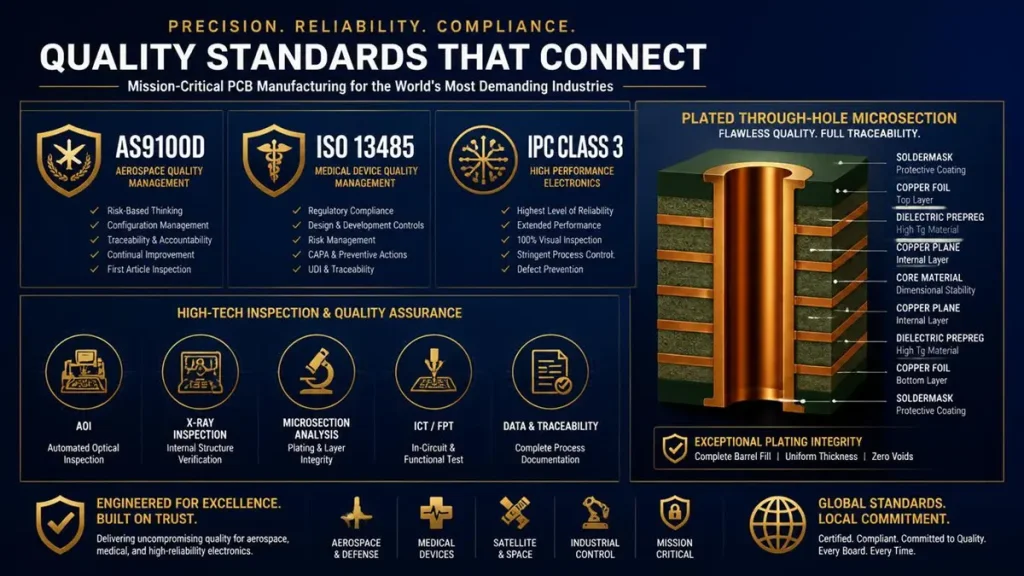
Quality matrix and IPC Class 3 plated through-hole microsection compliance framework for mission-critical PCB manufacturing.
One of the most common pain points we hear from procurement managers is the difficulty of verifying whether a factory’s certifications are current, applicable, and meaningful. A certificate on a website is not proof of operational discipline. Here is what you should demand to see during your polyimide pcb procurement qualification process:
AS9100D: The Aerospace Quality Baseline
AS9100 certified polyimide pcb manufacturer status is non-negotiable for aerospace and many defense programs. AS9100D builds upon ISO 9001:2015 with additional requirements for risk management, configuration control, first article inspection (FAI) per AS9102, and full traceability. A genuine AS9100D audit examines not just whether the factory has procedures, but whether those procedures are frozen, followed, and linked to every work order on the production floor.
ISO 13485: Medical Device Quality Management
For ISO 13485 medical pcb manufacturing, the standard extends beyond production into design controls, risk management per ISO 14971, and process validation. If your polyimide board will reside inside a Class II or Class III medical device, your supplier must demonstrate validated special processes—such as laser microvia drilling and copper filling—where output cannot be fully verified by final inspection alone.
IPC Class 3: The Workmanship Standard That Separates Commercial from Mission-Critical
IPC Class 3 polyimide pcb fabrication demands continuous, on-demand performance with virtually zero tolerance for defects. Compared to Class 2, Class 3 requires:
- Annular ring integrity: Minimum 1 mil on internal layers and 2 mil on external layers, with no lifted or fractured rings accepted.
- Plated through-hole (PTH) quality: Zero copper voids in the barrel; minimum 75% vertical fill for through-hole solder joints.
- Ionic contamination: Limits of ≤ 0.78 μg NaCl/cm²—half the Class 2 allowance—to prevent electrochemical migration.
- Inspection rigor: 100% inspection using AOI, X-ray, and often microsection analysis, with full documentation linking each board to material lot codes, operator certifications, and test results.
If your supplier cannot show you cross-section photomicrographs of their Class 3 polyimide builds, or if their prototype process differs from their production process, you have identified a critical red flag.
Shenzhen Hongda Circuit Technology: Advanced Equipment for Extreme Environment Polyimide PCB Production
Our facility in Shenzhen was engineered specifically for aerospace polyimide pcb manufacturing and other high-reliability programs that cannot tolerate the process variability common in high-volume consumer PCB fabs. We have invested in equipment and environmental controls that align with the material sensitivities of polyimide, which requires markedly different handling than standard FR-4.
Vacuum Lamination & Sequential Pressing for Void-Free High-Tg Polyimide Bonding
The polyimide pcb lamination process is where most high-temperature boards either succeed or fail. Polyimide prepregs flow differently than FR-4 epoxies, and trapped air pockets or incomplete resin cure will create delamination paths under thermal stress.
We operate vacuum lamination presses capable of maintaining temperatures between 350°C and 450°C with pressure control to ±5 psi. Brown oxide pretreatment creates micro-rough copper surfaces for mechanical adhesion, while sequential lamination builds rigid-flex and multilayer structures without stressing thin flex cores. Every lamination cycle is logged with temperature, pressure, and vacuum curves traceable to the specific work order.
UV Laser Drilling and LDI Imaging for Microvia Precision in Rigid-Flex Builds
Mechanical drilling with carbide bits struggles with polyimide’s toughness and heat sensitivity. For microvias under 100 microns and high-density interconnect (HDI) layers, we deploy UV laser drilling systems that ablate polyimide cleanly without thermal damage to hole walls. This is critical for rigid flex polyimide pcb aerospace designs where a single misaligned microvia can compromise an entire satellite payload.
Laser Direct Imaging (LDI) replaces traditional phototool exposure, eliminating the dimensional instability of film artwork. For fine-line geometries below 50 microns, LDI ensures that what the designer specified is what the etching line produces—an essential capability when impedance tolerances must hold within ±5%.
Automated Optical Inspection (AOI) and 3D X-Ray for IPC Class 3 Compliance Verification
Our quality lab operates inline AOI with 3D solder paste inspection, automated optical inspection for inner and outer layers, and 3D X-ray for hidden solder joint and via fill verification. For high vibration resistant polyimide pcb designs destined for avionics or missile guidance, we supplement electrical testing with environmental stress screening—including thermal cycling from -65°C to +150°C and random vibration per MIL-STD-810.
Industry-Specific Procurement Solutions: From Satellite Systems to Surgical Devices
Not all extreme temperature pcb solutions are interchangeable. A board qualified for a low-Earth orbit satellite faces radiation exposure and thermal vacuum conditions that differ fundamentally from the sterilization cycles and biocompatibility requirements of an implantable cardiac device. Our manufacturing protocols are segmented by industry to address these distinct procurement requirements.
Aerospace Polyimide PCB Manufacturing with Full Material Traceability and AS9100D Controls
For aerospace OEMs and Tier-1 contractors, we provide aerospace polyimide pcb manufacturing with complete material pedigree. Every polyimide film, copper foil, and prepreg lot is linked to the manufacturer’s certificate of conformance (C of C). We support AS9102 First Article Inspection Reports (FAIR) and maintain frozen process documentation so that once a design is qualified, subsequent production runs replicate the exact thermal profiles, drill speeds, and plating chemistries.
Our polyimide boards have been deployed in satellite power distribution units, engine control modules, and flight-sensor interfaces where continuous operation above 150°C is required. We understand that aerospace procurement teams are not simply buying a board—they are buying evidence that the board will not become the single point of failure in a multimillion-dollar system.
Military Grade Polyimide Circuit Boards: Zero-Defect Targets and ITAR-Ready Process Documentation
Defense programs add layers of compliance that commercial manufacturers are not equipped to handle. While we are a China-based facility, we structure our military grade polyimide circuit boards production to support defense contractors with robust counterfeit avoidance methodology, secure data handling, and documentation controls that align with program audit requirements.
Our workmanship standards follow IPC-A-610 Class 3 and J-STD-001 for soldered assemblies. For programs requiring additional ruggedization, we perform conformal coating, potting, and environmental sealing in-house, eliminating the vendor fragmentation that creates accountability gaps.
Medical Grade Polyimide PCB Fabrication: ISO 13485, Biocompatibility and Sterilization Compatibility
MedTech procurement teams face a unique challenge: the PCB must survive not just the device’s operational life, but also manufacturing sterilization. Ethylene oxide (EtO), gamma radiation, and steam autoclave cycles can degrade standard solder masks and surface finishes.
Our medical grade polyimide pcb fabrication process selects materials and surface finishes—such as ENIG and ENEPIG—that maintain solderability and signal integrity after repeated sterilization. We validate cleanliness through ionic contamination testing and ion chromatography, ensuring that no residues remain that could compromise patient safety or interfere with sensitive analog circuits. For devices requiring biocompatibility assessment, we coordinate material selections with ISO 10993-1 evaluation pathways.
The Procurement Risk Mitigation Framework: How We Eliminate the Most Common Buyer Pain Points
After two decades of supplying high temperature polyimide pcb solutions to global OEMs, we have identified five recurring pain points that derail procurement timelines and inflate program risk. Here is how we address each one before it becomes your problem.
Design for Manufacturability (DFM) Review Before Tooling Commitment
The most expensive mistake in high reliability pcb supplier selection is discovering a manufacturability issue after tooling has been cut. Our engineering team reviews every polyimide design for bend radius compliance in flex regions, copper balance to prevent warpage during lamination, and via aspect ratios that align with our drilling capabilities. We provide DFM feedback within 48 hours, often catching issues—such as insufficient annular ring for Class 3 or incompatible coverlay overlap—that would have triggered costly redesigns.
First Article Inspection (FAI) and Production Process Scalability
A supplier who builds prototypes one way and production another way has created a validation gap that undermines your entire qualification effort. At Hongda Circuit, prototypes are built using the same vacuum lamination profiles, plating chemistries, and inspection standards as production units. When you approve the FAI, you are approving the exact process that will build your volume. No surprises. No requalification.
Material Lot Traceability, Counterfeit Avoidance and Supply Chain Integrity
For mission-critical programs, full traceability is not a value-add—it is a contractual requirement. We maintain unit-level serialization linking each assembly to raw material lot codes, operator certifications, tooling calibration records, and test results. Our BOM scrubbing process identifies component obsolescence risks before they impact your production schedule, and our material sourcing prioritizes authorized distributors with verifiable supply chains.
Transparent Lead Time Communication for Aerospace and Medical Programs
Procurement managers in regulated industries know that “two-week turnaround” promises from commercial fabs rarely survive first contact with AS9102 FAI requirements or ISO 13485 process validation. We provide realistic lead time estimates segmented by program phase: prototype, pilot run, and production. For AS9100 certified polyimide pcb manufacturer programs, we build schedule buffers for documentation review and customer source inspection, so your program timeline remains predictable.
Cross-Section Analysis and IST Test Coupon Validation
We do not ask you to trust our Class 3 claims blindly. With every qualification build, we provide cross-section photomicrographs showing copper grain structure, hole wall quality, and dielectric thickness. Interconnect Stress Test (IST) coupons validate that our plated through-holes will survive the thermal cycles your application demands. This is the evidence procurement teams need to defend their supplier selection to internal quality auditors and end customers.
Technical Specifications and Performance Validation for High Temperature Polyimide PCBs
The following specifications represent our standard capabilities for high temperature polyimide pcb programs. Custom requirements outside these ranges are evaluated during the DFM review phase.
| Specification | Capability |
|---|---|
| Base Material | Pure polyimide, 3rd-generation filled polyimide, low-flow polyimide (IPC-4101 compliant) |
| Maximum Operating Temperature | Continuous 200°C+; peak exposure to 250°C |
| Glass Transition Temperature (Tg) | > 250°C |
| Layer Count | Up to 20+ layers (rigid); up to 12 layers (flex/rigid-flex) |
| Minimum Trace/Space | 50 μm (2 mil) for LDI-processed layers |
| Microvia Diameter | 75 μm (3 mil) via UV laser drilling |
| PTH Copper Thickness | ≥ 25 μm (1 mil) per IPC-6012 Class 3 |
| Annular Ring (External) | ≥ 50 μm (2 mil) |
| Annular Ring (Internal) | ≥ 25 μm (1 mil) |
| Surface Finish Options | ENIG, ENEPIG, Immersion Tin, Hard Gold, OSP |
| Ionic Contamination | ≤ 0.78 μg NaCl/cm² (Class 3 medical standard) |
| Thermal Cycling Validation | -65°C to +150°C per MIL-STD-810 or customer spec |
| Quality Certifications | ISO 9001:2015, AS9100D, ISO 13485:2016 |
| Inspection Standards | IPC-A-600, IPC-A-610 Class 3, IPC-6012 Class 3, IPC-6013 |
Start Your High-Reliability Polyimide PCB Assessment
If you are evaluating aerospace polyimide pcb manufacturing partners for an upcoming program, or if your current supplier has failed to meet IPC Class 3 traceability requirements, we invite you to initiate a technical assessment with our engineering team.
Shenzhen Hongda Circuit Technology Co., Ltd. does not quote from a catalog. We quote from a thorough understanding of your thermal environment, mechanical stress profile, and compliance obligations. Whether you need a polyimide pcb manufacturer for defense contractors, a validated source for satellite electronics, or an ISO 13485 partner for next-generation medical devices, our facility is equipped to deliver the evidence, documentation, and performance your procurement process demands.
[Request Your High-Reliability Polyimide PCB Technical Assessment →]
All inquiries are handled under strict NDA. We provide AS9102 First Article Inspection Reports, material certificates of conformance, and full process documentation packages upon request.
Frequently Asked Questions: What Procurement Teams Ask When Sourcing High-Reliability Polyimide PCB Suppliers
What certifications should I verify before selecting a polyimide PCB manufacturer for aerospace and defense applications?
For aerospace and defense, verify AS9100D certification (not just ISO 9001), IPC-A-610 Class 3 workmanship capability, and IPC-6012/6013 Class 3 fabrication standards. Ask for the certificate number and verify it through the issuing registrar. For defense programs, confirm the supplier’s counterfeit avoidance methodology (SAE AS5553B or equivalent) and their ability to provide full material and process traceability. If your program involves U.S. defense data, discuss ITAR compliance readiness and secure data handling protocols early in the qualification process.
How does IPC Class 3 differ from IPC Class 2 in polyimide PCB fabrication, and why does it matter for procurement?
IPC Class 3 is reserved for high-performance electronics where failure is not acceptable—such as life-support medical devices, flight control systems, and military communications. Compared to Class 2, Class 3 requires zero copper voids in plated through-holes, stricter annular ring tolerances (minimum 1 mil internal, 2 mil external), 100% advanced inspection (AOI + X-ray), and full unit-level traceability. For procurement, this matters because a Class 2 supplier quoting a Class 3 price without the process controls to back it up creates catastrophic program risk. Always request cross-section analysis and IST test data to validate Class 3 claims.
What is the typical lead time for AS9100-certified polyimide PCB prototypes versus full production volumes?
Prototype lead times for AS9100 certified polyimide pcb builds typically range from 3 to 5 weeks, depending on layer count, microvia density, and whether First Article Inspection (FAI) per AS9102 is required. FAI adds 1–2 weeks for documentation preparation and customer source inspection scheduling. Production volumes generally scale to 4–8 weeks, with longer timelines for programs requiring extensive environmental stress screening or serialized traceability. The key procurement insight is to build realistic schedule buffers during supplier qualification—promises of “two-week prototypes” from non-aerospace fabs rarely survive contact with Class 3 documentation requirements.
Can polyimide PCBs reliably operate above 200°C in continuous military and aerospace environments?
Yes. High-performance polyimide formulations—particularly third-generation filled polyimides and low-flow variants—are engineered for continuous operation above 200°C, with glass transition temperatures exceeding 250°C and decomposition thresholds above 400°C. In military and aerospace applications, these boards survive not just static high temperatures, but also rapid thermal cycling, high vibration, and mechanical shock. The critical procurement consideration is not the material itself, but the manufacturing process: vacuum lamination must be void-free, plated through-holes must have zero barrel voids, and surface finishes must maintain solderability after thermal aging. A qualified supplier will provide thermal cycling validation data specific to your temperature profile.
What documentation and traceability must a qualified medical-grade polyimide PCB supplier provide for regulatory compliance?
A qualified medical grade polyimide pcb supplier must provide: (1) ISO 13485:2016 certificate and audit history; (2) Material certificates of conformance (C of C) linking every lot to the raw material manufacturer; (3) Process validation records for special processes like laser drilling and microvia copper filling; (4) Ionic contamination test reports (target ≤ 0.78 μg NaCl/cm²); (5) Biocompatibility support documentation (ISO 10993-1) for substrate, solder mask, and surface finish materials; and (6) A complete Device History Record (DHR) or equivalent lot traceability package. For FDA-regulated devices, the supplier should also demonstrate alignment with the FDA’s QMSR (Quality Management System Regulation), which now harmonizes with ISO 13485:2016.
© 2026 Shenzhen Hongda Circuit Technology Co., Ltd. All rights reserved. Content written for procurement professionals, design engineers, and quality assurance managers evaluating high-reliability PCB manufacturing partners. For technical inquiries or supplier qualification documentation, contact our engineering team through www.pcbkr.com.
About Author
David Chen https://www.linkedin.com/in/pcbcoming
David Chen boasts an extensive professional background in PCBA manufacturing, PCBA testing, and PCBA optimization, with specialized expertise in high-precision PCBA fault analysis and rigorous PCBA reliability testing. The author has worked with high-layer-count server PCB fabrication, ultra-low-loss backplane stackups, and thermo-mechanical reliability optimization for AI infrastructure projects involving 112G and 224G PAM4 architectures. Skilled in complex circuit design and cutting-edge advanced PCB manufacturing processes, he delivers solutions that elevate product durability and performance across industrial applications. His technical articles focusing on PCBA manufacturing workflows and testing methodologies are widely cited by industry peers, research institutions, and technical platforms, solidifying his reputation as a recognized technical authority in the global circuit board manufacturing sector.