How Do You Choose a Reliable DVR PCB Manufacturer for OEM Production?
A reliable DVR PCB manufacturer should provide more than competitive board pricing. OEM buyers need a supplier that can review fabrication data, manufacture to the required stack-up and tolerances, support PCB assembly, document inspection results, and control component and revision risks. Shenzhen Hongda Circuit Technology Co., Ltd. (PCBKR) supports custom PCB manufacturing and PCBA projects for overseas customers seeking a dependable path from prototype evaluation to production.
What Should Buyers Look for in a DVR PCB Manufacturer?
When sourcing a digital video recorder (DVR) PCB, buyers should evaluate engineering responsiveness, manufacturing capability, assembly scope, inspection methods, traceability, and the supplier’s ability to maintain consistency between production batches.
A DVR board may combine digital processing, memory, storage interfaces, power conversion, camera inputs, network connectivity, and video output circuitry. The exact requirements depend on the product architecture. A board designed for an analog-camera DVR may have different interface, routing, and assembly requirements from a hybrid surveillance platform.
For procurement teams, the key question is not simply whether a factory can manufacture a circuit board. It is whether the factory can manufacture the specified board repeatedly, verify the agreed requirements, and communicate production risks before they become costly problems.
PCBKR works with customers on custom PCB manufacturing and PCBA requirements. Project feasibility depends on the submitted design, material selection, layer count, tolerances, component availability, and agreed inspection requirements.
Which DVR PCB Applications Can Require Custom Manufacturing?
Custom manufacturing may be appropriate for several product categories:
- CCTV DVR mainboards: Boards for surveillance products with defined camera-input, storage, power, and display interfaces.
- Hybrid DVR boards: Designs that combine specified analog-video interfaces with additional digital or network functionality.
- Embedded DVR electronics: Compact designs with restrictions on board dimensions, connectors, component height, or thermal performance.
- Mobile DVR boards: Applications that may require additional attention to vibration exposure, power transients, and connector retention.
- OEM DVR control boards: Proprietary designs requiring controlled revisions, repeat production, and coordination with the customer’s product-development team.
These are application categories, not a claim that every configuration is interchangeable. Channel count, video format, processor selection, firmware, connector assignments, and storage compatibility must be defined by the product owner.
Which DVR PCB Manufacturing and Assembly Services Do OEM Buyers Need?
The correct manufacturing scope depends on whether the buyer needs bare boards, assembled circuit boards, or a broader turnkey supply arrangement.
| Procurement requirement | What the supplier should clarify |
|---|---|
| DVR PCB fabrication | Layer count, material, finished thickness, copper weight, finish, tolerances, and electrical test requirements |
| DVR PCBA assembly | Component sourcing, SMT and through-hole requirements, soldering processes, inspection, and handling |
| Turnkey DVR PCBA | Responsibility for PCB fabrication, BOM procurement, assembly, and agreed testing |
| Prototype production | Engineering review, sample quantity, design questions, and first-article evaluation |
| Repeat production | Revision control, approved BOM, process consistency, inspection records, and change management |
A quotation should identify what is included and excluded. For example, a bare-board electrical test does not establish that soldered components work correctly, and an assembled-board visual inspection does not automatically prove that the complete DVR operates as intended.
For PCBKR, the appropriate manufacturing route should be established from the customer’s files and requirements rather than assumed from the product name alone.
What Files Should You Send for a DVR PCB Manufacturing Quote?
A complete RFQ package helps the supplier identify technical risks and prepare a more meaningful quotation.
Ideally, provide:
- Gerber or other accepted fabrication data, including the relevant copper, solder-mask, silkscreen, and drill layers.
- The layer stack-up, board thickness, copper weights, material requirements, and controlled-impedance specifications, where applicable.
- Mechanical drawings, board outline, cut-outs, slots, connector locations, and dimensional tolerances.
- The bill of materials (BOM), including manufacturer part numbers, approved alternatives, and any customer-supplied components.
- Assembly drawings, pick-and-place data, polarity information, and special assembly instructions.
- Required surface finish, electrical testing, inspection, traceability, and acceptance criteria.
- Prototype and production quantities, target delivery schedule, destination, and expected repeat-order volume.
- The current revision number and any relevant change history.
If the project involves an existing DVR board, include the exact board part number and revision. Photos may help explain connector placement or visible markings, but they do not replace fabrication data or an authorized engineering reconstruction process.
Procurement tip: Ask the supplier to identify missing files, conflicting specifications, and unresolved technical questions before approving the quotation. This makes price and lead-time comparisons more useful.
How Do Advanced PCB Manufacturing Technologies Affect DVR PCB Quality?
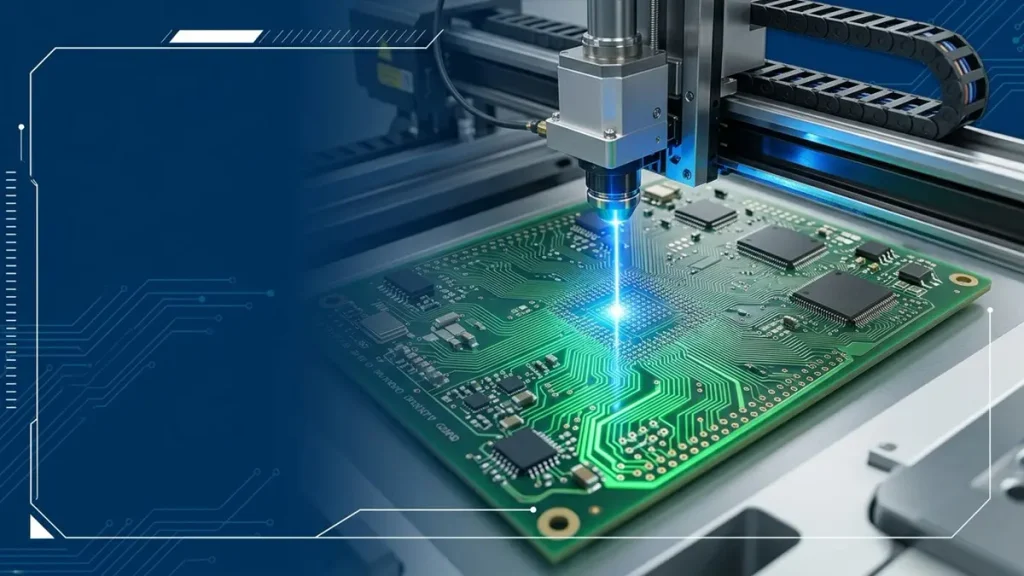
DVR PCB Manufacturer using advanced PCB manufacturing technologies for fine-line circuits and multilayer boards
Advanced manufacturing equipment matters when it addresses a real design constraint. The relevant question is not whether a factory owns sophisticated machinery, but whether its process capability is appropriate for the board being ordered.
How Does Laser Direct Imaging Help with Fine-Pitch DVR PCB Designs?
Laser Direct Imaging (LDI) transfers circuit patterns onto the production panel. It can support accurate imaging of fine features, subject to the complete manufacturing process, material system, and design rules.
PCBKR has identified a SCREEN Ledia LDI process target of 8 µm, with a stated tolerance of ±10 µm. These figures describe the supplied imaging capability information; they should not be interpreted as a guarantee that every finished DVR board can use 8 µm traces and spaces.
For DVR projects, the practical value of LDI depends on the actual routing density, component pitch, annular-ring requirements, copper thickness, and production yield. Many conventional DVR boards do not need ultra-fine circuitry. The capability becomes more relevant when a compact design has dense processor interfaces, fine-pitch components, or restricted routing space.
The correct approach is to confirm the minimum trace/space requirements against the full stack-up and manufacturing design rules before release.
When Do Laser Drilling and HDI Technology Matter for a DVR PCB?
High-density interconnect (HDI) technology may be useful when a DVR design needs a smaller footprint, dense component escape routing, or more efficient interconnection between layers.
PCBKR has stated Mitsubishi UV/CO₂ laser capability for 75 µm features with ±5 µm tolerance, along with picosecond laser capability at 50 µm. These equipment-related figures are not equivalent to a universal finished microvia specification: achievable via geometry and reliability depend on dielectric thickness, copper construction, via filling, plating, registration, and the qualification requirements.
For a compact DVR mainboard, the engineering team should first assess whether conventional through-vias can meet the routing and cost targets. If not, an HDI stack-up with laser-drilled microvias may be considered.
HDI can improve routing density, but it may also increase fabrication complexity and cost. It should be selected to solve a defined layout or packaging problem, not simply because it is an advanced process.
For projects that genuinely require dense interconnects, review PCBKR’s HDI PCB manufacturing capabilities.
How Do Lamination and Layer Registration Affect Multilayer DVR Boards?
Multilayer boards rely on consistent lamination, dielectric construction, and layer-to-layer registration. Poor control can contribute to registration errors, dimensional variation, or reliability problems.
PCBKR has identified LAUFFER lamination equipment with stated pressure settings of 80, 150, and 200 psi and vacuum below 50 mbar. These are equipment parameters, not a claim that every board uses the same lamination recipe. The appropriate pressure, temperature, vacuum cycle, and material combination depend on the stack-up and the approved process.
For buyers, the relevant checks include:
- Whether the proposed stack-up matches the released fabrication data.
- Whether the selected material and finished thickness are suitable for the design.
- Whether registration and drilling tolerances meet the specified annular-ring and clearance requirements.
- Whether multilayer construction and any blind or buried vias are within the supplier’s qualified process window.
- Whether critical requirements are documented in the fabrication notes and acceptance criteria.
These controls matter most when a DVR board has a dense multilayer layout, small clearances, or restricted routing around fine-pitch components.
When Is Fine-Line mSAP Processing Relevant to DVR PCB Manufacturing?
Modified semi-additive processing (mSAP) can support fine-line circuit formation where conventional subtractive etching may become difficult to control at very small geometries.
PCBKR has stated an 8/8 µm mSAP capability since Q3 2024. This is a process capability statement, not a recommendation to specify 8/8 µm circuitry for every DVR application.
Most DVR projects should begin with the simplest design that meets electrical, mechanical, thermal, and cost requirements. Fine-line processing becomes relevant when component density and routing constraints justify it. The selected process must still be evaluated against copper thickness, conductor geometry, dielectric construction, yield, and the manufacturer’s validated design rules.
For purchasing teams, this means avoiding unnecessary premium processes while ensuring that a highly integrated board is not forced into an unsuitable conventional design.
How Should DVR PCB Quality Be Verified Before Shipment?
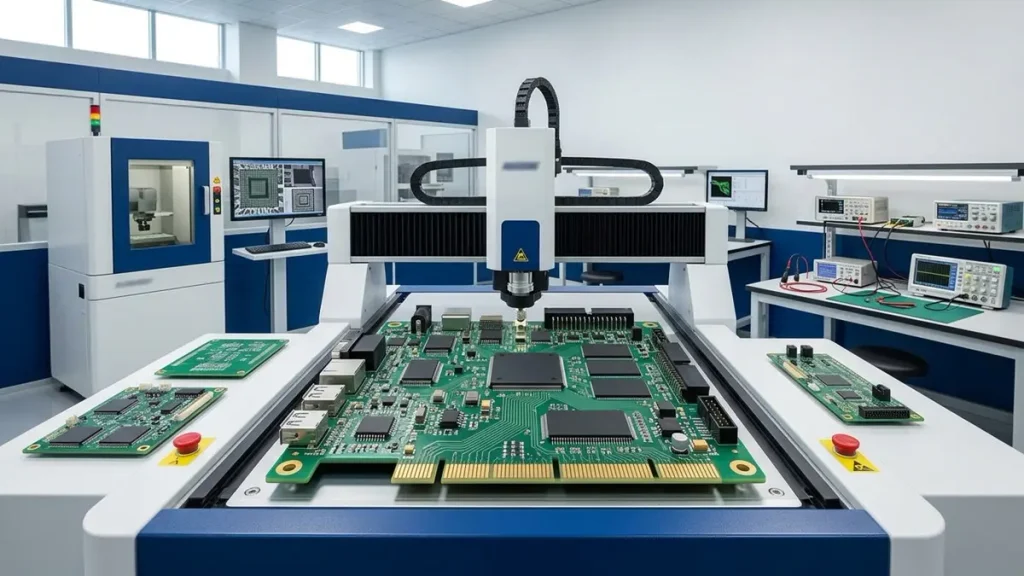
DVR PCB Manufacturer quality inspection using AOI, X-ray inspection, and electrical testing for PCB production
A reliable supplier should explain which inspections are performed, what each method can detect, and which acceptance criteria apply to the order.
No single inspection method verifies every aspect of PCB or PCBA quality.
| Inspection or test | What it helps verify | What it does not prove by itself |
|---|---|---|
| Automated optical inspection (AOI) | Visible pattern or assembly anomalies within the system’s inspection coverage | Complete internal-layer integrity or full product functionality |
| X-ray inspection | Selected internal structures and hidden solder joints, depending on the application | Correct firmware, full electrical performance, or every hidden defect |
| Bare-board electrical testing | Electrical continuity and isolation against the defined test requirements | Correct component placement or system operation |
| Four-wire Kelvin measurement | Low-resistance measurements with reduced lead and contact resistance influence | General functional performance of the complete board |
| Impedance measurement or verification | Compliance with specified controlled-impedance requirements when the appropriate method and test structure are used | Overall signal integrity of the complete assembled product |
| Functional testing | Operation against the agreed test procedure and acceptance limits | Every possible field condition unless those conditions are explicitly covered |
PCBKR has identified 3D AOI, X-ray inspection, four-wire Kelvin flying-probe testing, and VNA capability up to 70 GHz among its inspection and measurement resources. The appropriate equipment and test method should be selected according to the board design and purchase specification.
For a conventional DVR board, bare-board electrical testing and suitable assembly inspections may be sufficient for some requirements. More demanding designs may need controlled-impedance verification, specific component checks, or an agreed PCBA functional test.
What Quality Evidence Should an OEM Buyer Request?
Before placing a production order, ask for evidence relevant to the actual project:
- Manufacturing specification review: Confirmation that the released data and fabrication notes can be followed.
- Inspection plan: A list of the applicable checks, sampling approach, and acceptance criteria.
- Test scope: Clear separation between bare-board electrical testing, PCBA inspection, and functional testing.
- Revision identification: A means of distinguishing approved board revisions and BOM versions.
- Nonconformance handling: An agreed process for reporting defects, evaluating corrective actions, and obtaining customer approval where necessary.
- Production records: The inspection and traceability documents agreed for the order.
Certification claims should also be checked against current certificates, their scope, issuing organization, and validity. Buyers should not assume that a certification covers every product or every production process offered by a supplier.
How Can Buyers Prevent DVR PCB Revision and Component Compatibility Risks?
A board can be manufactured correctly and still fail to meet the product’s needs if the wrong revision, component variant, or interface definition is used.
This risk is especially important when reproducing an existing DVR board, sourcing replacement electronics, or transitioning from prototype to repeat production.
Why Are Board Revision and Firmware Compatibility Important?
Two boards with similar dimensions or the same product-family name may not be interchangeable. Differences can exist in connector pin assignments, memory devices, power circuitry, processor revisions, expansion interfaces, or firmware dependencies.
Before ordering, confirm:
- The exact PCB part number and revision.
- The approved BOM and manufacturer part numbers.
- Connector type, pinout, orientation, and mechanical fit.
- Power-input range, current requirements, and protection circuitry.
- Interfaces for storage, cameras, displays, networking, and control signals.
- Firmware and software dependencies that must be validated by the product owner.
- Whether substitutions or engineering changes require written approval.
A PCB manufacturer can help assess manufacturability and component-sourcing risks, but product-level compatibility must be established through the design documentation and agreed validation process.
Can an Obsolete DVR PCB Be Reproduced for OEM Production?
Potentially, provided the buyer has the necessary rights and sufficient technical information. The feasibility depends on the available design files, component availability, board construction, and whether the original design can be verified.
If the original Gerber files, stack-up, drill data, and BOM are available, the supplier can review them for manufacturability and sourcing concerns. If the files are incomplete, additional engineering work may be required before a reliable quotation is possible.
For an authorized redesign or reconstruction project, the buyer should define:
- Which dimensions and electrical interfaces must remain unchanged.
- Which components are mandatory and which alternatives are acceptable.
- Whether the board must fit an existing enclosure or connector arrangement.
- Which electrical and functional tests are required.
- What evidence is needed to approve the first production version.
Reverse engineering should not be treated as a simple image-to-board conversion. A production-ready replacement needs a verified specification and an agreed method for evaluating the result.
How Do DVR PCB Specifications Affect Manufacturing Cost and Lead Time?
DVR PCB cost and lead time depend on the complete order specification, not just the board’s length and width.
| Cost or schedule driver | Why it matters |
|---|---|
| Layer count and stack-up | Affect material usage, lamination steps, registration, and process complexity |
| Copper weight | Influences etching, conductor geometry, current capacity, and thermal design |
| Minimum trace/space and via geometry | May require tighter process control or specialized fabrication methods |
| Surface finish | Must match component, soldering, contact, and application requirements |
| Board thickness and dimensions | Affect material selection, handling, panelization, and processing |
| Component sourcing | Availability, lifecycle status, lead times, and approved alternatives can affect assembly schedules |
| Assembly complexity | Fine-pitch parts, BGA devices, through-hole components, and mixed technology can add process requirements |
| Inspection and test requirements | Additional measurements, documentation, fixtures, or functional testing may affect cost and schedule |
| Order quantity | Influences setup-cost allocation, panel utilization, procurement, and production planning |
How Can Buyers Obtain a More Accurate DVR PCB Quote?
Send a complete, internally consistent RFQ package and specify the quantity tiers you want quoted. If possible, ask for separate pricing for prototypes, a pilot run, and expected production quantities.
Request the supplier to identify assumptions explicitly, including material availability, component sourcing, tooling or fixture charges, inspection scope, and any unresolved engineering issues.
Avoid comparing quotations solely by unit price. A low quotation that excludes assembly, electrical testing, required materials, or critical documentation may not represent the same deliverable.
Lead time should also be broken down where relevant into engineering review, bare-board fabrication, component procurement, assembly, inspection, and shipment. A supplier should confirm the schedule against the actual specification and current component availability rather than promise an unqualified delivery period.
Can PCBKR Support DVR PCB Prototypes and Production Orders?
PCBKR, operated by Shenzhen Hongda Circuit Technology Co., Ltd., provides PCB manufacturing and PCBA-related services for customers evaluating custom electronics production. The appropriate process route depends on the design data, manufacturing requirements, and requested supply scope.
For a DVR PCB project, the engineering review should establish whether the board is a conventional multilayer design, a denser HDI layout, or a design with particular impedance, copper, or mechanical requirements.
PCBKR’s stated manufacturing and inspection resources include LDI imaging, laser processing, controlled lamination equipment, 3D AOI, X-ray inspection, four-wire Kelvin flying-probe testing, and VNA measurement capability up to 70 GHz. Not every project needs every process or test. The RFQ should identify the requirements that apply to the specific board.
For OEM buyers, the practical next step is to share the available design files and define the intended production scope. This allows the team to review manufacturability, clarify missing information, and determine which inspection and test methods are appropriate.
Explore the PCB manufacturer and manufacturing service information to understand the broader PCB manufacturing scope.
Request a DVR PCB manufacturing quotation
To help PCBKR evaluate your project, send the following information to sales@pcbkr.com:
- PCB Gerber files or available design package.
- Layer count, material, finished thickness, copper weight, and surface finish.
- BOM and assembly files if PCBA is required.
- Prototype and production quantities.
- Required inspection, electrical testing, and functional testing.
- Target delivery date and destination.
- Current revision and any special compatibility requirements.
If your files are incomplete, explain what is available and what remains to be confirmed. The project can then be assessed according to the information provided.
Website: https://www.pcbkr.com/
Frequently Asked Questions About DVR PCB Manufacturers
How Do I Choose a Reliable DVR PCB Manufacturer?
Compare the supplier’s manufacturing capabilities against your actual board specifications. Confirm its experience with the required layer count, copper weight, tolerances, surface finish, and assembly scope. Ask how it handles engineering questions, revision control, inspection records, and nonconforming products. Request relevant quality evidence and clarify whether functional testing is included or must be arranged separately.
What Files Are Required for a Custom DVR PCB Quote?
For bare-board fabrication, provide Gerber or accepted fabrication data, drill files, stack-up, board outline, material and copper specifications, surface finish, and required tolerances. For PCBA, also provide the BOM, pick-and-place file, assembly drawings, component alternatives, and special instructions. Include the order quantity, target schedule, and current revision so the supplier can evaluate cost and feasibility.
What Is the Difference Between DVR PCB Fabrication and DVR PCBA?
DVR PCB fabrication produces the bare circuit board with the specified conductive patterns, dielectric layers, holes, and surface finish. DVR PCBA adds electronic components through assembly processes such as SMT and through-hole soldering where required. A turnkey order may combine board fabrication, component sourcing, assembly, and agreed testing. Buyers should confirm exactly which services and deliverables are included in the quotation.
How Can I Verify DVR PCBA Quality Before Mass Production?
Agree on the acceptance criteria before production. Depending on the design, the plan may include component and polarity inspection, AOI, X-ray for applicable hidden solder joints, electrical checks, and a documented functional test if required. Review the first-article results and resolve any deviations before authorizing volume production. A functional test must use an agreed procedure; bare-board electrical testing alone does not prove that an assembled DVR works correctly.
Can a DVR PCB Manufacturer Support Obsolete Board Replacement or Component Substitution?
A manufacturer may be able to assess an authorized replacement or redesign if adequate design data and interface requirements are available. The buyer should provide the original board revision, available fabrication files, BOM, mechanical constraints, and required compatibility criteria. Component substitutions should be reviewed for electrical, mechanical, thermal, lifecycle, and firmware dependencies. Do not approve a substitute solely because its package or part description appears similar.
About Shenzhen Hongda Circuit Technology Co., Ltd.
PCBKR supports PCB manufacturing and PCBA-related projects for customers developing and sourcing electronic products. Manufacturing feasibility, available processes, inspection scope, and delivery schedules are confirmed against each project’s requirements.
Contact: sales@pcbkr.com
Website: https://www.pcbkr.com/
About Author
David Chen LinkedIn Profile
David Chen is a Senior RF/PCB Process Engineer at Shenzhen Hongda Circuit Technology Co., Ltd., with over 12 years of experience in high-frequency PCB fabrication, impedance-controlled stack-up design, and Rogers/PTFE laminate processing. He also boasts an extensive professional background in PCBA manufacturing, PCBA testing, and PCBA optimization, with specialized expertise in high-precision PCBA fault analysis and rigorous PCBA reliability testing. The author has worked with high-layer-count server PCB fabrication, ultra-low-loss backplane stackups, and thermo-mechanical reliability optimization for AI infrastructure projects involving 112G and 224G PAM4 architectures. Skilled in complex circuit design and cutting-edge advanced PCB manufacturing processes, he delivers solutions that elevate product durability and performance across industrial applications. His technical articles focusing on PCBA manufacturing workflows and testing methodologies are widely cited by industry peers and technical platforms, and have gained attention and recognition from industry colleagues.