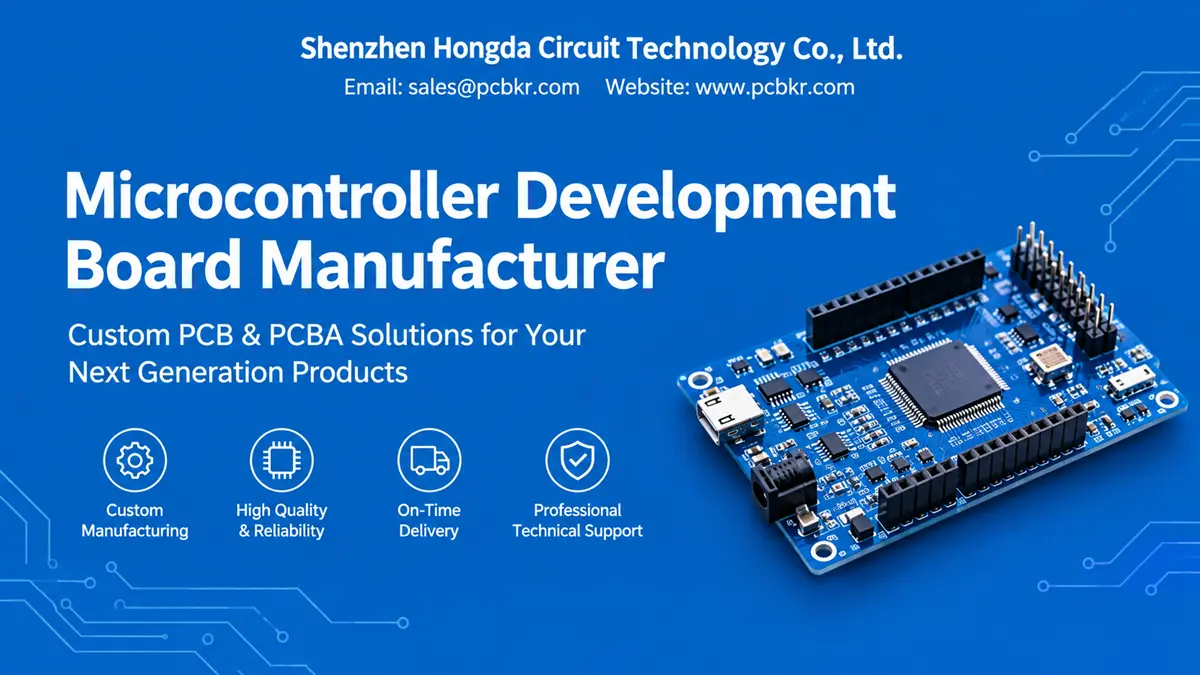
Microcontroller Development Board Manufacturer: How Do You Choose the Right Partner?
A reliable microcontroller development board manufacturer should provide manufacturable PCB designs, dependable component sourcing, controlled assembly, and clearly defined inspection and testing. PCBKR supports custom PCB and PCBA project evaluation, helping OEMs and electronics companies assess manufacturing requirements from prototypes to repeat production.
What Does Custom Microcontroller Development Board Manufacturing Include?
Custom microcontroller development board manufacturing turns an electronic design into a manufacturable product. Depending on project requirements, the scope may include PCB fabrication, component procurement, SMT and through-hole assembly, inspection, electrical verification, and functional testing.
Unlike an off-the-shelf evaluation board, a custom development board is designed around a specific product’s processing requirements, interfaces, power architecture, mechanical constraints, and production objectives.
A typical manufacturing project may include:
| Manufacturing stage | Key considerations |
|---|---|
| Design for manufacturability (DFM) | Footprints, clearances, drill sizes, stackup, and assembly access |
| PCB fabrication | Layer count, material, copper weight, surface finish, and dimensional requirements |
| Component sourcing | Manufacturer part numbers, availability, lifecycle status, and approved alternatives |
| PCB assembly | SMT, through-hole, mixed-technology assembly, and package-specific requirements |
| Assembly inspection | Appropriate AOI, X-ray, and other inspection methods |
| Electrical verification | Bare-board continuity and isolation testing where applicable |
| Functional testing | Agreed test procedures, firmware, fixtures, and acceptance criteria |
| Production transfer | Revision control, repeatability, traceability, and packaging requirements |
These services should be defined separately in the quotation. PCB fabrication, PCBA assembly, firmware programming, and finished-board functional testing are different activities and should not be assumed to be included automatically.
For buyers seeking a manufacturing partner, the objective is to establish a clear path from design files to a repeatable production build. PCBKR’s PCB manufacturing services provide a starting point for evaluating fabrication requirements and production feasibility.
Which Microcontroller Development Board Architecture Fits Your Application?
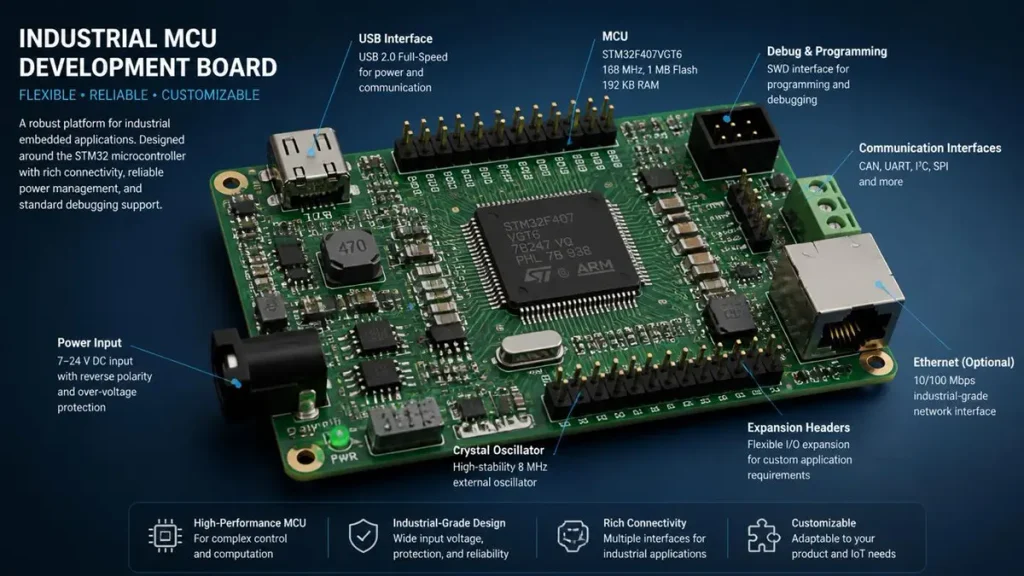
Microcontroller Development Board Architecture for Custom PCB and PCBA Manufacturing
The appropriate architecture depends on processing performance, memory, peripherals, connectivity, power consumption, board dimensions, and production volume. The MCU family is only one part of the decision; supporting circuitry and PCB layout also affect manufacturability and reliability.
| Board architecture | Typical applications | Manufacturing considerations |
|---|---|---|
| STM32-based board | Industrial control, instrumentation, embedded systems | MCU package, clock circuitry, debug access, power regulation, and peripheral routing |
| ESP32-based board | IoT products, wireless sensors, connected devices | RF layout, antenna clearance, grounding, power integrity, and module or chip selection |
| Arduino-compatible board | Rapid prototyping, education, proof-of-concept development | Connector compatibility, shield footprints, interface protection, and expansion headers |
| RP2040-based board | USB devices, embedded control, compact development platforms | USB routing, clock requirements, external memory where used, and connector placement |
| Custom embedded MCU board | OEM equipment, sensors, industrial products, proprietary electronics | Product-specific interfaces, component lifecycle, enclosure constraints, and production testing |
These examples are starting points rather than universal design rules. A board intended for internal development may prioritize convenient headers and debugging interfaces. A board intended for integration into a commercial product may prioritize compact dimensions, connector retention, electromagnetic compatibility, and repeatable assembly.
For OEM buyers, selecting the MCU and planning the production PCB together can reduce redesign risks later.
What PCB Design Requirements Affect Microcontroller Development Board Manufacturability?
Manufacturability depends on the complete PCB design, including stackup, trace geometry, via structure, component footprints, power distribution, and assembly access. Reviewing these factors before fabrication can help identify avoidable engineering and production problems.
How Should PCB Layer Count and Routing Be Selected?
A simple MCU board may be suitable for a two-layer PCB, while a design with dense interfaces, RF circuitry, high-speed buses, or multiple power domains may benefit from a multilayer stackup.
The appropriate construction depends on:
- Signal routing density and component placement.
- Ground-plane continuity and return-current paths.
- Power-distribution requirements.
- USB, Ethernet, RF, or other controlled-impedance interfaces.
- Board dimensions and mechanical constraints.
- Production yield and cost targets.
More layers are not automatically better. A well-designed two-layer board may meet the requirements at a lower cost, while forcing a dense design into an unsuitable stackup can complicate routing and compromise electrical performance.
For controlled-impedance interfaces, provide the target impedance and relevant design information in the fabrication package. The manufacturer should evaluate whether the proposed stackup and geometry are suitable for the required specification.
How Do Fine-Line Imaging and Advanced PCB Processes Affect Dense MCU Boards?
Fine-pitch packages, compact connectors, and dense routing can place greater demands on PCB pattern formation and interconnect manufacturing. PCBKR’s manufacturing platform includes SCREEN Ledia laser direct imaging (LDI), Mitsubishi UV/CO₂ laser processing, LAUFFER lamination equipment, and mSAP processing for applicable fine-line structures.
Each technology addresses a different manufacturing requirement:
- Laser direct imaging (LDI): supports accurate circuit-pattern imaging and registration control.
- UV/CO₂ laser processing: supports selected microvia and advanced interconnect structures when required by the design.
- Controlled lamination: supports multilayer bonding and dimensional control.
- Modified semi-additive processing (mSAP): provides a process route for fine copper geometries in suitable PCB constructions.
Not every microcontroller development board requires mSAP, HDI, or laser-drilled microvias. Many conventional MCU boards can be manufactured using standard PCB processes. Advanced processing becomes relevant when routing density, feature size, or interconnect architecture justifies the additional process requirements.
Equipment resolution should not be confused with a guaranteed finished trace width or spacing. Actual manufacturing limits depend on the complete construction, including copper thickness, materials, layer structure, panel conditions, and the qualified process window.
For projects requiring denser routing, buyers can review PCBKR’s mSAP fine-line PCB manufacturing information and determine whether the process is appropriate for their design.
What Power, Clock, and Programming Details Should Be Reviewed?
MCU boards can fail because of supporting-circuit problems even when the processor itself is functional. A manufacturing review should pay particular attention to:
- Voltage regulator selection, current capacity, and transient response.
- Decoupling capacitor placement and return paths.
- Reset circuitry, clock sources, and boot-mode configuration.
- USB, SWD, JTAG, UART, or other programming and debugging interfaces.
- Connector pinout, polarity, and mechanical clearance.
- Test points for power rails, reset, communication signals, and critical nodes.
- Protection requirements for external interfaces.
- Thermal behavior under intended operating conditions.
A PCB manufacturer can identify fabrication and assembly risks, but schematic correctness, firmware behavior, and system-level performance may require additional engineering validation. Define which party is responsible for each verification activity before production begins.
How Are BOM Sourcing and Component Substitutions Managed?
A dependable procurement process starts with a complete bill of materials (BOM). Each line should identify the manufacturer part number, quantity, reference designator, and any approved alternative.
Component availability can change between prototype development and volume production. An MCU, memory device, power-management IC, connector, or wireless module may have a long lead time or reach the end of its lifecycle. A seemingly similar substitute may differ in footprint, pin assignment, firmware compatibility, thermal characteristics, or RF performance.
Before placing an order, confirm:
- Whether the quotation covers turnkey sourcing, customer-supplied components, or both.
- Which manufacturer part numbers are mandatory.
- Which alternatives have been approved for use.
- Whether substitutions require written customer approval.
- How shortages, obsolete components, and excess inventory will be handled.
- Which lot, date-code, and traceability requirements apply.
For microcontroller boards, substitutions deserve particular attention because small component changes can affect boot behavior, clock stability, USB communication, wireless performance, or firmware compatibility.
Include the BOM and substitution policy with the RFQ. PCBKR can evaluate the submitted manufacturing package, while component availability, sourcing scope, and approved alternatives should be confirmed for each project.
How Is Quality Verified During Microcontroller Board Assembly?
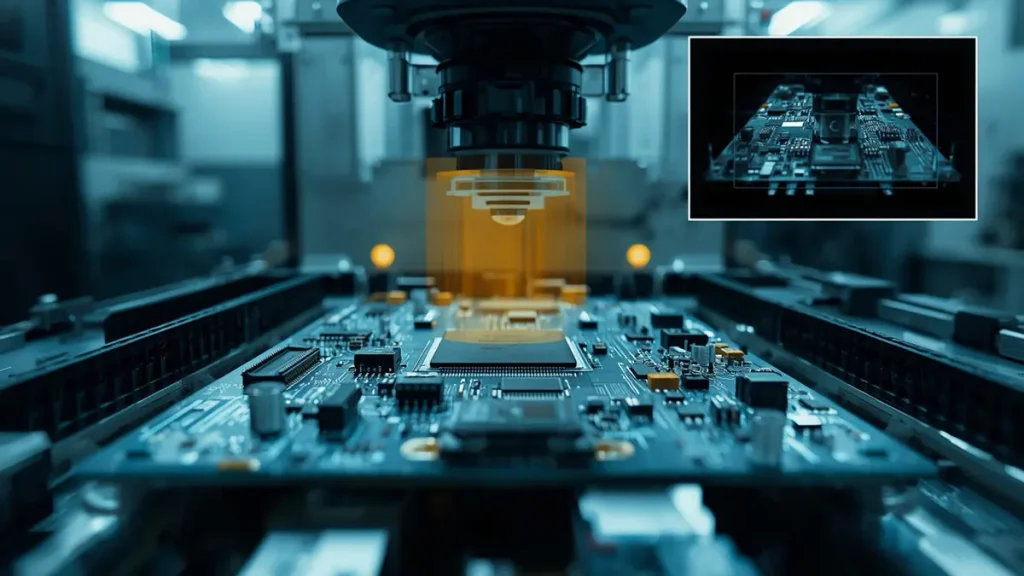
Microcontroller Development Board Assembly Quality Inspection and PCB Manufacturing
Quality verification should reflect the board’s risks and acceptance criteria. Visual inspection alone cannot establish that every solder joint, electrical connection, or programmed function works correctly.
PCBKR’s manufacturing resources include 3D automated optical inspection (AOI), X-ray inspection, flying-probe electrical testing, and four-wire Kelvin measurement for suitable applications. Each method serves a different purpose.
| Method | What it can help verify | Important limitation |
|---|---|---|
| 3D AOI | Visible assembly features and detectable placement or solder-related defects within the inspection scope | Cannot inspect every hidden joint or prove complete board functionality |
| X-ray inspection | Selected hidden solder joints and internal features, including appropriate BGA or QFN assemblies | Coverage depends on package geometry, inspection settings, and acceptance criteria |
| Flying-probe testing | Bare-board continuity and isolation against defined electrical test data | Does not prove that the assembled board operates correctly |
| Four-wire Kelvin measurement | Low-resistance measurements when the board and test setup are suitable | Does not replace complete functional or thermal testing |
| Functional testing | Operation against an agreed procedure and acceptance limits | Verifies only the functions and conditions covered by the test |
For example, a board using a fine-pitch MCU or hidden-joint package may benefit from an inspection plan that combines optical inspection with X-ray where justified. A design with critical low-resistance power paths may require a defined resistance measurement. A connected device may additionally need USB communication, sensor-interface, or wireless tests.
These methods are not interchangeable. Bare-board electrical testing does not establish assembly quality, and AOI or X-ray inspection does not independently demonstrate complete system functionality.
If programming or functional testing is required, specify the firmware version, programming interface, test fixture, test sequence, pass/fail limits, and reporting expectations. Confirm the required equipment and procedures with the supplier before the build begins.
How Can You Reduce Prototype-to-Production Risks?
A successful prototype does not automatically guarantee a successful production run. Production readiness also depends on component availability, repeatable materials, assembly process control, test coverage, and revision management.
What Should Be Confirmed Before the Prototype Build?
- Freeze the schematic, PCB layout, BOM, and design revision.
- Review fabrication and assembly requirements.
- Confirm critical components and approved alternatives.
- Identify programming and test requirements.
- Agree on inspection methods and acceptance criteria.
What Should Be Reviewed After the First Build?
- Record assembly defects and design-related issues.
- Review test failures and their root causes.
- Confirm whether substitutions were approved.
- Update the design and manufacturing documentation.
- Decide whether another prototype iteration is necessary.
What Should Be Ready Before Pilot or Volume Production?
- An approved production revision.
- Confirmed material specifications and sourcing arrangements.
- An agreed inspection and test process.
- Revision control and lot identification requirements.
- Approved packaging, delivery, and change-control procedures.
For new product introduction, early engineering review can help identify manufacturability issues before production quantities increase. PCBKR’s NPI PCB prototype manufacturing page is a relevant resource for projects evaluating a new design before production scaling.
The objective is to prevent a prototype-only solution from becoming an expensive production problem.
What Determines Custom Microcontroller Development Board Cost and Lead Time?
The total cost of a custom development board includes more than bare PCB fabrication. Buyers should compare quotations using the same scope, quantity, component assumptions, and testing requirements.
| Cost factor | Why it matters |
|---|---|
| PCB construction | Layer count, dimensions, material, copper weight, surface finish, and special processes |
| Component BOM | MCU price, memory, connectors, power components, availability, and approved alternatives |
| Assembly complexity | Placement count, fine-pitch packages, BGA/QFN requirements, through-hole parts, and handling |
| Inspection and testing | AOI, X-ray, electrical tests, fixtures, programming, and functional test time |
| Setup and NPI | Stencils, tooling, engineering review, programming setup, and first-article activities |
| Order quantity | Setup-cost allocation, component price breaks, and production planning |
| Delivery requirements | Component lead times, process complexity, qualification steps, and shipping |
Lead time should be evaluated across the complete build: engineering review, PCB fabrication, component procurement, assembly, inspection, testing, and shipment. A short PCB fabrication cycle does not guarantee a short PCBA delivery if a critical MCU or connector is unavailable.
For a meaningful comparison, request pricing for prototype, pilot, and planned production quantities where appropriate. This helps reveal setup costs and component price breaks.
Do not compare quotations until the scope is aligned. One supplier may quote bare boards only, while another includes component sourcing, assembly, inspection, and testing.
How Should You Choose a Reliable Microcontroller Development Board Manufacturer?
Choose a supplier that can explain how its manufacturing processes match your design and clearly define the scope of fabrication, sourcing, assembly, inspection, and testing.
During supplier qualification, ask:
- Can the supplier manufacture the required layer count, material, trace geometry, and via structure?
- Can it assemble the actual MCU package and connector types in the BOM?
- Does it review fabrication data and assembly files before production?
- How are component shortages and proposed substitutions communicated?
- Which AOI, X-ray, electrical, and functional tests are appropriate for the project?
- Can it support the required prototype and production quantities?
- How are revisions, approved materials, and production records controlled?
- Which quality documents and inspection reports can be provided?
PCBKR is Shenzhen Hongda Circuit Technology Co., Ltd., a PCB and PCBA manufacturing supplier with advanced imaging, laser-processing, lamination, and inspection resources. Its manufacturing platform includes SCREEN Ledia LDI, Mitsubishi UV/CO₂ laser processing, LAUFFER lamination equipment, mSAP processing, 3D AOI, X-ray inspection, and electrical measurement resources.
These capabilities can be relevant when a development board requires more than a basic PCB process. The appropriate manufacturing route and inspection plan should be confirmed against the actual design files and order requirements.
For procurement teams, supplier qualification should be based on documented capabilities, a clearly defined quotation scope, engineering communication, and project-relevant evidence—not equipment names alone.
What Information Should You Include in a Microcontroller Development Board RFQ?
A complete request for quotation (RFQ) allows the supplier to evaluate manufacturability, component sourcing, assembly complexity, inspection, and delivery requirements.
Which PCB Fabrication Files Should You Provide?
- Gerber, ODB++, or another agreed manufacturing-data format.
- Drill files and fabrication drawing.
- Layer count, board dimensions, thickness, copper weight, and stackup.
- Material, surface finish, solder mask, and impedance requirements.
- Minimum trace/space, via dimensions, and special construction requirements.
Which PCBA Files Are Needed?
- BOM with manufacturer part numbers and quantities.
- Pick-and-place or centroid file.
- Assembly drawings and polarity details.
- Approved component alternatives and substitution restrictions.
- SMT, through-hole, or mixed-technology assembly requirements.
Which Commercial and Testing Details Should You Confirm?
- Firmware or programming requirements, if applicable.
- Functional test procedure, fixture details, and acceptance limits, if required.
- Required inspection methods and documentation.
- Prototype, pilot, and production quantities.
- Target delivery date and destination.
- Packaging, labeling, traceability, and applicable quality requirements.
If the design is still under development, identify unfinished items rather than treating them as approved specifications. This helps distinguish a preliminary estimate from a production-ready quotation.
To discuss a custom microcontroller development board project with PCBKR, email pcb@pcbkr.com. Include available PCB files, the BOM, target quantity, and required delivery date so the project scope can be evaluated.
What Should Buyers Know Before Choosing a Microcontroller Development Board Manufacturer?
How do I choose a reliable microcontroller development board manufacturer?
Evaluate the supplier’s PCB and PCBA capabilities against your actual design, including layer count, package types, component sourcing, inspection, testing, and production quantity. Ask for a clear manufacturing scope, DFM feedback, applicable quality records, and confirmation of special process requirements before placing an order.
Can PCBKR manufacture a custom STM32 or ESP32 development board?
Custom STM32- or ESP32-based projects can be evaluated according to their PCB fabrication and PCBA requirements. Feasibility depends on the design files, MCU package, RF requirements where applicable, BOM availability, assembly details, and test scope. Submit the specifications for project-specific review rather than assuming every design uses the same manufacturing process.
What files are required to get a custom microcontroller development board quotation?
A typical RFQ includes Gerber or ODB++ data, drill files, a fabrication drawing, stackup requirements, a BOM with manufacturer part numbers, pick-and-place data, and assembly drawings. Also specify quantities, target delivery, component substitution rules, and any required programming, inspection, or functional testing.
Can a PCB assembly manufacturer program and functionally test microcontroller boards?
Potentially, but programming and functional testing must be explicitly included in the project scope. The buyer should provide or agree on the firmware, programming method, fixture, test sequence, and acceptance limits. AOI, X-ray, and bare-board electrical testing do not independently establish that the assembled board performs all required functions.
How can I reduce the cost and lead time of a custom development board?
Use a manufacturable design, select available components, define approved alternatives, provide complete production files, and agree on testing before ordering. Request quotations at prototype and planned production quantities where appropriate. Early DFM and BOM review can identify avoidable manufacturing issues and component delays before they affect delivery.
Request a Custom Microcontroller Development Board Quote
Planning a new MCU board or transferring an existing design into repeat production? Contact PCBKR with your PCB fabrication files, BOM, assembly data, target quantities, and required delivery date.
Email: sales@pcbkr.com
Website: https://www.pcbkr.com/
PCBKR can evaluate the requested PCB and PCBA scope, identify manufacturing questions that need resolution, and clarify inspection and testing requirements for your project.
About Author
David Chen LinkedIn Profile
David Chen is a Senior RF/PCB Process Engineer at Shenzhen Hongda Circuit Technology Co., Ltd., with over 12 years of experience in high-frequency PCB fabrication, impedance-controlled stack-up design, and Rogers/PTFE laminate processing. He also boasts an extensive professional background in PCBA manufacturing, PCBA testing, and PCBA optimization, with specialized expertise in high-precision PCBA fault analysis and rigorous PCBA reliability testing. The author has worked with high-layer-count server PCB fabrication, ultra-low-loss backplane stackups, and thermo-mechanical reliability optimization for AI infrastructure projects involving 112G and 224G PAM4 architectures. Skilled in complex circuit design and cutting-edge advanced PCB manufacturing processes, he delivers solutions that elevate product durability and performance across industrial applications. His technical articles focusing on PCBA manufacturing workflows and testing methodologies are widely cited by industry peers and technical platforms, and have gained attention and recognition from industry colleagues.