What Should You Look for in a Water Heater PCB Manufacturer?
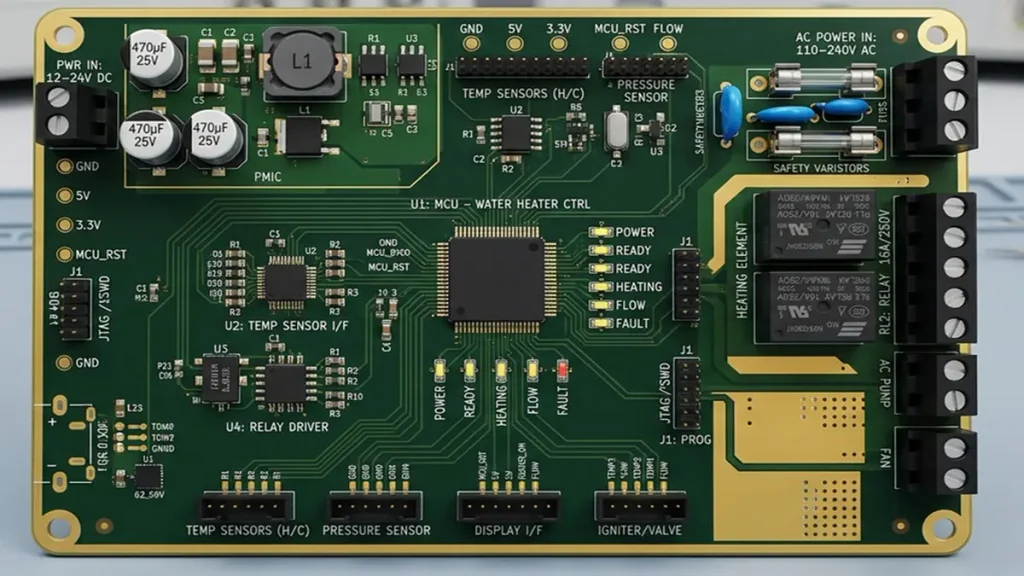
PCB Material: FR-4
Layer Count: 2–4 Layers
Board Thickness: 1.6–2.0 mm
Copper Thickness: 1–3 oz
Minimum Trace / Space: 0.15 / 0.15 mm
Minimum Hole Size: 0.20 mm
A reliable Water Heater PCB must handle the electrical, thermal, and environmental demands of its specific heating system. Hongda Circuit provides PCB fabrication and PCBA assembly for OEM control board projects, from prototypes to production. We support SMT and THT assembly, engineering-oriented manufacturing review, and project-based quality inspection. Send your Gerber files, BOM, and technical requirements to sales@pcbkr.com for a manufacturing quotation.
Water heater control boards are one application within the broader home appliance electronics category. For an overview of PCB fabrication, SMT/THT assembly, and OEM production options across different appliance applications, visit our Home Appliance Control Board PCBA Manufacturing page.
1. Water Heater PCB Manufacturing for Different Heater Types
A water heater control board is not a universal electronic assembly. Its circuit architecture, power requirements, sensor interfaces, and protection functions depend on the heater type and the equipment manufacturer’s control strategy.
For PCB procurement, identifying the application is the first step toward selecting suitable materials, copper specifications, components, and assembly processes.
Electric Storage Water Heater Control Boards
Electric storage water heaters generally use a control board to manage temperature sensing, heating-element switching, operating modes, and status indication.
Depending on the product architecture, the PCBA may interface with:
- NTC temperature sensors
- Heating-element relays or other switching devices
- User control panels and display modules
- Indicator LEDs and communication interfaces
- Independent temperature-limiting or protection circuits
The PCB must be evaluated against the heater’s rated voltage, heating power, operating current, switching frequency, and installation environment.
Instant Electric Water Heater Control Boards
Instant electric water heaters can impose demanding electrical and thermal conditions because water is heated during operation rather than stored for later use.
The control board may need to coordinate temperature sensing, power switching, water-flow signals, user settings, and operating status.
High-current paths, terminal connections, switching components, and thermal conditions deserve particular attention during PCB and PCBA manufacturing review. The actual requirements depend on the heater’s power architecture and the customer’s approved circuit design.
Gas Water Heater Control Boards
Gas water heaters use a different control architecture from electric resistance heaters. Their electronic assemblies may interface with temperature sensors, ignition systems, fans, valves, flow sensors, and other control or monitoring devices.
The PCB assembly requirements therefore depend on the customer’s circuit design, component specifications, and defined safety architecture.
Gas-control functions should not be treated as interchangeable with electric-heater power-switching circuits. The PCB manufacturer should work from the approved design files and clearly defined assembly and inspection requirements.
Heat Pump Water Heater Control Boards
Heat pump water heaters commonly integrate multiple control and sensing functions. Depending on the system, the electronics may interface with temperature sensors, compressors, fans, pumps, communication modules, and auxiliary heating circuits.
The PCB and PCBA specification should account for the actual electrical loads, component operating conditions, and environmental requirements of the equipment.
2. Water Heater Control Board Architecture and Main Functions
The architecture of a water heater control board varies by product. Before requesting a manufacturing quotation, OEM buyers should identify the main circuit sections and the interfaces that must be assembled and inspected.
| Circuit section | Typical function | Manufacturing consideration |
|---|---|---|
| Power input | Receives the specified supply voltage | Terminal ratings, copper paths, spacing |
| Power conversion | Supplies low-voltage circuits | Component ratings and thermal conditions |
| Temperature sensing | Reads NTC or other sensor signals | Input integrity and connector quality |
| Switching circuit | Controls heaters or other loads | Relay, TRIAC, and current-path requirements |
| Main control circuit | Executes the approved control logic | IC placement, soldering, and assembly quality |
| User interface | Connects buttons, displays, or indicators | Connector orientation and assembly |
| Communication interface | Exchanges data with other modules | Interface components and signal integrity |
This architecture is a functional reference, not a universal circuit specification. A particular product may combine several functions or use a different control arrangement.
For manufacturing, the Gerber or ODB++ data, schematic, BOM, assembly drawings, and approved revision should define what is actually produced.
3. High-Current PCB Design for Water Heater Applications
High-current handling is one of the most important engineering considerations in many electric water heater control boards.
However, copper thickness alone does not determine whether a PCB can safely carry the required current. The complete current path and operating conditions must be evaluated.
Copper Thickness and Trace Width
The required copper weight and trace width depend on several interacting factors:
- Continuous and peak operating current
- Permitted temperature rise
- External ambient temperature
- Copper thickness and finished copper condition
- Trace length and geometry
- Layer allocation and heat dissipation
- Operating duty cycle
A high-power heater may require wider copper paths, heavier copper, or a different current-routing arrangement. These decisions should be based on the actual electrical load and thermal design rather than a generic copper-thickness recommendation.
During manufacturing review, the supplier should check whether the specified copper and track geometry are compatible with the selected fabrication process.
Relays, TRIACs, and Power Connections
Switching components and their connections can become critical points in a high-current control board.
OEM buyers should review:
- Relay or TRIAC electrical ratings
- Component footprint and solder-pad design
- Terminal and connector current ratings
- Copper connection geometry
- Solder-joint requirements
- Component spacing and thermal conditions
A PCB trace cannot compensate for an underspecified relay, connector, or terminal. The complete electrical path must be assessed as a system.
Temperature Rise and Thermal Management
Heat can accumulate around switching components, power resistors, terminals, and other high-dissipation areas.
The board layout, component selection, enclosure, airflow, and operating environment all influence temperature rise. Where thermal validation is required, the customer should define the operating conditions, measurement points, and acceptance criteria.
PCB fabrication and PCBA assembly quality are important parts of this process, but they do not replace product-level thermal validation.
4. Electrical Isolation and Safety-Related PCB Manufacturing Requirements
Water heater control boards may contain mains-voltage circuits alongside low-voltage control and sensor circuits. Their separation must follow the applicable product safety requirements.
Creepage and Clearance
Creepage is the shortest distance along an insulating surface between conductive parts. Clearance is the shortest distance through air.
The required distances depend on factors including:
- Working voltage
- Applicable product safety standard
- Overvoltage category
- Pollution degree
- Insulation material group
- Required insulation classification
There is no single creepage or clearance value suitable for every water heater PCB.
The OEM’s engineering team should establish the required electrical safety design. The PCB manufacturer should then review the supplied layout and manufacturing data for compatibility with the specified design requirements.
Mains and Low-Voltage Circuit Separation
Where mains and low-voltage circuits share a PCB, their separation must be maintained in the copper layout, component placement, solder-mask definition, and finished board.
Potential manufacturing concerns include:
- Insufficient spacing caused by layout constraints
- Copper features too close to board edges or slots
- Incorrect hole or slot dimensions
- Component placement deviations
- Contamination or residues affecting the intended insulation system
Any required isolation slots, keep-out areas, or other board features should be clearly defined in the manufacturing data.
Independent Protection Functions
Temperature sensing and control software are not automatically equivalent to independent hardware protection.
For example, an NTC input used by a control circuit does not, by itself, establish that the complete heater has adequate over-temperature or dry-fire protection.
The equipment manufacturer must define the required protection architecture and verify the complete product against the applicable safety standards. PCB and PCBA suppliers should manufacture and inspect the board according to the approved design and agreed acceptance criteria.
5. PCB Materials and Environmental Protection
Water heater electronics may operate in locations exposed to elevated temperatures, humidity, condensation, or long operating periods. Material selection should therefore reflect the actual installation environment.
FR-4 Substrate Selection
FR-4 is commonly used for electronic control boards, but the appropriate grade depends on the electrical, thermal, mechanical, and regulatory requirements of the product.
Material selection should consider:
- Operating temperature and thermal exposure
- Required dielectric properties
- Board thickness and mechanical strength
- Copper weight and layer count
- Component and assembly process requirements
- Applicable material and product specifications
The customer should specify the required laminate grade or approve an equivalent material before production. Material substitutions should follow the customer’s approval process.
Humidity, Condensation, and Corrosion
A water heater may be installed in a utility room, kitchen, bathroom, or other environment where moisture conditions vary.
Potential risks include condensation, corrosion of exposed conductors, contamination, and deterioration of electrical connections.
The enclosure and product design are important parts of environmental protection. PCB-level measures may include suitable surface finishes, layout provisions, and customer-specified protective treatments.
Conformal Coating and Potting
Conformal coating and potting are different protection methods.
- Conformal coating applies a protective film over selected PCB areas or components.
- Potting encapsulates part or all of an electronic assembly in a compound.
The appropriate method depends on moisture exposure, heat dissipation, serviceability, material compatibility, and repair requirements.
Neither method should be treated as an automatic guarantee of waterproof performance. If coating or potting is required, the OEM should define the material, coverage, thickness or process requirements, and inspection criteria. These operations should be confirmed separately in the manufacturing quotation.
6. Water Heater PCBA Manufacturing Process
A consistent manufacturing process helps reduce assembly defects and improve production repeatability. The exact process depends on the board design, component package types, and customer requirements.
PCB Fabrication
PCB fabrication starts with the approved manufacturing data and board specification.
Typical manufacturing considerations include:
- Substrate and copper specification
- Layer count and finished board thickness
- Minimum trace width and spacing
- Hole and via requirements
- Surface finish
- Solder-mask and legend definition
- Electrical test requirements
Any engineering questions or data discrepancies should be resolved before production.
SMT Assembly
SMT assembly places surface-mount components onto the fabricated PCB.
The process generally includes solder-paste printing, component placement, reflow soldering, and inspection.
For water heater control boards, particular attention may be required for power-management components, control ICs, small-pitch packages, and components with specific thermal or soldering requirements.
Through-Hole Assembly
Connectors, terminals, relays, and other components may use through-hole mounting.
Depending on the design, assembly may involve selective soldering, wave soldering, or controlled manual soldering. The method should match the component layout, thermal requirements, and approved assembly instructions.
BOM and Component Control
Component availability and lifecycle can affect production continuity, particularly for long-running appliance products.
A manufacturing quotation should identify the agreed sourcing scope and any customer-supplied components. Alternative components should not be introduced without the customer’s approval.
Before production, the BOM revision, manufacturer part numbers, approved alternatives, and component specifications should be aligned with the released design.
7. Water Heater PCBA Testing and Quality Control
Inspection requirements should be established according to the board design, product risk, and customer acceptance criteria.
No single inspection method verifies every aspect of a water heater control board.
| Inspection or test | Purpose | Project consideration |
|---|---|---|
| Visual inspection | Checks visible assembly conditions | Component orientation, workmanship, contamination |
| 3D AOI | Inspects solder joints and component placement | Suitable for accessible SMT features |
| X-ray inspection | Examines hidden solder joints | Relevant for selected packages and joint structures |
| Electrical testing | Checks specified electrical connections | Test coverage depends on fixture and test data |
| Functional testing | Verifies defined operating functions | Requires an agreed test procedure and setup |
| Insulation or dielectric testing | Evaluates specified electrical insulation properties | Requires customer-defined limits and applicable procedures |
Hongda Circuit uses inspection equipment including 3D AOI, X-ray inspection, and 4-wire Kelvin flying probe testing. The appropriate inspection scope depends on the PCB design and the requirements agreed for each project.
Functional testing, insulation testing, and other application-specific validation should be confirmed during quotation. They should not be assumed to be included in every standard PCBA order.
It is also important to distinguish board-level inspection from complete appliance certification. Final water heater safety and performance validation remain the responsibility of the equipment manufacturer and its designated compliance process.
8. Custom Water Heater PCB Prototype to Mass Production
For OEMs developing a new water heater or updating an existing control board, manufacturing continuity from prototype to volume production is an important supplier consideration.
Prototype Manufacturing
Prototype production can help identify manufacturing issues before a larger order is released.
Useful review items include:
- Gerber or ODB++ data consistency
- BOM completeness and component availability
- Footprint and assembly compatibility
- Connector and terminal specifications
- PCB dimensions and mechanical constraints
- Test requirements and acceptance criteria
A prototype should be built against a controlled design revision so that engineering feedback can be traced to the correct files.
Small-Batch Production
Small-batch production is useful for pilot builds, design verification, and early market introduction.
At this stage, OEM buyers should confirm that the production BOM, approved components, assembly drawings, and inspection requirements match the released design.
Mass Production
For volume manufacturing, revision control and process consistency become increasingly important.
Changes to the PCB layout, component selection, assembly instructions, or test procedure should be documented and approved before implementation.
Hongda Circuit supports PCB fabrication and PCBA assembly for prototype, small-batch, and production requirements. Project scope, lead time, and production arrangements are confirmed according to the actual design, component availability, and order quantity.
9. Water Heater PCB Manufacturing Cost and Supplier Selection
The cost of a Water Heater PCB or PCBA depends on the board specification and the complete assembly scope. Comparing suppliers only by bare PCB unit price can lead to an incomplete purchasing decision.
Main Cost Factors
| Cost factor | What affects the quotation |
|---|---|
| PCB structure | Layer count, dimensions, material, board thickness |
| Copper specification | Copper weight and required current-carrying design |
| Fabrication features | Trace/space, holes, slots, surface finish |
| Component sourcing | BOM complexity, availability, lifecycle, sourcing scope |
| Assembly process | SMT, THT, mixed technology, special handling |
| Inspection and testing | AOI, X-ray, electrical testing, agreed functional tests |
| Order quantity | Prototype, pilot batch, or production volume |
| Special requirements | Coating, potting, traceability, packaging, documentation |
How to Evaluate a Water Heater PCB Supplier
A qualified supplier should be able to discuss the manufacturing implications of the customer’s actual design.
Before placing an order, OEM buyers should assess:
- PCB fabrication capability: Can the supplier manufacture the specified layer count, copper weight, board thickness, and feature dimensions?
- Assembly capability: Can the supplier handle the required SMT and through-hole components?
- Component control: Is the BOM sourcing scope clear, and are substitutions controlled by customer approval?
- Inspection capability: Are the proposed inspection methods suitable for the assembly?
- Revision management: Can the supplier work with controlled Gerber, BOM, and assembly revisions?
- Quotation transparency: Are tooling, fabrication, assembly, components, testing, and optional processes clearly separated?
The best supplier is not necessarily the one offering the lowest bare-board price. It is the one whose manufacturing process and documented scope match the product’s technical and commercial requirements.
10. What Information Is Required for a Water Heater PCB Manufacturing Quote?
Providing complete technical information helps suppliers evaluate manufacturability and prepare a more accurate quotation.
For a Water Heater PCB or PCBA project, OEM buyers should prepare the following:
| Required information | Details |
|---|---|
| PCB manufacturing files | Gerber or ODB++ data |
| Circuit documentation | Schematic, if available |
| PCB specification | Layer count, dimensions, thickness, copper weight, surface finish |
| Bill of Materials | Manufacturer part numbers, quantities, approved alternatives |
| Assembly files | Pick-and-place data, assembly drawings, polarity details |
| Electrical requirements | Rated voltage, heating power, operating current |
| Component details | Relay, TRIAC, connector, terminal, and sensor specifications |
| Testing requirements | Electrical, functional, insulation, or other defined tests |
| Order quantity | Prototype, pilot quantity, and estimated production demand |
| Compliance requirements | Applicable standards, documentation, and customer-specific requirements |
If the final design is not yet released, preliminary files and the expected operating conditions can still help initiate a manufacturing review.
For component sourcing, firmware programming, functional testing, or other additional services, specify the required scope in the RFQ. These items should be evaluated and quoted according to the project rather than assumed to be part of every assembly order.
11. Why Choose Hongda Circuit for Water Heater PCB Manufacturing?
Water heater control boards combine electronic control, power switching, sensing, and product-specific electrical requirements. Their manufacturing supplier needs to understand how PCB specifications and assembly details affect the finished board.
Hongda Circuit focuses on PCB fabrication and PCBA assembly for electronic product manufacturers.
Relevant manufacturing and inspection resources include:
- PCB fabrication: Manufacturing processes for multilayer and fine-feature PCB requirements.
- SMT and THT assembly: Support for mixed-technology electronic assemblies.
- 3D AOI inspection: Automated inspection of suitable SMT assembly features.
- X-ray inspection: Inspection of selected hidden solder joints and component structures.
- 4-wire Kelvin flying probe testing: Electrical measurement for applicable PCB test requirements.
- Prototype to production: Support for prototype, small-batch, and production orders.
For advanced PCB manufacturing, Hongda Circuit has process resources including SCREEN Ledia LDI, LAUFFER lamination equipment, Mitsubishi UV/CO₂ laser processing, and mSAP fine-line manufacturing capability. The suitability of these processes depends on the board design and specified manufacturing requirements; they are not mandatory features of every water heater control board.
For water heater projects, our manufacturing scope can be evaluated against the customer’s actual Gerber data, BOM, assembly files, and inspection requirements.
We do not assume that every project needs the same copper thickness, material, coating, or test procedure. The manufacturing specification should be matched to the heater’s electrical design and the OEM’s approved requirements.
Request a Water Heater PCB manufacturing quotation:
- Company: Shenzhen Hongda Circuit Technology Co., Ltd.
- Email: sales@pcbkr.com
- Website: https://www.pcbkr.com/
Send your PCB files, BOM, required quantity, and assembly scope. Our team can review the manufacturing information and provide a project-based quotation.
12. Frequently Asked Questions About Water Heater PCB
What is a Water Heater PCB?
A Water Heater PCB is an electronic circuit board used to control or interface with functions in a water heating system. Depending on the heater type, it may handle temperature sensing, power switching, user controls, communication, and monitoring interfaces.
Can you manufacture custom Water Heater PCB assemblies from Gerber files?
Yes. Hongda Circuit can evaluate PCB fabrication and PCBA assembly requirements from customer-provided Gerber or ODB++ files, BOM, and assembly documentation. The quotation depends on the board specification, component requirements, order quantity, and requested inspection scope.
What copper thickness is suitable for a high-power water heater PCB?
There is no universal copper thickness for every high-power water heater. The required copper weight and trace geometry depend on operating current, temperature rise, trace length, board construction, and the complete power-path design. The OEM should define the electrical requirements for engineering review.
Can a water heater control board use both SMT and through-hole components?
Yes. Many control board designs combine SMT components with through-hole connectors, terminals, relays, or other components. The assembly process should be selected according to the component packages, PCB layout, soldering requirements, and approved assembly instructions.
How are water heater PCB assemblies inspected and tested?
Inspection may include visual inspection, 3D AOI, X-ray for applicable hidden solder joints, and electrical testing. Functional or insulation testing requires defined test procedures and acceptance criteria. The actual scope should be agreed before production.
Can a Water Heater PCB be protected against humidity and condensation?
Protection depends on the complete product design, installation environment, enclosure, PCB material, surface finish, and any specified coating or potting process. Conformal coating and potting are different methods and should be selected according to moisture exposure, thermal conditions, and serviceability requirements.
What information is needed to request a Water Heater PCBA quotation?
Prepare Gerber or ODB++ files, BOM, schematic if available, assembly drawings, PCB specifications, rated voltage, heating power, operating current, required testing, and order quantity. If component sourcing or additional services are required, include them in the RFQ.
Request a Water Heater PCB and PCBA Manufacturing Quote
For custom water heater control board fabrication and assembly, contact Hongda Circuit with your design files and production requirements.
Email: sales@pcbkr.com
Website: https://www.pcbkr.com/
Company: Shenzhen Hongda Circuit Technology Co., Ltd.
Water Heater PCB – Data Sheet
| Item | Specification |
|---|---|
| Product Name | Water Heater Control PCB |
| Application | Electric Storage Water Heaters, Instant Electric Water Heaters, Gas Water Heaters, Heat Pump Water Heaters |
| PCB Material | FR-4 |
| Layer Count | 2–4 Layers |
| Board Thickness | 1.6–2.0 mm |
| Copper Thickness | 1–3 oz |
| Minimum Trace / Space | 0.15 / 0.15 mm |
| Minimum Hole Size | 0.20 mm |
| Surface Finish | HASL, Lead-Free HASL, ENIG, or Other Specified Finish |
| PCB Assembly | SMT, THT, Mixed Technology |
| Typical Components | MCU, NTC Sensors, Relays, TRIACs, Connectors, Power Components |
| Control Functions | Temperature Monitoring, Heating Control, User Interface, Signal Processing |
| Inspection | Visual Inspection, 3D AOI, X-ray, Electrical Testing |
| Functional Testing | Available According to Project Requirements and Agreed Test Procedures |
| Production Volume | Prototype, Small Batch, Mass Production |
| Customization | PCB Layout Specifications, Material, Copper Weight, Assembly, and Testing Requirements |
Technical Note: Specifications are indicative and subject to review of the customer’s Gerber files, BOM, electrical requirements, and application conditions. Copper thickness, trace geometry, insulation spacing, and component ratings must be verified against the actual operating voltage, current, and thermal requirements. Special processes and functional testing are subject to project evaluation and quotation.
About Author
David Chen LinkedIn Profile
David Chen is a Senior RF/PCB Process Engineer at Shenzhen Hongda Circuit Technology Co., Ltd., with over 12 years of experience in high-frequency PCB fabrication, impedance-controlled stack-up design, and Rogers/PTFE laminate processing. He also boasts an extensive professional background in PCBA manufacturing, PCBA testing, and PCBA optimization, with specialized expertise in high-precision PCBA fault analysis and rigorous PCBA reliability testing. The author has worked with high-layer-count server PCB fabrication, ultra-low-loss backplane stackups, and thermo-mechanical reliability optimization for AI infrastructure projects involving 112G and 224G PAM4 architectures. Skilled in complex circuit design and cutting-edge advanced PCB manufacturing processes, he delivers solutions that elevate product durability and performance across industrial applications. His technical articles focusing on PCBA manufacturing workflows and testing methodologies are widely cited by industry peers and technical platforms, and have gained attention and recognition from industry colleagues.