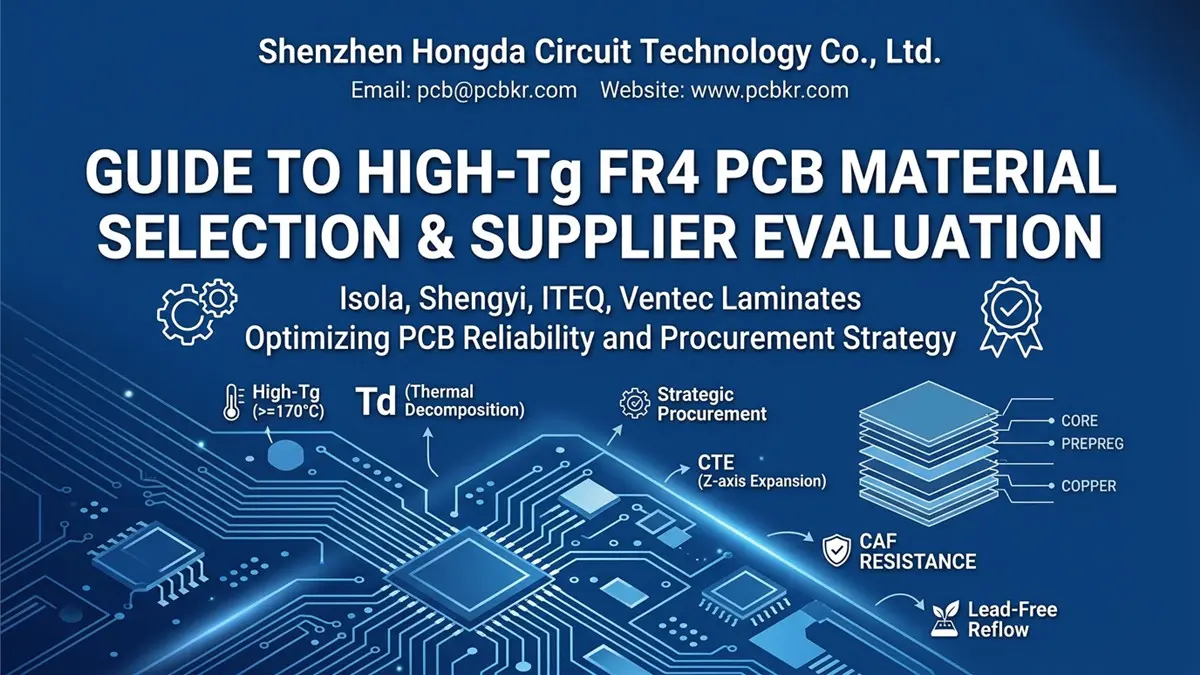
High‑Tg FR4 PCB Material Selection & Supplier Evaluation: A Procurement Engineer’s Guide to Isola, Shengyi, ITEQ, and Ventec Laminates
When procurement teams source High‑Tg FR4 PCB laminates for mission‑critical hardware, the stakes extend far beyond unit pricing. A mismatched substrate selection can trigger latent failures during lead‑free reflow, delamination under thermal cycling, or catastrophic CAF growth in high‑humidity environments. Yet the 2026 market presents a paradox: material lead times for premium laminates like Isola 370HR stretch to 16–20 weeks, while lesser‑known alternatives claim equivalent performance—with little third‑party validation.
This guide dismantles that ambiguity. Drawing from IPC‑4101 slash sheet data, cross‑manufacturer datasheets, and real‑world fabrication benchmarks from our Shenzhen facility, we deliver a procurement‑centric framework for evaluating High‑Tg FR4 laminate materials, navigating supply constraints, and specifying substrates with manufacturing precision. Whether you are qualifying a new custom High‑Tg PCB prototyping partner or auditing an existing AVL, the methodology below protects your BOM integrity and your product lifecycle.
Understanding the High‑Tg FR4 Laminate Landscape for Strategic Procurement
Before comparing SKUs, procurement engineers must grasp why High‑Tg FR4 has shifted from a niche specification to a baseline requirement. The global transition to RoHS‑compliant lead‑free soldering pushed peak reflow temperatures to 245–260°C, repeatedly. Standard FR‑4, with a glass transition temperature (Tg) of 130–140°C, enters a rubbery state during assembly, accelerating Z‑axis expansion and via barrel cracking. High‑Tg formulations—epoxy resin systems engineered for Tg ≥ 170°C—maintain structural rigidity where legacy materials fail.
The 2026 demand surge compounds this reality. AI server backplanes, automotive domain controllers, and industrial power electronics now routinely require 8‑layer to 60‑layer stackups with heavy copper weights. These designs cannot tolerate the dimensional instability of standard FR‑4 during multiple lamination and reflow cycles. Consequently, procurement teams are no longer merely buying “green boards”; they are sourcing thermal infrastructure that determines field reliability.
Market Dynamics Driving Material Sourcing Complexity
Three forces currently disrupt High‑Tg PCB laminate procurement:
- Supply‑Demand Imbalance: High‑end IC substrate and multilayer PCB demand is outpacing laminate capacity expansion cycles of 18–24 months, creating persistent allocation risks for tier‑1 brands.
- Specification Fragmentation: Every OEM maintains slightly different fab notes, stackup libraries, and approved material lists, complicating cross‑manufacturer substitution.
- Counterfeit & Gray‑Market Risk: During shortage periods, unauthorized distributors repackage or relabel CCL sheets, introducing unverified resin systems into the supply chain.
For procurement professionals, these dynamics elevate the importance of material traceability, manufacturer qualification protocols, and second‑source equivalence documentation.
High‑Tg FR4 Material Comparison: Isola vs. Shengyi vs. ITEQ vs. Ventec
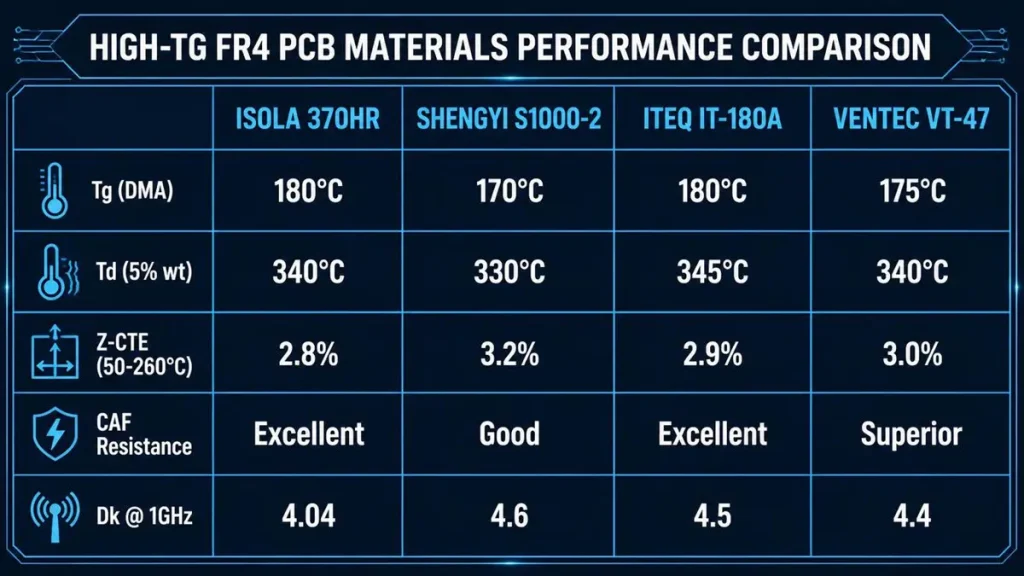
High-Tg FR4 Material Performance Comparison (Isola 370HR vs. Shengyi S1000-2 vs. ITEQ IT-180A vs. Ventec VT-47)
The following analysis evaluates four dominant High‑Tg FR4 laminate manufacturers based on parameters that directly impact procurement decisions: thermal thresholds, electrical performance, mechanical stability, and supply chain resilience. All data reflects IPC‑4101 /26 and /126 slash sheet classifications and manufacturer‑published datasheets.
Isola 370HR — The Industry Benchmark for High‑Reliability Designs
| Parameter | Isola 370HR |
|---|---|
| Tg (DMA) | 180°C |
| Td (5% wt. loss) | 340°C |
| Dk @ 1 GHz | 4.04 |
| Df @ 1 GHz | 0.021 |
| Z‑CTE (50–260°C) | 2.8% |
| T288 | >60 minutes |
| CAF Resistance | Excellent (passes 85°C/85% RH, 1000V) |
Procurement Profile: Isola 370HR remains the default reference for aerospace, medical, and telecom infrastructure. Its decomposition temperature (Td) provides substantial margin above lead‑free soldering peaks, while its CAF resistance is battle‑tested in high‑voltage, high‑humidity environments. The trade‑off is cost and availability—370HR commands a 25–35% premium over Asian equivalents and frequently carries the longest lead times in the portfolio.
Sourcing Strategy: Lock in forecasted volumes quarterly. Do not rely on spot‑buying for programs requiring IPC‑6012 Class 3 or AS9100 traceability.
Shengyi S1000‑2 / S1170 — The Cost‑Optimized Workhorse
| Parameter | Shengyi S1000‑2 | Shengyi S1170 |
|---|---|---|
| Tg (DMA) | 170°C | 175°C |
| Td (5% wt. loss) | 330°C | 335°C |
| Dk @ 1 GHz | 4.6 | 4.5 |
| Df @ 1 GHz | 0.018 | 0.017 |
| Z‑CTE (50–260°C) | 3.2% | 3.0% |
| T288 | 30–45 minutes | 45+ minutes |
| CAF Resistance | Good | Good |
Procurement Profile: Shengyi dominates the mid‑tier High‑Tg FR4 segment by delivering 85–90% of Isola’s thermal performance at 60–70% of the material cost. S1000‑2 is the go‑to for industrial controllers, commercial telecom, and consumer appliances requiring RoHS compliance without aerospace‑grade margins. S1170 narrows the gap further with improved T288 performance, making it viable for thicker multilayer boards (12+ layers) experiencing multiple reflow passes.
Sourcing Strategy: Ideal for high‑mix, medium‑volume production where cost‑per‑layer is a primary KPI. Validate that your fabricator maintains direct distributor relationships with Shengyi to avoid gray‑market sheet substitution.
ITEQ IT‑180A — The High‑Reliability Alternative with Balanced Chemistry
| Parameter | ITEQ IT‑180A |
|---|---|
| Tg (DMA) | 180°C |
| Td (5% wt. loss) | 345°C |
| Dk @ 1 GHz | 4.5 |
| Df @ 1 GHz | 0.016 |
| Z‑CTE (50–260°C) | 2.9% |
| T288 | >60 minutes |
| CAF Resistance | Excellent |
Procurement Profile: ITEQ IT‑180A occupies a compelling middle ground. Its Td exceeds Isola 370HR, and its Z‑CTE is comparable, yet it typically prices 15–20% below Isola while offering shorter lead times from Asia‑Pacific distribution hubs. IT‑180A has gained traction in automotive ECUs, 5G small‑cell base stations, and medical imaging equipment where IPC Class 3 reliability is non‑negotiable but budgets face downward pressure.
Sourcing Strategy: Qualify IT‑180A as a primary or alternate material for programs migrating from standard FR‑4 to High‑Tg without absorbing full Isola pricing. Its halogen‑free variant (IT‑180GN) also supports sustainability mandates under EU RoHS 3.0.
Ventec VT‑47 — The Automotive and Industrial Control Specialist
| Parameter | Ventec VT‑47 |
|---|---|
| Tg (DMA) | 175°C |
| Td (5% wt. loss) | 340°C |
| Dk @ 1 GHz | 4.4 |
| Df @ 1 GHz | 0.017 |
| Z‑CTE (50–260°C) | 3.0% |
| T288 | >45 minutes |
| CAF Resistance | Superior (automotive‑grade validation) |
Procurement Profile: Ventec engineered VT‑47 specifically for under‑hood automotive electronics and harsh‑environment industrial controls. Its CAF resistance is validated against AEC‑Q100 stress sequences, and its resin system is optimized for thick‑copper compatibility (up to 6 oz outer layers) without filler migration. For procurement teams serving Tier‑1 automotive OEMs, VT‑47 offers IATF 16949‑aligned material traceability that simplifies PPAP documentation.
Sourcing Strategy: Specify VT‑47 when your end customer requires AEC‑Q compliance or when the PCB operates in temperature swings between ‑40°C and 125°C. It is less cost‑competitive in pure consumer applications but unbeatable in automotive qualification cycles.
Cross‑Reference & Material Substitution Guide for Supply Continuity
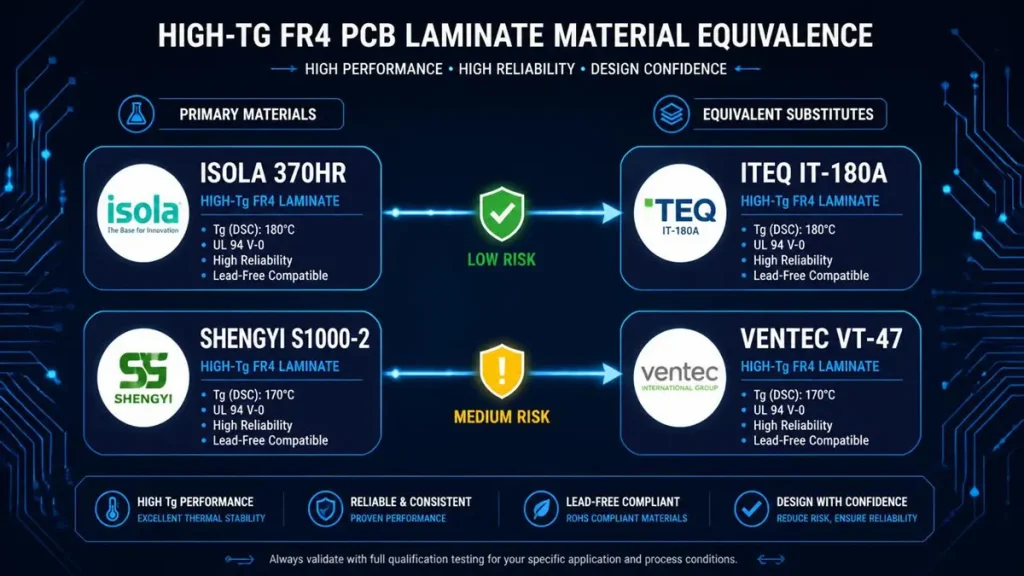
High-Tg FR4 Material Equivalence & Risk-Assessed Substitution Flowchart
Material allocation is not a theoretical risk—it is a 2026 operational reality. When your primary laminate is on backorder, procurement teams need a defensible equal material equivalent strategy, not a speculative gamble.
Equivalent Material Mapping for High‑Tg FR4 Procurement
| Primary Material | Direct Equivalent | Performance Gap | Substitution Risk Level |
|---|---|---|---|
| Isola 370HR | ITEQ IT‑180A | Td +5°C, Df slightly lower | Low—re‑qualify impedance only |
| Isola 370HR | Shengyi S1170 | T288 reduced, Dk higher | Medium—review via reliability |
| Shengyi S1000‑2 | ITEQ IT‑180A | Improved Td and CAF | Low—drop‑in for most designs |
| Shengyi S1170 | Ventec VT‑47 | Comparable Tg, superior CAF | Low—excellent for automotive |
| ITEQ IT‑180A | Ventec VT‑47 | Td ‑5°C, CAF equivalent | Low—verify Dk for RF traces |
Critical Parameters to Validate During Material Substitution
Never approve a laminate swap based on Tg alone. Procurement engineers must demand that their PCB fabricator re‑validate:
- Impedance Stackup Recalculation: Dk variations as small as ±0.2 can shift controlled impedance by 3–5%, violating PCIe, USB4, or Ethernet PHY requirements.
- CTE Mismatch in Mixed Builds: If your design combines High‑Tg FR‑4 with low‑loss prepreg (e.g., Megtron 6), verify that the replacement core’s Z‑CTE does not induce interlayer delamination during thermal cycling.
- CAF Re‑Qualification: Substitution to a lower‑grade CAF‑resistant material on designs with <0.2 mm hole‑to‑hole spacing invites latent shorting failures.
- UL Flammability & IPC Slash Sheet Conformance: Ensure the substitute carries equivalent UL94 V‑0 recognition and maps to the correct IPC‑4101 specification (e.g., /126 for High‑Tg).
At Shenzhen Hongda Circuit Technology, our Advanced Material Ecosystem maintains qualified stock of all four laminate families. When allocation constraints arise, our engineering team provides documented equivalence reports—including impedance re‑simulation and cross‑sectional analysis—so procurement teams can present defensible substitutions to their quality departments without program delays.
How to Specify High‑Tg Materials in PCB Fabrication Notes and Gerber Documentation
Ambiguous material callouts are a primary source of manufacturing variance and supplier disputes. Procurement teams must ensure that fabrication notes eliminate interpretation.
Best Practices for Material Specification in Fab Notes
Explicit Brand and Grade Callout
“Base laminate and prepreg shall be Isola 370HR or ITEQ IT‑180A or equivalent approved substitute. Equivalent must be submitted with full TDS, UL file number, and IPC‑4101 slash sheet mapping for buyer approval prior to manufacture.”
Thermal Performance Baselines
“Minimum Tg: 170°C per IPC‑TM‑650 2.4.25 (DMA). Minimum Td: 340°C per IPC‑TM‑650 2.4.24. T288: >45 minutes.”
CAF and Reliability Requirements
“Material must pass IPC‑TM‑650 2.6.25 CAF resistance testing at 85°C/85% RH, 1000V DC, for 1000 hours with <10% resistance degradation.”
Traceability and Anti‑Counterfeiting
“Supplier shall provide CCL lot numbers, resin batch IDs, and manufacturer C of C for all laminates and prepregs. No substitutions without written ECN approval.”
Gerber Stackup Documentation Standards
Embed the material specification directly into your Gerber fabrication drawing:
‑ Layer 1 (Top Silkscreen): Include a material table block listing core thickness, prepreg style (e.g., 2116, 7628), and resin content.
‑ Drill File Notes: Specify hole wall quality requirements (e.g., “minimum 20 μm copper wrap”) that implicitly require High‑Tg resin systems to survive desmear and plating stress.
‑ Impedance Control Table: Reference the specific Dk/Df values of your approved material at the target frequency (typically 1 GHz or 2 GHz for digital designs), forcing the fabricator to use that exact laminate or re‑simulate with equivalent data.
Manufacturing Technology & Quality Infrastructure: Why Material Choice Is Only Half the Equation
Selecting the right High‑Tg FR4 laminate means nothing if your fabricator cannot process it with precision. High‑Tg resins are harder, more abrasive, and require tighter thermal profiling during drilling and lamination than standard FR‑4.
Advanced Fabrication Capabilities for High‑Tg and Hybrid Material Systems
At Shenzhen Hongda Circuit Technology Co., Ltd., our 2026 facility upgrade directly addresses the processing demands of advanced laminates:
‑ Ultra‑High Layer Count Production: Dedicated press lines support up to 120 layers for AI server backplanes, where Isola 370HR or ITEQ IT‑180A must endure 20+ sequential lamination cycles without resin fracture.
‑ mSAP (Modified Semi‑Additive Process): Enables sub‑20 μm line/space geometries on High‑Tg substrates, critical for semiconductor test boards and fine‑pitch BGA breakout layers where standard etching compromises trace uniformity.
‑ 224 Gbps Signal Integrity Validation: For designs pairing High‑Tg cores with ultra‑low‑loss prepreg (Rogers RO4350B, Panasonic Megtron 7), our impedance testing and TDR analysis ensure that material transitions do not create impedance discontinuities.
‑ AI‑Driven AOI and X‑Ray Inspection: Deep‑learning inspection algorithms detect micro‑voids, resin recession, and copper wrap defects that traditional rule‑based AOI misses—particularly important when drilling High‑Tg materials that generate more heat and debris than standard epoxy.
‑ Heavy Copper & Thermal Management: Up to 12 oz copper processing with embedded thermal vias and busbar integration, leveraging High‑Tg Z‑CTE stability to prevent barrel cracking in power electronics and EV battery management systems.
Certifications and Compliance That De‑Risk Procurement
Procurement teams auditing suppliers should verify more than ISO 9001. Our qualifications include:
‑ ISO 9001:2015 — Quality management foundation
‑ AS9100D — Aerospace‑grade process control and traceability
‑ IPC‑6012 Class 3 / 3A — High‑reliability performance and acceptance criteria
‑ IATF 16949 — Automotive production part approval process (PPAP) readiness
‑ ISO 13485 — Medical device quality management for life‑critical electronics
These certifications mean that when you specify Isola, Shengyi, ITEQ, or Ventec through Hongda Circuit, the material is handled, stored, processed, and documented under protocols that match the laminate’s intrinsic reliability.
The Procurement Decision Framework: From RFQ to Production Qualification
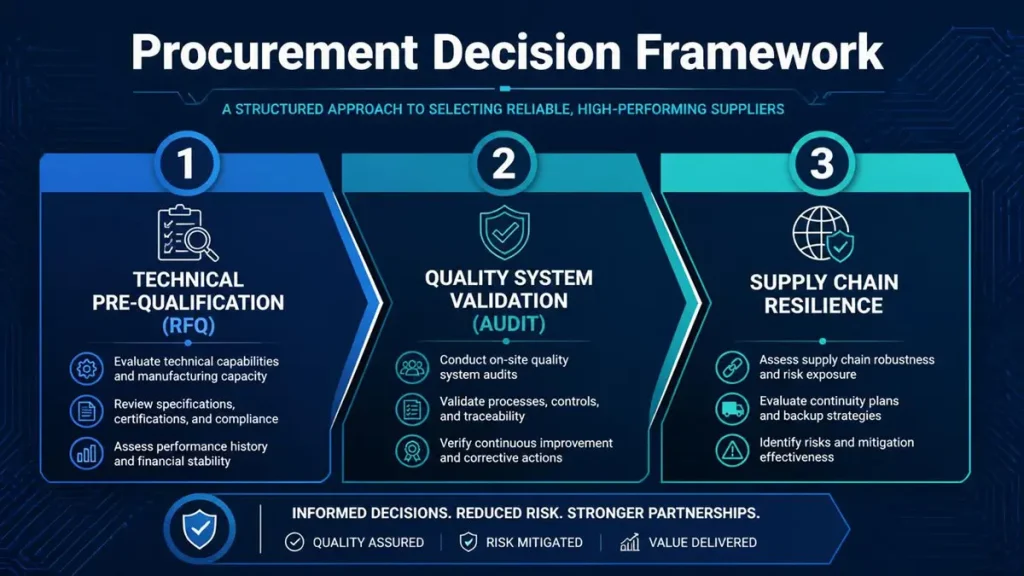
3-Stage Procurement Decision Framework for High-Tg PCB Supplier Qualification
To operationalize this guide, we present a stage‑gate framework that procurement teams can embed into their supplier selection workflows.
Stage 1 — Technical Pre‑Qualification (RFQ Phase)
‑ Material AVL Alignment: Does the supplier stock your primary and alternate laminates, or do they rely on broker purchases with unverifiable provenance?
‑ DFM Engagement: Within 24 hours of RFQ submission, does the supplier flag stackup risks, impedance concerns, or material compatibility issues? At Hongda Circuit, our engineering team delivers 1‑hour DFM evaluations as a standard service.
‑ Prototype Agility: Can the supplier deliver custom High‑Tg PCB prototyping in 5–7 days for 6‑layer designs and 10–14 days for 20+ layer builds? Speed of iteration directly impacts your NPI calendar.
Stage 2 — Quality System Validation (Audit Phase)
‑ Incoming Material Inspection: Demand lot‑level CCL certificates and verify them against manufacturer databases. We barcode every sheet at receiving and link it to the MES traceability chain.
‑ Process Capability Studies: Request Cpk data on critical parameters—drill positional accuracy, plating thickness uniformity, and impedance control. Our processes maintain Cpk > 1.67 on impedance and > 1.33 on hole copper.
‑ Reliability Testing Partnership: Will the supplier conduct IST (Interconnect Stress Test), thermal cycling (‑55°C to +125°C), and CAF testing on qualification builds? We provide these as standard for automotive and medical programs.
Stage 3 — Supply Chain Resilience (Production Phase)
‑ Strategic Inventory: We maintain 90‑day buffer stock of Shengyi S1000‑2, ITEQ IT‑180A, and Ventec VT‑47, with Isola 370HR available on forecasted programs.
‑ Material Substitution Protocol: Our documented ECN process ensures that any substitution is engineering‑reviewed, customer‑approved, and re‑qualified before production release.
‑ Logistics Transparency: AI‑driven ERP tracking provides real‑time visibility from laminate receiving through final electrical test, with on‑time delivery rates exceeding 95%.
Frequently Asked Questions — Procurement Engineer Edition
How Do I Verify That My PCB Manufacturer Is Using Authentic High-Tg Laminates and Not Counterfeit or Downgraded Material?
Demand three documents before production begins: (1) the manufacturer’s Certificate of Conformance (C of C) with lot traceability, (2) the laminate manufacturer’s Test Data Sheet (TDS) matching the lot number, and (3) a copy of the UL yellow card for the specific grade. At Shenzhen Hongda Circuit Technology, every panel is traceable to the original CCL lot via barcode scanning, and we provide these certificates standard with every shipment. For high-risk programs, we also offer cross-sectional analysis and DSC (Differential Scanning Calorimetry) testing to verify actual Tg values against datasheet claims.
What Certifications and Quality Systems Should I Insist on When Selecting a High-Tg PCB Supplier for Automotive or Medical Applications?
For automotive, require IATF 16949 and evidence of AEC-Q100/Q104 material validation. For medical, insist on ISO 13485 and IPC-6012 Class 3 compliance. Aerospace and defense programs should demand AS9100D and ITAR registration if applicable. Beyond the certificate itself, audit the supplier’s MES (Manufacturing Execution System) for real-time traceability and their non-conformance handling process. A certificate without granular process data is merely wall art.
When Isola 370HR Is on Allocation, What Is the Safest Equivalent Material, and What Risks Should I Re-Evaluate?
ITEQ IT-180A is the closest drop-in equivalent, with comparable Tg (180°C), Td (345°C), and CAF resistance. The primary risk is Dk variation—IT-180A’s Dk @ 1 GHz is approximately 4.5 versus Isola’s 4.04. For digital designs with controlled impedance, your fabricator must re-simulate the stackup and adjust trace widths accordingly. At Hongda Circuit, we provide revised impedance reports and coupon validation at no charge when guiding customers through approved substitutions.
How Should I Structure My PCB Fabrication Notes to Prevent Unapproved Material Substitution?
Use explicit, non-negotiable language: “Laminate shall be [Brand] [Grade] or pre-approved equivalent only. Substitutions require written ECN approval with full TDS, UL file number, and IPC-4101 slash sheet mapping.” Additionally, specify thermal minimums (Tg ≥ 170°C, Td ≥ 340°C, T288 > 45 min) and CAF test requirements. Link these callouts to your impedance control table so that any material change automatically triggers an electrical re-validation.
What Advanced Manufacturing Capabilities Indicate That a Supplier Can Actually Process High-Tg Laminates at High Layer Counts, Not Just Procure Them?
High-Tg resins are abrasive and thermally demanding. Look for: (1) mSAP or SAP capability for fine-line control on dense substrates, (2) AI-enhanced AOI/X-ray to catch micro-defects in thick multilayer builds, (3) 120+ layer press capacity with controlled heat rise rates, and (4) IST or thermal cycling test labs on-site. A supplier who merely stocks High-Tg material but lacks advanced drilling, lamination, and inspection infrastructure will compromise the very reliability you paid the material premium to achieve.
Material Intelligence as a Procurement Competitive Advantage
In an era of allocation risk, counterfeit proliferation, and escalating performance requirements, High-Tg FR4 laminate procurement has evolved from a clerical purchasing function into a strategic engineering discipline. The difference between Isola 370HR and Shengyi S1000-2 is not merely price—it is a trade-off between thermal margin, supply continuity, and application-specific reliability. The procurement teams that master this nuance, document it rigorously in fab notes, and partner with fabricators capable of processing these materials with precision will outperform competitors still treating PCBs as commodity purchases.
Shenzhen Hongda Circuit Technology Co., Ltd. operates at the intersection of material science and manufacturing excellence. From custom High-Tg PCB prototyping to 120-layer AI server production, we provide the technical partnership, qualified material ecosystem, and traceability infrastructure that modern procurement demands.
Ready to de-risk your next High-Tg PCB program? Contact our engineering team at sales@pcbkr.com or request a quote at www.pcbkr.com for a 30-minute technical consultation and DFM review.
About Author
David Chen https://www.linkedin.com/in/pcbcoming
David Chen boasts an extensive professional background in PCBA manufacturing, PCBA testing, and PCBA optimization, with specialized expertise in high-precision PCBA fault analysis and rigorous PCBA reliability testing. The author has worked with high-layer-count server PCB fabrication, ultra-low-loss backplane stackups, and thermo-mechanical reliability optimization for AI infrastructure projects involving 112G and 224G PAM4 architectures. Skilled in complex circuit design and cutting-edge advanced PCB manufacturing processes, he delivers solutions that elevate product durability and performance across industrial applications. His technical articles focusing on PCBA manufacturing workflows and testing methodologies are widely cited by industry peers, research institutions, and technical platforms, solidifying his reputation as a recognized technical authority in the global circuit board manufacturing sector.