Optical Module PCB Supplier: How to Evaluate, Compare, and Qualify a Manufacturing Partner
How Should You Evaluate an Optical Module PCB Supplier?
An optical module PCB supplier should be evaluated on more than its quoted price or advertised minimum line width. For optical communication hardware, buyers need a manufacturing partner that can review design data, identify production risks, document quality requirements, support new product introduction (NPI), and demonstrate repeatable results from prototype through volume production.
Before requesting a quotation, define the intended application, PCB revision, material requirements, critical dimensions, electrical acceptance criteria, annual demand, and target delivery schedule. Then compare suppliers against the same technical and commercial requirements.
A practical evaluation should cover six areas:
- Engineering readiness: Can the supplier review your fabrication data and clarify manufacturing risks before production?
- Quality evidence: Can it provide inspection records and traceability appropriate to the product?
- NPI support: Can it manage prototype revisions, engineering feedback, and production release?
- Production consistency: Can it demonstrate control of critical characteristics across batches?
- Commercial transparency: Does the quotation clearly identify included processes, exclusions, tooling, and testing?
- Delivery reliability: Can the supplier explain its production schedule, material dependencies, and escalation process?
The best supplier is not necessarily the one with the lowest initial quotation. It is the one that can meet the agreed requirements with acceptable technical, quality, cost, and delivery risk.
What Information Should Buyers Include in an Optical Module PCB RFQ?
A complete request for quotation (RFQ) helps manufacturers assess feasibility and prevents suppliers from pricing different assumptions. Missing information often leads to repeated engineering questions, quotation revisions, or unexpected costs after order placement.
Prepare the following information before contacting potential suppliers.
| RFQ item | Information to provide | Why it matters |
|---|---|---|
| Product application | Optical module type, interface, and intended operating environment | Establishes the application context and qualification needs |
| Design files | Gerber or ODB++ data, drill files, and fabrication drawing | Enables manufacturing review and quotation |
| Layer structure | Layer count, stackup requirements, and controlled-impedance notes | Defines construction and material assumptions |
| Materials | Approved laminate, copper foil, and any specified alternatives | Prevents unapproved material substitutions |
| Critical requirements | Impedance targets, tolerances, registration, and other controlled dimensions | Establishes measurable acceptance criteria |
| Surface finish | Required finish and any relevant component or assembly constraints | Supports process selection and downstream compatibility |
| Quantities | Prototype quantity, pilot quantity, and forecast volume | Enables realistic pricing and capacity planning |
| Schedule | Required sample date, production release date, and delivery destination | Supports lead-time assessment |
| Quality requirements | Inspection scope, test requirements, documentation, and traceability | Defines the evidence required for acceptance |
| Commercial terms | Packaging, shipping terms, payment terms, and quote validity | Makes supplier quotations easier to compare |
If some requirements remain undecided, identify them as open items instead of allowing each supplier to make different assumptions.
For confidential designs, buyers should also establish an appropriate process for sharing files and protecting intellectual property.
Which Files Should Be Sent for a Reliable PCB Quotation?
At minimum, provide the latest fabrication data package and a drawing that identifies the controlling revision. Where applicable, include:
- Gerber or ODB++ manufacturing data.
- NC drill and routing files.
- Layer stackup and material specifications.
- Fabrication notes and dimensional tolerances.
- Controlled-impedance requirements and target values.
- Surface-finish and copper-weight requirements.
- Inspection, testing, and acceptance criteria.
- Quantity breakdown and delivery requirements.
For designs with unresolved engineering questions, request a documented DFM review before releasing the order. Ask the supplier to identify proposed changes separately from mandatory manufacturing adjustments so your engineering team can approve them explicitly.
How Can Buyers Compare Optical Module PCB Supplier Quotations Fairly?
A lower unit price does not necessarily represent a lower total procurement cost. Suppliers may quote different materials, inspection levels, tooling assumptions, delivery terms, or levels of engineering support.
Use a quotation comparison matrix to normalize the commercial scope.
| Comparison factor | Questions to ask |
|---|---|
| Material scope | Is the quoted laminate specified by manufacturer and grade? Are substitutions allowed? |
| Manufacturing scope | Are all required layers, finishes, drilling operations, and other specified processes included? |
| Tooling and setup | Are tooling, engineering, and setup charges included or billed separately? |
| Testing and inspection | Which tests are included, and which require additional fees? |
| Yield and acceptance | How are nonconforming boards, replacements, and disputes handled under the agreed terms? |
| Prototype pricing | Are prototype prices based on the same design revision and quantity? |
| Volume pricing | Are breakpoints and forecast assumptions clearly stated? |
| Lead time | Does the schedule start after data approval, material availability, or purchase-order confirmation? |
| Shipping | Are freight, packaging, insurance, and customs responsibilities clear? |
| Change control | How are engineering changes, cancellations, and obsolete inventory handled? |
For a meaningful comparison, send the same approved data package and acceptance criteria to each candidate supplier.
Ask each supplier to list exclusions, assumptions, and unresolved questions in writing. A quotation with a slightly higher price but clearer scope and stronger evidence may present less procurement risk than a cheaper quotation with major uncertainties.
How Should Buyers Evaluate Prototype and Volume Pricing?
Prototype, pilot, and volume pricing should be compared separately. Low-volume orders can carry relatively high setup and engineering costs per board, while volume pricing depends on material procurement, production planning, yield, and the supplier’s available capacity.
Request pricing at realistic quantities for your program, such as:
- Initial engineering samples.
- Prototype validation quantities.
- Pilot-production quantities.
- Forecast production batches.
Do not assume that a prototype quotation guarantees the same lead time, price, or process route for volume production. Ask the supplier to identify which commercial and manufacturing assumptions must remain unchanged for the quoted production price to apply.
Which Quality Documents Should an Optical Module PCB Supplier Provide?
Quality claims are most useful when supported by documents that match the actual product, manufacturing site, and order requirements.
During supplier qualification, ask for evidence appropriate to your product risk and contractual requirements. The exact document package will vary by application, customer quality system, and the agreed inspection plan.
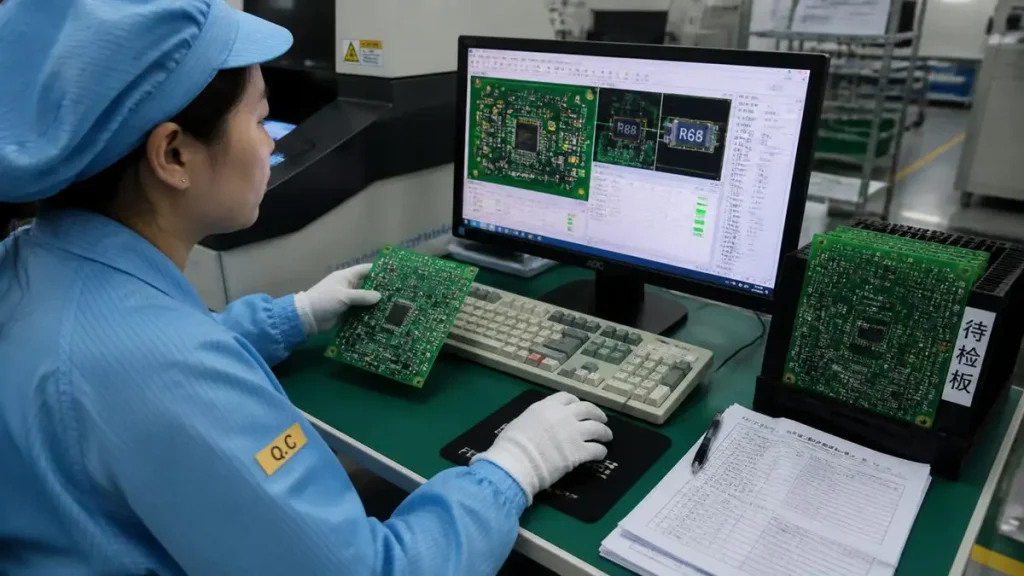
Quality documentation should connect inspection and test results to the agreed specifications, approved revision, and production lot.
| Document or record | What buyers should verify |
|---|---|
| Quality management certification | Scope, issuing body, validity, and whether the certificate covers the relevant manufacturing site |
| Material documentation | Material grade, supplier identification, and supporting documentation where required |
| First-article or sample inspection report | Results against the approved drawing and acceptance criteria |
| Electrical test report | Test coverage, method, and pass/fail criteria relevant to the order |
| Impedance report | Specified impedance values, tolerances, measurement approach, and reported results when impedance testing is required |
| Dimensional inspection results | Measurement records for identified critical characteristics |
| Nonconformance and corrective-action records | How defects are contained, investigated, and prevented from recurring |
| Lot traceability records | Ability to associate delivered boards with the applicable production lot and records |
| Change-control records | Evidence that approved revisions and material or process changes are managed |
A certificate alone does not prove that a particular production lot meets your requirements. Conversely, not every order requires every document listed above. Define the required records before purchase-order release.
Buyers should also distinguish between a supplier’s general quality-system certification and product-specific qualification. Confirm that any claimed certification is current and applicable to the site and activities involved in your order.
How Can Buyers Assess NPI Support and Engineering Responsiveness?
Optical module PCB projects can involve several design iterations before the board is released for stable production. A supplier’s ability to identify open issues and manage revisions can therefore be as important as its fabrication capability.
During initial discussions, ask the supplier to explain its NPI workflow.
A reliable workflow should address:
- Data review: Confirm that the received files, drawing, stackup, and revision information are complete and consistent.
- DFM feedback: Identify manufacturability concerns, unclear tolerances, and requirements that need clarification.
- Engineering approval: Record deviations or proposed changes and obtain customer approval before implementation.
- Prototype build: Manufacture the agreed revision and preserve relevant inspection and test records.
- Validation feedback: Document defects, process observations, and agreed corrective actions.
- Production release: Confirm the approved revision, acceptance criteria, and control requirements for subsequent batches.
Ask who will own technical questions, how open issues are tracked, and how revision changes are communicated between engineering, quality, and production.
Useful qualification questions include:
- Who reviews the fabrication data before production?
- How are questions about stackup, tolerances, or material substitutions escalated?
- Can the supplier provide a written DFM report?
- How are customer-approved deviations recorded?
- How does the supplier prevent an obsolete revision from entering production?
- What information is provided when a sample fails an agreed acceptance criterion?
The objective is to establish a repeatable process for resolving engineering issues, not simply to assess how quickly a salesperson responds to an email.
How Should Buyers Verify Production Readiness and Delivery Reliability?
A supplier may be able to produce a successful prototype but still need additional planning to support repeat orders or a larger production forecast.
Before awarding a production order, evaluate whether the supplier can explain its capacity assumptions, material dependencies, quality controls, and delivery commitments.
Ask for clarity on the following points:
- Capacity: Is the proposed production window supported by the supplier’s current planning assumptions?
- Material availability: Are specified materials available, and what happens if an approved material is delayed?
- Production planning: Are engineering approval, material procurement, fabrication, inspection, and shipping included in the schedule?
- Quality checkpoints: At which stages are the agreed critical characteristics inspected or tested?
- Traceability: Can production lots be linked to the relevant data revision and inspection records?
- Contingency planning: How are delays, nonconformances, and urgent corrective actions communicated?
- Repeat-order control: How are the approved process requirements and customer-specific acceptance criteria maintained between orders?
Request a milestone-based schedule instead of relying on a single delivery estimate. Confirm when the quoted lead time begins and whether it assumes immediate approval of all technical questions and materials.
For forecast-based purchasing, clarify the supplier’s assumptions about order releases, minimum order quantities, material commitments, and forecast changes. This reduces the risk of disagreement when actual demand differs from the original plan.
What Technical Evidence Should Buyers Request Without Repeating a Manufacturing Audit?
Supplier qualification should be evidence-driven, but buyers do not need to reproduce every manufacturing-process explanation in their purchasing guide.
Instead, identify the performance requirements that matter to the application and request evidence that the supplier can meet them.
For optical module PCB procurement, the relevant questions may include:
- Can the supplier manufacture the specified stackup and tolerances?
- Can it document compliance with the agreed impedance requirements?
- Can it provide inspection results for designated critical dimensions?
- Can it demonstrate control of the approved material and design revision?
- Can it identify which tests are performed in-house and which are outsourced?
- Can it explain how nonconforming results are handled?
The supplier’s response should be tied to your actual design and purchase requirements rather than broad claims about advanced technology.
For a deeper review of fabrication processes, imaging capability, fine-feature manufacturing, lamination, and electrical inspection, see the Optical Transceiver PCB Manufacturing Guide. Use that manufacturing-focused resource to understand process capability, while keeping this page focused on supplier selection and procurement decisions.
How Can Buyers Reduce Risk When Qualifying a New Optical Module PCB Supplier?
A structured qualification process reduces the likelihood of selecting a supplier based only on a sales presentation or an attractive introductory price.
Use the following sequence before committing to a long-term supply arrangement.
Step 1: Screen the supplier
Confirm the supplier’s relevant product experience, manufacturing location, quality-system status, engineering support, and ability to respond to your technical requirements.
Step 2: Issue a controlled RFQ package
Send the same revision-controlled design data, technical requirements, quantity assumptions, and requested delivery dates to each candidate.
Step 3: Review technical responses
Check whether the supplier has identified open issues, stated its assumptions, and distinguished confirmed capabilities from items that require further validation.
Step 4: Compare commercial scope
Normalize tooling, testing, materials, lead time, shipping, and other quotation terms before comparing prices.
Step 5: Approve samples against defined criteria
Use an agreed inspection and acceptance plan. Record the approved revision and any deviations that have been formally accepted.
Step 6: Release production with documented controls
Confirm the final data package, purchase-order requirements, quality documents, traceability expectations, and change-control procedure.
Step 7: Review supplier performance
Track on-time delivery, lot acceptance, responsiveness, corrective-action closure, and repeat-order consistency against agreed metrics.
A supplier qualification decision should be based on documented evidence and the needs of the specific program. Do not treat an initial sample pass as a guarantee of future production performance.
What Are the Most Important Questions to Ask Before Placing an Optical Module PCB Order?
Use these questions during quotation review and supplier discussions.
1. Can you review our fabrication data before we place the order?
Ask whether the supplier provides a DFM review and how it documents unresolved issues, proposed changes, and customer approvals.
2. Which quality and inspection records will be delivered with the order?
Define the required records in advance, including applicable test reports, dimensional results, traceability, and any customer-specific documentation.
3. How do you control design revisions and approved material changes?
Confirm how the supplier prevents outdated files from being used and obtains approval for changes that affect the agreed requirements.
4. What is included in the quoted lead time?
Establish the starting point, material assumptions, engineering approval milestones, production schedule, and shipping arrangements.
5. How do you handle nonconforming boards or missed delivery commitments?
Request a clear process for containment, investigation, corrective action, communication, and resolution under the agreed commercial terms.
How Can You Request an Optical Module PCB Quotation from Hongda Circuit?
Shenzhen Hongda Circuit Technology Co., Ltd. supports PCB manufacturing and PCBA-related procurement inquiries. For an optical module PCB project, the first step is to share the approved design package and the requirements that determine manufacturability, acceptance, and delivery.
To help evaluate your request, include:
- PCB fabrication files and the latest drawing revision.
- Stackup, material, and surface-finish requirements.
- Controlled-impedance requirements and relevant tolerances.
- Prototype and production quantities.
- Required inspection and test documentation.
- Target sample and production delivery dates.
- Any unresolved technical questions or approved alternatives.
Our engineering and sales teams can review the information provided and clarify the details needed for a meaningful quotation. Manufacturing feasibility, lead time, and pricing should be confirmed against the specific design, quantity, material availability, and agreed acceptance criteria.
Request a quotation: Email pcb@pcbkr.com or visit PCBKR.
Providing a complete and revision-controlled RFQ package helps establish a clearer basis for technical review, quotation comparison, and production planning.
Optical Module PCB Supplier FAQs
What Is an Optical Module PCB?
An optical module PCB is a printed circuit board used within an optical communication module to interconnect electronic components and support the module’s electrical, control, and power requirements. Its construction depends on the module design, interface, mechanical constraints, and electrical performance targets.
How Do I Choose the Right Optical Module PCB Supplier?
Compare suppliers based on their ability to review your design files, meet specified manufacturing tolerances, provide relevant inspection records, support prototype validation, control design revisions, and deliver against an agreed schedule. Request documented evidence for critical requirements rather than relying only on general capability claims.
What Files Are Required for an Optical Module PCB Quote?
A typical RFQ package includes Gerber or ODB++ files, NC drill data, a fabrication drawing, stackup and material specifications, impedance requirements, surface-finish details, order quantities, and delivery targets. Include inspection and acceptance criteria so suppliers can quote against the same requirements.
How Much Does a Custom Optical Module PCB Cost?
The cost depends on the board’s layer count, dimensions, material selection, routing density, manufacturing tolerances, surface finish, inspection requirements, order quantity, and delivery schedule. To compare quotations accurately, provide the same revision-controlled design package and ask each supplier to identify tooling charges, testing fees, exclusions, and material assumptions.
What Quality Documents Should I Request from an Optical Module PCB Manufacturer?
Depending on the application and purchase-order requirements, request relevant material documentation, first-article inspection results, electrical test reports, impedance results where applicable, dimensional inspection records, and lot traceability. Confirm any required quality certifications and verify that their scope applies to the relevant manufacturing site.
Can an Optical Module PCB Supplier Support Both Prototypes and Mass Production?
Ask the supplier to explain its transition from prototype builds to pilot production and repeat orders. Confirm how it controls design revisions, approved materials, critical characteristics, inspection requirements, and production scheduling. Prototype success is useful evidence, but volume-production readiness should be assessed separately.
What Should I Check Before Approving an Optical Module PCB Supplier?
Before approval, verify the supplier’s technical response, quotation assumptions, quality documentation, sample acceptance results, revision-control process, lead-time commitments, and handling of nonconforming products. Record the final acceptance criteria and approved design revision before releasing the production order.
About the Author
David Chen writes about PCB and PCBA manufacturing, design-for-manufacturing review, testing, reliability, and production optimization. His focus is on helping engineering and procurement teams evaluate manufacturing risks and make better-informed supplier decisions.
LinkedIn: David Chen