Power Electronics PCBA: How Do You Choose a Manufacturer?
Choosing a power electronics PCBA manufacturer requires evaluating high-current assembly capability, thermal management, component sourcing, soldering quality, electrical testing, and production traceability. For OEMs, the right supplier should support prototype development, engineering review, SMT and through-hole assembly, functional testing, and a reliable transition from small batches to mass production.
Materials and Key Parameters for Power Electronics PCBA
| Item | Typical Materials / Specifications |
|---|---|
| PCB substrate | FR-4, high-Tg FR-4 (Tg 150–180°C), or high-CTI laminate |
| Heavy-copper PCB | 2–6 oz copper (70–210 μm); higher copper weights for high-current designs |
| PCB layers | 2–8 layers typical; 10–16 layers for complex power-control systems |
| Board thickness | 1.6–3.2 mm typical; 2.0–4.0 mm for high-power applications |
| Copper foil | 35, 70, 105, or 140 μm per layer |
| Surface finish | ENIG, lead-free HASL, or OSP |
| Solder mask | High-temperature, flame-retardant solder mask |
| Conductive components | MOSFETs, IGBTs, SiC/GaN devices, rectifiers, and power ICs |
| Passive components | Power resistors, ceramic capacitors, electrolytic capacitors, and inductors |
| Thermal management | Thermal vias, copper planes, aluminum substrates, heatsinks, or thermal interface materials |
| Connectors | High-current terminals, screw terminals, busbar connectors, or press-fit connectors |
| Soldering materials | SAC305 lead-free solder paste or application-specific solder alloys |
| Assembly technology | SMT, through-hole technology (THT), or mixed-technology assembly |
| Electrical testing | AOI, X-ray where needed, in-circuit testing, and functional testing |
Note: These are typical engineering ranges, not universal requirements. Final specifications depend on operating current, voltage, switching frequency, thermal load, insulation requirements, and component package design.
Power Electronics PCBA Product Details
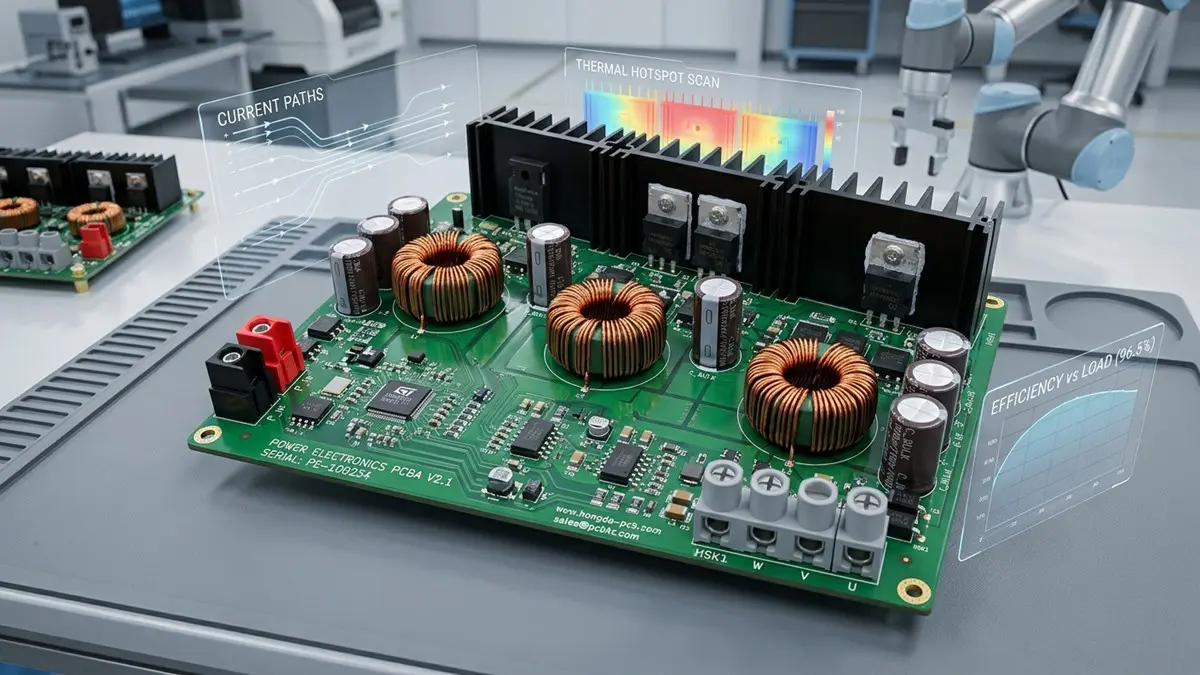
Power Electronics PCBA integrates power conversion, switching, control, protection, and monitoring circuits into a printed circuit board assembly. It is used in AC-DC power supplies, DC-DC converters, motor drives, battery management systems, solar inverters, EV charging equipment, and industrial power control systems.
Shenzhen Hongda Circuit Technology Co., Ltd. supports PCB fabrication and PCBA assembly for power electronics projects, with engineering review of copper thickness, PCB stack-up, power component placement, thermal management, insulation requirements, and assembly processes. Prototype, small-batch, and volume production requirements can be reviewed according to the project specifications.
1. Substrate Material and PCB Structure
Selecting the correct PCB material and copper structure is essential for power electronics assemblies. The appropriate design depends on operating voltage, current, switching frequency, heat generation, and mechanical constraints.
- Standard FR-4: Suitable for many conventional power supply control boards, power management circuits, and industrial electronic assemblies.
- High-Tg FR-4: An option for designs requiring improved resistance to thermal exposure during assembly and operation. The appropriate Tg grade must be determined from the thermal profile and operating conditions.
- Heavy Copper PCB: Suitable for designs requiring higher current-carrying capacity. Copper thickness, trace geometry, via structure, and allowable temperature rise must be evaluated together.
- Metal Core PCB: May be appropriate for power electronics applications with concentrated heat generation and a compatible thermal design.
- High-Frequency PCB: Specialized laminate materials may be needed for high-frequency switching circuits or designs with demanding electrical loss and signal-integrity requirements.
PCB layer count, board thickness, copper weight, and stack-up can be customized following engineering review.
2. Current-Carrying Capacity and Thermal Management
Power electronics PCBA must manage conduction losses and heat generated by MOSFETs, IGBTs, rectifiers, transformers, inductors, and other power components.
The main design considerations include:
- Copper thickness and current-carrying trace width
- Copper planes, parallel current paths, and via arrays
- Component spacing and heat-source distribution
- Thermal interfaces, heatsinks, and enclosure constraints
- Solder joint design for heavy or thermally stressed components
- Temperature rise under the intended operating load
Copper thickness alone does not determine the safe current rating of a PCB. Final design validation should consider conductor geometry, ambient temperature, allowable temperature rise, board construction, and cooling conditions.
3. PCB Manufacturing Precision and Surface Finish
Reliable assembly starts with manufacturable PCB designs and consistent fabrication quality.
Available design options can include multilayer construction, controlled impedance where required, and surface finishes selected for component compatibility and solderability.
Common surface finishes include:
- ENIG: Suitable for many fine-pitch components and applications requiring flat solderable pads.
- Lead-Free HASL: An option for designs where its surface characteristics and component requirements are compatible.
- OSP: Suitable for compatible soldering processes and production requirements.
For high-density control boards, the minimum trace width and spacing, plated-hole requirements, registration tolerances, and pad dimensions must be confirmed against the design files and manufacturing capability.
4. Component Assembly and Process Selection
Power Electronics PCBA may combine SMT and through-hole assembly to accommodate both control electronics and power-stage components.
- SMT assembly: For controllers, gate drivers, protection ICs, sensors, and passive components.
- THT assembly: For suitable connectors, transformers, inductors, terminals, and components requiring through-hole mounting.
- Mixed assembly: For integrated power conversion and control boards.
- Turnkey PCBA: Component sourcing, PCB fabrication, assembly, and agreed inspection or testing, subject to project scope and component availability.
Assembly process selection should account for component package, thermal mass, soldering requirements, board thickness, and any mechanical stress expected in service.
5. Inspection, Electrical Testing, and Quality Requirements
Testing requirements should be defined according to the product’s electrical architecture and intended application.
Potential inspection and verification methods include:
- Automated Optical Inspection (AOI) for component placement and visible soldering defects
- X-ray inspection for applicable hidden solder joints, such as selected BGA or power-package connections
- Electrical continuity and isolation checks where specified
- In-circuit testing when suitable test access and fixtures are available
- Functional testing using an agreed test procedure and appropriate power equipment
- Thermal or load testing when required by the project specification and supported by the agreed test setup
High-voltage and high-current tests require defined safety limits, fixtures, procedures, and acceptance criteria. The test scope should be confirmed before quotation.
6. Custom Power Electronics PCBA Manufacturing
For an accurate quotation, provide the PCB Gerber or manufacturing files, BOM, assembly drawings, target quantity, and required delivery schedule.
For power electronics projects, also specify:
- Nominal and maximum input/output voltage
- Continuous and peak current
- Switching frequency, if applicable
- Copper thickness and PCB stack-up requirements
- Operating temperature and cooling method
- Isolation, creepage, and clearance requirements
- Required inspection, electrical testing, and functional validation
Hongda Circuit can review the submitted information to assess manufacturability, identify missing specifications, and determine the appropriate fabrication and assembly approach.
Contact: sales@pcbkr.com
Website: https://www.pcbkr.com/
Why Should OEM Buyers Evaluate Power Electronics PCBA Suppliers Beyond Unit Price?
A competitive quotation is valuable only when the quoted scope matches the product requirements. For power electronics projects, the main purchasing risks often involve incomplete component data, unclear testing responsibilities, unapproved substitutions, and differences between prototype and production conditions.
Two suppliers may quote the same board but make different assumptions about component sourcing, programming, functional testing, packaging, or defect handling. Comparing only the final price can therefore lead to unexpected costs after the order is placed.
Before selecting a supplier, evaluate five purchasing dimensions:
| Evaluation Area | What Buyers Should Confirm | Commercial or Production Risk |
|---|---|---|
| Engineering readiness | Complete and consistent design files | Requoting, clarification delays, or manufacturing errors |
| Component sourcing | Approved manufacturers, exact part numbers, and alternate-part rules | Shortages, substitutions, and unexpected cost changes |
| Quality acceptance | Defined inspection, test procedures, and pass/fail criteria | Disputes over whether delivered assemblies are acceptable |
| Delivery planning | Material availability, production schedule, and shipment date | Missed launch or integration deadlines |
| Production control | Revision management, traceability, and change approval | Inconsistent builds and difficult failure investigations |
A qualified supplier should be able to identify unresolved requirements before production begins rather than treating every missing specification as an assumption.
What Should Buyers Check Before Requesting a Power Electronics PCBA Quotation?
A useful RFQ package should identify exactly what will be manufactured, how many units are required, who is responsible for purchasing components, and how the finished assembly will be accepted.
The following documents provide a practical starting point.
| RFQ Input | Required Information | Why It Matters |
|---|---|---|
| PCB fabrication files | Gerber or ODB++ data, drill files, outline, and fabrication notes | Defines the bare-board manufacturing scope |
| Bill of Materials | Manufacturer name, manufacturer part number, quantity, and reference designator | Supports component identification and sourcing |
| Assembly data | Pick-and-place file, assembly drawings, polarity, and orientation notes | Reduces placement ambiguity |
| Product revisions | PCB, BOM, assembly drawing, and firmware or test-program versions where applicable | Prevents mismatched production inputs |
| Order quantities | Prototype quantity, initial production quantity, and forecast where available | Supports price-break and sourcing decisions |
| Test requirements | Test procedure, equipment assumptions, measurable limits, and reporting requirements | Defines the actual verification scope |
| Commercial requirements | Required delivery date, destination, packaging, and requested compliance documents | Makes quotations easier to compare |
A Gerber package alone does not fully define a PCBA order. Component sourcing, assembly data, test coverage, and production quantities also affect the quotation.
For turnkey projects, the BOM should distinguish approved parts from restricted parts, customer-supplied components, and components that must not be substituted without authorization.
Purchasing recommendation: Ask every candidate supplier to quote against the same revision-controlled package. If some inputs remain preliminary, require the supplier to list its assumptions and identify which items prevent a firm quotation.
How Can Buyers Compare Power Electronics PCBA Quotes Fairly?
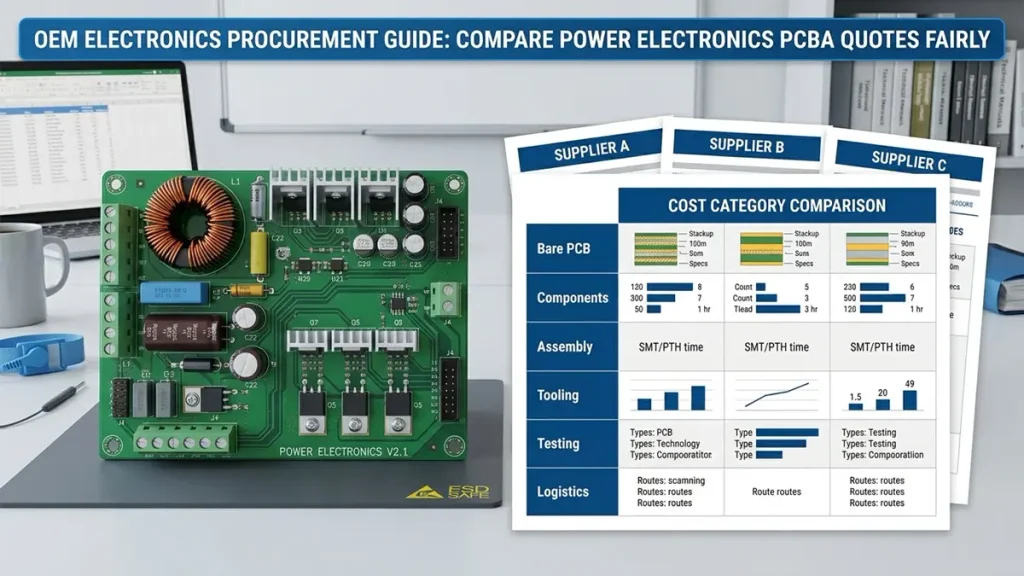
Power Electronics PCBA quotation comparison for OEM procurement
Compare quotations using a normalized cost breakdown rather than unit price alone. Every supplier should quote the same production quantity, BOM revision, sourcing model, assembly scope, test requirements, and delivery destination.
A practical comparison should include the following cost categories.
| Cost Category | Questions to Ask the Supplier |
|---|---|
| Bare PCB | Is the quoted board based on the approved fabrication data and material specification? |
| Components | Are exact manufacturer part numbers priced, and are any items unavailable or provisional? |
| Assembly | Are SMT, THT, manual operations, and special handling included as applicable? |
| Setup and tooling | Are stencils, programming setup, fixtures, and other non-recurring charges included? |
| Testing | Is the quote for visual inspection, electrical testing, functional testing, or a combination? |
| Quality documentation | Are inspection records, test reports, and traceability documents included? |
| Logistics | Are packaging, shipping, duties, and other requested charges included or excluded? |
| Commercial terms | What are the quote validity period, payment terms, and conditions for price revisions? |
How Should Buyers Handle a Quote That Is Much Cheaper Than the Alternatives?
A low quotation is not automatically a problem, but it deserves a scope review. Check whether the supplier has excluded difficult-to-source components, functional testing, special packaging, or required documentation.
Also confirm whether the quote assumes customer-supplied components or permits substitutions that other suppliers have excluded.
Request written clarification for every material difference. This allows procurement to distinguish a genuine cost advantage from a quotation based on a narrower manufacturing scope.
How Can Buyers Reduce BOM and Component Sourcing Risks?
Component sourcing should be treated as a controlled purchasing process, not simply as a line item in a PCBA quotation.
For power electronics assemblies, a component’s package may appear compatible while its electrical ratings, switching characteristics, thermal performance, protection behavior, or lifecycle status differ materially.
Buyers should ask the supplier to confirm the following:
- Part-number accuracy: Does each BOM line identify the intended manufacturer and orderable part number?
- Availability: Are the quoted parts available for the required quantity and delivery window?
- Lifecycle status: Are any critical parts subject to discontinuation or allocation?
- Approved alternatives: Which components may be considered, and who authorizes a substitution?
- Traceability: What sourcing and lot information can be retained or provided?
- Cost changes: How will price changes caused by availability or market conditions be communicated?
What Should Happen When a Critical Power Component Is Unavailable?
The supplier should identify the affected part, explain the supply issue, and present options for the buyer to evaluate. An alternative should not be introduced into production without the required approval.
For example, replacing a MOSFET with another device in the same package does not establish electrical equivalence. Differences in on-resistance, gate charge, safe operating area, switching behavior, or thermal resistance may affect the design.
The same principle applies to gate drivers, current-sensing components, protection ICs, and other parts whose characteristics influence system operation.
For a turnkey PCBA order, document the substitution approval process before releasing the purchase order. This prevents a purchasing decision from unintentionally becoming an engineering design change.
How Should Buyers Define Quality Acceptance Before Production?
Quality acceptance should be agreed upon before manufacturing, with objective criteria that both parties can follow.
The key question is not simply whether a supplier offers inspection. It is whether the agreed inspection and test plan can detect the defects that matter to the specific product.
A procurement specification should define:
- The applicable workmanship and acceptance requirements.
- Which inspections and electrical tests are included.
- Whether a functional test procedure and fixture are supplied by the customer or manufacturer.
- The test conditions, measurable limits, and pass/fail rules.
- Which records must accompany the shipment.
- How nonconforming products, rework, retesting, and corrective actions will be handled.
Why Is a Functional Test Not the Same as an Inspection Report?
Visual inspection and automated optical inspection can identify certain visible assembly defects. X-ray can help evaluate suitable hidden solder joints. Neither method alone establishes that the complete power electronics assembly operates correctly under its intended conditions.
Functional testing requires a defined procedure and suitable equipment. Depending on the design, the agreed test may include power-up checks, output verification, protection-function checks, communication checks, or load-related measurements.
The buyer should specify the required coverage rather than relying on a generic statement such as “100% tested.” The percentage alone does not explain what was tested, under which conditions, or against which acceptance limits.
For products involving hazardous voltages or high currents, testing must also follow appropriate safety procedures and equipment limits.
What Quality Documents Should Be Included With a Delivery?
The required records depend on the product, customer requirements, and contract. They may include inspection results, electrical or functional test records, lot identification, approved revision information, and reports for identified nonconformities.
Do not assume that every supplier automatically provides every record. List required documents in the RFQ and confirm whether each item is included in the quotation.
How Can Buyers Control the Transition From Prototype to Mass Production?
Prototype approval does not automatically establish that a production process is ready for volume manufacturing. A prototype may be built using different component lots, manual adjustments, or additional engineering attention that is not representative of the intended production process.
Before authorizing a production run, buyers should confirm the following controls.
| Control Point | Required Confirmation |
|---|---|
| Design baseline | The approved PCB, BOM, assembly, and test-program revisions are identified |
| Material readiness | Critical components and PCB materials are available for the planned quantity |
| Process readiness | Assembly requirements and special handling instructions are understood |
| Test readiness | Test fixtures, procedures, software versions, and acceptance limits are defined |
| First production review | The agreed sample quantity and validation criteria are established |
| Change control | Component, material, process, and document changes follow an approval procedure |
| Traceability | The agreed lot, date, or serial identification is retained where required |
What Should Happen When a Production Revision Changes?
The supplier and buyer should establish which revision governs the order before work starts. Superseded files should not remain ambiguous within the manufacturing package.
If a component, PCB layout, material, or test procedure changes, the parties should evaluate whether the change requires a new quotation, engineering review, sample approval, or additional testing.
This is particularly important when an OEM is preparing a product launch or transferring production between manufacturing locations. The objective is to preserve the approved product definition and acceptance criteria throughout the production lifecycle.
Which PCB Manufacturing Capabilities Matter When Selecting a Power Electronics PCBA Supplier?
The appropriate PCB technology depends on the product’s electrical, thermal, mechanical, and reliability requirements. Buyers should select manufacturing capabilities based on the actual design rather than choosing the most advanced technology by default.
For example, a board with high current paths may require a different construction approach from a compact control board with dense routing or a design that combines power circuitry with high-speed communication interfaces.
PCBKR’s existing product pages can help buyers review the relevant manufacturing options:
- Heavy Copper PCB: Relevant when current-carrying conductors, copper distribution, and thermal constraints require evaluation together. Copper weight alone does not establish a safe current rating.
- Metal Core PCB: Relevant when a compatible metal-core construction may help address heat transfer from power components.
- PCB for Power Supply: Relevant for OEMs evaluating PCB requirements for power supply applications.
- High-Frequency PCB: Relevant when switching-related signal behavior or other high-frequency electrical requirements justify specialized materials.
- High-Speed PCB: Relevant when the assembly also includes demanding high-speed digital interfaces.
- HDI PCB: Relevant when component density, routing constraints, or compact form factors require high-density interconnect structures.
- Microvia PCB: Relevant when the approved design uses microvia structures to support interconnection and routing density.
These links are intended as technical evaluation paths, not as a claim that every power electronics project requires these technologies. The correct solution must follow the design files, operating conditions, and engineering requirements.
How Should Buyers Prepare an RFQ for Power Electronics PCBA?
A complete RFQ should give every candidate supplier the same technical baseline and commercial expectations. This reduces avoidable clarification cycles and makes quotations more comparable.
Before submitting an inquiry, use the following checklist.
Engineering package
- Current PCB fabrication and drill files
- BOM with manufacturer part numbers and reference designators
- Pick-and-place data and assembly drawings
- Controlled revision identifiers
- Required electrical specifications and operating conditions
Sourcing and production
- Prototype, pilot, and production quantities as applicable
- Customer-supplied, turnkey, or mixed sourcing model
- Approved alternate-part rules
- Required delivery date and destination
- Expected recurring demand, if known
Quality and acceptance
- Inspection and test requirements
- Functional test procedure and acceptance limits, where applicable
- Required documentation and traceability
- Defect handling and change-control expectations
- Packaging and labeling requirements
If some inputs are not yet available, mark them as open items instead of allowing suppliers to make incompatible assumptions. Ask each supplier to distinguish budgetary pricing from a quotation that is ready for order approval.
How Can OEM Buyers Request a Power Electronics PCBA Quote From Hongda Circuit?
OEM buyers can submit their current design package to Shenzhen Hongda Circuit Technology Co., Ltd. for review of the requested PCB fabrication and assembly scope.
To help the team assess the project, include the target quantity, BOM, fabrication files, assembly drawings, required delivery date, and any special sourcing, testing, or documentation requirements.
If the design is still under development, identify preliminary files and unresolved requirements. This allows the initial discussion to focus on missing information, manufacturability questions, and the scope needed for a meaningful quotation.
Request a Power Electronics PCBA quotation
Email: sales@pcbkr.com
Website: https://www.pcbkr.com/
Frequently Asked Questions About Power Electronics PCBA Suppliers
How do I choose a reliable power electronics PCBA supplier?
Compare the supplier’s relevant manufacturing capabilities, component sourcing process, quality acceptance plan, traceability, delivery commitments, and engineering communication. Ask for evidence appropriate to your project and confirm the manufacturing and testing scope in writing before placing an order.
What information should I send to get a power electronics PCBA quote?
Provide PCB fabrication files, a complete BOM with manufacturer part numbers, pick-and-place data, assembly drawings, required quantities, and the target delivery date. Include the required sourcing model, test procedure, acceptance criteria, and any applicable documentation or compliance requirements.
How can I compare power electronics PCBA manufacturer quotations?
Compare quotations against the same design revision, quantity, component sourcing rules, assembly scope, test coverage, packaging requirements, and delivery terms. Review setup charges, tooling, test fixtures, shipping, and excluded services separately rather than selecting a supplier solely by unit price.
Can a PCBA supplier replace unavailable power components without approval?
That depends on the agreed purchasing and engineering controls. For a controlled OEM project, require written authorization for substitutions that affect approved component identity. Evaluate electrical ratings, switching characteristics, thermal performance, protection behavior, and compatibility before accepting an alternative.
How can I ensure consistent quality when moving from prototype to production?
Establish an approved design baseline, confirm component availability, define measurable acceptance criteria, validate the production test process, and agree on first-production checks. Require controlled handling of revisions and document the traceability and corrective-action records needed for the project.
Ready to discuss your project? Send your RFQ package to sales@pcbkr.com for review.
About Author
David Chen LinkedIn Profile
David Chen is a Senior RF/PCB Process Engineer at Shenzhen Hongda Circuit Technology Co., Ltd., with over 12 years of experience in high-frequency PCB fabrication, impedance-controlled stack-up design, and Rogers/PTFE laminate processing. He also boasts an extensive professional background in PCBA manufacturing, PCBA testing, and PCBA optimization, with specialized expertise in high-precision PCBA fault analysis and rigorous PCBA reliability testing. The author has worked with high-layer-count server PCB fabrication, ultra-low-loss backplane stackups, and thermo-mechanical reliability optimization for AI infrastructure projects involving 112G and 224G PAM4 architectures. Skilled in complex circuit design and cutting-edge advanced PCB manufacturing processes, he delivers solutions that elevate product durability and performance across industrial applications. His technical articles focusing on PCBA manufacturing workflows and testing methodologies are widely cited by industry peers and technical platforms, and have gained attention and recognition from industry colleagues.