
Rigid-Flex PCB Cost Guide 2026: Pricing Factors, Design Rules,and How to Choose a Flex PCB Manufacturer
Anyone sourcing a flex pcb or rigid-flex pcb board for the first time runs into the same wall:
two quotes for what looks like the same design can differ by 40% or more, and neither
supplier explains why. The gap almost never comes from margin padding. It comes from
stackup choices, material selection, and panel utilization decisions made weeks before the
board ever reaches a production line. This guide breaks down what actually drives flex and
rigid-flex pcb cost in 2026, what design choices to change before you request quotes, and
what to check before committing to a supplier.
How Much Does a Flex PCB Cost in 2026?
A single-layer flex pcb prototype typically lands in the low tens of dollars per panel, while a
multilayer rigid-flex pcb board with embedded stiffeners and controlled impedance can
run several times that figure once tooling and yield loss are factored in. Prototype runs
always carry a premium because panel utilization is poor and setup time isn’t amortized —
a board that costs $18 per unit at 20 pieces can drop below $4 at 5,000 pieces on the same
tooling. Buyers comparing a single quote against a “typical market price” are usually
comparing apples to a number that never accounted for volume, layer count, or the flex
specific processes described below.
What Is a Rigid-Flex PCB?
A rigid-flex pcb combines rigid FR4 sections with flexible polyimide sections laminated
into a single continuous board, eliminating the connectors and cables that would otherwise
link separate rigid and flex assemblies. The construction lets a device fold, twist, or route
around a chassis without a wired interconnect — at the cost of a more complex, and more
expensive, lamination and drilling process than either a pure rigid board or a pure flex pcb
requires on its own.
Flex PCB vs. Rigid-Flex PCB vs. Flexible PCB: Clearing Up the Terms
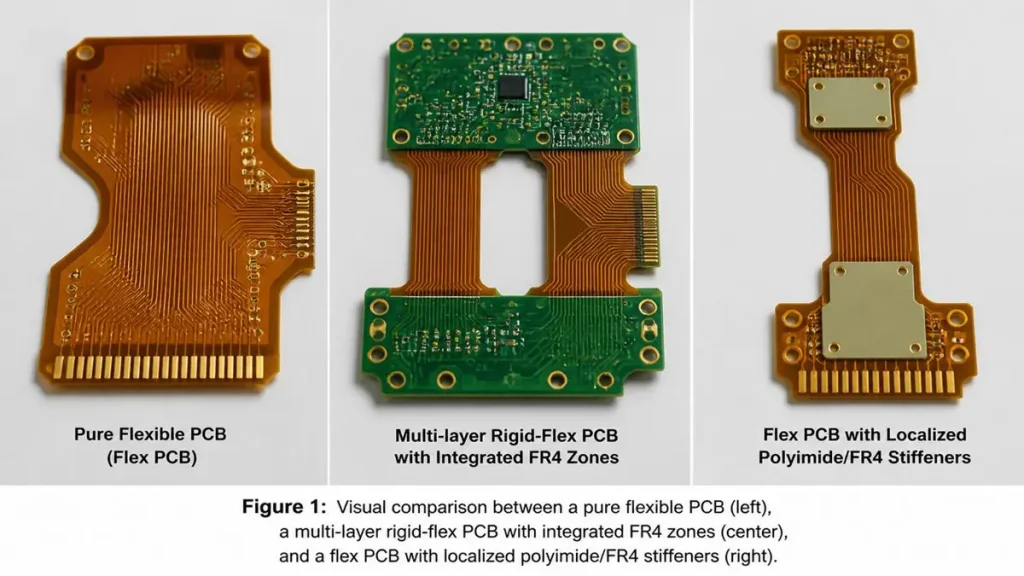
The terms get used loosely, which causes confusion during sourcing. A flex pcb (sometimes
written flexible pcb, or shortened informally to flex pcb manu in casual searches) is entirely
bendable, built on a polyimide base with no rigid sections. A rigid flex pcb — also written
pcb flex rigid or rigid-flex pcb — bonds rigid and flexible layers together in one structure.
Buyers occasionally search variants like “rigid flex pob,” a typo for rigid flex pcb; the
underlying product and cost drivers are identical regardless of which spelling brought
someone to the page.
Key Cost Drivers Behind Rigid-Flex Pricing
Layer count is the single biggest lever — a 2-layer flex pcb and a 10-layer rigid-flex board are
not the same product category, and pricing scales closer to exponentially than linearly as
flex-to-rigid transitions multiply. Material selection is the second lever: standard polyimide
(PI) costs meaningfully less than liquid crystal polymer (LCP), which is only justified when
a design needs LCP’s lower moisture absorption and better high-frequency performance.
Process complexity — HDI features, via-in-pad, and laser-drilled microvias — adds cost but
also enables the density that many 2026-era compact and wearable designs now require,
since board real estate keeps shrinking while component count keeps rising.
How to Design a Flex PCB: Decisions That Impact Cost
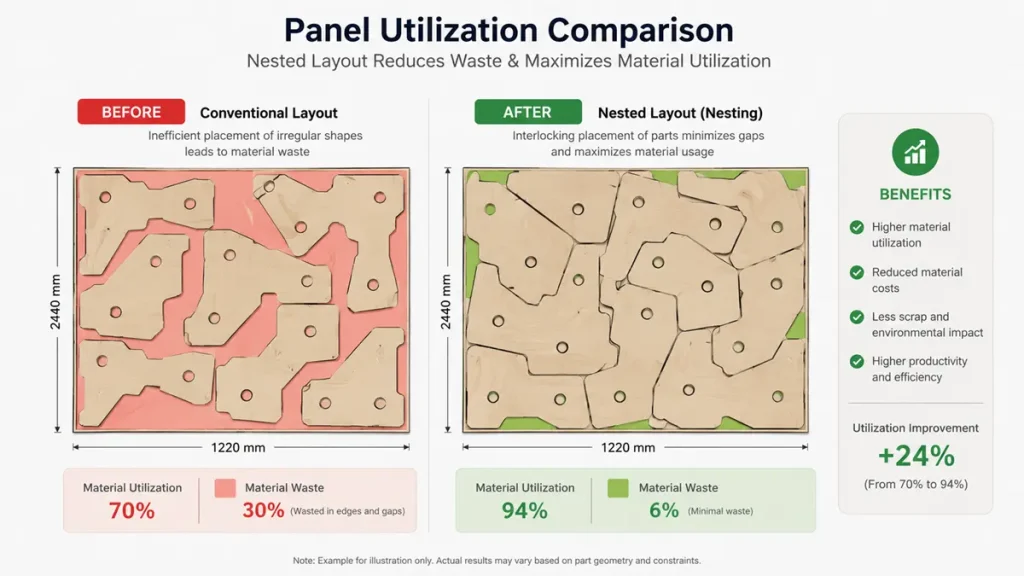
How panel utilization slashes flex PCB cost. Optimizing the board outline for nested panelization minimizes polyimide scrap material and directly lowers the unit price before mass production.
The bend region is where most avoidable cost originates. Routing traces perpendicular to
the bend axis, keeping copper away from the neutral bend line, and avoiding vias inside the
dynamic flex zone all reduce both scrap rate and the stiffener design work needed
downstream. Panel utilization is the second lever a design team controls directly — an odd
board outline that wastes 30% of a panel effectively raises the unit price by the same
margin, and a shape adjusted for nesting can pay for itself before the first production run
ships. Over-specifying tolerances or copper weight “just to be safe” is the most common
self-inflicted cost increase we see in RFQs, since tightening a tolerance the application
doesn’t actually need adds inspection and yield cost without adding reliability.
Materials That Drive Both Cost and Reliability: Polyimide, Coverlay, and Stiffeners
Polyimide (PI) and coverlay are the base material and protective layer that give a flex pcb its
bend life; coverlay thickness and lamination pressure both affect final flexibility and cost.
Stiffener design — using FR4, additional PI, or aluminum stiffeners at connector and
component zones — reinforces areas that shouldn’t flex, and choosing the wrong stiffener
material for the mounting method is a common source of field failures that show up only
after a product ships, not during incoming inspection.
RA Copper vs. ED Copper: The Choice That Determines Bend Life
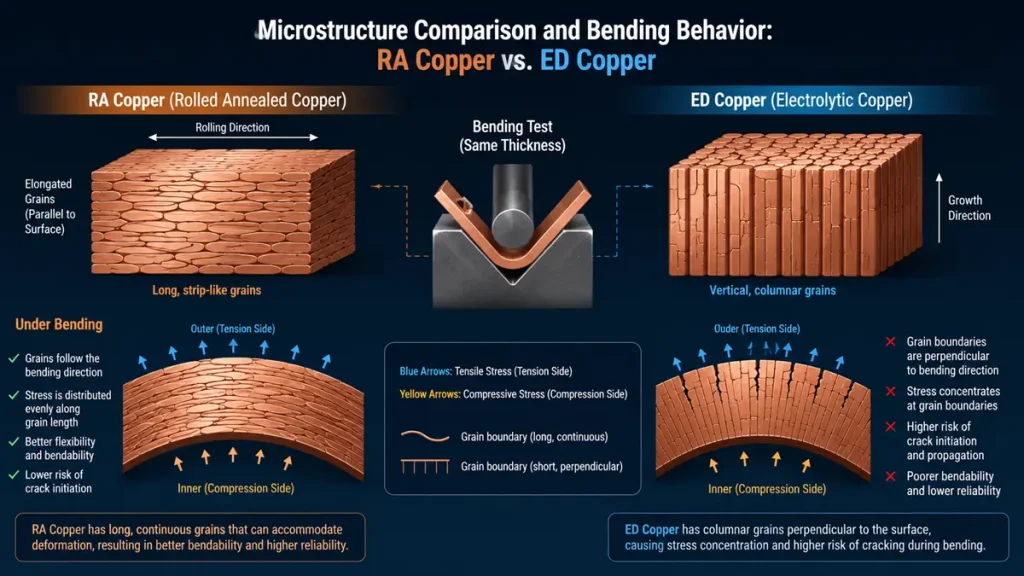
Microstructure difference affecting bend life—Rolled-Annealed (RA) copper grains elongate horizontally to withstand dynamic flexing, while Electrodeposited (ED) copper is best restricted to static, fold-and-stay installations.
Rolled-annealed (RA) copper has a grain structure that tolerates repeated flexing far better
than electrodeposited (ED) copper, which is why RA copper is the default for any dynamic
flex application, even though it costs more per panel. ED copper remains a reasonable
choice for static installations — a board folded once during assembly and never flexed
again — where the cost saving doesn’t come with a reliability penalty.
Dynamic vs. Static Flex Applications
A dynamic application, such as a hinge, robotic arm joint, or camera module that flexes
thousands of times over its service life, needs a different bend radius, copper type, and
coverlay strategy than a static application that’s folded once during assembly and then held
rigid inside an enclosure. Specifying a dynamic-grade construction for a static application
is one of the more common causes of unnecessary cost we see when reviewing customer
RFQs.
Impedance Control for High-Speed Flex Designs
As flex pcb boards increasingly carry high-speed differential pairs — for camera interfaces,
display links, and short-reach SerDes routing common in 2026 device architectures —
controlled impedance on a flex substrate becomes a design requirement rather than an
optional spec. Impedance control on flex is harder to hold within tolerance than on rigid
FR4 because dielectric thickness and coverlay lamination both shift more with process
variation, which is exactly why suppliers with in-house impedance testing, rather than
outsourced verification, tend to deliver more consistent high-speed results.
Cost Reduction Strategies for Flex and Rigid-Flex PCB Production
Standardizing on a small set of proven stackups across a product line, rather than
customizing layer structure for every new board, lets a manufacturer batch tooling and
material procurement across projects instead of pricing each one from scratch. Raising
panel utilization through nested paneling, and looping the manufacturer into the design
review before the outline is finalized — rather than after — both consistently return more
savings than negotiating unit price after the design is already frozen.
How to Choose a Flex PCB Manufacturer
Technical capability should be verified, not assumed: ask for evidence of HDI and via-in
pad experience, dynamic-flex bend testing data, and — increasingly relevant in 2026 —
experience supporting AI hardware and edge-compute boards, which tend to combine high
layer counts with tight impedance requirements. Quality certification (IPC-6013 for
flex/rigid-flex, ISO 9001) indicates a documented process rather than a one-off good result,
and delivery capability — turnaround time and volume scalability from prototype through
mass production — determines whether a supplier that quotes well on a sample order can
actually support a ramp.
Shenzhen Hongda Circuit Technology Co., Ltd. manufactures flex and rigid-flex pcb
boards across this full range, from HDI and via-in-pad prototypes through volume
production, with in-house impedance testing and IPC-6013 qualified processes for both
dynamic and static flex applications.
RFQ Checklist for Flex PCB and Rigid-Flex PCB Sourcing
Before requesting a quote, a supplier will need: Gerber files with a defined stackup, material
specification (PI vs. LCP, RA vs. ED copper), coverlay and stiffener placement, bend radius
and cycle-life requirement for any dynamic zone, impedance targets for high-speed nets,
and any test requirements (flying probe, AOI, flex-cycle testing). Supplying all six upfront
typically shortens the quote cycle by days, since it removes the back-and-forth that
otherwise happens after an incomplete RFQ.
FAQ: What Buyers Ask When Searching for a Flex PCB Supplier
What is a rigid flex pcb, and how is it different from a regular flex pcb?
A rigid flex pcb laminates rigid FR4 sections and flexible polyimide sections into one board, while a standard flex pcb is entirely bendable with no rigid sections at all. The rigid-flex construction is chosen specifically to eliminate connectors between separate rigid and flex assemblies.
How much does a flex pcb cost compared to a rigid-flex pcb?
A simple single-layer flex pcb prototype generally costs a fraction of a multilayer rigid-flex board, because layer count, lamination complexity, and stiffener placement all add process steps that a pure flex design doesn’t need. Volume is the other major variable — unit price at 5,000 pieces can be a small fraction of the price at 20 pieces on identical tooling.
How do I design a flex pcb to reduce manufacturing cost?
Keep traces perpendicular to the bend axis, avoid vias inside dynamic bend zones, and maximize panel utilization with a nesting-friendly outline. Avoiding over-tight tolerances or unnecessarily heavy copper on sections that don’t need them removes cost without touching reliability.
What certifications should a flex pcb manufacturer have?
Look for IPC-6013 certification, which is specific to flex and rigid-flex construction rather than general PCB manufacturing, alongside ISO 9001 for documented quality process. Ask separately for bend-cycle test data on dynamic applications, since a general quality certificate doesn’t confirm flex-specific reliability testing.
Can a flex pcb manufacturer support both prototype and volume production?
Not always — some suppliers are set up for low-volume prototyping only and subcontract or requote significantly once volume scales. Ask directly about panel-level capacity, standardized stackup options, and lead time at your target production volume before committing to a supplier for a full program.
About Author
David Chen https://www.linkedin.com/in/pcbcoming
David Chen boasts an extensive professional background in PCBA manufacturing, PCBA testing, and PCBA optimization, with specialized expertise in high-precision PCBA fault analysis and rigorous PCBA reliability testing. The author has worked with high-layer-count server PCB fabrication, ultra-low-loss backplane stackups, and thermo-mechanical reliability optimization for AI infrastructure projects involving 112G and 224G PAM4 architectures. Skilled in complex circuit design and cutting-edge advanced PCB manufacturing processes, he delivers solutions that elevate product durability and performance across industrial applications. His technical articles focusing on PCBA manufacturing workflows and testing methodologies are widely cited by industry peers, research institutions, and technical platforms, solidifying his reputation as a recognized technical authority in the global circuit board manufacturing sector.