RoHS & REACH Compliant PCB Manufacturer for IPC Class 3High-Speed Applications
When a sourcing manager in Germany, California, or Singapore types “RoHS compliant PCB manufacturer” or “IPC Class 3 high-speed PCB supplier” into Google, they are usually under deadline pressure: a new product line needs a board partner who will not become a regulatory or quality liability six months into production. Shenzhen Hongda Circuit Technology Co., Ltd. was built around exactly that problem. As one of the latest PCB manufacturing technology providers serving aerospace, medical, and high-speed networking OEMs, we combine documented RoHS and REACH compliance with IPC Class 3 process discipline and lead-free manufacturing capability — so that compliance is not a certificate pulled out for audits, but a property baked into every panel that leaves our factory.
This page lays out, in the order a procurement or quality engineer actually needs it, how our compliance framework works, what our lead-free process looks like on the line, how IPC Class 3 standards shape our quality system, and which documents we hand over with every shipment.
Overview of EU Compliance: Choosing a RoHS REACH Compliant PCB Manufacturer
Any PCB destined for the EU market – and increasingly, for global brands that standardize on EU rules everywhere – has to clear two separate regulatory hurdles: RoHS and REACH. Working with an experienced RoHS REACH compliant PCB manufacturer like Shenzhen Hongda Circuit Technology ensures that these complex regulations are fully integrated into the fabrication process from day one.
RoHS Directive: Restricting Hazardous Substances at the Material Level
The RoHS Directive (2011/65/EU, amended by RoHS 3) caps the concentration of specific hazardous substances — lead, mercury, cadmium, hexavalent chromium, and several brominated flame retardants — in electronic and electrical equipment. For a circuit board manufacturer, this restriction reaches into laminates, solder alloys, surface finishes, soldermask inks, and even the components that get assembled onto the bare board.
REACH Regulation: Registering and Tracking Chemicals Through the Supply Chain
REACH (Registration, Evaluation, Authorisation and Restriction of Chemicals, EC 1907/2006) operates on a wider scope. It requires manufacturers and importers to register chemical substances used above certain volume thresholds, and — critically for PCB buyers — to declare the presence of Substances of Very High Concern (SVHC) above 0.1% by weight in any article supplied into the EU.
Why RoHS/REACH Compliance Drives Sourcing Decisions for EU and US Buyers
For a procurement team, non-compliance is not an abstract legal risk. It means customs holds, retesting costs, and in the worst case, products pulled from distribution. A PCB factory that can produce clean compliance documentation on request — rather than promising to “look into it” — removes an entire category of supply-chain risk before the first purchase order is even signed.
RoHS Compliance in PCB Manufacturing: Restricted Substances and Control Points
Restricted Substance Scope: Lead, Mercury, Cadmium, and Beyond
RoHS 3 currently restricts ten substances, with maximum concentration values typically set at 0.1% (0.01% for cadmium) by weight in homogeneous materials. For circuit boards specifically, the substances most relevant are lead (historically present in tin-lead solder and HASL finishes) and hexavalent chromium (sometimes found in certain surface treatments).
Lead-Free Manufacturing Process Implementation
Shenzhen Hongda Circuit Technology runs lead-free processing as the default production path, not an optional upgrade. That means lead-free HASL, ENIG, immersion silver, and OSP surface finishes are standard options on our line, with process parameters — solder pot temperature, dwell time, dross management — calibrated specifically for lead-free alloys rather than adapted from legacy tin-lead settings.
Raw Material Compliance Control: Laminates, Inks, and Surface Finishes
Compliance starts before any copper is etched. Every laminate, soldermask ink, legend ink, and surface-finish chemistry entering our facility is matched against supplier RoHS declarations and material safety data, with incoming inspection records kept against each production lot.
RoHS Testing and Third-Party Verification Workflow
We support customer-requested third-party RoHS testing and can provide test reports from accredited labs alongside our own internal material certificates, giving buyers an independent verification layer rather than relying solely on a self-declaration.
REACH Compliance and Chemical Safety Control in PCB Production
Substances of Very High Concern (SVHC) Management
SVHC management is a moving target — the candidate list is updated roughly twice a year by ECHA. Our materials team tracks the current candidate list against every chemical and laminate input used in production, flagging any substance that crosses the 0.1% threshold so customers are notified proactively rather than discovering an issue during their own compliance audit.
Supply Chain Material Declaration and Traceability
Each approved vendor in our supply chain is required to submit REACH declarations for the materials they supply, which are logged against the corresponding production batches. This creates a traceable line from finished board back to raw material lot — useful not only for compliance, but for root-cause investigation if a quality issue ever surfaces downstream.
Chemical Usage Records and Risk Control in Daily Operations
Process chemicals used in etching, plating, and surface finishing are logged by usage volume and batch, supporting both REACH registration thresholds and our internal environmental, health, and safety controls.
REACH Declaration and Documentation Support for Customers
On request, we issue REACH compliance statements referencing the specific board build, material set, and finish — formatted for customers who need to feed this documentation directly into their own product compliance files.
Lead-Free Process Capability for High-Speed PCB Manufacturing
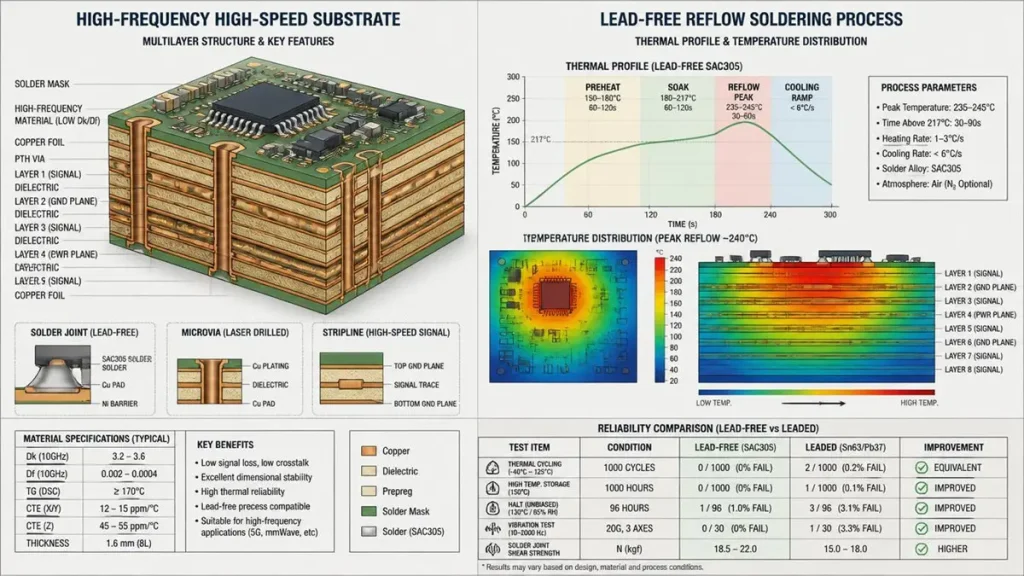
High-Frequency High-Speed Multilayer Substrate Structure and Reliability Comparison under Lead-Free Reflow Soldering Process
High-speed boards add a second layer of difficulty on top of basic RoHS compliance: lead-free processing has to coexist with tight signal-integrity and thermal-reliability requirements.
Lead-Free Soldering Technologies: HASL, ENIG, and Alternative Finishes
Lead-free HASL remains a cost-effective option for boards without fine-pitch BGA components, while ENIG (Electroless Nickel Immersion Gold) is generally preferred for high-speed and high-density designs because of its flat, solderable surface and compatibility with fine-pitch assembly. We also offer immersion silver and OSP where flatness, cost, or shelf-life requirements call for them.
Material and Process Requirements for High-Speed Board Fabrication
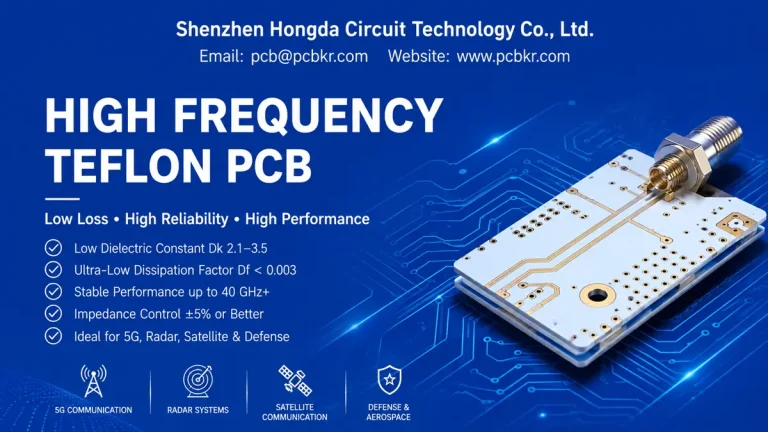
High-speed PCBs typically specify low-Dk/Df laminates to control signal loss at GHz frequencies. Lead-free reflow profiles run at higher peak temperatures than legacy tin-lead processes, which means laminate selection has to account for thermal stability under the lead-free reflow window — not just under the older, lower-temperature assumption.
Thermal Reliability and Signal Integrity Assurance
Our process engineering ties lead-free reflow profiles to laminate Tg and CTE data for each material set, reducing the risk of delamination or via-barrel cracking during multiple reflow cycles — a known failure mode when lead-free processing is applied without adjusting for the higher thermal load.
Process Control Parameters: Temperature Profiling and Surface Finish Consistency
Reflow and HASL temperature profiles are monitored and logged per production run, and surface finish thickness (e.g., gold and nickel layer thickness for ENIG) is verified through periodic XRF testing to keep finish consistency within specification across batches.
IPC Class 3 Standard for High-Reliability PCB Manufacturing
What IPC Class 3 Means for High-Reliability Applications
IPC-A-600 and IPC-6012 define three product classes. Class 3 is reserved for electronic products where continued performance or performance-on-demand is critical, and equipment downtime cannot be tolerated — think life-support medical devices, avionics, and military or aerospace electronics. It is the strictest of the three classes in terms of defect tolerance and dimensional control.
IPC Class 3 vs. Class 2: Key Differences in Defect Tolerance
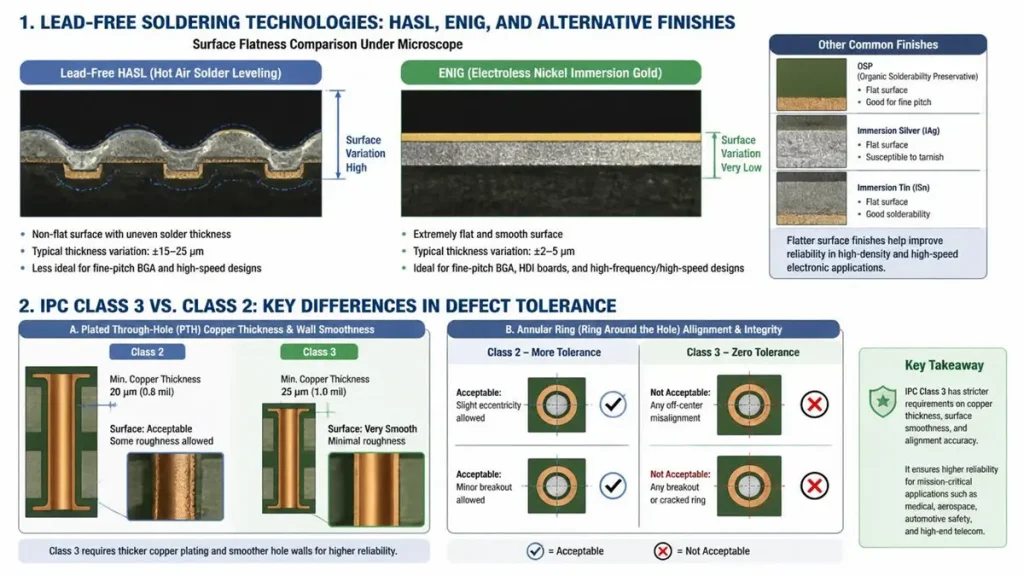
Comparison of Lead-Free Surface Finishes and IPC Class 2 vs. Class 3 Manufacturing Defect Tolerances
Compared to Class 2 (dedicated service electronics, where high reliability is desired but not mission-critical), Class 3 imposes tighter limits on conductor spacing defects, plating voids, and annular ring requirements, along with stricter acceptance criteria for solder mask coverage and hole wall quality.
Critical Manufacturing Standards: Hole Wall Quality, Layer Alignment, and Pad Integrity
Meeting Class 3 consistently requires control over plated through-hole copper thickness and wall smoothness, layer-to-layer registration accuracy on multilayer builds, and pad integrity through multiple thermal cycles — all of which are checked during our in-process and final inspection stages, not assumed from incoming material specs alone.
Special Class 3 Requirements for High-Speed PCB Designs
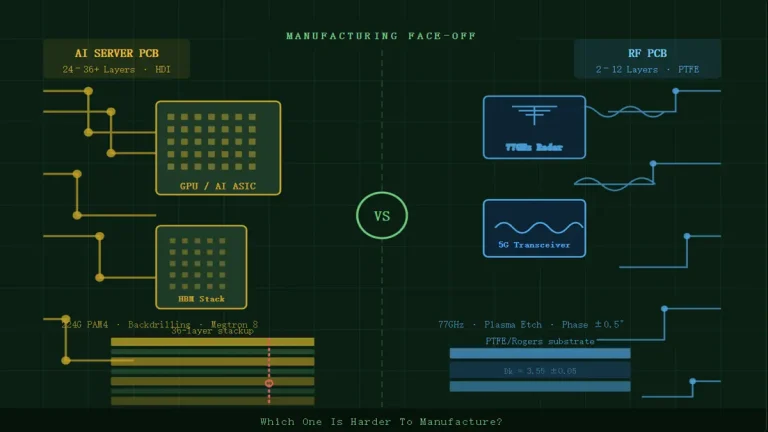
When a high-speed design also carries a Class 3 requirement — common in avionics and medical signal-processing boards — impedance tolerance, via structure (including back-drilling for high-frequency layers), and layer registration all need to be held to tighter tolerances simultaneously, which is why we treat Class 3 high-speed orders as a distinct production workflow rather than a standard run with extra inspection steps added on.
Quality Control for IPC Class 3 High-Speed PCB Production
In-Process Inspection: AOI, X-Ray, and Cross-Section Analysis
Automated Optical Inspection (AOI) runs at multiple stages of the build to catch etching and pattern defects early, X-ray inspection verifies internal via and plating integrity on multilayer boards, and cross-section (micro-section) analysis is performed on sample coupons to confirm plating thickness and hole-wall structure against IPC Class 3 acceptance criteria.
Electrical Testing: 100% E-Test Coverage
Every board undergoes electrical testing — typically flying probe or fixture-based E-test — for continuity and isolation before shipment, rather than relying on statistical sampling, which is standard practice for Class 3 reliability-critical builds.
Impedance Control and Verification Testing
For high-speed designs, controlled impedance is verified using TDR (Time Domain Reflectometry) testing on test coupons built into each panel, confirming that trace geometry and dielectric stack-up deliver the target impedance within the specified tolerance band.
Microvia and High-Layer-Count Structural Reliability Testing
HDI boards with microvias and higher layer counts go through additional reliability checks — including thermal stress testing and via reliability assessment — to confirm structural integrity before the design moves into volume production.
Compliance Documentation and Traceability for PCB Buyers
A compliant manufacturing process is only as useful to a buyer as the paperwork that proves it. With every order, Shenzhen Hongda Circuit Technology can provide:
- RoHS and REACH compliance declarations specific to the board build and material set
- IPC Class 3 inspection and test reports tied to the production batch
- Material certifications, including UL listings and MSDS for key process chemicals
- Batch traceability records linking finished boards back to raw material lots and production dates
This documentation set is designed to drop directly into a customer’s own quality and compliance files, reducing the back-and-forth typically needed before a new supplier passes an internal audit.
Application Scenarios Requiring RoHS, REACH, and IPC Class 3 Compliance
Avionics: Flight-Critical Electronics Demanding Class 3 Reliability
Avionics systems cannot tolerate field failures, which is why most flight-critical PCB specifications call out IPC Class 3 by default, alongside the material traceability needed to support aerospace quality audits.
Medical Systems: Life-Support and Diagnostic Equipment Standards
Implantable and life-support devices, along with high-precision diagnostic equipment, generally require both RoHS-compliant materials and Class 3 manufacturing discipline, since a board failure in these applications carries direct patient-safety consequences.
High-Speed Networking Equipment: Signal Integrity Under Regulatory Constraints
Data center switches, 5G infrastructure, and high-speed networking hardware combine demanding signal-integrity requirements with RoHS/REACH obligations for global market access, making the dual capability — high-speed fabrication plus full compliance documentation — a baseline requirement rather than a differentiator for this segment.
Why Partnering with a RoHS REACH Compliant PCB Manufacturer Matters for Global OEMs
Reducing Regulatory and Customs Risk
A documented RoHS/REACH compliance trail reduces the chance of customs delays, retesting requirements, or market withdrawal – risks that fall directly on the OEM brand if a supplier’s documentation does not hold up. By establishing a long-term partnership with a trustworthy RoHS REACH compliant PCB manufacturer, global brands can secure their import pathways and ensure uninterrupted market access.
Meeting Import and Market Access Requirements
For products shipping into the EU and other RoHS-aligned markets, compliant PCBs are a prerequisite for market access, not an optional quality enhancement — making supplier compliance capability a gating factor in the sourcing decision itself.
Strengthening Product Reliability and Brand Trust
IPC Class 3 manufacturing discipline, layered on top of regulatory compliance, gives OEMs a board partner whose quality system is built for reliability-critical applications — supporting both product performance in the field and the brand trust that follows from fewer field failures.
Frequently Asked Questions for PCB Buyers Evaluating Suppliers
How can I verify that a PCB manufacturer is genuinely RoHS and REACH compliant, not just self-declared?
Ask for material-level certificates from the laminate, ink, and surface-finish suppliers, plus third-party test reports for the specific board build rather than a generic company-wide statement. A supplier that can produce batch-specific RoHS/REACH documentation — like Shenzhen Hongda Circuit Technology does on request — is demonstrating traceable compliance, not just paperwork on file.
What’s the difference between IPC Class 2 and IPC Class 3, and does my product actually need Class 3?
Class 2 suits most commercial and industrial electronics where high reliability is desirable but occasional field issues are tolerable. Class 3 is appropriate when downtime or failure is unacceptable — aerospace, medical, and military applications are the typical use cases. If your end product falls outside those categories, Class 2 manufacturing at a lower cost may be the more efficient choice.
Can lead-free PCB manufacturing affect high-speed signal performance?
Lead-free reflow runs at higher temperatures, which mainly affects laminate thermal stability and via reliability rather than signal integrity directly. The signal-performance risk comes from pairing lead-free processing with a laminate or stack-up not validated for the higher thermal profile — which is why material selection and process qualification need to be handled together, not separately.
What documentation should I request before placing a first order with a new PCB supplier?
At minimum: RoHS/REACH compliance declarations, IPC class certification or test reports matching your specified class, material certificates (UL, MSDS), and a sample of batch traceability records. These documents let your quality team validate the supplier before volume production starts, rather than discovering gaps after parts have shipped.
How do I evaluate a PCB factory’s quality control process for a high-speed, IPC Class 3 project specifically?
Look for evidence of impedance verification (TDR testing), 100% electrical test coverage rather than sampling, and cross-section analysis tied to IPC Class 3 acceptance criteria — not just generic AOI inspection. Ask whether high-speed Class 3 orders run through a distinct quality workflow, since combining both requirements typically calls for tighter process controls than either standard alone.
About Author
David Chen https://www.linkedin.com/in/pcbcoming
David Chen boasts an extensive professional background in PCBA manufacturing, PCBA testing, and PCBA optimization, with specialized expertise in high-precision PCBA fault analysis and rigorous PCBA reliability testing. The author has worked with high-layer-count server PCB fabrication, ultra-low-loss backplane stackups, and thermo-mechanical reliability optimization for AI infrastructure projects involving 112G and 224G PAM4 architectures. Skilled in complex circuit design and cutting-edge advanced PCB manufacturing processes, he delivers solutions that elevate product durability and performance across industrial applications. His technical articles focusing on PCBA manufacturing workflows and testing methodologies are widely cited by industry peers, research institutions, and technical platforms, solidifying his reputation as a recognized technical authority in the global circuit board manufacturing sector.