How Do You Source a Reliable Coffee Maker PCB for OEM Manufacturing?
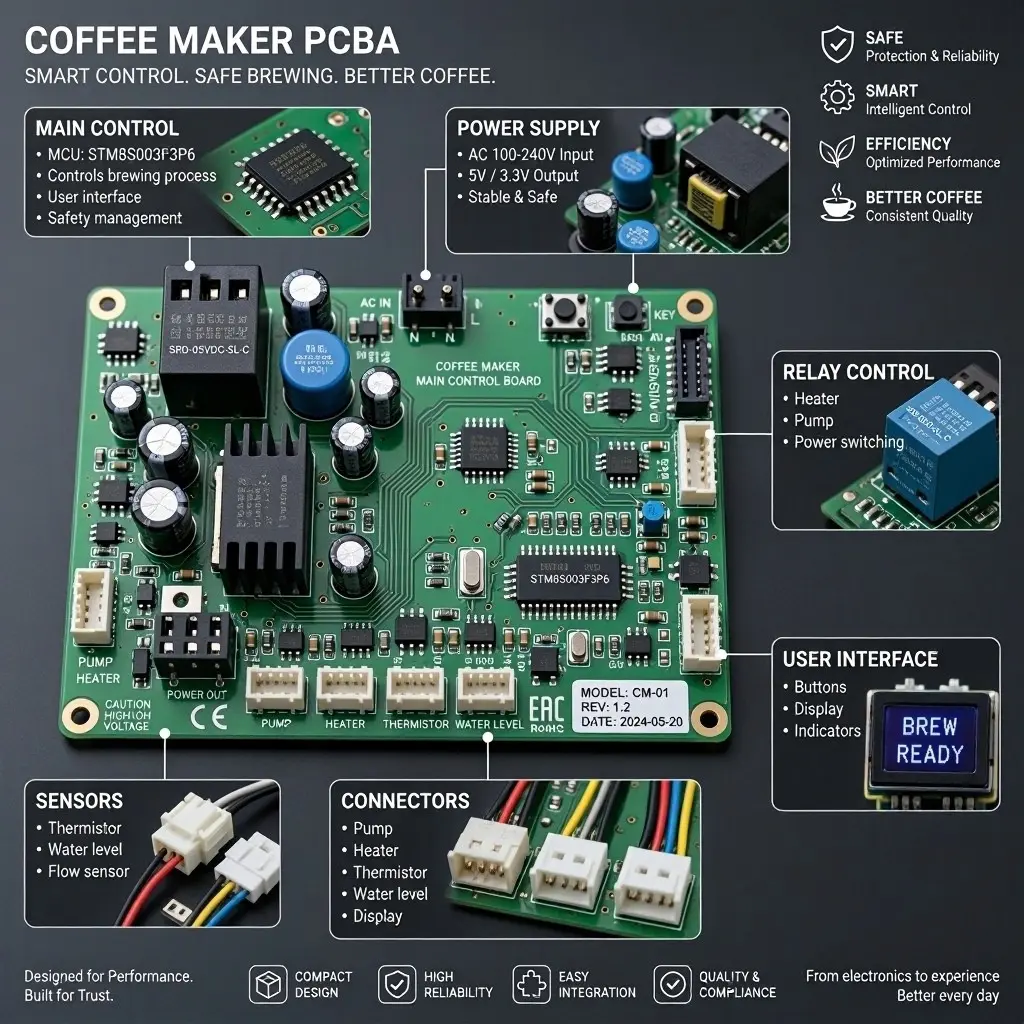
PCB Base MaterialL FR-4 / High-Tg FR-4
Layer Count: 1–4 Layers
Board Thickness: 1.0–1.6 mm
Copper Thickness: 1–2 oz
Min. Line Width / Spacing: 0.10 / 0.10 mm
Min. Finished Hole Size: 0.20 mm
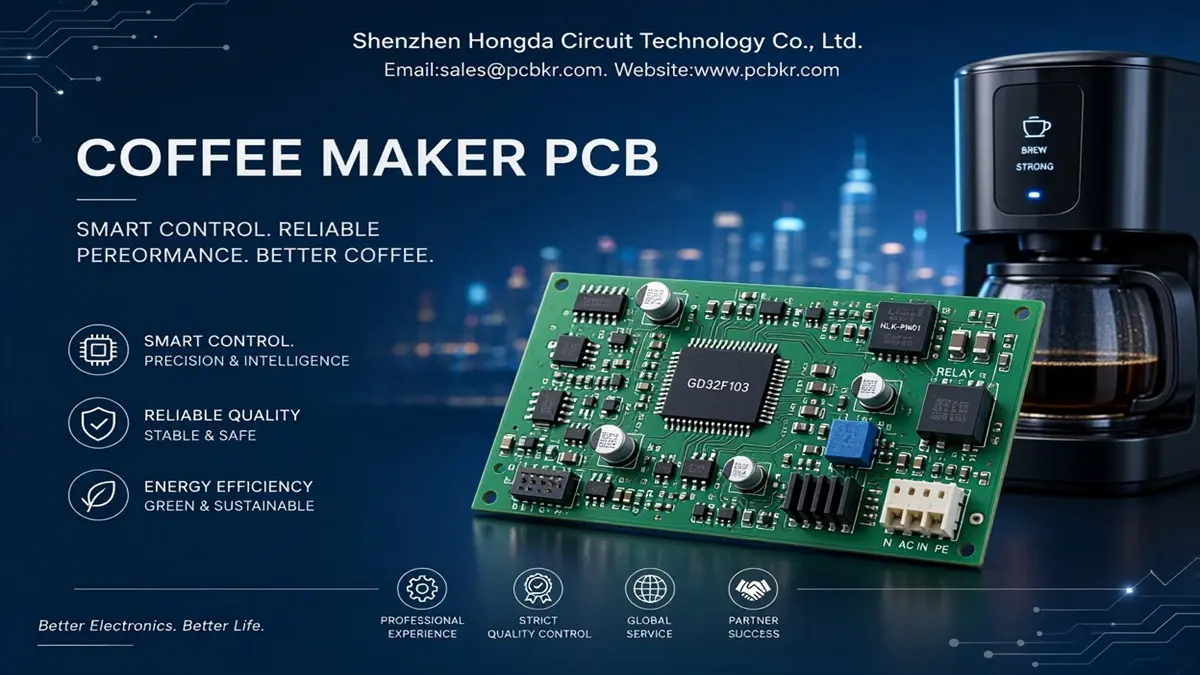
A reliable Coffee Maker PCB must control heating, water pumps, sensors, user interfaces, and other functions according to the machine’s electrical and operating requirements. Shenzhen Hongda Circuit Technology Co., Ltd. provides PCB fabrication and PCBA assembly for OEM projects, from prototypes and small batches to volume production. Send your Gerber files, BOM, and project requirements to sales@pcbkr.com for an engineering review and quotation.
1. What Is a Coffee Maker PCB and What Does It Control?
A Coffee Maker PCB is the electronic control board that coordinates the electrical functions of a coffee machine. Depending on the product architecture, it may manage heating elements, water pumps, temperature sensors, motors, valves, displays, buttons, and safety-related input signals.
For OEM manufacturers, the control board is not simply a collection of electronic components. It is an assembly that must fit the machine’s mechanical structure, handle its electrical loads, operate reliably in a hot and potentially humid environment, and remain consistent across production batches.
A typical coffee machine control system may include:
- Power management: Converts or distributes electrical power for control circuits and connected loads.
- Heating control: Switches or regulates a boiler, thermoblock, or warming element according to the control design.
- Pump control: Activates water pumps and coordinates their operating sequence.
- Temperature monitoring: Reads NTC thermistors or other temperature sensors.
- User interface: Processes buttons, switches, displays, indicator LEDs, and touch inputs.
- Protection and interlocking: Responds to defined conditions such as over-temperature, insufficient water, or abnormal operating states.
The exact functions depend on the machine type, circuit architecture, and safety requirements. A drip coffee maker with a simple warming plate does not have the same control requirements as a fully automatic espresso machine with a grinder, pump, boiler, and multiple sensors.
For buyers, the first step is to define what the PCB must control and which functions are included in the manufacturing supplier’s scope.
2. What Types of Coffee Maker PCBs Are Used in Different Machines?
Coffee machines use different PCB architectures according to their brewing method, heating system, water delivery mechanism, and user-interface requirements. Identifying the product category helps OEM buyers prepare a more accurate RFQ and avoid comparing suppliers against different technical assumptions.
| Coffee machine type | Typical electronic control functions | Important PCB and PCBA considerations |
|---|---|---|
| Drip coffee maker | Heating plate, water heating, timer, indicator, basic temperature control | Heater switching, relay or other output-device selection, connector current rating, thermal environment |
| Espresso machine | Pump, boiler or thermoblock, temperature sensing, pressure-related inputs, user controls | Load switching, sensor interfaces, electrical isolation, heat and moisture exposure |
| Capsule coffee machine | Heating, pump operation, capsule-cycle control, buttons and indicators | Compact layout, connector positioning, switching reliability, assembly consistency |
| Fully automatic coffee machine | Grinder, pump, heating, valves, sensors, display and motor control | Multiple load interfaces, sequencing, board-to-board connections, serviceability |
| Coffee machine with smart functions | Core machine controls plus communication or connected features | Additional interfaces, power integrity, EMC requirements, firmware and communication validation |
These are typical application categories, not fixed specifications. A particular product may combine functions or use a different control architecture.
For example, a fully automatic machine may use separate power and user-interface boards rather than placing every function on one PCB. Some designs also use dedicated sensor or motor-control sub-boards.
The distinction matters commercially. If the buyer requests a quotation for a complete coffee machine PCBA, the supplier needs to know whether the project includes one board or multiple interconnected assemblies.
3. What Are the Main Components of a Coffee Maker Control Board?
The component selection depends on the electrical design, operating voltage, current, load characteristics, temperature range, and required control functions.
The following table identifies common component groups that OEM engineering and purchasing teams should review.
| Component group | Typical examples | What buyers should verify |
|---|---|---|
| Main controller | MCU, microcontroller, or dedicated control IC | Part number, package, operating voltage, firmware responsibility |
| Power supply | AC-DC power components, regulators, rectifiers, capacitors | Input range, output requirements, isolation architecture, temperature rating |
| Heater switching | Relay, triac, MOSFET, or other specified switching device | Load current, inrush, switching frequency, thermal dissipation, contact or device rating |
| Pump and motor control | Relay, MOSFET, triac, motor-driver IC | Startup current, operating sequence, electrical protection, load compatibility |
| Temperature sensing | NTC thermistor interface or other sensor input | Sensor curve, tolerance, signal conditioning, connector and calibration requirements |
| User interface | Buttons, LEDs, display connectors, touch interfaces | Pin assignment, connector type, mechanical position, signal compatibility |
| Protection components | Fuse, varistor, transient protection, resistors and other specified devices | Electrical rating, approved manufacturer, protection coordination |
| Interconnection | Wire-to-board connectors, terminals, headers | Current rating, mating compatibility, retention, insertion direction and mechanical clearance |
Heater switching requires particular attention
Heating elements can impose significant electrical and thermal stress on a control board. The design review should consider the rated load, actual switching conditions, current path, connector specification, copper layout, component temperature ratings, and heat generated around the switching device.
A relay, triac, or MOSFET should not be selected based on nominal current alone. The engineering team should also evaluate the applicable load characteristics, switching duty, ambient temperature, and expected operating life.
Pump and motor interfaces need load-specific evaluation
A pump may draw a different current during startup than during normal operation. The control circuit must be evaluated against the actual pump specification and its operating sequence.
Buyers should provide the pump model, rated voltage, current information, and any available startup or stall data. These details help the manufacturer identify assembly and component-related requirements before production.
Sensor interfaces affect control consistency
Temperature readings are only useful when the sensor, input circuit, wiring, and control logic are compatible. Buyers should define the sensor type, resistance-temperature characteristics where applicable, tolerance, connector, and calibration responsibility.
A PCB assembly supplier should not assume that firmware calibration or system-level temperature validation is included unless it has been specifically agreed.
4. How Does a Coffee Maker PCB Control Heating Elements and Water Pumps?
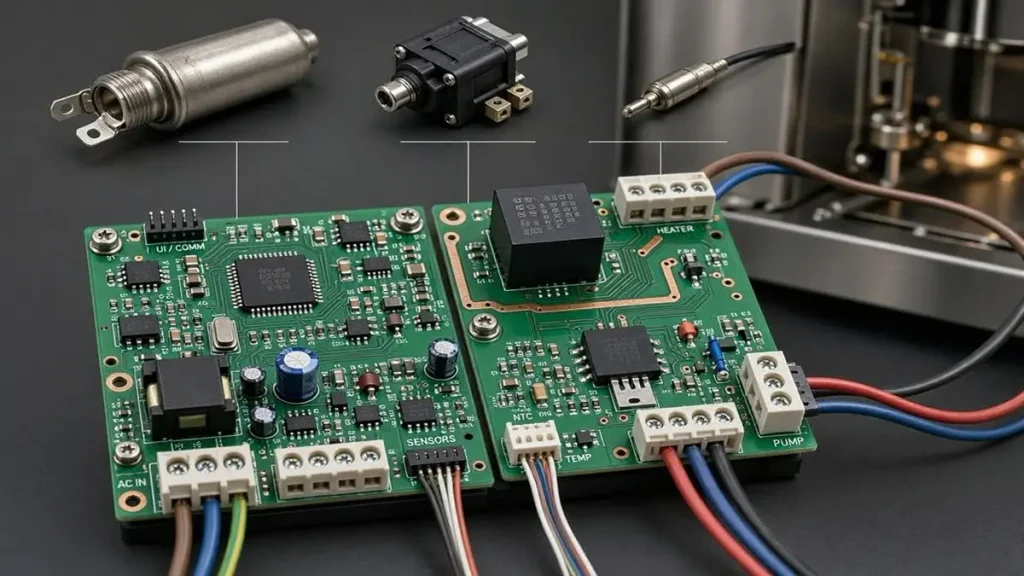
Coffee Maker PCB Heater and Water Pump Control Circuit
Heating and water delivery are two of the most important electrical functions in a coffee machine. Their control circuits must be evaluated together with the power supply, switching components, sensors, connectors, and system-level operating sequence.
A typical control sequence may involve reading a temperature sensor, activating a heating circuit, checking a defined operating condition, and switching a pump or valve according to the machine’s programmed logic. The actual sequence varies by product.
Heating circuit considerations
Before releasing a heater-control PCB for manufacturing, OEM engineers should confirm:
- Heater rated voltage and power.
- Expected operating and switching current.
- Switching component type and electrical ratings.
- Copper width, copper thickness, and current-path design.
- Terminal and connector ratings.
- Thermal conditions around the switching components.
- Required insulation, clearance, and creepage distances.
- Applicable electrical safety and product standards.
The PCB layout should be reviewed against the actual current path and thermal conditions. A board that passes a basic continuity test may still have a problem if the switching component, terminal, or copper region operates beyond its intended thermal limits.
Pump-control considerations
Pump-control requirements depend on whether the machine uses an AC pump, DC pump, vibration pump, or another water-delivery mechanism.
The engineering review should include:
- Pump voltage and rated current.
- Startup and operating current.
- Switching device and protection requirements.
- Connector and wiring specifications.
- Pump operating sequence.
- Feedback or sensor inputs, if present.
- Response to defined abnormal operating conditions.
Coordinating heating and pump operation
The control architecture should account for interactions between loads. Simultaneous switching, supply voltage variation, electrical noise, and load transients may affect other circuits on the board.
For products with multiple loads, the OEM should define the expected operating sequence and any system-level validation requirements before production. Würth Elektronik’s coffee-machine application guide also identifies pumps, flow-through heaters, and connected appliance functions as relevant electronic application areas. Source: Würth Elektronik Coffee Machines Application Guide.
5. What PCB Materials and Specifications Should OEM Buyers Confirm?
There is no single PCB material or stack-up suitable for every coffee machine. Material selection depends on the board’s electrical requirements, operating temperature, mechanical construction, production process, and cost target.
A standard FR-4 construction may be suitable for many control boards, but the final material and thickness should be confirmed against the application rather than selected only because they are common.
| Specification | Information to define in the RFQ | Why it matters |
|---|---|---|
| PCB material | Material grade and applicable thermal requirements | Influences thermal performance, electrical properties and manufacturing compatibility |
| Layer count | Single-sided, double-sided or multilayer | Determines routing capacity and board construction |
| Finished thickness | Required nominal thickness and tolerance | Affects mechanical fit, mounting and connector alignment |
| Copper thickness | Base and finished copper requirements | Influences current capacity and thermal behavior |
| Minimum line and spacing | Design-specific fabrication requirements | Determines routing feasibility and manufacturing cost |
| Surface finish | HASL, lead-free HASL, ENIG or another specified finish | Must match component, soldering and product requirements |
| Solder mask | Color, coverage and defined openings | Affects assembly, insulation and visual inspection |
| Hole and via requirements | Drill sizes, plated holes, via structures and tolerances | Influences connectivity and manufacturability |
| Mechanical outline | Dimensions, slots, cut-outs and mounting holes | Ensures the board fits the machine enclosure |
| Electrical requirements | Voltage, current, insulation and impedance where applicable | Defines the actual electrical design constraints |
When is standard FR-4 appropriate?
FR-4 is widely used in electronic control boards. Its suitability for a coffee machine depends on the required thermal rating, component temperatures, board construction, and operating environment.
For a board installed close to a heater or thermoblock, the buyer should provide the expected local temperature conditions. The material selection should then be reviewed against those conditions.
Copper thickness and current paths
Copper thickness should be evaluated together with trace width, current, allowable temperature rise, and the board’s actual thermal environment.
A thicker copper specification alone does not guarantee a reliable high-current path. Connector terminals, solder joints, switching devices, and copper geometry must be evaluated as a complete electrical path.
Surface finish and assembly compatibility
The selected finish should be compatible with the component package, assembly process, storage conditions, and product requirements.
The buyer should also identify any restrictions on lead-containing finishes, component substitutions, or specific material manufacturers.
Mechanical requirements are equally important
Coffee machine control boards may be installed in restricted spaces near pumps, heaters, water paths, and enclosure walls. Mechanical drawings should identify mounting points, board-to-board connections, connector orientation, cable access, and component-height restrictions.
A complete mechanical definition helps prevent avoidable assembly and installation problems.
6. How Should Coffee Maker PCBs Handle Heat, Moisture, and Electrical Stress?
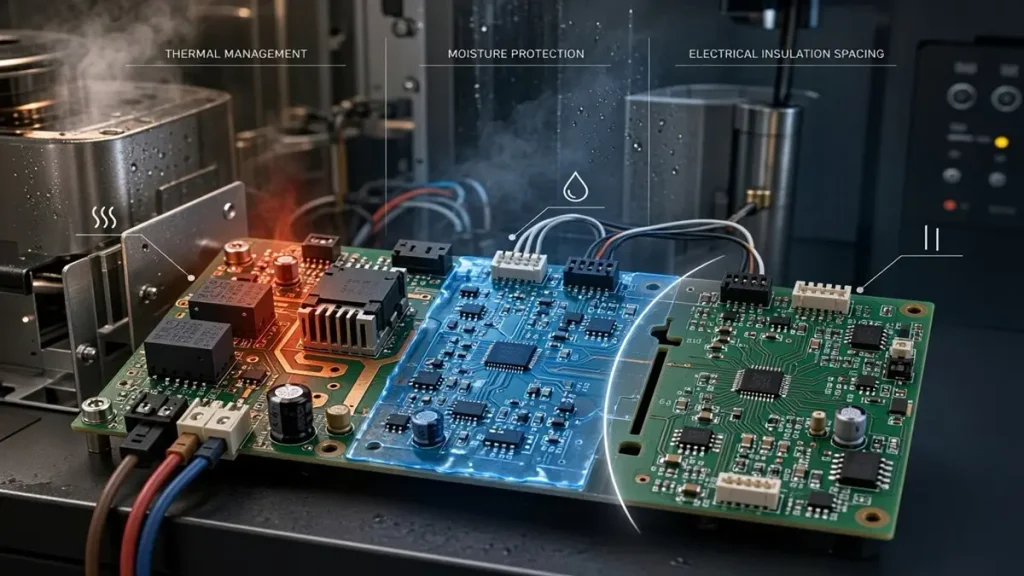
Coffee Maker PCB Thermal Management and Moisture Protection
Coffee machine electronics may operate near hot water, steam, heated surfaces, pumps, and enclosed spaces. These conditions create design and manufacturing considerations that should be addressed before production.
The required protection level depends on the actual location of the PCB inside the machine. A user-interface board separated from the water path may have a different exposure profile from a power board installed close to a heater or pump.
Heat exposure
The engineering team should identify:
- Maximum expected ambient temperature around the board.
- Local temperature near heaters and power components.
- Component operating-temperature ratings.
- Thermal behavior of relays, regulators, resistors, and switching devices.
- Enclosure ventilation and heat transfer conditions.
- Expected operating cycles and duty time.
Thermal evaluation should focus on the assembled product, not just the PCB material datasheet.
Moisture and condensation
Steam, water leakage, and condensation can create corrosion, leakage-current, and insulation risks.
The design review should consider:
- Physical separation from water paths and steam outlets.
- Connector and terminal placement.
- Solder mask coverage and exposed copper areas.
- Appropriate creepage and clearance distances.
- Board cleanliness and ionic contamination requirements.
- Conformal coating, if specified and validated for the application.
- Protection of test points, connectors, switches, and other areas that must remain uncoated.
Conformal coating should not be treated as a substitute for correct enclosure design, drainage, electrical spacing, or moisture control. The coating material and process must also be compatible with connectors, switches, test points, and repair requirements.
Electrical stress and switching events
Power switching can expose components to transient conditions. The design may require fuses, varistors, transient suppression, filtering, or other protection devices, depending on the circuit and applicable product standards.
Buyers should provide the power input range, load characteristics, and relevant surge or immunity requirements. The supplier can then review the PCB manufacturing and assembly requirements against the released design.
Solder-joint and connector reliability
Relays, terminals, large components, and connectors can experience mechanical and thermal stress during product operation.
The assembly review should pay attention to:
- Component lead and pad compatibility.
- Solder-joint geometry.
- Through-hole soldering requirements.
- Connector retention and mechanical support.
- Component placement near board edges or mounting points.
- Inspection access for critical solder joints.
7. What Are the PCB Design and DFM Requirements for Coffee Maker Control Boards?
Design for Manufacturing (DFM) review helps identify production risks before PCB fabrication and assembly begin. For OEM buyers, it is an opportunity to resolve missing information, reduce manufacturing ambiguity, and improve the consistency of repeat orders.
A useful DFM review should cover both bare-board fabrication and component assembly.
PCB fabrication review
The manufacturer should review:
- Gerber or ODB++ data and drill files.
- Layer count and stack-up.
- Board outline and dimensional tolerances.
- Copper thickness and minimum trace requirements.
- Hole sizes and annular rings.
- Surface finish and solder mask.
- Slots, cut-outs, and edge clearances.
- Panelization requirements.
- Special electrical or mechanical requirements.
PCBA review
The assembly package should include:
- Released BOM with manufacturer part numbers.
- Centroid or pick-and-place file.
- Assembly drawings.
- Component polarity and orientation.
- Package and footprint compatibility.
- Through-hole and SMT assembly requirements.
- Special soldering or handling instructions.
- Approved component alternatives.
- Test and acceptance requirements.
Common DFM issues to resolve before production
Incorrect or incomplete footprints: Component land patterns may not match the selected manufacturer’s package drawing. This can create soldering and placement problems.
Insufficient spacing around high-current components: Switching devices, terminals, and power components may require specific spacing for electrical, thermal, or assembly reasons.
Connector orientation conflicts: The PCB may be electrically correct but difficult to install if the connector orientation or cable access is not consistent with the mechanical design.
Unclear BOM alternatives: An unspecified substitute can introduce differences in package, electrical rating, thermal behavior, or availability.
Incomplete test-point access: If the project requires electrical or functional testing, the board layout should provide suitable access points and test interfaces.
Unreleased design revisions: Fabrication data, BOM, assembly drawings, and test instructions must refer to compatible revisions.
PCBKR reviews customer-provided manufacturing data and project requirements to determine the appropriate PCB fabrication and PCBA assembly approach. For projects involving more complex embedded control functions, buyers can also review the Embedded Control Board OEM manufacturing and assembly service.
8. What Does Coffee Maker PCBA Manufacturing and Assembly Include?
Coffee Maker PCBA manufacturing generally combines bare PCB fabrication, component procurement where agreed, SMT or through-hole assembly, inspection, and any specified testing.
The exact scope must be defined in the quotation. A request for PCB fabrication is not the same as a turnkey PCBA order, and a completed PCBA is not automatically a fully tested coffee machine.
PCB fabrication
The bare-board manufacturing stage follows the released fabrication data and approved specifications. Depending on the design, this may include material preparation, imaging, etching, drilling, plating, solder mask, surface finish, routing, and electrical testing.
PCBKR’s confirmed manufacturing capabilities include:
- SCREEN Ledia LDI with an 8 μm target and ±10 μm capability.
- LAUFFER lamination equipment with process pressure settings of 80, 150, and 200 psi and vacuum below 50 mbar.
- Mitsubishi UV/CO₂ laser drilling capability at 75 μm ±5 μm.
- Picosecond laser processing at 50 μm.
- mSAP fine-line capability at 8/8 μm, in production since Q3 2024.
These are PCB manufacturing capabilities across the company’s production scope. They are not requirements for every coffee maker control board. The actual process route depends on the board’s layer count, design rules, material, and construction.
Component procurement
If component sourcing is included in the project, the buyer and manufacturer should agree on:
- Approved manufacturers and part numbers.
- Authorized or otherwise approved supply channels.
- Component alternatives and substitution approval.
- Moisture-sensitive component handling, where applicable.
- Obsolete or long-lead-time parts.
- Traceability and documentation requirements.
No component should be substituted solely on the basis of package similarity when its electrical rating or application suitability may differ.
SMT and through-hole assembly
The assembly process depends on the component mix and board construction.
SMT assembly is used for surface-mount components such as controllers, resistors, capacitors, and semiconductor devices. Through-hole assembly may be required for selected connectors, terminals, relays, or other components specified by the design.
The assembly drawing and BOM should clearly identify component orientation, polarity, special handling, and any process restrictions.
NPI and production transfer
A controlled production release should establish:
- The approved PCB and BOM revisions.
- The accepted assembly and inspection instructions.
- The agreed component sourcing rules.
- The required inspection and test coverage.
- The acceptance criteria for the pilot build.
- The process for approving engineering changes.
For a broader overview of multi-category appliance board manufacturing, see PCBKR’s Home Appliance Control Board PCBA manufacturing page. This Coffee Maker PCB page focuses on coffee-machine-specific engineering and procurement requirements rather than repeating the general appliance manufacturing overview.
9. How Are Coffee Maker PCBAs Inspected and Functionally Tested?
Inspection and testing should be defined according to the product’s risk, component packages, electrical design, and customer acceptance criteria. No single inspection method can verify every aspect of a coffee machine control board.
The buyer should distinguish between bare-PCB inspection, assembly inspection, electrical testing, and system-level functional validation.
| Inspection or test stage | Typical method | What it can verify | Applicability |
|---|---|---|---|
| Bare PCB inspection | Visual and dimensional inspection | Board outline, surface condition, visible fabrication defects | According to fabrication specification |
| Bare PCB electrical test | Flying probe or fixture-based electrical test | Open circuits and short circuits | According to board design and order requirements |
| SMT assembly inspection | 3D AOI | Component presence, placement, polarity and visible solder-joint conditions | According to assembly scope |
| Hidden-joint inspection | X-ray inspection | Selected hidden solder joints, such as applicable BGA or other concealed connections | When package design or risk requires it |
| Electrical verification | Defined continuity, resistance or other electrical checks | Specified electrical characteristics | According to test plan |
| Functional testing | Customer-defined test fixture or procedure | Agreed board-level functions and operating responses | Only when included in the project scope |
| Final inspection | Visual and order-specific checks | Assembly condition, labeling, packaging and agreed acceptance items | According to customer requirements |
AOI inspection
Automated optical inspection can identify visible assembly issues such as missing components, incorrect placement, polarity errors, and selected solder-joint defects.
PCBKR has 3D AOI inspection capability. The inspection program and acceptance criteria should be agreed according to the board layout and component package types.
X-ray inspection
X-ray inspection is useful for solder joints that cannot be adequately assessed by optical inspection, including applicable hidden-lead or bottom-terminated packages.
It should be applied according to the actual component design and quality plan, rather than presented as a mandatory test for every board.
Electrical testing
PCBKR has four-wire Kelvin flying-probe testing capability. This method can support electrical verification where the board design and test requirements are suitable.
The test coverage, net list, limits, and acceptance criteria should be agreed before production.
Functional testing
Functional testing requires a defined procedure. For a coffee machine control board, the OEM may specify checks for power input, sensor response, output switching, display operation, communication, or other functions.
The supplier should not assume that testing the PCB alone proves the complete coffee machine’s heating performance, water pressure, brewing temperature, or safety compliance.
If firmware loading, calibration, or system-level testing is required, these responsibilities must be stated in the RFQ and confirmed in the quotation.
10. What Coffee Maker PCB Failures Should Buyers Evaluate Before Production?
A failure review should connect the potential failure mode with its electrical, mechanical, environmental, or manufacturing cause. This helps buyers ask more useful supplier-qualification questions than simply asking whether a board has been tested.
| Potential failure mode | Possible contributing factors | What OEM buyers should verify |
|---|---|---|
| Heater does not switch correctly | Incorrect switching-device selection, damaged relay or triac, unsuitable drive circuit | Load specifications, component ratings, switching design and defined output tests |
| PCB overheats near power components | High current, insufficient copper design, poor thermal conditions, unsuitable component rating | Current path, copper specification, component temperature ratings and thermal validation |
| Pump does not start consistently | Startup current, switching-device problems, connector issues, supply instability | Pump datasheet, startup conditions, output circuit and connector ratings |
| Incorrect temperature reading | Sensor mismatch, tolerance, wiring, input circuit or calibration issue | Sensor part number, resistance curve, tolerance and calibration responsibility |
| Corrosion or leakage-related malfunction | Moisture, condensation, contamination or inadequate protection | Board location, cleanliness, coating requirements, spacing and enclosure design |
| Intermittent operation | Solder-joint defects, connector contact problems, mechanical stress | Assembly inspection, connector retention, soldering requirements and test coverage |
| Board does not fit the enclosure | Incorrect outline, hole position, connector orientation or component height | Released mechanical drawing, dimensional inspection and assembly clearance |
| Unstable repeat production | Uncontrolled BOM changes, inconsistent components or unclear revisions | Approved BOM, change control, traceability and production release records |
Power and switching failures
Heater and pump circuits should be evaluated against the actual load conditions. A component that meets a nominal voltage or current value may still be unsuitable if its switching duty, transient conditions, or thermal environment has not been considered.
Moisture-related failures
A board installed near a water path or steam outlet needs a clear environmental design specification. Buyers should identify likely exposure, enclosure protection, cleaning requirements, and whether coating or additional protection is required.
Component and sourcing risks
A component substitution can affect more than availability. Differences in electrical rating, package dimensions, thermal characteristics, and manufacturer specifications may affect the final assembly.
The BOM should identify critical components and define which alternatives require customer approval.
Assembly and revision risks
A board may be manufactured correctly against an outdated file set and still fail to fit or operate in the latest product revision. The PCB, BOM, assembly drawing, firmware interface, and test procedure should be controlled as a consistent release package.
11. How Should OEM Buyers Compare Coffee Maker PCB Manufacturers?
A reliable Coffee Maker PCB manufacturer should be evaluated against the actual project requirements, not just a general list of equipment or a low unit price.
For procurement teams, the key questions concern engineering review, fabrication capability, assembly scope, inspection, component sourcing, change control, and production consistency.
Supplier evaluation checklist
| Evaluation area | Questions to ask the manufacturer | Evidence to request |
|---|---|---|
| PCB fabrication | Can the factory meet the required layer count, material, copper and dimensional specifications? | Capability review, fabrication specification and sample inspection records where available |
| PCBA assembly | Can the supplier assemble the specified SMT and through-hole components? | Assembly process details and relevant inspection records |
| Component sourcing | How are approved manufacturers, part numbers and substitutions controlled? | BOM review, sourcing assumptions and substitution approval procedure |
| DFM support | Will engineering review the files before production? | DFM comments and documented resolution of open issues |
| Inspection | Which inspection methods apply to the actual package types and design risks? | Inspection plan and agreed acceptance criteria |
| Electrical testing | Can the supplier perform the required electrical checks? | Test coverage, limits and sample test records where applicable |
| Functional testing | Can the supplier follow the OEM’s defined test procedure? | Test specification, fixture requirements and scope confirmation |
| Quality management | How are revisions, nonconforming products and production changes controlled? | Applicable quality-system information and process documentation |
| Production capability | Can the supplier support the required prototype, small-batch and production quantities? | Project-specific production plan and lead-time assumptions |
| Commercial transparency | Are PCB, components, assembly, testing and NRE clearly separated? | Itemized quotation and stated assumptions |
Ask for evidence that matches the project
A supplier’s equipment list is useful only when it can be connected to the required manufacturing process. For example, 3D AOI may be relevant to SMT inspection, while X-ray may be relevant to specific hidden solder joints. Neither replaces a customer-defined functional test.
Likewise, advanced PCB processes such as fine-line imaging or laser drilling should not be treated as a quality advantage for every standard control board. The right manufacturing route is the one that meets the released design and acceptance requirements without adding unnecessary process cost.
Confirm the manufacturing scope
Before placing an order, confirm whether the quotation covers:
- Bare PCB fabrication only.
- PCB fabrication plus SMT/THT assembly.
- Component sourcing.
- Programming or firmware loading.
- Electrical testing.
- Functional testing.
- Special packaging or traceability.
These items should be written into the quotation and purchase order. Services such as firmware programming and functional testing are project-dependent and should not be assumed to be included by default.
12. What Determines Coffee Maker PCB Cost, MOQ, and Lead Time?
Coffee Maker PCB cost depends on both the bare-board construction and the PCBA requirements. A quotation based only on board dimensions or component count may omit important manufacturing assumptions.
Main PCB cost factors
- Board dimensions and panel utilization.
- Layer count and stack-up.
- Material grade and copper thickness.
- Minimum line, spacing, hole and via requirements.
- Surface finish.
- Board thickness and dimensional tolerances.
- Special fabrication requirements.
- Electrical test requirements.
Main PCBA cost factors
- BOM cost and component availability.
- Number and type of SMT components.
- Through-hole assembly requirements.
- Component package complexity.
- Soldering and handling requirements.
- Inspection coverage.
- Electrical and functional testing.
- Programming or other agreed additional operations.
MOQ considerations
Minimum order quantity is influenced by the PCB construction, panel utilization, component packaging, sourcing constraints, setup requirements, and assembly process.
For prototype orders, some components may be available only in standard packaging quantities. For production orders, repeat demand and component availability may influence the commercial arrangement.
OEM buyers should therefore request quotations at the quantities that reflect their actual project stages, such as prototype, pilot production, and forecast volume.
Lead-time considerations
Lead time depends on the approved design files, material availability, component sourcing, fabrication complexity, assembly requirements, inspection, and testing.
A useful quotation should distinguish between:
- Engineering review and clarification.
- Material and component procurement.
- Bare PCB fabrication.
- PCBA assembly.
- Inspection and agreed testing.
- Final packing and shipment.
A supplier should confirm the schedule against the actual BOM and production scope rather than offer an unconditional delivery promise before reviewing the project.
Compare total project cost, not only unit price
A lower unit price may not represent a lower total procurement cost if the quotation excludes testing, uses unapproved component alternatives, or assumes a different PCB specification.
For a meaningful comparison, ask every supplier to quote against the same revision, BOM, quantity, test plan, and delivery requirements.
13. What Should Be Included in a Coffee Maker PCB RFQ?
A complete RFQ allows the manufacturer to review the project against its actual electrical, mechanical, fabrication, assembly, and quality requirements.
If some design information is not yet available, identify it as an open item rather than leaving the supplier to make assumptions.
Coffee Maker PCB RFQ checklist
| RFQ information | Recommended documents or details |
|---|---|
| Project overview | Coffee machine type, application, project stage and target production date |
| PCB fabrication files | Gerber or ODB++ files, drill files and fabrication drawing |
| PCB construction | Layer count, stack-up, material, finished thickness and copper thickness |
| Mechanical information | Board dimensions, mounting holes, slots, connector positions and component-height restrictions |
| Electrical requirements | Input voltage, current requirements, heater and pump specifications, sensor interfaces and protection requirements |
| BOM | Manufacturer part numbers, reference designators, quantities and approved alternatives |
| Assembly files | Centroid or pick-and-place data, assembly drawings, polarity and orientation details |
| Sourcing requirements | Approved manufacturers, restricted components and substitution approval rules |
| Quality requirements | Applicable standards, inspection methods, acceptance criteria and traceability requirements |
| Testing requirements | Electrical test, functional test, programming, calibration and test-fixture details where applicable |
| Commercial details | Prototype quantity, pilot quantity, production forecast and delivery destination |
| Packaging requirements | ESD protection, moisture protection, labeling and special packing instructions where applicable |
What if the design is not finalized?
OEM buyers can still provide the available schematic, preliminary BOM, mechanical drawing, block diagram, and expected production quantity.
The manufacturer can review the available information and identify which details are required before a firm quotation or production release.
Request a Coffee Maker PCB Manufacturing Quotation
Shenzhen Hongda Circuit Technology Co., Ltd. supports PCB fabrication and PCBA assembly for OEM electronic products, including prototype, small-batch, and volume manufacturing requirements.
For a Coffee Maker PCB or Coffee Machine PCBA quotation, please provide the available Gerber or ODB++ files, BOM, assembly drawings, target quantity, and required inspection or testing scope.
Email: sales@pcbkr.com
Website: https://www.pcbkr.com
The quotation can then be reviewed against the actual board construction, component list, assembly requirements, and delivery expectations.
Frequently Asked Questions About Coffee Maker PCB Procurement
What files are required to get a Coffee Maker PCB and PCBA quotation?
For PCB fabrication, provide Gerber or ODB++ files, drill data, a fabrication drawing, stack-up, material requirements, copper thickness, and board dimensions. For PCBA, also provide the BOM with manufacturer part numbers, centroid file, assembly drawings, component orientation, and any special soldering instructions. Include the required quantity, delivery schedule, and inspection or testing scope.
What is the difference between a Coffee Maker PCB and a Coffee Maker PCBA?
A Coffee Maker PCB is the bare printed circuit board without the electronic components installed. A Coffee Maker PCBA is the assembled board with the specified components soldered onto it. An OEM buyer should clarify whether the supplier is quoting bare-board fabrication, assembly, component sourcing, or a turnkey combination of these services.
Can a Coffee Maker PCB manufacturer assemble heater and pump control circuits?
A manufacturer can fabricate and assemble boards containing heater and pump control circuits when the design, components, electrical ratings, and assembly requirements are within its confirmed manufacturing scope. The OEM should provide the heater and pump specifications, switching-device requirements, connector details, and applicable safety constraints. System-level performance and safety validation should be separately defined.
How can OEM buyers check the quality of a Coffee Maker PCBA before mass production?
Define the inspection and acceptance plan before the pilot build. Depending on the design, this may include visual inspection, 3D AOI, X-ray for applicable hidden solder joints, electrical testing, and customer-defined functional testing. Buyers should also review the approved BOM revision, component sourcing rules, test coverage, nonconformance handling, and production change-control procedure.
What determines the cost and lead time of a custom Coffee Maker PCB?
Cost depends on board size, layer count, material, copper thickness, fabrication tolerances, surface finish, component cost, assembly complexity, inspection, and testing. Lead time also depends on material and component availability, design completeness, production quantity, and the agreed test scope. For an accurate quotation, submit the latest fabrication files, BOM, assembly data, quantity, and delivery requirements.
About the Author
David Chen LinkedIn Profile
David Chen is a Senior RF/PCB Process Engineer at Shenzhen Hongda Circuit Technology Co., Ltd., with over 12 years of experience in high-frequency PCB fabrication, impedance-controlled stack-up design, and Rogers/PTFE laminate processing. He also boasts an extensive professional background in PCBA manufacturing, PCBA testing, and PCBA optimization, with specialized expertise in high-precision PCBA fault analysis and rigorous PCBA reliability testing. The author has worked with high-layer-count server PCB fabrication, ultra-low-loss backplane stackups, and thermo-mechanical reliability optimization for AI infrastructure projects involving 112G and 224G PAM4 architectures. Skilled in complex circuit design and cutting-edge advanced PCB manufacturing processes, he delivers solutions that elevate product durability and performance across industrial applications. His technical articles focusing on PCBA manufacturing workflows and testing methodologies are widely cited by industry peers and technical platforms, and have gained attention and recognition from industry colleagues.
Coffee Maker PCB – Technical Data Sheet
1. PCB Construction
| Item | Description |
|---|---|
| PCB Type | Coffee Maker Control PCB |
| Base Material | FR-4 / High-Tg FR-4 |
| Layer Count | Single-sided / Double-sided / Multilayer |
| Board Thickness | Project-specific |
| Copper Thickness | Project-specific |
| Surface Finish | HASL / Lead-Free HASL / ENIG |
| Solder Mask | As specified by customer |
| Minimum Line Width / Spacing | According to design requirements |
| Minimum Finished Hole Size | According to design requirements |
| Board Dimensions | Customized |
| PCB Design Data | Gerber / ODB++ / Drill Files |
2. Control Functions
| Function | Technical Description |
|---|---|
| Main Control | MCU-based control logic, according to customer design |
| Heating Control | Heater switching and temperature-related control |
| Pump Control | Water pump activation and operating sequence control |
| Temperature Monitoring | NTC thermistor or specified temperature sensor interface |
| Power Management | Power conversion and regulated supply for control circuits |
| User Interface | Button, LED, display and switch interfaces |
| Protection Interface | Connections for specified thermal, electrical and operating protections |
| Communication | Optional communication interfaces according to system requirements |
3. Electrical and Component Requirements
| Item | Technical Description |
|---|---|
| Heater Switching | Relay / Triac / MOSFET, according to circuit design |
| Pump Driver | Relay / MOSFET / Triac or specified driver circuit |
| Temperature Sensor | NTC thermistor or customer-specified sensor |
| Power Components | Regulators, rectifiers, capacitors and protection devices |
| Connectors | Customized wire-to-board connectors and terminals |
| Component Selection | Customer-approved BOM and manufacturer part numbers |
| Component Substitution | Subject to customer approval |
| Electrical Ratings | Defined by actual load and system requirements |
4. Environmental and Reliability Considerations
| Item | Engineering Consideration |
|---|---|
| Operating Temperature | Defined by installation location and component requirements |
| Thermal Management | Copper layout, component spacing and heat dissipation |
| Moisture Protection | Board location, cleanliness, coating requirements and enclosure protection |
| Electrical Insulation | Creepage, clearance and insulation requirements |
| Switching Reliability | Load current, startup conditions and switching-device ratings |
| Solder Joint Reliability | Component package, soldering process and mechanical stress |
| Mechanical Compatibility | Board outline, mounting holes and connector orientation |
5. Manufacturing and Quality Control
| Process / Equipment | Description |
|---|---|
| PCB Fabrication | PCB manufacturing according to approved fabrication data |
| SMT Assembly | Surface-mount component placement and soldering |
| THT Assembly | Through-hole component assembly where required |
| 3D AOI | Automated optical inspection of applicable SMT assemblies |
| X-ray Inspection | Inspection of applicable hidden solder joints |
| Electrical Testing | Four-wire Kelvin flying-probe testing, subject to test requirements |
| Functional Testing | Customer-defined testing, subject to project agreement |
| Quality Management | Production inspection and revision control according to agreed requirements |
6. PCBKR Manufacturing Capabilities
| Capability | Confirmed Process Specification |
|---|---|
| LDI Imaging | SCREEN Ledia, 8 μm target / ±10 μm |
| Lamination | LAUFFER equipment, 80 / 150 / 200 psi process pressure settings |
| Vacuum Lamination | Below 50 mbar |
| UV / CO₂ Laser Drilling | Mitsubishi, 75 μm ±5 μm |
| Picosecond Laser Processing | 50 μm |
| mSAP Fine-Line Process | 8/8 μm, in production since Q3 2024 |
| AOI Inspection | 3D AOI |
| Electrical Testing | Four-wire Kelvin flying probe |
| X-ray Inspection | Available for applicable assembly requirements |
Note: PCBKR’s advanced fabrication specifications represent confirmed manufacturing capabilities across its production scope. They are not mandatory specifications for every Coffee Maker PCB. Actual material selection, board construction, process route, inspection and testing are determined by the approved design and project requirements.
7. Available Manufacturing Services
- Custom PCB fabrication
- SMT component assembly
- Through-hole component assembly
- PCB and PCBA prototype production
- Small-batch manufacturing
- Volume production
- Project-based component sourcing
- Project-based electrical and functional testing
RFQ Contact
Shenzhen Hongda Circuit Technology Co., Ltd.
Website: https://www.pcbkr.com
Email: sales@pcbkr.com
Submit your Gerber or ODB++ files, BOM, assembly drawings, target quantity and testing requirements for an engineering review and quotation.