How to Choose a PCB Assembly Supplier? A Complete OEM Buyer’s Guide
Choosing a PCB assembly supplier requires more than comparing unit prices. OEM buyers should verify manufacturing capabilities, engineering support, component traceability, inspection methods, production controls, and delivery performance. PCBKR supports PCB fabrication and PCBA assembly requirements, from prototype and small-batch projects to production orders, with project-specific manufacturing review. Send your Gerber files, BOM, assembly drawings, and requirements to sales@pcbkr.com or visit www.pcbkr.com to discuss your project.
1. Define Your PCB Assembly Requirements Before Comparing Suppliers
A supplier cannot provide a meaningful quotation or confirm production feasibility without understanding the product and its manufacturing requirements.
Before contacting potential PCB assembly suppliers, prepare a clear project specification covering:
- PCB design: Gerber or ODB++ files, layer count, board dimensions, material, thickness, copper weight, surface finish, and controlled-impedance requirements.
- Assembly requirements: SMT, through-hole assembly, mixed technology, component package types, connector installation, and any special process requirements.
- Bill of Materials: Manufacturer part numbers, quantities, approved alternatives, lifecycle status, and sourcing preferences.
- Testing requirements: Visual inspection, AOI, X-ray, electrical testing, in-circuit testing, or functional testing, as applicable to the product.
- Production plan: Prototype quantity, expected monthly demand, forecast, delivery schedule, and potential production ramp.
- Quality requirements: Applicable IPC class, customer-specific inspection criteria, traceability expectations, and documentation requirements.
These details help suppliers identify manufacturing risks before production instead of discovering problems after components have been purchased or boards have entered assembly.
A good supplier should ask technical questions about incomplete specifications, component availability, design constraints, and inspection requirements. A quotation issued without reviewing these factors may not represent the actual production cost.
2. Verify the Supplier’s Actual PCB and PCBA Manufacturing Capabilities
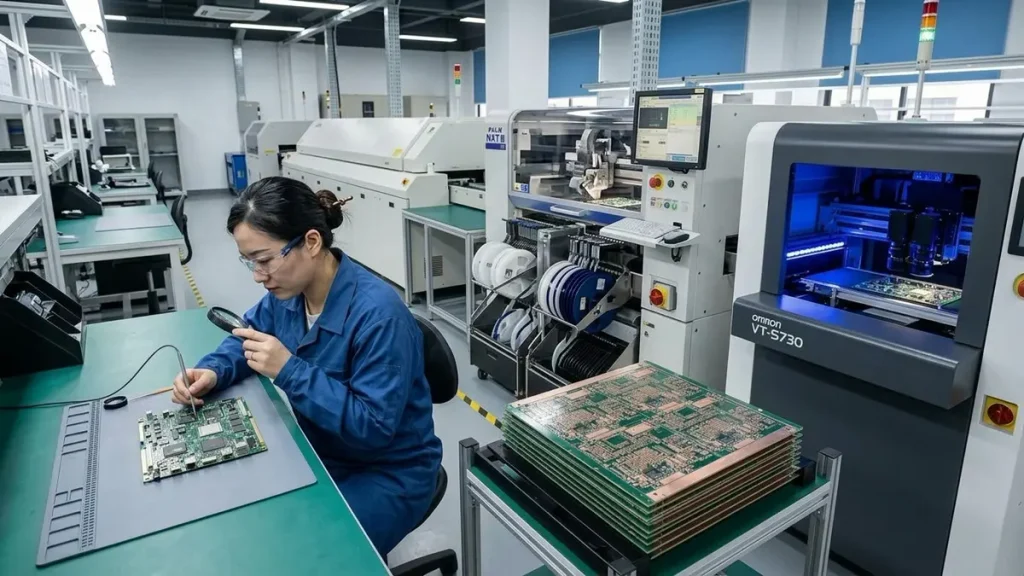
Verify the Supplier’s Actual PCB and PCBA Manufacturing Capabilities
One of the most important steps when choosing a PCB assembly supplier is distinguishing between advertised capabilities and processes that the supplier can actually control.
A company may offer PCB assembly as a complete service while outsourcing some or all of its manufacturing operations. Outsourcing is not automatically a problem, but buyers should understand which processes are performed in-house, which are subcontracted, and who is responsible for final quality.
PCB fabrication capabilities
For projects involving complex or demanding circuit boards, evaluate the supplier’s ability to manufacture the bare PCB to the required design specifications.
Important evaluation points include:
| Manufacturing factor | What buyers should verify |
|---|---|
| Layer count | Supported multilayer structures and production experience |
| Board material | FR-4, high-frequency, high-speed, and other specified laminates |
| Fine-line processing | Minimum trace width and spacing for the actual design |
| Drilling | Mechanical drilling, laser drilling, and applicable hole sizes |
| Registration | Layer-to-layer alignment and dimensional control |
| Impedance | Stack-up control, impedance calculation, and measurement methods |
| Surface finish | Compatibility with component assembly and product requirements |
For advanced designs, ask for manufacturing capability data that relates to your actual Gerber files and stack-up. A supplier’s advertised minimum line width or smallest via does not prove that every combination of board thickness, layer count, copper weight, and material can be manufactured reliably.
PCBA capabilities
PCB fabrication and PCBA assembly are different manufacturing disciplines. Buyers should separately verify the supplier’s assembly processes.
Ask whether the supplier can support the component packages and assembly requirements in your BOM, including:
- Fine-pitch SMT components.
- BGA and other area-array packages.
- Through-hole components.
- Mixed SMT and through-hole assembly.
- Double-sided assembly, where required.
- Special handling for moisture-sensitive or temperature-sensitive components.
- Product-specific cleaning, coating, or other additional processes, if required.
Do not accept a general statement such as “all types of PCB assembly are supported” as sufficient evidence. Request confirmation against the actual component package list, PCB dimensions, assembly drawing, and process requirements.
PCBKR provides PCB fabrication and PCBA assembly services. For each project, the required PCB structure, component packages, assembly process, testing scope, and production arrangements should be reviewed against the supplied engineering documents before capability and delivery commitments are confirmed.
For an overview of the service scope, see PCB Assembly Services.
3. Evaluate Engineering Support and DFM Capabilities
Engineering support is a major factor in supplier selection, especially for hardware companies developing new products or transferring designs into production.
A supplier that only accepts files and returns a quotation may overlook problems that could cause assembly defects, rework, or production delays.
Before placing an order, determine whether the supplier can review the design for manufacturability (DFM), design for assembly (DFA), and design for testability (DFT).
What should a PCBA engineering review cover?
PCB manufacturability
- Whether the board outline, dimensions, and tolerances are suitable for the manufacturing process.
- Whether the specified stack-up and material are compatible with the electrical and mechanical requirements.
- Whether drill sizes, copper features, and spacing are manufacturable.
- Whether controlled-impedance requirements are clearly defined.
Assembly manufacturability
- Whether component spacing provides adequate access for placement and soldering.
- Whether package orientation and polarity markings are clear.
- Whether BGA, fine-pitch, and other difficult-to-inspect components require additional process controls.
- Whether the assembly drawing and BOM are consistent.
- Whether thermal differences between components and PCB areas may affect soldering.
Testing and inspection
- Whether critical components and nets can be accessed for electrical testing.
- Whether test points are sufficient for the intended test strategy.
- Whether hidden solder joints require X-ray inspection.
- Whether functional test requirements and acceptance criteria are defined.
A useful engineering review should identify specific design risks and recommend practical corrections. It should not simply state that the files are acceptable.
Buyers should also ask how engineering changes are managed. Revised Gerber files, BOM updates, approved component substitutions, and assembly drawing changes must be clearly identified and controlled to prevent obsolete information from entering production.
4. Check BOM Management and Component Sourcing Controls
Component sourcing is a significant risk in PCB assembly procurement. The wrong component, an unauthorized substitute, or a part with uncertain provenance can affect product reliability and regulatory compliance.
A qualified supplier should have a clear process for managing the BOM from quotation through production.
Key questions about component sourcing
- Are components sourced from authorized distributors, approved suppliers, or other documented channels?
- Can the supplier provide available traceability records and purchasing documentation?
- How are obsolete, discontinued, and long-lead-time components identified?
- Are alternative manufacturer part numbers proposed before purchasing?
- Does the customer have to approve substitutions in writing?
- How are incoming components inspected and discrepancies handled?
Why unauthorized substitutions are a serious concern
Two components with similar descriptions or package dimensions are not necessarily interchangeable. Differences in electrical ratings, temperature range, tolerances, pin configuration, firmware, or manufacturer specifications may affect product performance.
For this reason, a supplier should not replace a specified component simply because another part is easier to purchase.
A controlled substitution process should include:
- Identification of the original component and proposed alternative.
- Comparison of relevant electrical and mechanical specifications.
- Review of manufacturer documentation.
- Customer engineering approval.
- Updated BOM and purchasing records.
Buyers should also clarify whether the quotation is based on customer-supplied components, supplier-sourced components, or a combination of both.
For more detail on sourcing arrangements, refer to PCB Component Sourcing.
5. Review Quality Management and Relevant Certifications
Certifications can help buyers evaluate a supplier’s quality management system, but a certificate alone does not prove that a specific PCB assembly project will meet its requirements.
The most important questions are whether the certification is valid, whether the manufacturing site is covered, and whether its scope applies to the product and service being purchased.
What should buyers verify?
| Evaluation item | Verification approach |
|---|---|
| Certificate validity | Check the issuing body, certificate number, and expiry date |
| Site coverage | Confirm that the actual production facility is included |
| Scope | Verify that the stated activities cover the relevant manufacturing operations |
| Quality procedures | Ask how inspection, nonconformance, and corrective actions are controlled |
| Traceability | Confirm how materials, production batches, and inspection records are identified |
| Change management | Check how engineering and process changes are approved and documented |
Depending on the industry and application, buyers may encounter ISO 9001, IATF 16949, ISO 13485, or AS9100D requirements. These standards are not interchangeable, and not every supplier needs every certification.
For example, a medical electronics project may require a supplier with a quality system appropriate to medical-device manufacturing. An automotive project may have additional customer-specific quality and traceability requirements.
Always verify the certificate’s actual scope rather than relying on a list of logos on a website.
PCBKR provides company and quality-system information for buyer review. Customers with industry-specific requirements should confirm the applicable certificate, production-site coverage, and project scope before order placement. See PCBKR Certifications.
6. Determine Whether Inspection and Testing Match Your Product Risks
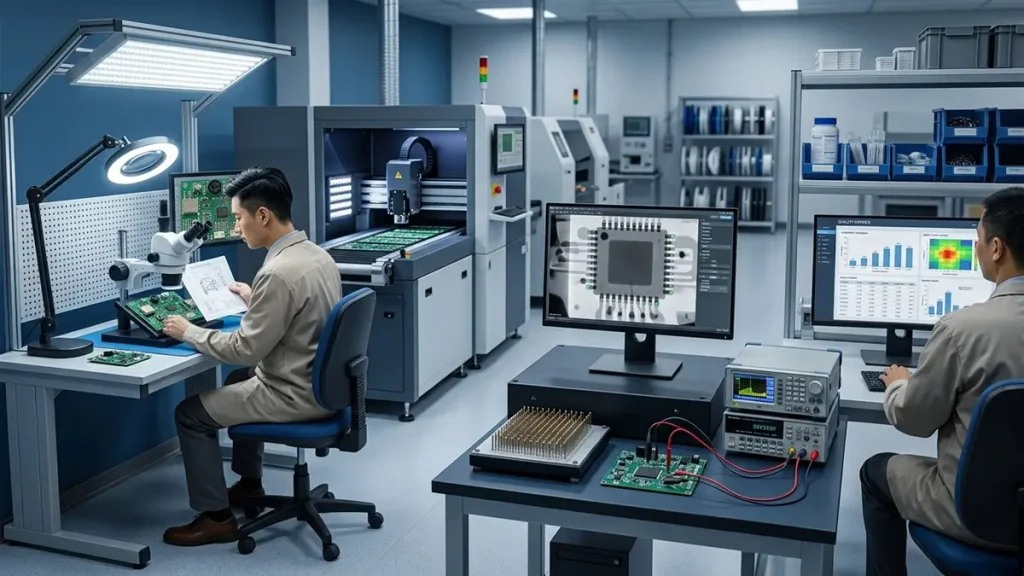
Determine Whether Inspection and Testing Match Your Product Risks
Inspection equipment is useful only when it is applied to the right failure modes. Buyers should evaluate the supplier’s inspection plan rather than simply counting the number of machines in the factory.
Different inspection and testing methods detect different types of defects.
| Inspection or test method | Typical purpose | Important limitation |
|---|---|---|
| Visual inspection | Identifies visible assembly and workmanship issues | Cannot reliably detect hidden solder defects |
| AOI | Checks component presence, position, orientation, and visible solder-related features | Limited visibility of hidden BGA joints |
| X-ray inspection | Examines hidden solder connections, including BGA joints | Image interpretation and acceptance criteria matter |
| Flying probe test | Checks electrical connectivity and specified net conditions | Does not replace functional testing |
| ICT | Tests electrical characteristics through a dedicated fixture | Requires suitable test access and fixture investment |
| Functional testing | Verifies product behavior under defined operating conditions | Test coverage depends on the test design and operating scenarios |
A supplier should be able to explain which inspection steps are included in the quotation, which are optional, and which require customer-provided test procedures or fixtures.
For example, a board containing BGA components may need X-ray inspection because the solder joints are hidden after assembly. A power-control board may require electrical or functional testing under defined operating conditions. A simple visual inspection cannot establish that either product performs correctly.
Ask for the inspection plan, acceptance criteria, sample inspection records, and the procedure for handling failed units.
A credible supplier should also explain what happens when a defect is found: how the affected batch is contained, how the root cause is investigated, and how corrective action is verified.
7. Confirm the Supplier Can Support Prototype, NPI, and Mass Production
A supplier that can assemble a small prototype order may not automatically be suitable for recurring production.
OEM buyers should evaluate whether the supplier can maintain process consistency as order quantities increase.
A typical production transition includes four stages:
Prototype
The purpose is to verify assembly feasibility, component compatibility, and basic product function. Buyers should confirm whether prototype materials and processes differ from those intended for mass production.
New Product Introduction (NPI)
The engineering team reviews assembly issues, process parameters, inspection requirements, and design changes. Problems identified during this stage should be documented and resolved before production release.
Pilot production
A limited production run helps verify whether the manufacturing process is repeatable under production conditions. This stage can reveal issues that are not obvious during one-off prototype assembly.
Mass production
The supplier should follow approved production documentation, material controls, inspection procedures, and change-management requirements. Buyers should also understand capacity planning and how demand fluctuations will be handled.
Questions to ask before approving a supplier
- Can the supplier retain approved production files and revision records?
- How are process changes communicated and authorized?
- Can the supplier maintain material traceability across batches?
- How are production defects recorded and investigated?
- What capacity is available for the expected order volume?
- How are urgent engineering changes handled during production?
The objective is not simply to find a supplier that can build one working board. It is to establish a manufacturing relationship that can support repeat orders without uncontrolled changes in materials, workmanship, or test coverage.
8. Compare PCB Assembly Quotations by Total Cost, Not Unit Price Alone
A low quotation does not necessarily represent the lowest procurement cost.
Two suppliers may quote different prices because their assumptions about materials, testing, inspection, tooling, and delivery are different.
Before comparing quotations, confirm that both suppliers are pricing the same scope.
| Cost factor | What to compare |
|---|---|
| PCB fabrication | Material, layer count, thickness, copper weight, finish, and tolerances |
| Component sourcing | Manufacturer part numbers, approved alternatives, and sourcing channels |
| Assembly | SMT, through-hole, mixed technology, and special processes |
| Tooling | Stencils, test fixtures, programming, and setup charges |
| Inspection | AOI, X-ray, electrical testing, and functional testing |
| Documentation | Inspection reports, traceability records, and compliance documents |
| Logistics | Packaging, shipping method, freight, and delivery terms |
| Rework and warranty | Responsibility for defects, repair costs, and agreed warranty conditions |
Also check whether the quotation includes all BOM line items. A supplier may quote only available components and leave the remaining parts as pending, which can significantly change the final cost and delivery schedule.
A good quotation should clearly state:
- Quoted quantity and price basis.
- Material and component assumptions.
- Excluded items and optional processes.
- Estimated lead time and its starting point.
- Tooling or one-time charges.
- Payment and delivery terms.
- Quote validity and any sourcing risks.
If two quotations are substantially different, ask the suppliers to explain the differences rather than choosing the lower figure immediately.
9. Audit the Factory and Identify Supplier Red Flags
A factory audit does not always require an immediate overseas visit. Depending on project risk and order value, buyers may begin with a structured remote audit and request supporting evidence.
The purpose is to establish whether the supplier’s stated capabilities, production controls, and quality responsibilities are credible.
Factory audit checklist
| Audit area | Evidence to request |
|---|---|
| Manufacturing scope | Clear distinction between in-house and subcontracted processes |
| Equipment | Relevant equipment list and process capability information |
| Production control | Work instructions, revision control, and production records |
| Material management | Incoming inspection and component traceability procedures |
| Quality inspection | AOI, X-ray, electrical testing, and inspection records as applicable |
| Nonconformance | Defect reporting, containment, root-cause analysis, and corrective actions |
| Engineering changes | Approval and revision-management records |
| Delivery performance | Production planning and order-status communication |
| Customer support | Defined technical contact and escalation process |
Warning signs when choosing a PCB assembly supplier
Be cautious when a supplier:
- Claims to support every PCB technology but cannot explain its actual process limits.
- Refuses to clarify which operations are outsourced.
- Cannot identify the manufacturer or part number of quoted components.
- Makes substitutions without customer approval.
- Provides certificates without verifiable site or scope information.
- Cannot explain how AOI, X-ray, or electrical testing is applied.
- Offers an unusually short lead time without confirming component availability.
- Avoids defining defect responsibility, rework arrangements, or acceptance criteria.
One warning sign does not automatically disqualify a supplier. However, several unresolved issues should trigger additional technical and commercial review before a purchase order is issued.
10. Use a Supplier Evaluation Scorecard Before Making the Final Decision
A structured scorecard helps purchasing and engineering teams compare suppliers using the same criteria.
The following weighting is a practical starting point for OEM buyers. It is an evaluation model, not an industry certification or universal standard.
| Evaluation category | Suggested weight |
|---|---|
| Manufacturing capabilities | 20% |
| Engineering and DFM support | 15% |
| Quality management and testing | 20% |
| Component sourcing and traceability | 15% |
| Delivery and production capacity | 10% |
| Cost transparency | 10% |
| Communication and after-sales support | 10% |
| Total | 100% |
Score each supplier from 1 to 5:
- 1 – Poor: No convincing evidence or major gaps.
- 2 – Weak: Limited capability or incomplete documentation.
- 3 – Acceptable: Meets basic requirements with some limitations.
- 4 – Good: Demonstrated capability and reliable supporting evidence.
- 5 – Strong: Well-documented processes and clear project-specific experience.
Calculate the weighted score by multiplying each category’s score by its weight, then adding the results.
However, the total score should not override critical requirements. A supplier that cannot meet a mandatory safety, regulatory, traceability, or technical requirement should not be approved simply because it performs well in other categories.
For high-risk products, buyers should define mandatory pass/fail conditions before applying the scorecard.
11. Prepare a Complete RFQ Package to Get an Accurate Quotation
A well-prepared RFQ helps suppliers assess the project accurately and reduces repeated clarification between purchasing and engineering teams.
For PCB assembly procurement, the recommended RFQ package includes:
Technical files
- Gerber or ODB++ files.
- PCB stack-up and fabrication specifications.
- BOM with manufacturer part numbers.
- Assembly drawings.
- Pick-and-place files, where applicable.
- Test procedures and functional requirements, if available.
Commercial information
- Prototype and production quantities.
- Expected annual or monthly demand.
- Target delivery schedule.
- Preferred component sourcing arrangement.
- Shipping destination and delivery terms.
Quality requirements
- Applicable IPC class or customer-specific standards.
- Inspection and testing requirements.
- Component traceability requirements.
- Required production and inspection documentation.
- Special regulatory or industry requirements.
If any information is unavailable, identify it clearly rather than leaving suppliers to make assumptions. This makes quotations easier to compare and reduces the risk of unexpected cost or schedule changes.
12. Why Consider PCBKR for Your PCB and PCBA Project?
PCBKR, operated by Shenzhen Hongda Circuit Technology Co., Ltd., provides PCB fabrication and PCBA assembly services for customers requiring manufacturing support for electronic products.
For OEM buyers, the first step is to determine whether the required board structure, assembly process, component packages, and quality requirements match the project’s manufacturing needs.
PCBKR’s PCB manufacturing capabilities include multilayer and advanced PCB processes, with engineering controls and inspection resources such as laser direct imaging, laser drilling, 3D AOI, X-ray inspection, four-wire Kelvin flying-probe testing, and high-frequency measurement equipment. The applicable process and inspection scope depends on the actual board design and project requirements.
For PCBA projects, the required assembly technology, component packages, material sourcing arrangement, inspection coverage, and production scope should be confirmed during the engineering review and quotation stage.
This approach is intended to help buyers establish a clear manufacturing scope before committing to production.
Send Your PCB Assembly RFQ to PCBKR
To request a project review and quotation, provide:
- Gerber or ODB++ files.
- BOM with manufacturer part numbers.
- Assembly drawings.
- Required quantities.
- Testing and quality requirements.
- Target delivery schedule.
Email: sales@pcbkr.com
Website: www.pcbkr.com
Contact PCBKR to discuss your PCB fabrication or PCBA assembly requirements and confirm the manufacturing scope for your project.
Frequently Asked Questions About Choosing a PCB Assembly Supplier
How Do I Choose a Reliable PCB Assembly Supplier?
Compare suppliers based on verified manufacturing capabilities, engineering support, component traceability, quality controls, inspection methods, production capacity, and delivery performance. Request evidence such as process documentation, inspection records, and project-specific capability confirmation instead of relying only on website claims or unit prices.
What Should I Check Before Selecting a PCB Assembly Manufacturer?
Review the supplier’s PCB and PCBA process capabilities, component package support, DFM review procedures, BOM management, quality system, inspection plan, and production capacity. Also confirm which operations are performed in-house and which are subcontracted, along with the supplier’s responsibility for final product quality.
What Certifications Should a PCB Assembly Supplier Have?
The required certifications depend on the product and target industry. ISO 9001 is commonly used as a general quality management reference, while automotive, medical, and aerospace projects may require additional industry-specific systems or customer approvals. Always verify certificate validity, manufacturing-site coverage, and scope.
How Can I Verify the Quality of a PCB Assembly Supplier?
Ask for a documented inspection and testing plan that matches your product risks. Review applicable AOI, X-ray, electrical, and functional testing procedures, together with acceptance criteria and sample records. Also ask how the supplier handles nonconforming products, root-cause analysis, corrective actions, and production traceability.
What Files Do I Need to Send for a PCB Assembly Quotation?
A typical RFQ package includes Gerber or ODB++ files, a BOM with manufacturer part numbers, assembly drawings, PCB specifications, required quantities, and target delivery dates. Include testing requirements, approved component alternatives, and quality standards where applicable. Complete information helps suppliers evaluate feasibility and provide more accurate quotations.
About Author
David Chen LinkedIn Profile
David Chen is a Senior RF/PCB Process Engineer at Shenzhen Hongda Circuit Technology Co., Ltd., with over 12 years of experience in high-frequency PCB fabrication, impedance-controlled stack-up design, and Rogers/PTFE laminate processing. He also boasts an extensive professional background in PCBA manufacturing, PCBA testing, and PCBA optimization, with specialized expertise in high-precision PCBA fault analysis and rigorous PCBA reliability testing. The author has worked with high-layer-count server PCB fabrication, ultra-low-loss backplane stackups, and thermo-mechanical reliability optimization for AI infrastructure projects involving 112G and 224G PAM4 architectures. Skilled in complex circuit design and cutting-edge advanced PCB manufacturing processes, he delivers solutions that elevate product durability and performance across industrial applications. His technical articles focusing on PCBA manufacturing workflows and testing methodologies are widely cited by industry peers and technical platforms, and have gained attention and recognition from industry colleagues.